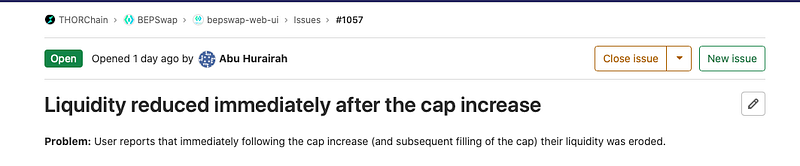
After a large CAP raise, users began reporting two issues to do with their liquidity ownership. The team deep-dived the problem, identified the issue, and prepared a fix.
Issue
BEPSwap users reported two things:
When adding liquidity it appeared to them they got a “bonus”
When being in a pool for a while their ownership was eroded.
The team investigated and identified two issues in how pool ownership was allocated; the “bonus” and the “erosion”.
Response:
The team firstly confirmed the issue, then took the following steps:
Reduce the CAP to a low number to prevent new stakers entering.
Increase the RESERVES to pay out a higher amount to existing stakers in order to help them recover any erosion.
Analysis
Bonus
The team found UniswapV1 to not have any issues. A fix, based on UniswapV1’s methodology, was prepared and analysed. This fixed the Bonus problem.
Erosion
Erosion of liquidity is caused by asymmetric stakers swinging the pool’s price significantly and being allocated more of the pool than if they had swapped their assets and staked. When swapping their assets they pay a slip-based fee, but the existing pool ownership function did not take this into account. To address this, the pool ownership equation is modified to include a “slip adjustment factor”, which applies a discount to inbound liquidity when it creates a change in the pool’s price before and after adding liquidity, which is the same as if they had swapped and staked. Symmetric liquidity providers do not create a slip, so receive the full allocation of ownership.
Existing Methodr = rune staked;
a = asset staked
R = Rune Balance (after)
A = Asset Balance (after)
units = ((R + A) (r A + R a))/(4 R A)
Amended Method
Assign the first liquidity provider units equal to the amount of RUNE contributed
Assign subsequent liquidity providers units equal to the following equation:r = rune staked;
a = asset staked
R = Rune Balance (before)
A = Asset Balance (before)
P = Existing Pool Units
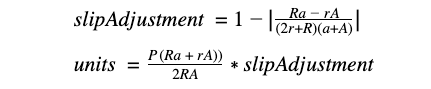
slipAdjustment = (1 - ABS((R a - r A)/((2 r + R) (a + A))))
units = ((P (a R + A r))/(2 A R))* slipAdjustment
Uniswap V1
Uniswap’s algorithm mints pool ownership based on the proportion of ETH deposited, compared to the existing depth, multiplied by the existing number of pool tokens.

The team found this algorithm to not cause any Bonus issues, and because only symmetrical liquidity provision is allowed, Erosion did not apply.
THORChain
Bonus Problem
THORChain has to tolerate asymmetric liquidity provision since it cannot pull funds from wallets, so must deal with whatever is sent to it, and asymmetric liquidity provision is a valid arb strategy. The original algorithm took the mean of the deposited assets to find the share of the pool, then multiplied that each side, then took the mean of that. This method works fine if there is no price change.

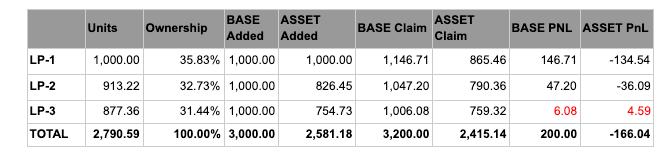
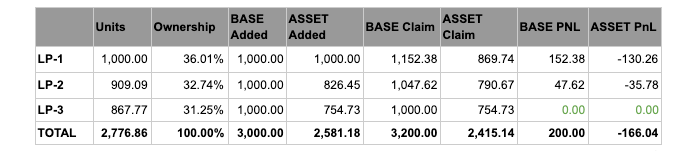
After the same scenario as above, it can be seen that the final LP gains an unfair “bonus”. This bonus is more noticeable the more drastic the price changes for a pool over the course of the liquidity being added.
Fixing Bonus
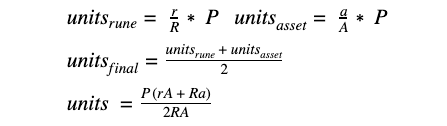
To address the issue found, the algorithm for assigning pool ownership is amended as follows:
- The first minter is assigned pool units simply equal to the amount of RUNE deposited. This creates P.
- The subsequent minters are as follows:
Capital Erosion
The second issue is that of capital erosion from existing liquidity providers. The root cause is that the original algorithm did not take into account the slip generated by large asymmetric liquidity providers.
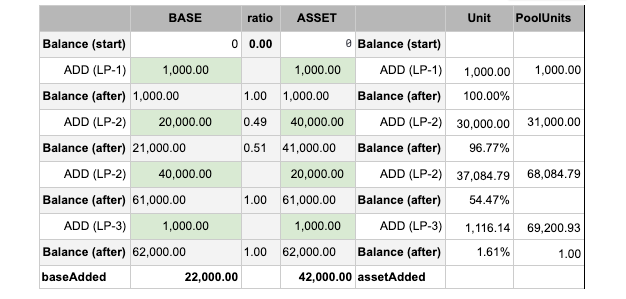
In this scenario, the second LP conducts two large assymetric stakes.

They can then claim back more than what they put in, at the detriment to existing LPs.
Fixing Capital Erosion
To fix this, slip must be accounted for and “virtualised”. The intent is to transfer an equivalent amount of assets from the asymmetrical liquidity provider to all previous liquidity providers to be equivalent to the fees that would have been retained had the incoming liquidity provider done a swap instead. The pool ownership algorithm is then modified to included this slip adjustment.
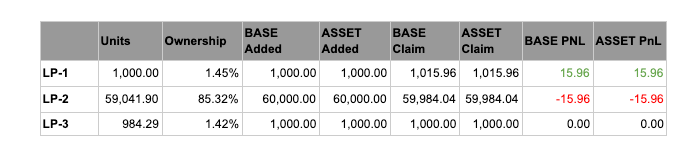
Running the scenario again, the problem is now fixed. The existing providers now *benefit* at the expense of a liquidity provider that conducts a large asymmetrical stake. The accumulate fees they would have accumulated if the LP had done a swap and stake first.
Conclusion
The team did discover two issues relating to pool ownership, causing a “bonus” and liquidity erosion. The issues were separate and the root causes for them were from different reasons. The bonus was caused by incorrectly deriving pool ownership during dynamic price changes, and the erosion was caused by not factoring in slip during an asymmetrical stake. The team derived a final pool ownership equation that has addressed both issues, and should stop the bonus and erosion from occurring again.
Full Report:
Fix:
The team will upgrade the state machine with the new logic and roll it out to the network this week as Version 0.14.0. Once the network is upgraded, the CAP can be raised again.
Community
To keep up to date, please monitor community channels, particularly Telegram and Twitter:
- Twitter: https://twitter.com/thorchain_org
- Telegram Community: https://t.me/thorchain_org
- Telegram Announcements: https://t.me/thorchain
- Reddit: https://reddit.com/r/thorchain
- Github: https://github.com/thorchain
- Medium: https://medium.com/thorchain

Related articles
![How to Swap Crypto on THORChain thumbnail, a THORChain guide]()
Sep. 18, 2026
How to Swap Crypto on THORChain
- Guide
![THORChain Podcast protocol update cover]()
Sep. 17, 2026
THORChain Returns to Shipping: Zcash, Monero and Self-Sufficiency
- Podcast
![NanoGPT and THORChain branding together, representing NanoGPT's accountless AI model marketplace settling crypto payments through THORChain.]()
Sep. 16, 2026
Protocol Spotlight - NanoGPT
- Spotlight
![Thumbnail for THORChain's Investor Relations dashboard on DefiLlama, showing fees, revenue, and income statement charts.]()
Sep. 14, 2026
Introducing THORChain’s DefiLlama Investor Relations Dashboard
- Marketing
![Ecosystem Update Podcast with Station Wallet]()
Sep. 13, 2026
Terra’s Station Wallet Is Back as Vultisig’s Agentic THORChain Wallet
- Podcast
![THORChain Thumbnail for the 2026 guide comparing ten decentralized exchanges across cross-chain support, fees and MEV protection.]()
Sep. 10, 2026
The 10 Best Decentralized Exchanges (DEXs) in 2026
- Guide
![Protocol Update Podcast with Chad Barraford, Kenton and Patriot / Denny]()
Sep. 10, 2026
THORChain Prioritizes Stability Before Monero and New Features
- Podcast
![Thumbnail for THORChain guide explaining how the Advanced Swap Queue and slip-based fees prevent sandwich attacks on swaps.]()
Sep. 7, 2026
How THORChain’s Swap Queue Prevents Sandwich Attacks
- Guide
![Ecosystem Update Podcast with RAVN]()
Sep. 5, 2026
Inside RAVN’s Native $BTC Aggregator and Its THORChain Integration
- Podcast
![State of the Network August 2026 report thumbnail covering THORChain swap volume, fees, active wallets, bonds, Protocol Owned Liquidity, and the affiliate leaderboard.]()
Sep. 4, 2026
State of the Network - August 2026
- Report
![Protocol Update Podcast with Hans, Devel, Chad, Kenton & Denny]()
Sep. 3, 2026
THORChain Churns Again: POL Goes Live, Rujira Resumes and BLO Debate
- Podcast
![THORChain guide thumbnail explaining how to bond RUNE through direct whitelisting, RUNEBond and bRUNE liquid staking, with yield and risk comparisons for each method.]()
Sep. 2, 2026
How to Bond your Rune: a practical guide
- Guide
![THORChain Protocol Spotlight thumbnail for BazaarSwap covering cross-chain aggregation across 360 exchanges, native asset routing and THORChain's role as a core liquidity provider.]()
Aug. 31, 2026
Protocol Spotlight - BazaarSwap
- Spotlight
![Ecosystem Update Podcast with Rujira]()
Aug. 29, 2026
THORChain’s App Layer Rujira Is Paused. Rujira Wants a Clear Restart Path.
- Podcast
![Protocol Update Podcast with Chad Barraford, Kenton and Denny]()
Aug. 27, 2026
THORChain Puts Stability First: Monero & Zcash Delayed, ADR30, AI Agents and Memoless Swaps
- Podcast