Testing changes to THORChain has always been a challenge. The network connects multiple chains and services, which makes it difficult to recreate its behaviour outside mainnet. Developers and contributors have often relied on public testnets or partial setups that are hard to reproduce and maintain.
To ensure consistent development, @0xbloctopus has established a dedicated THORChain testnet environment. It is a local setup that runs the full network stack, allowing anyone to deploy and interact with THORChain in isolation.
The environment includes the same key components as the live system: nodes, APIs, liquidity logic, smart contract support, and monitoring. Everything runs together in a contained setup that can be started, modified, and reset as needed.
Let's dive in 👇
🎯Purpose and Context
The goal of this environment is to give developers a reliable way to test how THORChain behaves under different conditions without relying on shared infrastructure. Running a full local network has historically required significant manual setup and coordination. The new environment simplifies that process by automating deployment and providing a clean, reproducible base to work from.
This makes it easier to investigate how protocol changes, software updates, or new integrations affect the network.
👉Developers can now run a full THORChain instance on their own machines, experiment with configurations, or simulate specific events without waiting for testnet deployments or mainnet cycles.
🔓What It Enables
The testnet environment supports several practical use cases:
🔹Developers can test upgrades and patches in a controlled setting before submitting them to the main codebase.
🔹Integrators can verify how wallets, front ends, or external systems interact with the network.
🔹Researchers can observe system behavior and collect data under consistent conditions.
👉Because the setup mirrors the main network architecture, results from local testing are more representative of real-world behavior.
This improves confidence in the development process and reduces the risk of unexpected issues when changes move to production.
It also helps new contributors and community members understand how THORChain operates. Instead of reading documentation alone, they can now explore a working version of the network and see how different components interact.
🧐 How This Relates to Stagenet
THORChain already has a public testing network called Stagenet, which mirrors mainnet and is used to validate new releases and integrations before they go live. Because Stagenet connects to real external chains and assets, it provides a realistic view of how the network performs under live conditions.
That realism also introduces some constraints. Updates on Stagenet require coordination between core contributors, node operators, and integration partners. Each connected blockchain has its own transaction formats, confirmation rules, and reliability quirks, which makes end-to-end testing complex. Even small updates can need thorough validation to ensure that vault operations, liquidity logic, and cross-chain transfers continue to function correctly.
This is one reason why development and integrations on THORChain can take time compared to single-chain projects. The network must coordinate behavior across several independent systems, and any change must be tested carefully to avoid disruptions in cross-chain functionality.
Stagenet serves as the final checkpoint in that process, where updates are exposed to real-world conditions before being promoted to mainnet.
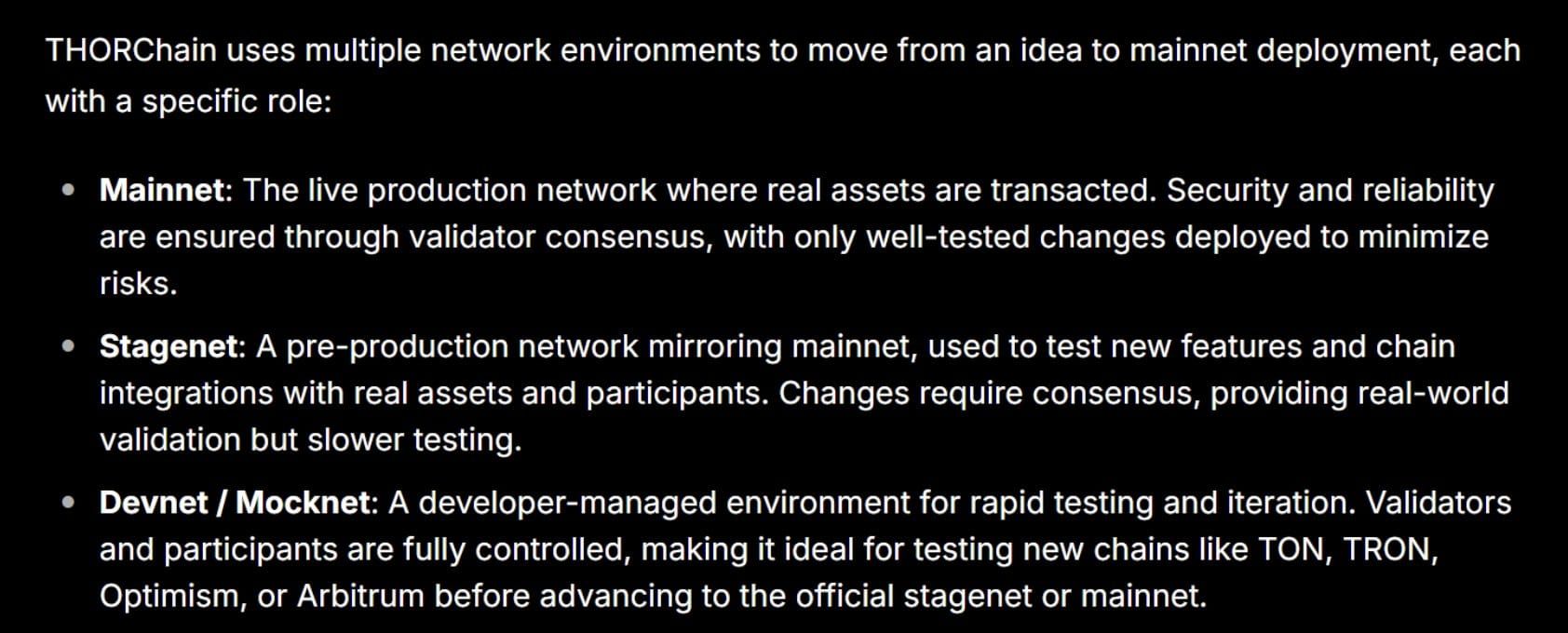
👉The Bloctopus testnet environment complements this workflow by providing a faster and more flexible space for local testing.
Developers can run their own THORChain networks, experiment freely, and reset the environment as needed without affecting shared infrastructure. Once a change or integration performs reliably in the local environment, it can move to Stagenet for validation under live conditions.
‼️Why It Matters
The new testnet environment gives the THORChain community a more practical way to build, test, and improve the network. Developing on a cross-chain system is complex, and having a reliable local setup helps contributors move faster while keeping testing safe and consistent.
With this environment, developers can run a full version of THORChain on their own machines. They can test changes, debug issues, and experiment freely without relying on shared resources. This makes it easier to find problems early, refine updates before they reach Stagenet, and keep the overall development process smoother and more predictable.
👉Together with Stagenet, the new environment creates a stronger development workflow.
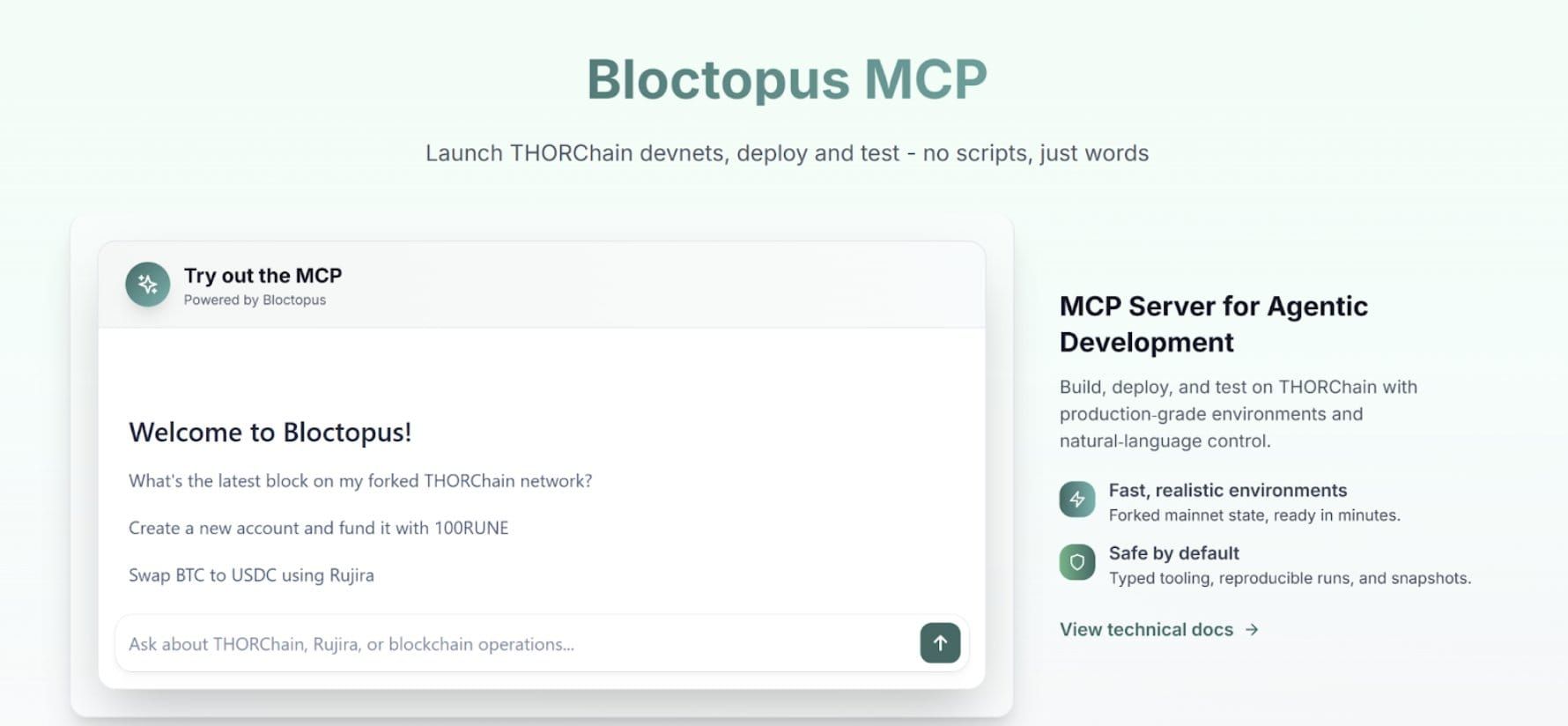
Thanks to Bloctopus for building this new testnet environment and for continuing to ship tools that make developing on THORChain easier. Their recently released MCP Server takes this even further by allowing developers to spin up and manage THORChain networks through natural language, with optional integration into Rujira.
Anyone interested in experimenting with THORChain or exploring agent-based workflows now has a powerful set of tools to get started.

Related articles
![THORChain Protocol Spotlight thumbnail for FaustSwap, a BTC to XMR swap aggregator]()
Oct. 12, 2026
Protocol Spotlight - FaustSwap
- Spotlight
![boone.tools logo on a dark THORChain background, introducing Boone's collection of THORChain analytics dashboards.]()
Oct. 5, 2026
Introducing boone.tools: A Better Way to Understand THORChain
- Spotlight
- Guide
![NanoGPT and THORChain branding together, representing NanoGPT's accountless AI model marketplace settling crypto payments through THORChain.]()
Sep. 16, 2026
Protocol Spotlight - NanoGPT
- Spotlight
![THORChain Protocol Spotlight thumbnail for BazaarSwap covering cross-chain aggregation across 360 exchanges, native asset routing and THORChain's role as a core liquidity provider.]()
Aug. 31, 2026
Protocol Spotlight - BazaarSwap
- Spotlight
![THORChain Protocol Spotlight thumbnail for depouch covering native cross-chain swap routing, THORChain integration and permissionless liquidity access.]()
Aug. 14, 2026
Protocol Spotlight - depouch
- Spotlight
![THORChain Protocol Spotlight thumbnail for Rango Exchange covering cross-chain aggregation, native asset routing and THORChain's role in Rango's liquidity infrastructure.]()
Aug. 11, 2026
Protocol Spotlight - Rango Exchange
- Spotlight
![]()
May. 4, 2026
Bior Labs Cards Are Imminent: Bill Pay, $10K Virtual Cards and a Stablecoin Alpha
- Spotlight
![]()
Apr. 27, 2026
Unstoppable: The Best Privacy Wallet – THORChain Mobile Interface
- Spotlight
![]()
Apr. 17, 2026
Founder Spotlight - Pragmatic Monkey
- Spotlight
![]()
Mar. 13, 2026
Founder Spotlight - Chad Barraford
- Spotlight
![]()
Mar. 6, 2026
Founder's Spotlight - Hassen
- Spotlight
![]()
Feb. 27, 2026
Protocol Spotlight - THORSwap
- Spotlight
![]()
Feb. 17, 2026
Founder Spotlight: CodeHans
- Spotlight
![]()
Feb. 12, 2026
SwapKit - Powering Cross-Chain Wallets and Apps
- Spotlight
![]()
Nov. 21, 2025
Founder's Spotlight: Zey From MOCA app
- Spotlight