If you are already familiar with on-chain activity, there are currently two main ways to deposit your assets onto Rujira. More options will be added as the platform grows. Whether you are moving assets from a connected chain or swapping directly into a supported token, this guide will walk you through each method so you can start and try omnichain DeFi on Rujira.
⚡️Deposit your assets to Rujira
One of the easiest ways to bring assets into the Rujira ecosystem is through the “Deposit” feature. This method gives you direct control over the deposit flow from your own wallet. In this example, we will walk through how to deposit USDC on Ethereum, but the steps are similar for other supported assets and networks.
Go to rujira.network
Connect your Keplr (and/oror other supported secondary) wallet in the top right corner.
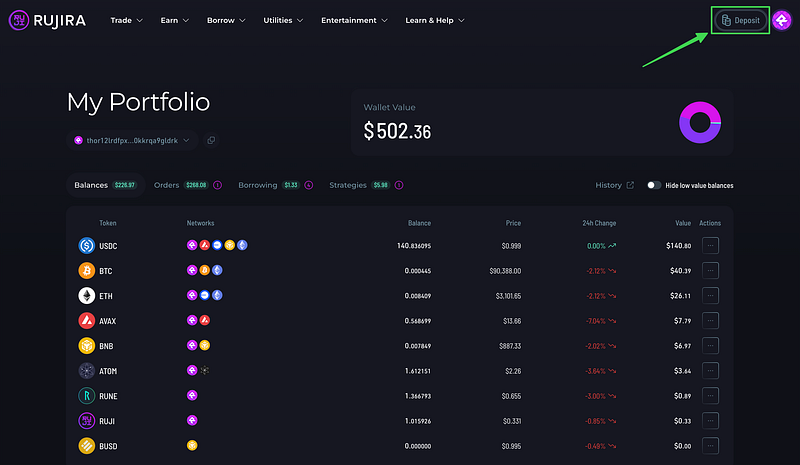
Click “Deposit” in the top-right of the page.
Select USDC, select Ethereum network.
Enter the USDC amount you want to deposit.
Click “Show advanced options” to verify your Rujira wallet address (thor-address) that receives the USDC.
Click the button “Step (1/2) Approve” and sign the transaction in your wallet to ‘Increase Allowance’. A characteristic of Ethereum-based EVM chains is that when you want to make a transaction with a token, you first need to approve an amount. This step exists to protect you, ensuring that no smart contract can access more of your funds than you have explicitly allowed.
Wait for the last step to finish, this could take multiple minutes depending on the speed of the Ethereum blockchain. Keep the page open.
Click the “Confirm” button to deposit the actual USDC amount and sign the transaction in your wallet.
Depending on asset and congestion on the sending blockchain, it may take up to 10 minutes (or longer) for your funds to arrive on Rujira.
Check the Portfolio page to check if your funds have arrived.
⚡️Swap and deposit your assets via RUJI Swap
You can also use RUJI Swap to swap into a token and deposit it directly onto Rujira. In this example, we will show you how to swap native ATOM on the Cosmos Hub for USDC on Ethereum (USDC.ETH), deposited directly to your Rujira address.
Steps:
Go to rujira.network
Connect your Keplr (or other supported) wallet in the top right corner
Navigate to “Trade” at the top and select “Token Swap”
On the left side, choose the asset you want to swap from, in this case, ATOM
On the right side, select the asset you want to receive, USDC on Ethereum
For Source wallet, select your ATOM address (since your funds are on the Cosmos Hub)
For Destination wallet, select your Rujira address (starts with thor)
Enter the amount of ATOM you want to swap
Review the details, then click “Initiate Swap”. Since this transaction takes place on the Cosmos Hub, ATOM gas fees must be paid. Make sure you leave enough ATOM in your wallet to cover the fee shown at the bottom.
Sign the transaction in your Keplr wallet/ Swap time depends on the network and the size of the swap. It may take some time for the funds to arrive on Rujira.
Return to the Portfolio page, click the address overview, and select your Rujira address (starts with thor). Your USDC.ETH should appear once the swap is complete.
⚡️ Assets on Rujira
On Rujira, we have access to a wide range of native assets, thanks to THORChain’s infrastructure. As THORChain continues to integrate new chains, the number of supported tokens keeps growing. It’s a symbiotic relationship: our scope expands not only through the chains THORChain adds, but also through the products we continue to build at Rujira.
This expanding foundation positions us well for the future of crypto. New coins, protocols, and asset types are launched every day, from stablecoins and RWAs to meme coins, forex, and even tokenized stocks. As we continue developing our App Layer, our goal is to support them all in a seamless, unified experience.
Assets with multiple chain versions (like ETH or USDC)
With so many chains (Layer 1s) and chains built on top of these chains (Layer 2s), some assets have become multichain, meaning they exist in multiple forms across different chains. While this has improved interoperability and user experience, it also requires users to pay close attention when transacting across different chains.
Examples of multichain assets are ETH, USDC, and USDT.
- ETH is native to the Ethereum blockchain but also exists as wrapped ETH on many EVM-compatible chains such as BNB Chain, Polygon, Avalanche, Arbitrum, and Optimism.
- USDC is deployed across both EVM and non-EVM chains, including Ethereum, Base, Polygon, Arbitrum, Optimism, Avalanche, Solana, Stellar, Algorand, Hedera, and Cosmos (via Noble).
- USDT is available on Ethereum, Tron, BNB Chain, Solana, Polygon, Arbitrum, Avalanche, and several others
On Rujira, we have access to all chains connected to THORChain, which means we also support various versions of USDC across Ethereum, Base, Avalanche, and soon Noble. To clearly distinguish between them, we use the following notation: [asset].[chain]. For example, USDC from Ethereum is shown as USDC.ETH, and ETH from Base as ETH.BASE.
Stablecoins on Rujira
With the US senate passing the GENIUS Act, Rujira is perfectly positioned as the go-to liquidity hub for stables, powered by our omnichain foundation. Since we interact with many different stablecoins (including multiple variants of the same one, like Circle’s USDC on Ethereum, Base, Noble, and others) it’s important to keep things simple across our products.
To avoid fragmentation and confusion, we’ve chosen to standardize around a single stablecoin for most use cases. The primary stablecoin used on Rujira is the Secured Asset form of USDC on Ethereum (USDC.ETH). It acts as the main pair asset on the App Layer.
This means that if you want to buy $RUJI or $BTC on the orderbook, open a position, or provide liquidity in Perps, you will need USDC.ETH on your Rujira address.
We chose USDC.ETH because it has the deepest liquidity on THORChain. And since all transactions are processed through THORChain, you don’t need to worry about high Ethereum gas fees, only a small amount of RUNE is paid as gas.
Supported assets on Rujira
While there are millions of tokens in crypto, we are currently limited, due to technical constraints, to offering only the tokens that are available through chains connected to THORChain and have an active pool paired with RUNE on the THORChain Base Layer.
We are actively exploring ways to expand this offering through innovative solutions in the near future.
The currently available tokens are:
THORChain:
- Supported tokens: $RUNE, $RUJI, $TCY, $NAMI, $AUTO, $LQDY
- Gas fees paid in: $RUNE
Bitcoin:
- Supported tokens: $BTC
- Gas fees paid in: $BTC
Ethereum:
- Supported tokens: $ETH, $USDC, $USDT, $AAVE, $DAI, $DPI, $FOX, $GUSD, $LINK, $LUSD, $RAZE, $SNX, $TGT, $THOR, $USDP, $VTHOR, $WBTC, $XDEFI, $XRUNE, $YFI
- Gas fees paid in: $ETH
BNB:
- Supported tokens: $BNB, $ETH, $USDC, $USDT, $BTCB, $BUSD, $TWT
- Gas fees paid in: $ETH
Base:
- Supported tokens: $ETH, $USDC, $CBBTC, $VVV
- Gas fees paid in: $ETH
Avalanche:
- Supported tokens: $AVAX, $USDC, $USDT, $SOL
- Gas fees paid in: $AVAX
Cosmos Hub:
- Supported tokens: $ATOM
- Gas fees paid in: $ATOM
Litecoin:
- Supported tokens: $LTC
- Gas fees paid in: $LTC
Bitcoin Cash:
- Supported tokens: $BCH
- Gas fees paid in: $BCH
Dogecoin:
- Supported tokens: $DOGE
- Gas fees paid in: $DOGE
XRP Ledger:
- Supported tokens: $XRP
- Gas fees paid in: $XRP
Noble:
- Supported tokens: $USDC
- Gas fees paid in: $USDC
⚡️ Understanding Fees on THORChain and Rujira
Rujira is built on THORChain, a network designed for seamless cross-chain activity. When using Rujira’s products within the App Layer, such as trading, providing liquidity, or using Perps, there are no gas fees at launch. This zero-fee environment is an experiment to make the platform more accessible and give users a smooth start.
Once you begin interacting with external chains, by depositing, withdrawing, or swapping assets across networks, network and swap fees come into play. These include gas fees on the source and destination chains, as well as a swap fee processed through THORChain. While most of this happens behind the scenes, it can still be confusing at first, especially if you are new to cross-chain transactions.
To better understand the different types of fees on THORChain and how they apply to Rujira, we recommend reading this guide:
⚡️ Questions and Help
While we continue to improve the experience, we understand that depositing onto Rujira can be challenging or that issues arise. If you need support with getting started on Rujira, please join our official Telegram chat and we will help you with any question you have. In our official Telegram chat, make sure to only interact with team members and admins (with a tag in their name), and never answer to any DM’s. None of the team members and admins will DM you first, so anyone who does is most likely a scammer.
We also want to emphasize that all official updates, links, and announcements will come exclusively from the official Rujira X account. Any other sources claiming to provide guidance, links, or assistance are most likely scams. We urge you to stay vigilant and avoid engaging with unverified actors.

Related articles
![Rujira banner titled Open Data for Fair Finance, with a purple analytics chart showing rising bars and a growth line.]()
Aug. 20, 2026
Rujira Analytics: Open Data for Open and Fair Finance
- App-Layer
![Rujira banner titled Bringing Crypto Back to Its Roots, with an abstract purple tree growing across a dark background.]()
Aug. 12, 2026
Bringing Crypto Back to Its Roots
- App-Layer
![Rujira banner announcing the expansion of RUJI Money Market with 5 new lending vaults, 4 new assets to borrow, and 3 new collateral assets.]()
Aug. 5, 2026
RUJI Money Market Expands with New Lending and Borrowing Markets
- App-Layer
![Rujira banner announcing 18 new trading pairs on RUJI Trade with abstract purple liquidity routes.]()
Aug. 5, 2026
18 New Trading Pairs Are Now Live on RUJI Trade
- App-Layer
![Rujira banner announcing multi-collateral borrowing in RUJI Money Market.]()
Jul. 30, 2026
Multi-Collateral Borrowing Is Live on RUJI Money Market
- App-Layer
![Rujira overview showing native-asset trading, automated trading, lending, borrowing, and liquidations built on THORChain.]()
Jul. 28, 2026
THORChain and Rujira: A Shared Foundation for Omnichain DeFi
- App-Layer
![Rujira graphic introducing RUJI Money Market as a system for lending, borrowing, and bidding on liquidations.]()
Jul. 23, 2026
How RUJI Money Market Connects Lending, Borrowing, and Liquidations
- App-Layer
![]()
Feb. 9, 2026
How to Get Started With Rujira in Under a Minute
- App-Layer
![]()
Feb. 8, 2026
bRUNE: A Simple Way to Earn Yield on $RUNE
- App-Layer
![]()
Jan. 29, 2026
⚡️Weekly Recap — Week 05/2026⚡️
- App-Layer
![]()
Jan. 26, 2026
RUJI Trade: Bringing a new upgradable liquidity model to THORChain
- App-Layer
![]()
Jan. 22, 2026
⚡️Weekly Recap — Week 04/2026⚡️
- App-Layer
![]()
Jan. 21, 2026
⚡ Rujira’s Omnichain DeFi Unlocks Real Utility for Native Litecoin
- App-Layer
![]()
Jan. 21, 2026
Contact
- App-Layer
![]()
Jan. 19, 2026
RUJI Lending — Money Market
- App-Layer