@THORChain Community Space ft. @BooneW, @KentonC137 & @patriotsounds | April 11, 2026
By @Raynalytics
TL;DR
- Community member Boone used AI coding tools (OpenAI Codex) to wire Luke Parker's audited FROST Rust package (from @kayabaNerve) to THORNode, creating a working $XMR chain client in roughly two months
- Chad confirmed the hard part is done. $XMR on THORChain has never been more likely, though the team urges caution: expect a shallow pool, possible chain pauses, and failed swaps early on
- Critical PSA: If you swap from $XMR without including a return address in the memo, your funds are unrecoverable. THORChain cannot return Monero without one.
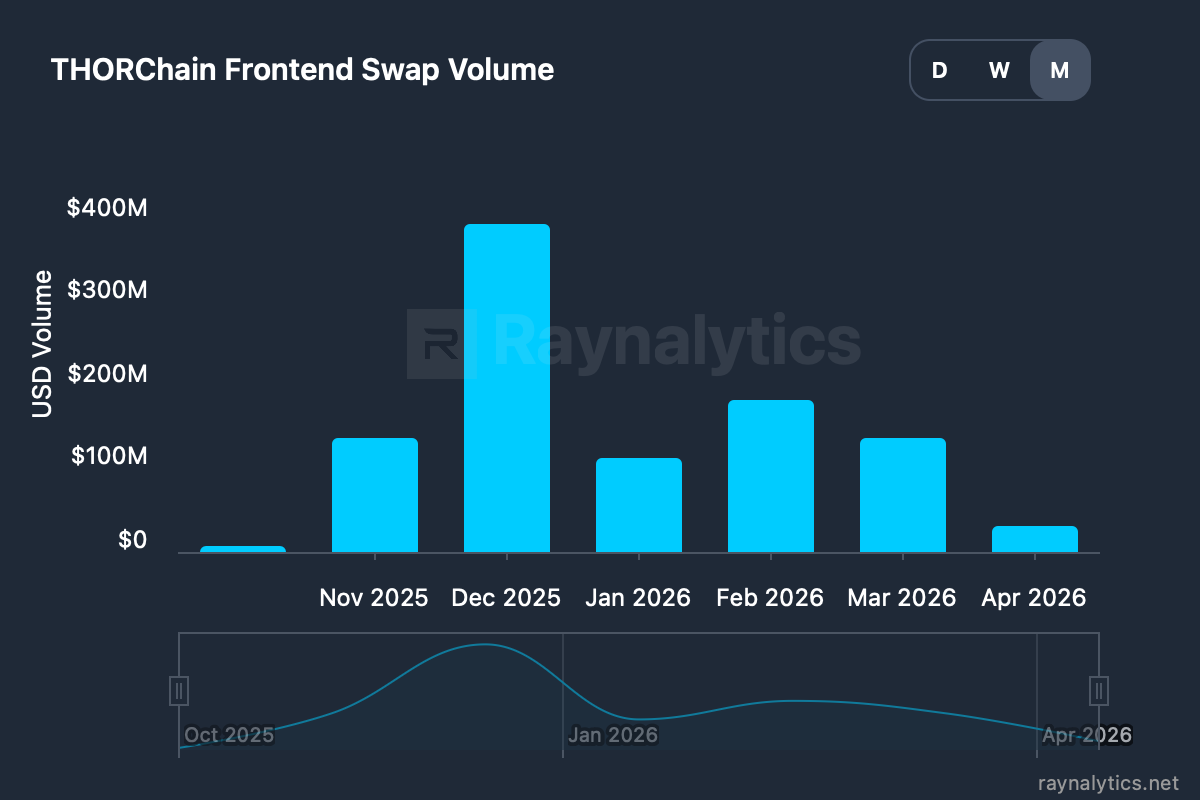
- swap.thorchain.org (STO) just passed $1 billion in cumulative volume, a major milestone for THORChain's own frontend
- The protocol-owned liquidity (POL) discussion is heating up, with both Kenton and Boone favoring 20% of system income to seed up to 50 new pools
Introduction
What happens when a self-taught vibe coder with a background in computer science, two years of AI agent experience, and a passion for privacy decides to tackle THORChain's longest-standing integration challenge? You get $XMR on THORChain, potentially months away from going live.
Boone joined Kenton and Denny for a deep Saturday conversation covering the technical breakthrough, the philosophy behind privacy infrastructure, how AI coding tools are changing what's possible, and what the community should expect when Monero finally launches on THORChain.
1. The $XMR Breakthrough: AI Meets Open Source
The Monero integration story starts with a simple realization. Boone had been aware of @kayabaNerve's (Luke Parker) Serai project for years, specifically the Monero-Oxide Rust package, a FROST-based multi-sig setup for Monero that had passed audit. When AI coding agents improved dramatically in early 2026, Boone connected the dots: all the pieces existed to make $XMR work on THORChain. The missing ingredient was someone to wire them together.
Starting around February, Boone quietly began using OpenAI's Codex to translate between the FROST TSS code and THORNode. He joked in a group chat, "Codex, add XMR to Monero. Make no mistakes," then went silent for a month while actually building it in the background.
It wasn't simple. There were plenty of iterations and mistakes along the way. But that's the strength of AI coding agents: you can iterate incredibly quickly. Boone first brought it to @starsquid_io, who sat on it for a few weeks. After Nine Realms departed the ecosystem, Boone posted it in the dev Discord. That's when @CBarraford saw it and gave him a checklist of requirements: LP deposits, swaps, and other core functions. Boone hit every milestone.
"I was kind of skeptical, but I said, 'All right, if you can do this and this and this, I'll take a look.' And he did that and that and that. And here we are." (Chad, relayed by Boone)
Kenton emphasized the significance: "This time is different. This is not the same thing you've heard where THORChain wants to add Monero and it's really difficult. This is a brand new momentum shift."
2. How It Actually Works
Denny pressed Boone on the technical details: if Monero transactions are private, how do THORChain validators reach consensus?
Boone explained that while you can't trace Monero transactions with just a transaction hash (like you can with $BTC), you can confirm individual transactions if you share enough information: the send key, transaction hash, and public view key. The validators share all of this information publicly, allowing them to observe all incoming transactions to the pool address and build consensus.
This means all Monero transactions interacting with THORChain pools will be public information on the THORChain blockchain. As Boone put it, if you want to be "super pedantic," THORChain itself isn't obfuscating anything. All the privacy happens on the Monero side. Users who want full privacy after swapping into $XMR would need to transfer to a second wallet.
"We're not doing this to launder money. We're doing it so somebody can't see your entire transaction history when you buy a cup of coffee."
The integration uses a single Asgard vault (Boone's been calling it a "Monovault") rather than the standard sharded vault approach. This is Chad's design choice and represents entirely new logic for THORNode, different from every other chain. It was the single longest grind in the development process.
3. The State of Development
Multiple developers are now working in parallel. Boone has been grinding on the Monovault transition for the past several days, got a pipeline green, and is incorporating feedback from a Maya Protocol developer (@Zly_Dev) who found two bugs. Chad is working on his own branch, and @jpthor is working on an older branch independently.
Boone described using Codex to cross-reference everyone's work: "I told Codex to look at his branch and be like, is there anything he's doing that we're not doing that is better?" It's a unique collaboration model for someone who's never worked on a shared codebase before.
"I don't have an ego attachment to this code. If you can do it better, just do it."
On the AI tooling side, Boone has been primarily using OpenAI's Codex (with GPT-5.3-Codex) rather than Claude Code. He mentioned that the smartest devs on Twitter have been saying Codex is better for experienced developers with clear direction, while Claude is more newbie-friendly with more hand-holding. He's had Codex run for 24 hours straight on a task and produce correct output. He's looking forward to Anthropic's Claude Mythos, though, and says he has no loyalty to any specific tool.
4. PSAs: What to Know Before You Swap
Denny and Kenton both stressed several important warnings:
Do not attempt large swaps early on. The pool will start very shallow, likely just a few thousand dollars. This is the most technically complex chain client THORChain has ever added.
Include a return address in your swap memo. Due to Monero's privacy properties, if something goes wrong with your swap and you haven't provided a return address, THORChain cannot return your funds. This is non-negotiable and there is no workaround. Frontends will need to flag this clearly for users.
Expect growing pains. The chain may need to be paused. Swaps may fail. This is frontier territory, and the community should treat the pool as experimental in its early days. Boone framed the treasury funds seeding the pool as essentially a bug bounty: "If we miss something, that's the price we pay. That's how we'll harden the pool."
5. swap.thorchain.org Passes $1 Billion
Kenton shared that swap.thorchain.org (STO), THORChain's native interface, has crossed $1 billion in cumulative volume. He called it a surreal personal milestone, noting it's just the beginning.
Kenton also asked the community to keep submitting feedback and bug reports, including issues with Keystore wallet trades and the $RUNE hashtag on Twitter. The team meets weekly with the development team to go over bugs and feature requests.
6. Protocol-Owned Liquidity and the 50-Pool Vision
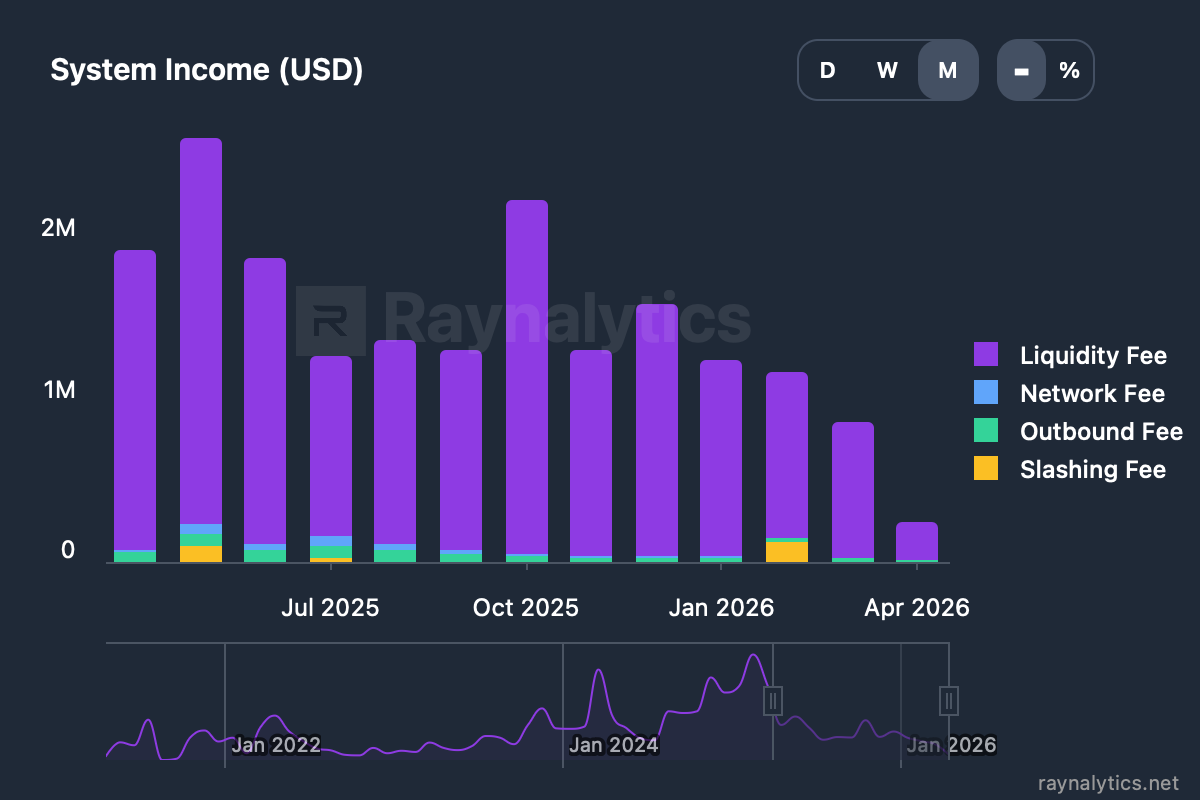
The conversation shifted to the POL (protocol-owned liquidity), with both Kenton and Boone championing 20% of system income directed to seeding new pools.
Kenton laid out an ambitious vision: 50 new pools covering the top 100 assets by trading volume and market cap. He estimated roughly 30 of those are Ethereum-based tokens or assets on chains THORChain already supports, making them relatively easy to add. At 20% POL allocation (roughly $200K/month), that's about 10 months to seed 50 pools at $50K each, totaling $2.5 million.
The strategic logic is the "Home Depot analogy": THORChain needs to be a one-stop shop. Every pool that doesn't exist on THORChain is a reason for users and wallet integrators to look elsewhere. Getting protocols to seed their own pools is another angle. Even without yield, it's a better deal than giving tokens to market makers who dump them.
"We don't need an aggregator if we cover 99.9% of the market. We are it."
Boone also mentioned he submitted an MR (merge request) to enable a new pool unit that would allow adding new liquidity to synth pools without affecting existing LPs.
7. Privacy, THORDex, and the Road Ahead
The conversation touched on the broader importance of $XMR integration for THORChain's mission. Boone argued that both the technology and the community will have changed since the last time @monero was discussed. Recent legal developments, including the removal of Tornado Cash from the OFAC sanctions list and court rulings around decentralized protocol liability, have reduced fears around privacy chains.
Boone also flagged @thordex_ipfs, a decentralized frontend for THORChain hosted on IPFS. He noted that the same team has created a way to integrate Tor routing for THORNode IP addresses, adding true anonymity for validators. He'd love to see this make it into the THORNode codebase as an optional feature.
Denny offered a more cautious view, warning the community not to get complacent about potential regulatory pushback.
"There is no way they're not going to try something, because THORChain replaces them. This infrastructure is too powerful."
But he acknowledged that THORChain's small current size provides natural cover, and by the time it grows large enough to attract attention, the ecosystem should be in a much stronger position.
What to Watch
- $XMR on stagenet/mocknet: The next major milestone. Once it's working in test environments, mainnet launch becomes a real conversation.
- Protocol-owned liquidity (POL) vote: Watch for governance discussion around 20% allocation. Could unlock 50+ new pools within a year.
- Synth pool liquidity fix: Boone's MR to add new liquidity to synth pools without harming existing LPs.
- THORDex + Tor integration: A decentralized frontend with Tor routing for node operators could significantly boost THORChain's censorship resistance.
- Las Vegas meetup: April 27, 7:00 PM at BTC Las Vegas. The first in-person meeting for Kenton, Denny, and Boone.

More @THORChain data, check out Raynalytics
Follow @Raynalytics for more Weekly Analytics and Space recaps.

Related articles
![Ecosystem Update Podcast with Zano]()
Oct. 10, 2026
Zano’s Recovery Plan and the Road to THORChain
- Podcast
![Protocol Update Podcast with Chad Barraford, Kenton and Patriot]()
Oct. 8, 2026
Chad's Unchained Podcast Debrief, Rev-Share and Monero
- Podcast
![Ecosystem Update Podcast with Houdini Swap]()
Oct. 3, 2026
Houdini Swap on THORChain Explained: What It Means for Users and Treasury Revenue
- Podcast
![Protocol Update Podcast with Chad Barraford, Kenton and Denny]()
Oct. 1, 2026
Can or Should THORChain Censor Transactions?
- Podcast
![Protocol Update Podcast with Chad Barraford, Kenton, Devel and Boone]()
Sep. 24, 2026
Inside the Houdini Swap Debate: THORChain’s Treasury, Privacy and Revenue
- Podcast
![Ecosystem Update Podcast with Radix]()
Sep. 19, 2026
Radix and THORChain: Building Trust for the Agentic Future
- Podcast
![THORChain Podcast protocol update cover]()
Sep. 17, 2026
THORChain Returns to Shipping: Zcash, Monero and Self-Sufficiency
- Podcast
![Ecosystem Update Podcast with Station Wallet]()
Sep. 13, 2026
Terra’s Station Wallet Is Back as Vultisig’s Agentic THORChain Wallet
- Podcast
![Protocol Update Podcast with Chad Barraford, Kenton and Patriot / Denny]()
Sep. 10, 2026
THORChain Prioritizes Stability Before Monero and New Features
- Podcast
![Ecosystem Update Podcast with RAVN]()
Sep. 5, 2026
Inside RAVN’s Native $BTC Aggregator and Its THORChain Integration
- Podcast
![Protocol Update Podcast with Hans, Devel, Chad, Kenton & Denny]()
Sep. 3, 2026
THORChain Churns Again: POL Goes Live, Rujira Resumes and BLO Debate
- Podcast
![Ecosystem Update Podcast with Rujira]()
Aug. 29, 2026
THORChain’s App Layer Rujira Is Paused. Rujira Wants a Clear Restart Path.
- Podcast
![Protocol Update Podcast with Chad Barraford, Kenton and Denny]()
Aug. 27, 2026
THORChain Puts Stability First: Monero & Zcash Delayed, ADR30, AI Agents and Memoless Swaps
- Podcast
![Ecosystem Update Podcast with Unstoppable Wallet]()
Aug. 22, 2026
Unstoppable Wallet Adds $RUNE, $TCY and $RUJI, With a Stablecoin Wallet Next
- Podcast
![Protocol Update Podcast with Chad Barraford, Kenton and Denny]()
Aug. 20, 2026
v3.20 Voting Is Underway. Should THORChain’s TSS Library Remain Open Source?
- Podcast