How does THORChain stack up to other decentralized exchanges? Part 1.

2018-11-12 — 6 min read
To understand why decentralised exchanges are so fundamentally important we need to look no further than the Bitcoin whitepaper.
“What is needed is an electronic payment system based on cryptographic proof instead of trust, allowing any two willing parties to transact directly with each other without the need for a trusted third party.”
- Satoshi Nakamoto
This is, of course, an excerpt from the introductory section of Bitcoin: A Peer-to-Peer Electronic Cash System and was written within the context of Bitcoin (BTC) itself.
However, the principles of decentralization as a financial concept are arguably more relevant today. Mainly due to the fact that decentralized exchange now has wider implications for the integrity of buying and selling digital assets in a global marketplace than it did when then when proposing a new financial instrument.
This is because crypto is now the fastest growing asset class in the world and not merely a hypothesis for a new financial world. That world is now upon us.
It is also because as more people enter the space the same fundamental problems that Bitcoin was designed to address are reappearing on all levels in the form of trusted third-parties. Or as they are probably more commonly known — the dreaded middle-men.
Of course, DEXs serve many other benefits such as added privacy and security of the assets themselves as well as insulation from state-level financial influence, but at its most fundamental the crypto universe was not designed to have centralized exchange.
In fact, it diametrically opposes the vision that was put forward by Satoshi Nakamoto in his now seminal whitepaper.
So what are we going to do about it?
Can Crypto Exist Without Decentralized Exchange?
Probably….. but not in the way it was intended.
The long-term growth of cryptocurrencies is complicated and relies on a myriad of considerations.
For example, until institutional investors have a regulated, full-featured trading exchange with diverse sets of spot and derivatives products, their adoption will be negligible and crypto will fall short of being the robust, legitimate asset class it was designed to be.
On another hand, crypto was also designed to be the self-sovereign, delineated model of financial accountability that removed the trust and responsibilities of banks and other financial instruments such as routine escrow mechanisms.
In any event, the simple fact remains that scalable decentralized exchange remains the largest unfulfilled tenet of decentralization. That is, we have not realised the promise of secure transactions in a liquid and scalable market without the need for a central authority.
Having the ability to exchange cryptocurrencies with minimal friction, risk and centralization is critical to adoption.
The THORChain solution improves on mechanics from other proposed DEXs as well as proposing new measures such as incentivized liquidity design.
Rune, the native THORChain Token
Rune will function as the settlement currency in the THORChain environment. Think of it in the same way that you think about gas on Ethereum.
It follows then that all network transaction fees are paid in Rune. Fees may be transaction fees, trading fees, bridge fees and liquidity fees, imposed by the different elements of the ecosystem.
Validators are required to stake Rune to be part of the Validator Sets. Once staked the Rune are bonded for a period of time to prevent nothing-at-stake attacks.
Same too with staking liquidity in the Continuous Liquidity Pools (CLPs). All liquidity will be backed with Rune.
If not evident, all actions (transactions, validators and liquidity) as the three primary functions of THORChain will all make use of Rune.
Initial total supply of Rune will be an arbitrary but finite number.
Incentivised on-chain liquidity
This is perhaps the single biggest innovation of the THORChain project, and one that aims to solve the single biggest issue of crypto exchange, and more specifically decentralized exchange: liquidity of markets.
One of the chief problems with low liquidity is price slippage. This is when there’s a delay between ordering a trade and having it executed. Given how volatile the crypto market is, that delay — could be enough for a sizeable shift in the price whether up or down.
If you’re lucky, this might work in your favor. If you’re not, you could lose money. As a trader, you want the order price to be as close to the executed price as possible to mitigate risk.
In short, less liquidity = more volatility as there is higher price slippage in illiquid markets in both directions.
THORChain aims to solve this by incentivizing users to contribute liquidity.
Creating the incentives for on-chain liquidity is a cornerstone feature of THORChain.
Instead of digital assets being held in accounts that don’t contribute to market liquidity, THORChain encourages users to stake their assets in on-chain making use ofcontinuous liquidity pools that add to market liquidity and earn their holders a return.
In effect, THORChain is creating an environment that is not only attractive and safe for the distribution of liquid assets across a network; but it is also actively incentivizing people to contribute liquidity with the aims of supporting the protocol, but also to make meaningful returns on that staked liquidity.
How does this work in practice?
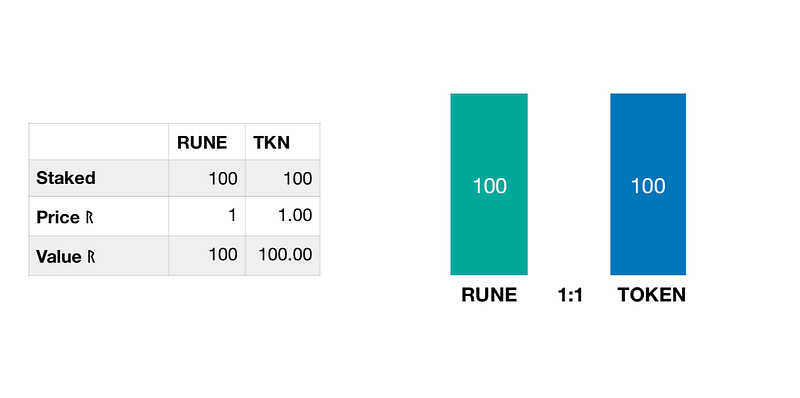
On-chain liquidity pools hold bonded assets at a 1:1 ratio in total value, where value = price * amount. In the image above 100 Rune are bonded to 100 Tokens at a 1:1 value ratio.
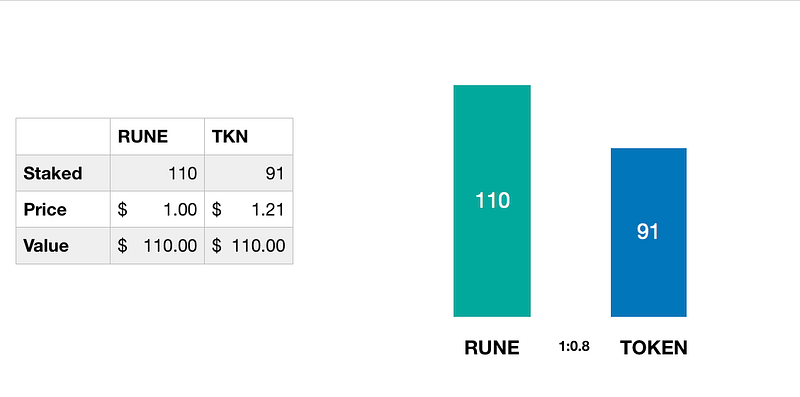
If the token value in the wider market increases to 1.20 Rune, then the value of the Token pool is now 120 Rune. Since the assets are bonded, the 120 Tokens are collateralized by 100 Rune, which is at a 17% discount to the wider market.
Anyone can now purchase Tokens at a discount by simply placing enough Rune in the pool to correct the pool value ratio back to 1.2:1. In this case, they would place 10 Rune, receive 9 Tokens (at a 10% discount) and the pool value ratio would be back to 1.2:1.
Summary and continuation
Decentralised exchange is critical to the overall health and integrity of the cryptocurrency landscape. By this, we mean secure transactions in a liquid and scalable market without the need for a central authority.
THORChain is the first decentralized protocol to actively address liquidity by incentivizing users to stake liquidity rather than store assets in cold-wallets or completely off-line.
Security is paramount to this solution, as it is with all DEXs, however with assured liquidity through incentivization, THORChain solves many of the core problems currently riddling the crypto world, namely; privacy, security, liquidity, and anonymity.
In future articles, we will continue to look into other features of the protocol such as the need for validators, staking, an analysis of incentives (in their different forms) and a direct comparison to other decentralized exchange solutions being proposed.
Join the Distribution
For more information or to participate in the distribution, head on over to https://thorchain.org/token.
Be sure to check out our official community channels for updates:
- Github: https://github.com/thorchain
- Medium: https://medium.com/thorchain
- Twitter: https://twitter.com/thorchain_org
- Reddit: https://reddit.com/r/thorchain
- Telegram Community: https://t.me/thorchain_org
- Telegram Announcements: https://t.me/thorchain
Resources:
- THORChain Whitepaper
- ASGARDEX Whitepaper

Related articles
![How to Swap Crypto on THORChain thumbnail, a THORChain guide]()
Sep. 18, 2026
How to Swap Crypto on THORChain
- Guide
![THORChain Podcast protocol update cover]()
Sep. 17, 2026
THORChain Returns to Shipping: Zcash, Monero and Self-Sufficiency
- Podcast
![NanoGPT and THORChain branding together, representing NanoGPT's accountless AI model marketplace settling crypto payments through THORChain.]()
Sep. 16, 2026
Protocol Spotlight - NanoGPT
- Spotlight
![Thumbnail for THORChain's Investor Relations dashboard on DefiLlama, showing fees, revenue, and income statement charts.]()
Sep. 14, 2026
Introducing THORChain’s DefiLlama Investor Relations Dashboard
- Marketing
![Ecosystem Update Podcast with Station Wallet]()
Sep. 13, 2026
Terra’s Station Wallet Is Back as Vultisig’s Agentic THORChain Wallet
- Podcast
![THORChain Thumbnail for the 2026 guide comparing ten decentralized exchanges across cross-chain support, fees and MEV protection.]()
Sep. 10, 2026
The 10 Best Decentralized Exchanges (DEXs) in 2026
- Guide
![Protocol Update Podcast with Chad Barraford, Kenton and Patriot / Denny]()
Sep. 10, 2026
THORChain Prioritizes Stability Before Monero and New Features
- Podcast
![Thumbnail for THORChain guide explaining how the Advanced Swap Queue and slip-based fees prevent sandwich attacks on swaps.]()
Sep. 7, 2026
How THORChain’s Swap Queue Prevents Sandwich Attacks
- Guide
![Ecosystem Update Podcast with RAVN]()
Sep. 5, 2026
Inside RAVN’s Native $BTC Aggregator and Its THORChain Integration
- Podcast
![State of the Network August 2026 report thumbnail covering THORChain swap volume, fees, active wallets, bonds, Protocol Owned Liquidity, and the affiliate leaderboard.]()
Sep. 4, 2026
State of the Network - August 2026
- Report
![Protocol Update Podcast with Hans, Devel, Chad, Kenton & Denny]()
Sep. 3, 2026
THORChain Churns Again: POL Goes Live, Rujira Resumes and BLO Debate
- Podcast
![THORChain guide thumbnail explaining how to bond RUNE through direct whitelisting, RUNEBond and bRUNE liquid staking, with yield and risk comparisons for each method.]()
Sep. 2, 2026
How to Bond your Rune: a practical guide
- Guide
![THORChain Protocol Spotlight thumbnail for BazaarSwap covering cross-chain aggregation across 360 exchanges, native asset routing and THORChain's role as a core liquidity provider.]()
Aug. 31, 2026
Protocol Spotlight - BazaarSwap
- Spotlight
![Ecosystem Update Podcast with Rujira]()
Aug. 29, 2026
THORChain’s App Layer Rujira Is Paused. Rujira Wants a Clear Restart Path.
- Podcast
![Protocol Update Podcast with Chad Barraford, Kenton and Denny]()
Aug. 27, 2026
THORChain Puts Stability First: Monero & Zcash Delayed, ADR30, AI Agents and Memoless Swaps
- Podcast