Overview
The team are building the Ethereum Bifröst and look for public input into its design.
There are multiple ways to achieve the design, but they have ramifications for user-experience, optimisations and DeFi composability.
Bifröst Design Goals
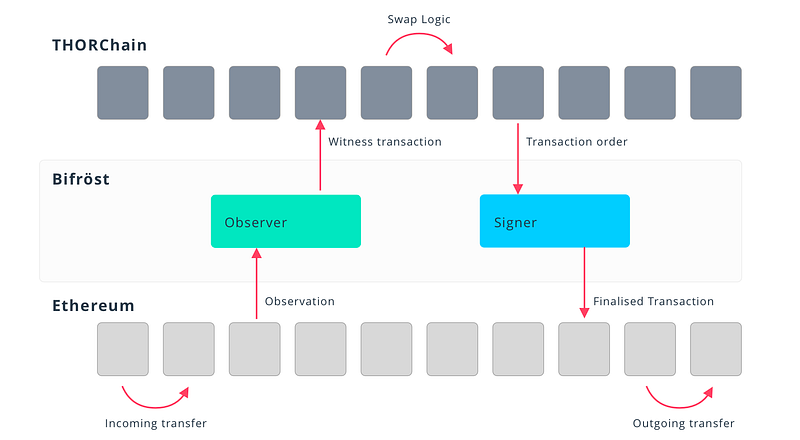
The Bifröst is simply a chain-specific connection. It includes a module that is equipped to scan the chain and make observations (the Observer), as well as a module to handle outgoing transaction requests (the Signer).
Observer & Witness Transactions
The Observer is tasked to watch vault addresses and bundle any relevant incoming transfers into a witness transaction for THORChain. The witness transaction passes the following standardised information:type Tx struct {
ID TxID `json:"id"`
Chain Chain `json:"chain"`
FromAddress Address `json:"from_address"`
ToAddress Address `json:"to_address"`
Coins Coins `json:"coins"`
Gas Gas `json:"gas"`
Memo string `json:"memo"`
}
For the case of Ethereum, the chain is identified as ETH whilst the assets will be identified as ETH.SYMBOL-CONTRACTADDRESS such as:
- ETH: ETH.ETH
- USDT: ETH.USDT-0xdac17f958d2ee523a2206206994597c13d831ec7
The memo passes through transaction intent, such as the following staking, swapping and withdrawing transactions:
stake:ETH.USDT-0xdac17f958d2ee523a2206206994597c13d831ec7
swap:ETH.USDT-0xdac17f958d2ee523a2206206994597c13d831ec7:
withdraw:ETH.USDT-0xdac17f958d2ee523a2206206994597c13d831ec7
Signer & Outgoing Transactions
The Signer receives transaction orders txOut from the THORChain state machine. These look like the following:type TxOutItem struct {
Chain Chain `json:"chain"`
ToAddress Address `json:"to"`
VaultPubKey PubKey `json:"vault_pubkey"`
Coin Coin `json:"coin"`
Memo string `json:"memo"`
InHash TxID `json:"in_hash"`
OutHash TxID `json:"out_hash"`
}
They are completely chain-agnostic, simply referring to the relevant chain once again as its identifier. It is the job of the Signer to bundle this into a valid transaction object for each chain and sign it. Initially a new txOutItem has an empty out_hash, since it has not been processed yet. The signer places the in_hash in the memo, such as:outbound:0xb24c6f1f8281dcb54b77a4676c03bd2b0ddd8b4823327485f9f1c0e46919c439
The outgoing memo is important, because it will allow the Observer to locate it on the chain, observe it once more, and then create a new witness transaction containing it. The state machine will recognise the memo and place the hash in as the out_hash. This allows the accounting to be complete, and will generate an event recording it.
Ethereum Nuances
The above design will work without problem with just ether ETH.ETH — the memo containing the transaction intent can be passed in via ethereum’s data-field. However, there are some issues when considering dealing with ERC-20 transfers.
Firstly, ERC-20 smart contracts are essentially silo’ed mini-databases on Ethereum that contain a mapping of token balances and addresses. When a transfer happens, a user simply authorises the ERC-20 smart contract to decrement their balance and increment the recipient’s balance. An event is created if successful. There is no single global registry of a user’s address and all the ERC-20 token balances associated with that address. Services such as Etherscan and Ethplorer are actually aggregrators — they monitor all block data and look for ALL ERC-20 transfers that concern every known address.
Secondly, ERC-20 transfer authorisations are passed in via a zero-ether transaction and its data-field — taking up the entire field with the following informationMethodID: 0xa9059cbb
[0]: 0000000000000000000000006262998ced04146fa42253a5c0af90ca02dfd2a3
[1]: 000000000000000000000000000000000000000000000000000000003bb94e80
The MethodID is simply the keccak256 hash of the transfer function. The array passed are the two inputs to the function itself:transfer(address _to, uint256 _value)
Problems
This design leads to the following problems:
All ERC-20 transfers must be prepared prior to the transaction taking place, in order to pass in the transaction intent (swap, stake, withdraw).
The Observer needs to monitor at great detail each block, in order to find relevant transactions.
The signer cannot batch outbound ERC-20 transfers.
Outbound ERC-20 transfers cannot be readily identified since there is nowhere to place the txOut memo.
Additionally, the prospect of DeFi composability becomes unlikely, since it would be difficult for a DeFi smart contract to know where the vault address is and interact with it.
Solutions
There are two main solutions. The first is “Vault-as-TSS-Address”, the second is “Vault-as-TSS-Owned-Smart-Contract”.
Vault-as-TSS-Address
The first solution is to encode the TSS public key into a valid ethereum address and use it to receive and process outgoing transactions. The user will use an ether transaction to pre-register transaction intent ahead of time from their address. The Observer will do thorough analysis of block content, looking at all ERC-20 transfer events and filtering out those of relevance. The Signer will do single ERC-20 outgoing transactions, and the Observer will identify the transactions by looking at the transaction content (address, amount, asset). The Signer could even use a channel to tell the Observer ahead of time which transaction hash is associated with each txOut. This solution, whilst viable, has all the problems mentioned above, but it would still work regardless.
Vault-as-TSS-Owned-Smart-Contract
The second solution is to encode the TSS public key into a valid ethereum address and use it as the “Owner” of an owned smart contract. The user will use the typical “Approve/TransferFrom” flow to register their transaction intent. The vault smart contract will serve as a single registry for all ERC-20 transfers, allowing the Observer an easy way to locate relevant transactions. The Signer can batch an array of outgoing transactions and process them by calling a transfer function on the smart contract that can handle arrays. The Signer can record the memo against each outgoing transaction (including batched ones) allowing the Observer to easily identify.
Additionally, the system gains DeFi composability by allowing other smart contracts to call the deposit function and process swaps, even to other networks. However, this would be a “fire-and-forget” approach, since the system would not be able to inform the originating smart contract of the success of a swap in the same block. Whilst partially limited, this would be sufficient to allow liquidations of assets by smart contracts, including liquidation cross-chain.
Other considerations, such as updating the owner, are relatively simple, since the TSS owner would update the smart contract ownership simply with a valid transaction. Owned smart contracts (using the onlyOwner modifier), are well-known primitive in Ethereum and have a limited attack surface as long as the implementation is correct.
Public Feedback
The team are looking for public feedback into the Ethereum Bifröst design and welcome all input. Both solutions above still respect the chain-agnostic behaviour of THORChain and don’t require any changes. The logic is handled purely in the Bifröst module.
Please reach out to the team via channels below and discuss. The team would love to hear from the Ethereum community.
Community
To keep up to date, please monitor community channels, particularly Telegram and Twitter:
- Twitter: https://twitter.com/thorchain_org
- Telegram Community: https://t.me/thorchain_org
- Telegram Announcements: https://t.me/thorchain
- Reddit: https://reddit.com/r/thorchain
- Github: https://github.com/thorchain
- Medium: https://medium.com/thorchain

Related articles
![How to Swap Crypto on THORChain thumbnail, a THORChain guide]()
Sep. 18, 2026
How to Swap Crypto on THORChain
- Guide
![THORChain Podcast protocol update cover]()
Sep. 17, 2026
THORChain Returns to Shipping: Zcash, Monero and Self-Sufficiency
- Podcast
![NanoGPT and THORChain branding together, representing NanoGPT's accountless AI model marketplace settling crypto payments through THORChain.]()
Sep. 16, 2026
Protocol Spotlight - NanoGPT
- Spotlight
![Thumbnail for THORChain's Investor Relations dashboard on DefiLlama, showing fees, revenue, and income statement charts.]()
Sep. 14, 2026
Introducing THORChain’s DefiLlama Investor Relations Dashboard
- Marketing
![Ecosystem Update Podcast with Station Wallet]()
Sep. 13, 2026
Terra’s Station Wallet Is Back as Vultisig’s Agentic THORChain Wallet
- Podcast
![THORChain Thumbnail for the 2026 guide comparing ten decentralized exchanges across cross-chain support, fees and MEV protection.]()
Sep. 10, 2026
The 10 Best Decentralized Exchanges (DEXs) in 2026
- Guide
![Protocol Update Podcast with Chad Barraford, Kenton and Patriot / Denny]()
Sep. 10, 2026
THORChain Prioritizes Stability Before Monero and New Features
- Podcast
![Thumbnail for THORChain guide explaining how the Advanced Swap Queue and slip-based fees prevent sandwich attacks on swaps.]()
Sep. 7, 2026
How THORChain’s Swap Queue Prevents Sandwich Attacks
- Guide
![Ecosystem Update Podcast with RAVN]()
Sep. 5, 2026
Inside RAVN’s Native $BTC Aggregator and Its THORChain Integration
- Podcast
![State of the Network August 2026 report thumbnail covering THORChain swap volume, fees, active wallets, bonds, Protocol Owned Liquidity, and the affiliate leaderboard.]()
Sep. 4, 2026
State of the Network - August 2026
- Report
![Protocol Update Podcast with Hans, Devel, Chad, Kenton & Denny]()
Sep. 3, 2026
THORChain Churns Again: POL Goes Live, Rujira Resumes and BLO Debate
- Podcast
![THORChain guide thumbnail explaining how to bond RUNE through direct whitelisting, RUNEBond and bRUNE liquid staking, with yield and risk comparisons for each method.]()
Sep. 2, 2026
How to Bond your Rune: a practical guide
- Guide
![THORChain Protocol Spotlight thumbnail for BazaarSwap covering cross-chain aggregation across 360 exchanges, native asset routing and THORChain's role as a core liquidity provider.]()
Aug. 31, 2026
Protocol Spotlight - BazaarSwap
- Spotlight
![Ecosystem Update Podcast with Rujira]()
Aug. 29, 2026
THORChain’s App Layer Rujira Is Paused. Rujira Wants a Clear Restart Path.
- Podcast
![Protocol Update Podcast with Chad Barraford, Kenton and Denny]()
Aug. 27, 2026
THORChain Puts Stability First: Monero & Zcash Delayed, ADR30, AI Agents and Memoless Swaps
- Podcast