How RUJI Money Market Connects Lending, Borrowing, and Liquidations

2026-07-23 — 5 min read
- App-Layer
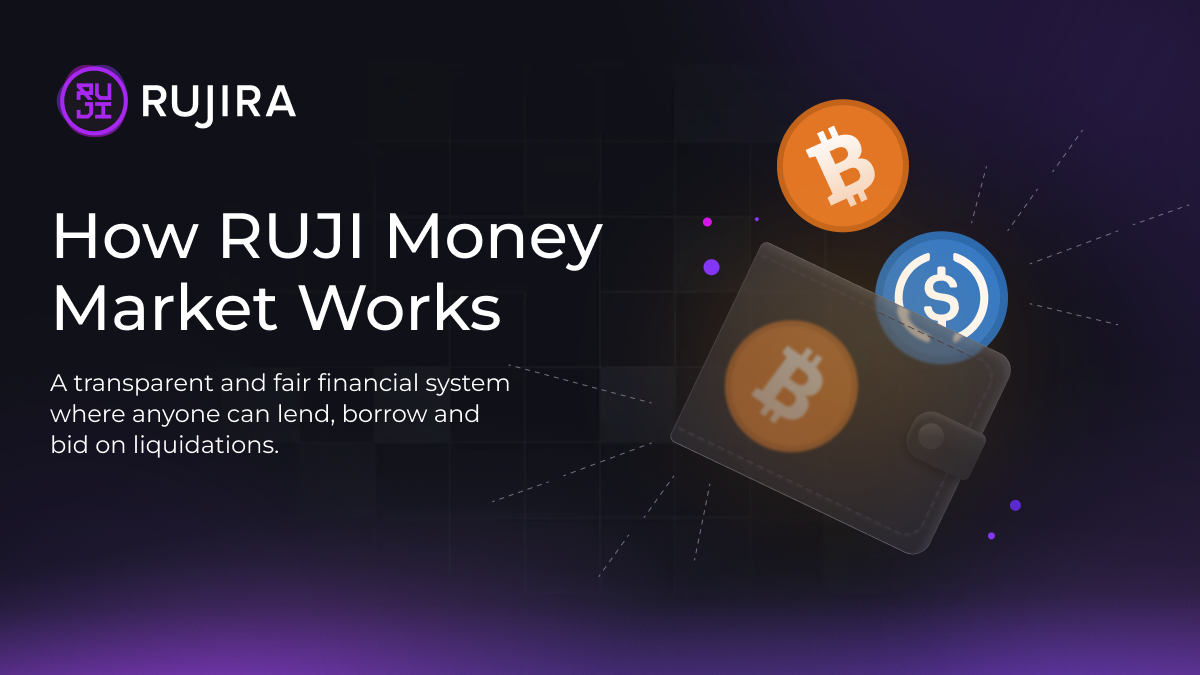
A transparent onchain system where lenders supply liquidity, borrowers unlock capital, and public liquidation bidding helps keep the market solvent.
Where does lending yield come from? Why must borrowers deposit more value than they borrow? And what happens when a borrowing position becomes unsafe?
RUJI Money Market makes the relationship between lending, borrowing, and liquidations visible. Lenders supply liquidity, borrowers pay to access it, and liquidation participants help repay debt when a position moves beyond its safe limit.
Together, these roles form one transparent, onchain system built around native crypto assets.
Lending: Put Native Assets to Work
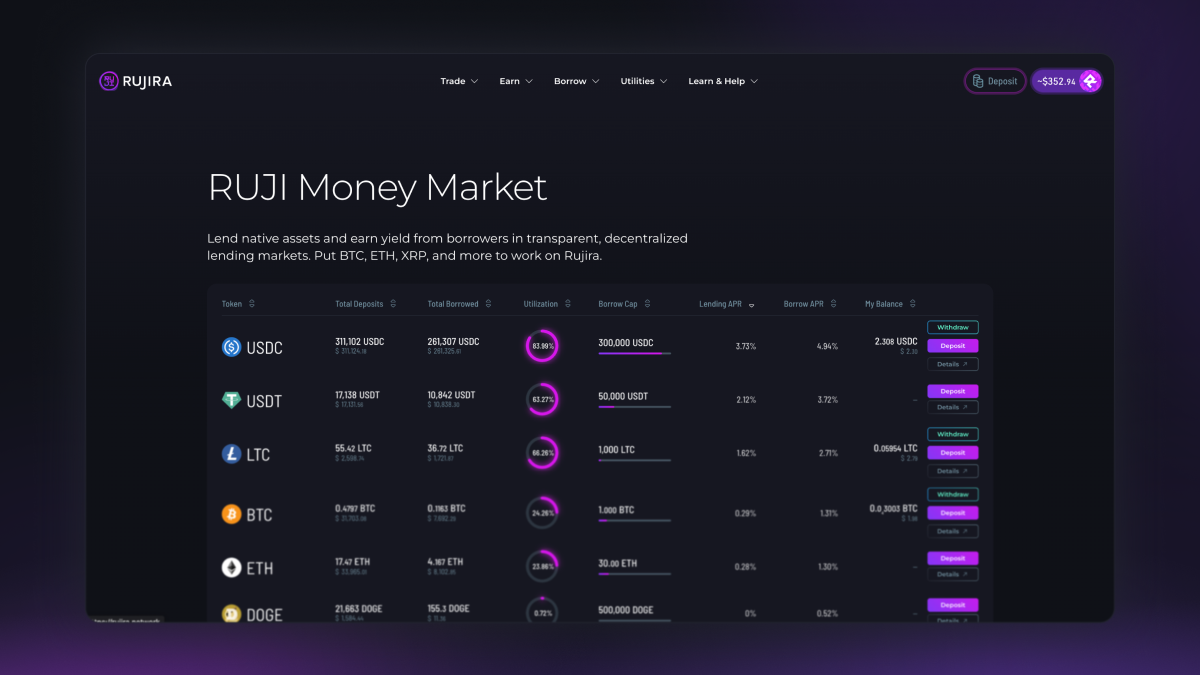
Lending begins with a simple exchange: lenders supply assets to a lending vault, and borrowers pay interest to use the available liquidity.
In return for a deposit, a lender receives a vault receipt token that accrues interest over time. According to the current RUJI Money Market design, 90% of the interest paid by borrowers goes to lenders, while 10% is retained as protocol revenue.
Interest rates are variable rather than fixed. They respond to each market’s utilization and the proportion of supplied liquidity that has been borrowed. When demand for an asset rises relative to its supply, borrowing becomes more expensive. This encourages more lending and gives borrowers a reason to reduce their positions, helping the market move toward equilibrium.
Deposits can be withdrawn while sufficient liquidity remains available. In practice, this means withdrawals depend on market utilization and are possible while utilization remains below 100%.
Borrowing: Access Liquidity Without Selling
Borrowing lets users unlock liquidity without selling the assets they want to keep.
A borrower deposits supported assets as collateral and borrows against their value. The loan is permissionless: there are no credit checks, lengthy applications, or fixed loan durations. Borrowers can repay part of their debt or close a position in full when they choose.
The trade-off is that every loan must be overcollateralized. The value deposited as collateral must be greater than the amount borrowed.
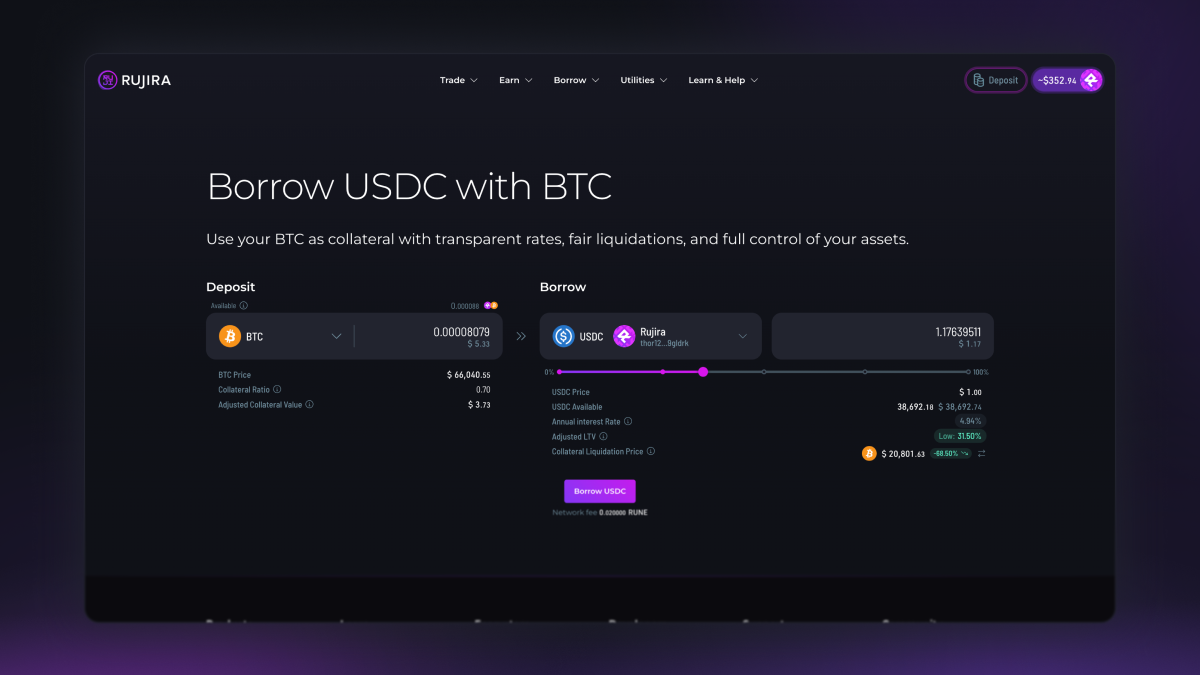
Why Loans Are Overcollateralized
Traditional lenders can assess a borrower’s identity, income, and credit history. A permissionless money market cannot rely on those checks. Instead, collateral backs every borrowing position.
Suppose BTC has a collateral ratio of 70%. In this example, $100 of BTC contributes up to $70 of adjusted collateral value. That does not mean the borrower has a risk-free $30 cushion. It means the protocol applies a risk factor to the collateral when calculating how much debt the account can support.
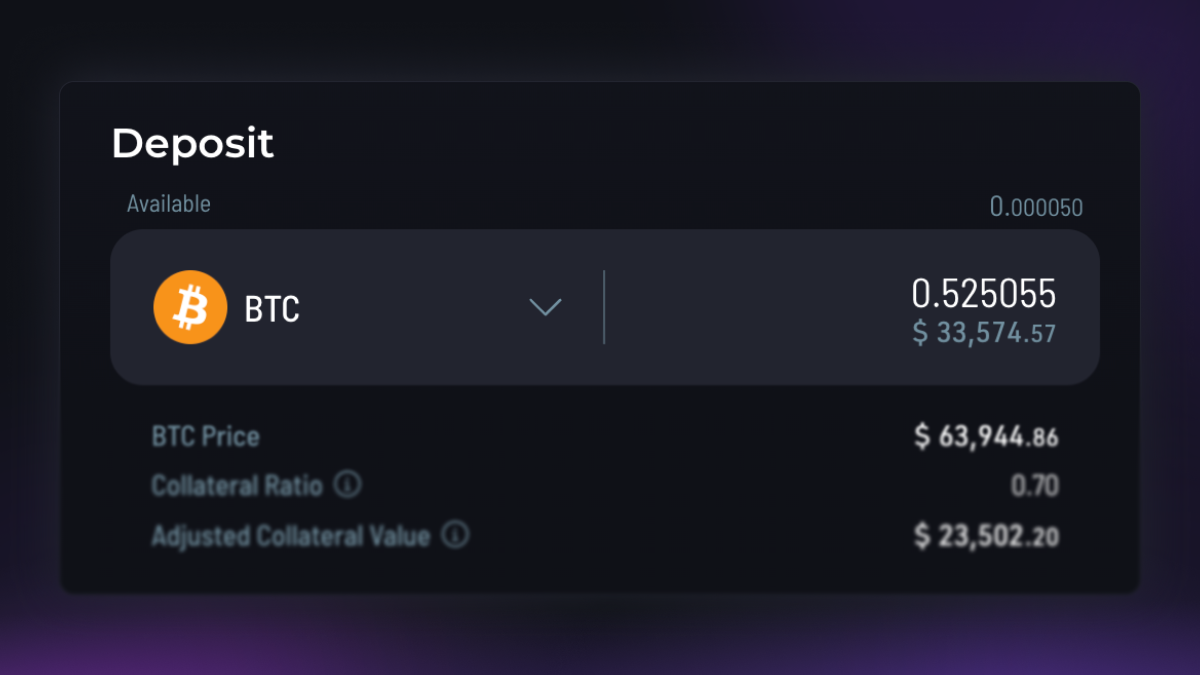
This buffer helps account for falling collateral prices, rising debt from accrued interest, and the time needed to complete a liquidation. It reduces the likelihood of bad debt and helps protect lenders.
Credit Accounts and Adjusted LTV
Each borrowing position is managed through a Credit Account. A Credit Account can contain supported collateral assets, each with its own collateral ratio.
The account’s Adjusted Loan-to-Value ratio, or Adjusted LTV, compares its debt with its total risk-adjusted collateral value:
- A lower Adjusted LTV means the position has more room before liquidation.
- As debt grows or collateral loses value, Adjusted LTV rises.
- If Adjusted LTV reaches or exceeds 100%, part of the position becomes eligible for liquidation.
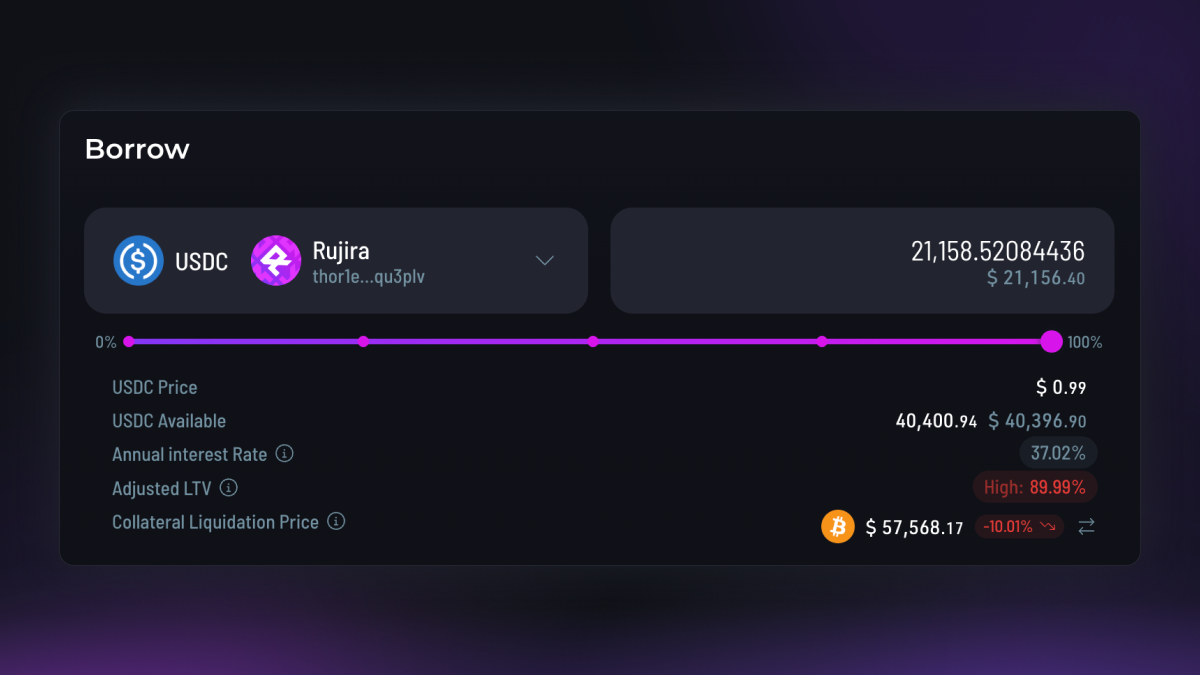
Liquidation is intended to bring the account back to a safer level, not necessarily to close the entire position. Borrowers should monitor both collateral prices and accrued interest because either can push Adjusted LTV upward.
Read the RUJI Money Market documentation
What Happens During a Liquidation
Liquidation is the mechanism that repays unsafe debt and protects lending-vault solvency.
Solvers monitor Credit Accounts and can trigger eligible liquidations. When a position crosses its limit, a portion of its collateral is sold through a market order on RUJI Trade. The proceeds repay debt to the lending vault, and the account returns toward a safer Adjusted LTV. Under the current fee design, the solver that triggers the liquidation receives a 0.5% liquidator fee calculated on the repaid debt.
For borrowers, liquidation means losing some collateral. But the mechanism is essential: without a reliable way to repay unsafe debt, lenders would bear more risk and the market could accumulate losses.
Read the RUJI Liquidations documentation
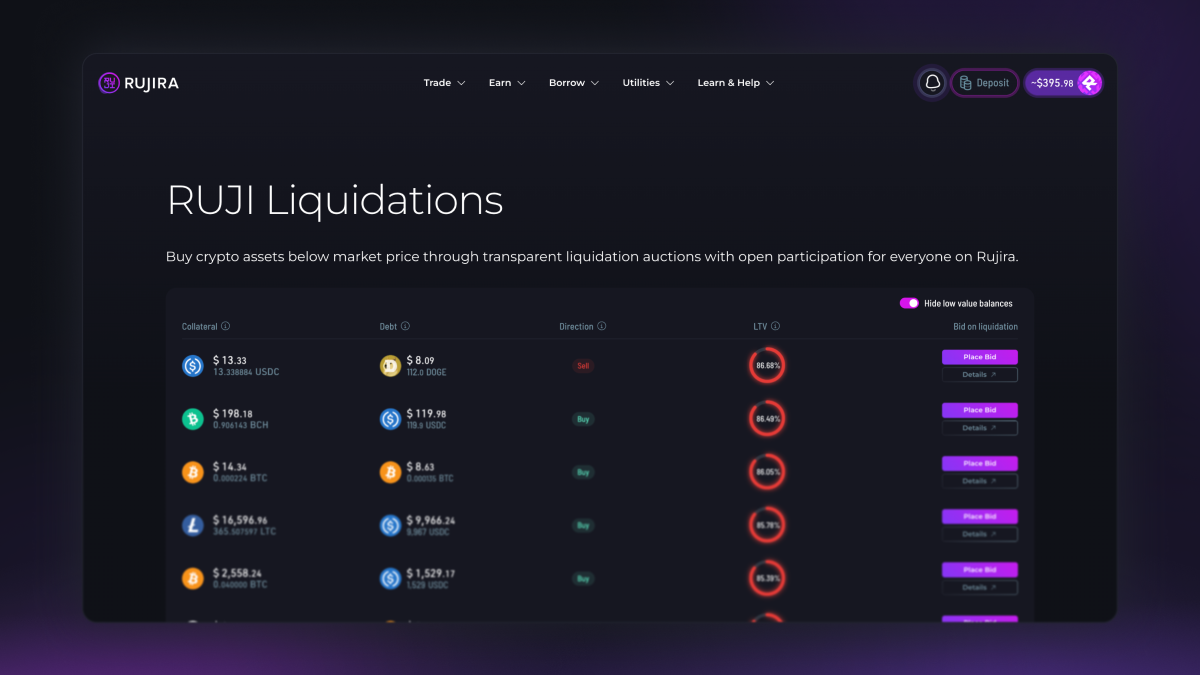
Opening Liquidations to Everyone
Most DeFi liquidation systems reward speed. Specialized bots compete to be first, often buying collateral at a fixed discount and immediately selling it. That can concentrate access among a small group of technically sophisticated operators.
RUJI Liquidations is designed to open this process through a public interface. Participants can place bids on at-risk collateral at discounts of up to 30%, without running a liquidation bot or writing code.
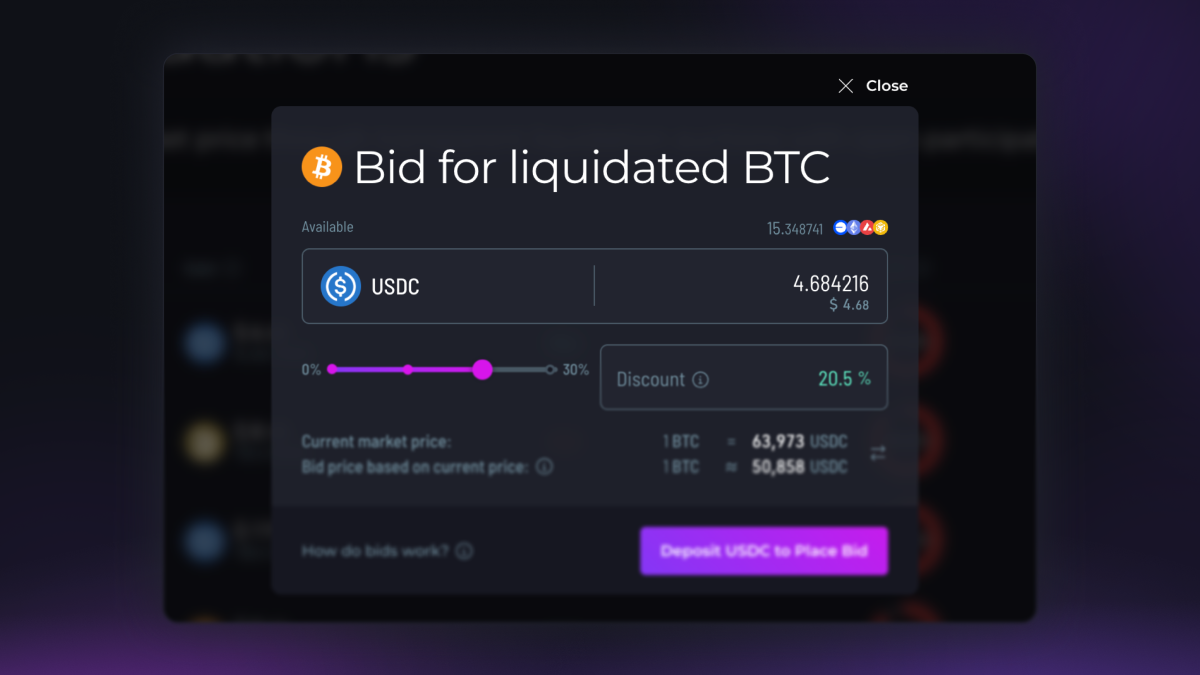
Behind each bid is a Tracking Order on RUJI Trade. The order follows the asset’s oracle price at the bidder’s chosen discount. When collateral is liquidated, bids with smaller discounts receive priority over bids with larger discounts.
That changes the competition. Instead of rewarding whoever reacts fastest, it rewards bidders willing to offer a price closer to the market price. The result can be a more competitive liquidation price, a lower liquidation cost for the borrower, and less incentive for immediate arbitrage selling.
One System, Three Roles
RUJI Money Market brings three groups together:
- Lenders supply the assets that make borrowing possible and receive most of the interest paid by borrowers.
- Borrowers create demand for that liquidity while keeping exposure to the assets they provide as collateral.
- Liquidation participants bid on at-risk collateral and help repay debt when positions become unsafe.
Each role supports the others. Borrowing demand creates interest for lenders. Lender liquidity makes borrowing possible. Competitive liquidation bidding helps protect vault solvency and can reduce the cost of liquidation for borrowers.
Different roles. Equal access.
Fair by design. Owned by you.
Understand the Risks
Before participating, review the current market parameters and product documentation, and make sure you understand how collateral ratios, interest, and liquidation thresholds affect your position.

Related articles
![Rujira banner titled Open Data for Fair Finance, with a purple analytics chart showing rising bars and a growth line.]()
Aug. 20, 2026
Rujira Analytics: Open Data for Open and Fair Finance
- App-Layer
![Rujira banner titled Bringing Crypto Back to Its Roots, with an abstract purple tree growing across a dark background.]()
Aug. 12, 2026
Bringing Crypto Back to Its Roots
- App-Layer
![Rujira banner announcing the expansion of RUJI Money Market with 5 new lending vaults, 4 new assets to borrow, and 3 new collateral assets.]()
Aug. 5, 2026
RUJI Money Market Expands with New Lending and Borrowing Markets
- App-Layer
![Rujira banner announcing 18 new trading pairs on RUJI Trade with abstract purple liquidity routes.]()
Aug. 5, 2026
18 New Trading Pairs Are Now Live on RUJI Trade
- App-Layer
![Rujira banner announcing multi-collateral borrowing in RUJI Money Market.]()
Jul. 30, 2026
Multi-Collateral Borrowing Is Live on RUJI Money Market
- App-Layer
![Rujira overview showing native-asset trading, automated trading, lending, borrowing, and liquidations built on THORChain.]()
Jul. 28, 2026
THORChain and Rujira: A Shared Foundation for Omnichain DeFi
- App-Layer
![]()
May. 5, 2026
RUJI Staking Rewards Are Live, Earn Real Protocol Revenue on Rujira
- App-Layer
![]()
Feb. 9, 2026
How to Get Started With Rujira in Under a Minute
- App-Layer
![]()
Feb. 8, 2026
bRUNE: A Simple Way to Earn Yield on $RUNE
- App-Layer
![]()
Jan. 29, 2026
⚡️Weekly Recap — Week 05/2026⚡️
- App-Layer
![]()
Jan. 26, 2026
RUJI Trade: Bringing a new upgradable liquidity model to THORChain
- App-Layer
![]()
Jan. 22, 2026
⚡️Weekly Recap — Week 04/2026⚡️
- App-Layer
![]()
Jan. 21, 2026
⚡ Rujira’s Omnichain DeFi Unlocks Real Utility for Native Litecoin
- App-Layer
![]()
Jan. 21, 2026
Contact Rujira: Support, Developers, Partnerships and Community
- App-Layer
![]()
Jan. 19, 2026
RUJI Lending — Money Market
- App-Layer