THORChain Stands for a Permissionless and Decentralized Ethos
THORChain held the line during the Kelp DAO exploit fallout. Inside: new revenue share model, dynamic fee algorithm landing in v3.18 and $XMR, $TAO, and Polkadot all queued up.

THORSday Community Space ft. @CBarraford, @KentonC137 & @patriotsounds | April 23, 2026
By @Raynalytics
TL;DR
- The Kelp DAO exploit (hundreds of millions drained via LayerZero's 1-of-1 DVN) sent stolen funds through THORChain. The protocol held the line on permissionless, neutral infrastructure rather than censoring, just as it did during Bybit.
- A new tiered revenue share model is being coded up: top integrators will get a share of THORChain fees based on volume they drive, giving BD a real lever to pull in partners.
- Dynamic fee model (targeted for v3.18) will auto-adjust fees per-affiliate, per-pair to compete aggressively on every trading pair.
- $XMR merge is ~1 week out. $TAO and Polkadot PRs open, likely landing in v3.18 (cut April 15).
- v3.17 unlocks separate base fees for stable-to-stable pairs, opening an underserved market.
1. Standing Firm Through the Kelp DAO Fallout
The week's biggest story was the Kelp DAO exploit. Hundreds of millions of dollars were drained from a protocol using LayerZero's 1-of-1 DVN (Decentralized Verifier Network) configuration. The accusation points to DPRK-linked actors, and a chunk of those funds flowed through THORChain as the attackers swapped between assets.
@CBarraford walked through a conversation he had years ago with someone from the Stargate/LayerZero side about this exact security model. At the time, the design required trusting a single oracle and relayer setup, and when Chad asked how they planned to properly decentralize it, the response was, well, "the DAO will figure that out."
"That was just so iconic. You don't go to the DAO for innovative ideas or solving problems. You need a visionary."
Chad Barraford
That exchange, years later, looks prescient. A 1-of-1 signature scheme is exactly the kind of centralized failure point that shouldn't exist in a protocol holding hundreds of millions.
But the real story for THORChain wasn't the exploit itself, it was the PR battle that followed. Critics again lined up to demand that THORChain censor the exploited funds or pause the protocol. Chad and Denny's response was the same as it was during the 1.5 billion dollar Bybit incident: THORChain is neutral, permissionless infrastructure. It always has been. Pausing isn't even a real option, because if you pause while stolen funds exist on-chain, you never restart. The funds don't go away.
They also pointed out that filters don't work. SwapKit operates some of the most sophisticated filtering in the ecosystem and still couldn't catch the largest tainted swap. Chain analysis address flags can be defeated with three wallet hops. Asking a DEX to censor transactions is a virtue signal, not a solution.
"Bad people transport things on highways, but the highway is necessary for society to function."
Patriot
Chad noted the inconsistency plainly: nobody yells at Uniswap for this, or at Ethereum for settling the transactions, or at Bitcoin for being the eventual exit. THORChain gets singled out because it works, because it is the most useful cross-chain venue out there.
Shout-out to @TheDesertLynx from the @Dashpay community, whose viral defense video cut through the noise, and to defenders from @RujiraNetwork, @Maya_Protocol, and across the ecosystem who showed up to make the case. As Kenton put it during a brief call-in from a Mexico City bus station:
"We're on the same path as Bitcoin. We're just 10 years behind. And we're going to win."
Kenton
2. Revenue Share Alpha Just Dropped
Buried in the middle of the Space was a genuine piece of alpha. Kenton proposed, and Chad is now coding up, a tiered revenue share model for integrators.
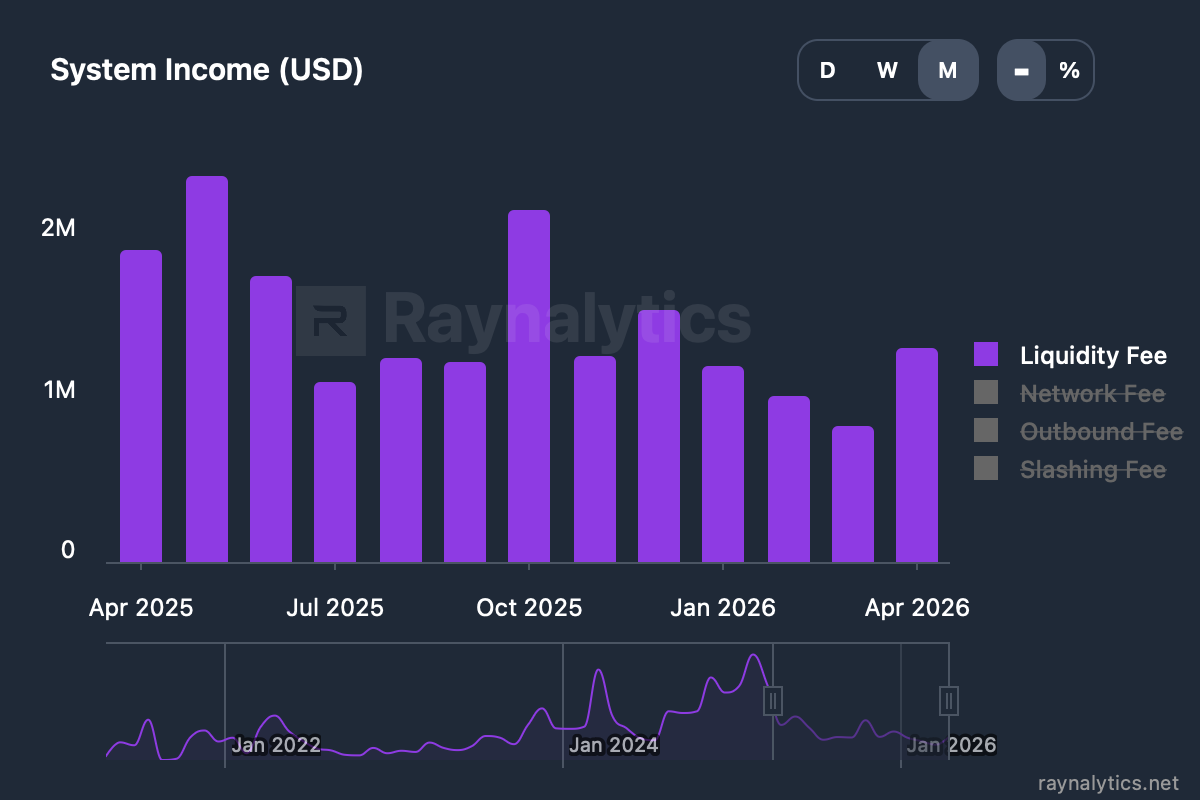
The concept is simple. When an affiliate like SwapKit or a wallet brings THORChain a defined amount of volume in a 30-day period, they get a percentage of the fees THORChain collects as a kickback. The more volume driven, the higher the tier, the bigger the share. In Chad's rough sketch: 200,000 dollars of revenue might earn 10%, 500,000 might earn 20%, 10 million might earn 50%.
Crucially, this gives THORChain BD (@Randy_Bechtold and the team) a real lever when pitching integrations. An affiliate charging 25 bips on all its partners has no particular reason to favor THORChain over Near or Chainflip, since their fee is the same regardless. A revenue share changes the math.
"The more swap volume they did, the higher percentage of a kickback they get. It's a perfectly tiered incentive."
Patriot
Chad's plan is to keep v1 simple: a per-Thorname operational Mimir that nodes can vote to enable for specific affiliates. If five nodes enable something malicious, six can vote against it. Chain governance as a normal circuit breaker. Start simple, learn from mainnet data, and iterate into v2.
3. Dynamic Fee Model: Competing on Every Pair
The second half of the fee story is the dynamic fee model Chad is very bullish on. Where revenue share expands THORChain's reach by signing up more integrators, the dynamic fee model goes deep: the protocol itself automatically adjusts the fee on each affiliate-pair combination to find the optimal competitive position.
Each day, the protocol looks at volume and fees collected per affiliate, per trading pair, then nudges the fee up or down by one bip depending on what's happening. Stable-to-stable pairs on a high-volume affiliate might drift down because competition is fierce. $BTC-to-$XMR pairs might drift up because THORChain will be the only venue offering them.
When @WithTheCoke asked how the chain "knows" the competition, Chad used a nice analogy: the protocol doesn't see other venues directly, it feels around the room. When fees were at nine bips and volume dropped, it infers someone else is trading cheaper. It just follows the signal.
Chad was clear about the noise problem: a Kelp DAO-sized event can cause the algorithm to mis-attribute volume spikes to its last fee change. Over long sample sizes it finds the right answer, but day-to-day there will be wrong moves by a bip or two. That is acceptable. Launch simple in v3.18, learn, iterate.
This only applies to Layer 1 swaps, not to Layer 1 to secured asset or secured to Layer 1 routes, so arbitrage flows stay on the existing static fee model.
"One's generating width and one's generating depth. You put those things together, it sounds pretty good to me."
Chad Barraford
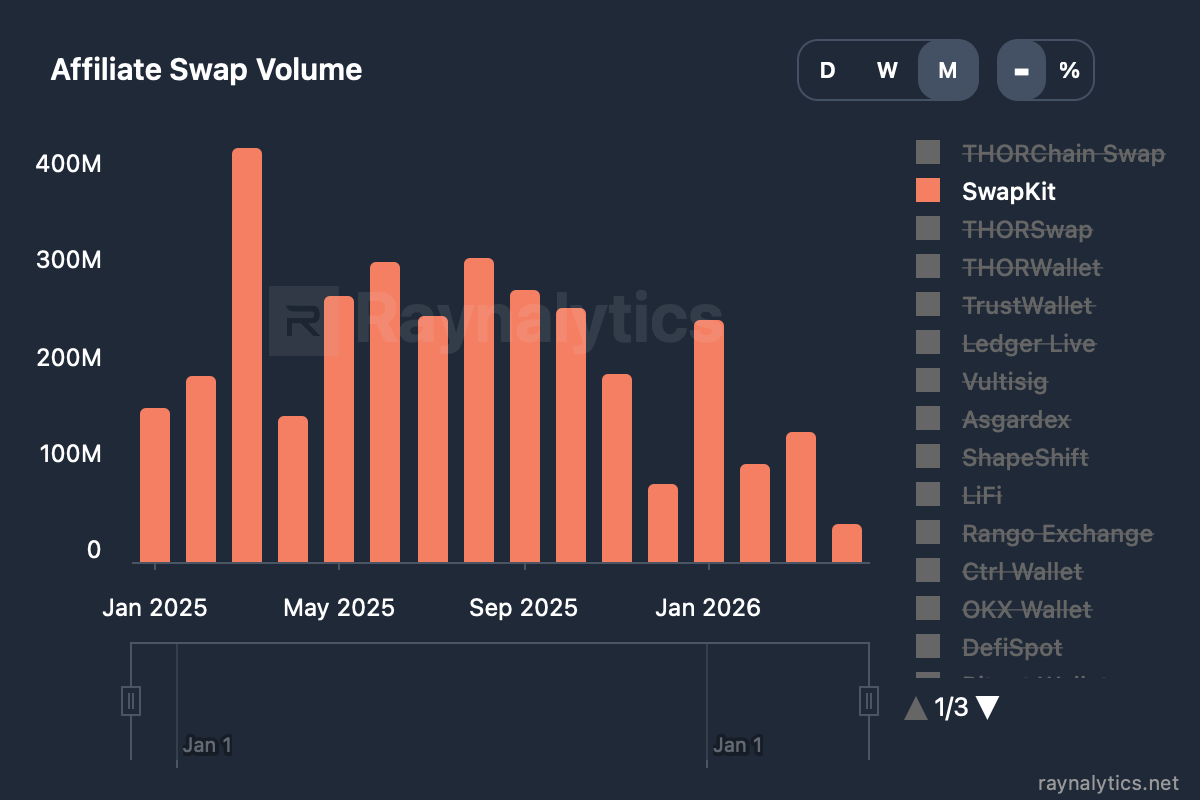
Oleg from @SwapKitPowered (@ol3gpetrov) publicly noted recently that THORChain gets about 4% of SwapKit's volume. That is the number Chad is trying to change, and dynamic fees are his best shot at it.
4. Stable-to-Stable Fee Tuning Lands in v3.17
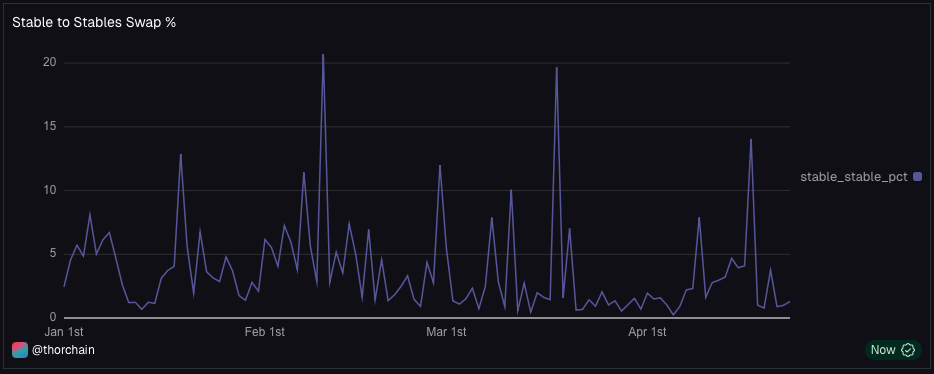
Shipping sooner (in v3.17, launching within a week or two) is a related change: THORChain can now set a different min fee for stable-to-stable pairs versus any other trading pair. The current flat 10-bip fee (20 bips on double swaps) simply isn't competitive in stable swap markets, and stables make up roughly 10% of THORChain volume today compared to 80% on some competitors like Near.
With a lower base fee for stable-to-stables, THORChain can plausibly claw back significant volume. As community member SodaMax noted, CCTP handles $USDC-to-$USDC well, but $USDT-to-$USDC is still underserved, and that is an opening.
5. $XMR Close, $TAO and Polkadot Queued Up
The $XMR integration is in final review. Chad expects the PR to merge within about a week, with stagenet testing to follow. Thanks largely to @BooneW for pushing this over the line.
A key technical constraint: Monero locks UTXOs for 10 blocks (about 20 minutes) after they are spent, to protect its obfuscation layer. That complicates UTXO consolidation strategy, and there will almost certainly be pauses on mainnet in the early days as the team finds the right balance.
When $XMR does hit mainnet, expect the pool to open shallow. A few thousand dollars of depth. Small swaps only. No big arbitrage plays, and patience on inevitable pauses. The integration will also use a single vault design for solvency, which is more verifiable than the standard six-Asgard-vault setup.
On the same train, $TAO (@bittensor) and Polkadot PRs are open and likely to be included in v3.18, which is cut on April 15 and released to nodes a week or two later. That means $XMR, $TAO, and $DOT could all land in the same cycle.
Shout-out to the @monero community following along, Chad welcomes input from XMR devs on the integration.
6. The Opt-in Chain Clients Debate
One of the more interesting governance questions in the Space: should $XMR launch before or after opt-in chain clients?
Opt-in chain clients would let individual nodes choose which chains they validate. Chad has a draft MR in progress, targeting v3.19. The question is whether to wait for it.
Chad's initial instinct: launch $XMR first, let opt-in ship after, and let nodes in unfriendly jurisdictions drop out later. Kenton pushed back hard from Mexico: "We all run XMR or no one runs it. We have strength in numbers."
Chad conceded the point is strong and said he'd survey the dev Discord. Expect this to be a live community debate heading into the v3.18 and v3.19 windows.
7. The $USDC Freeze Scenario
A community question came up: what would happen if Circle or Coinbase froze THORChain's $USDC vaults?
Chad's answer was unflinching. All six vault addresses (or the router, depending on implementation) would be frozen. Swaps would still work, but outbound transactions would not sign. THORChain would pause the pool, remove $USDC from the TOR anchor via a Mimir update, and effectively Ragnarok the $USDC and $USDC-based secured assets. LPs in that pool would lose their funds. There is no magic undo.
The silver lining: this would be catastrophic PR for the frozen stablecoin issuer. Chad doesn't think it's likely, and more importantly, it is the cost of holding a centralized stablecoin. You agree to those terms just by holding the asset.
"Eventually the greatest stable coin in the world will be Bitcoin."
Chad Barraford
8. The Direct Integration Push
Chad has noticeably shifted his own time allocation. Where Nine Realms used to handle most integration partner conversations, Chad and Randy are now taking those calls directly. It is already surfacing real feedback. One large wallet revealed it tried to integrate THORChain directly in 2022, ran into unresolved bugs, and switched to SwapKit. That should not happen anymore.
The @cakewallet team and two other Monero wallets are expected to integrate ahead of $XMR going live. Cake Wallet will be at the upcoming Bitcoin conference in Las Vegas where the team can debrief in person. A request to the community: if you have dev capability, try integrating against the THORChain API and share your feedback on what is unclear or broken. The @unstoppablebyhs dev building the swap front-end is also actively feeding back.
9. What to Watch
- v3.17 release (1-2 weeks out): stable-to-stable base fee flipped on, testing lower-fee stable swap execution against CCTP and friends.
- v3.18 cut April 15 (released to nodes ~2 weeks later): dynamic fee model, $TAO, Polkadot, and potentially $XMR.
- Opt-in chain clients (v3.19): debate incoming in dev Discord on whether $XMR mainnet should wait for it.
- Revenue share ADR: watch dev Discord for the forthcoming proposal.
- Bitcoin Conference Las Vegas (next week): Chad, Denny, Kenton, and ecosystem partners including Cake Wallet will be there. Come say hi.

More @THORChain data, check out Raynalytics
Follow @Raynalytics for more Weekly Analytics and Space recaps.