THORChain’s Native API - plugging liquidity directly to wallets and DEXs
THORChain can act as a backbone for liquidity and cross-chain swaps across wallets and decentralised exchanges. But how do you actually integrate it? Until now, there were two main options.
The first is to work directly with THORChain’s tech stack. This gives full control, but comes with complexity. Integrators need to handle chain maintenance, upgrades and infrastructure themselves. It offers full flexibility, but comes at a significant resource cost.
The second option is to rely on external SDKs or APIs provided by services such as Xchain.js or SwapKit. This approach is much easier to use. Most of the maintenance is handled by the provider, support is available, and integration can be done in just a few lines of code. It offers simplicity, but introduces dependency on the provider, including its fee structure.
Today, there is a third option: THORChain Native API. Let’s dive in. ⬇️
What is the THORChain Native API
THORChain now offers its own Native API for integrations with a simple objective: give builders direct access to swap functionality without relying on an external provider.
In practice, this means that wallets, interfaces and aggregators can connect straight to THORChain’s infrastructure. They can retrieve supported assets, request swap quotes, execute flows and track transactions, all through a single interface maintained by the protocol itself.
This marks a shift from how integrations were typically built. Until now, most teams accessed THORChain through third-party providers. The Native API removes that dependency and brings integrators closer to the protocol itself.
It doesn't change how THORChain operates. Swaps are executed in the same pools, validated by the same set of nodes, and the protocol continues to generate fees on each transaction.
What changes is how integrators connect. By removing the need for external API or SDK providers, the Native API eliminates an additional fee layer and simplifies the overall integration path.
Perks of the Native API: a leaner fee stack
Before looking at how the Native API impacts revenue, it is important to understand the current fee structure on THORChain.
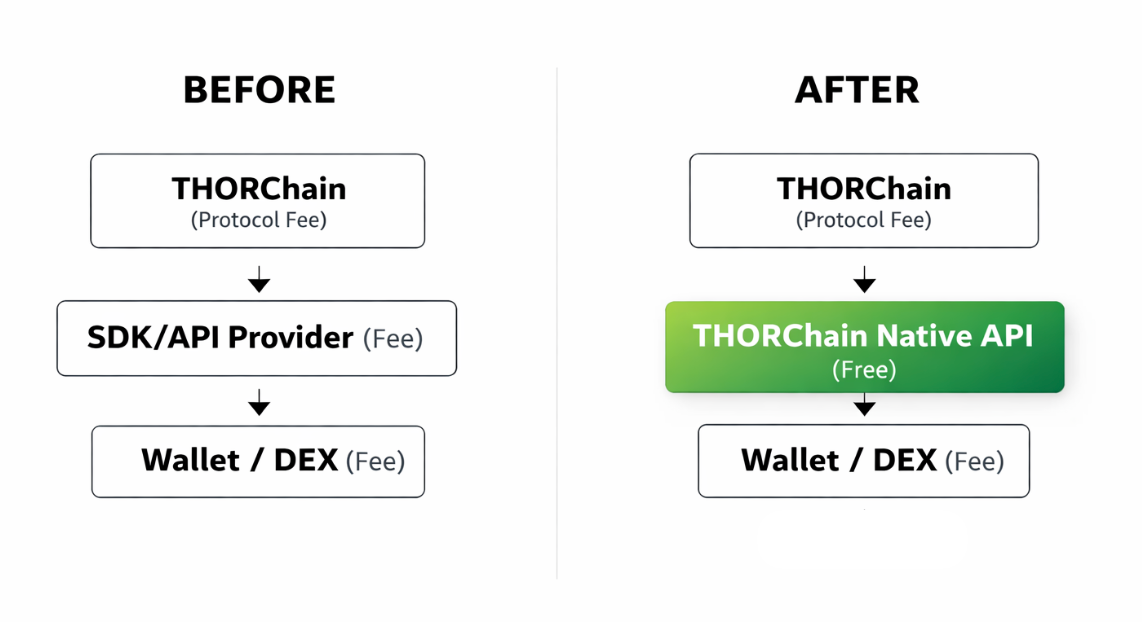
For each swap, the protocol charges a fee, currently around 10 BPS. On top of that, an API or SDK provider may add its own fee, and the wallet or exchange acting as the frontend adds its fee on top.
With the Native API, the provider fee disappears, as the NAtive API is free to use.
For integrators, this creates more flexibility: they can offer more competitive pricing or keep pricing as is and capture more margin. For users, this can translate into better rates.
With fewer layers, the Native API creates a leaner structure, improving efficiency across the stack. This is critical in an increasingly competitive market where pricing and execution are key.
Note: It is also worth noting that the Native API doesn’t replace existing providers entirely. Services like SwapKit still offer value through support, broader integrations and additional routing options. For now, the Native API focuses on direct access to THORChain and MAYAChain routes and assets.
How to interact with the Native API
The Native API is designed for builders. It is relevant for any team that wants to integrate THORChain swaps into their product. This includes wallets, trading interfaces, aggregators and applications looking to offer cross-chain functionality.
Integration is straightforward. Access starts with an API key. From there, teams can interact with THORChain’s endpoints to discover supported assets, retrieve quotes and manage swap flows.
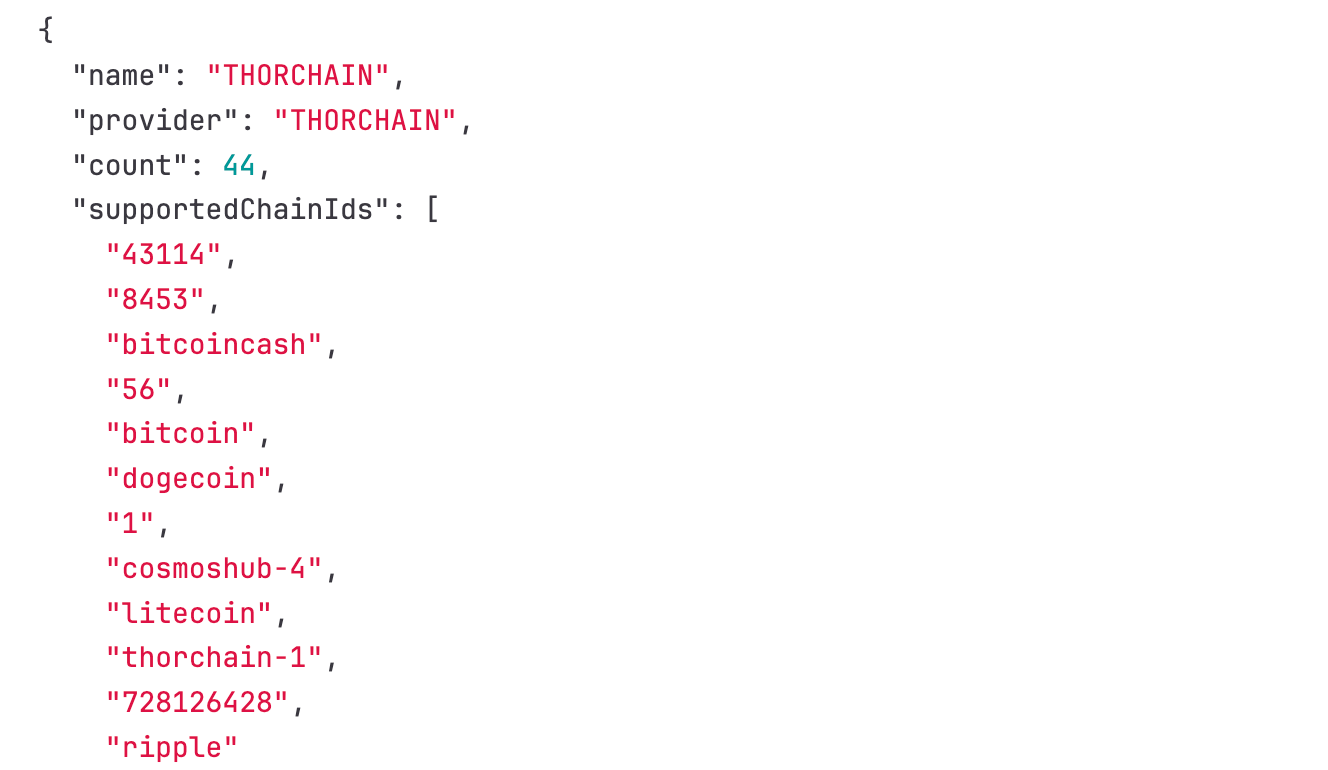
In practice, this means being able to query supported chains, access token data across networks, generate swap quotes with expected outputs and fees, and track transactions throughout their execution.
The API also supports more advanced flows such as memoless swaps, which simplify the user experience by removing the need to manually include transaction memos.
Documentation is structured to allow fast integration while maintaining full visibility on swap execution.
https://gitlab.com/thorchain/client/aggregator/-/blob/master/README.md?ref_type=heads
Final Thoughts
The Native API is a structural improvement in how THORChain is accessed. It makes the path between the protocol and the applications built on top of it more direct, removing a layer of fees and dependency.
In an increasingly competitive market, this is an important step. It gives integrators more flexibility and opens the door to better options for end users, who are constantly looking for cheaper and faster execution.