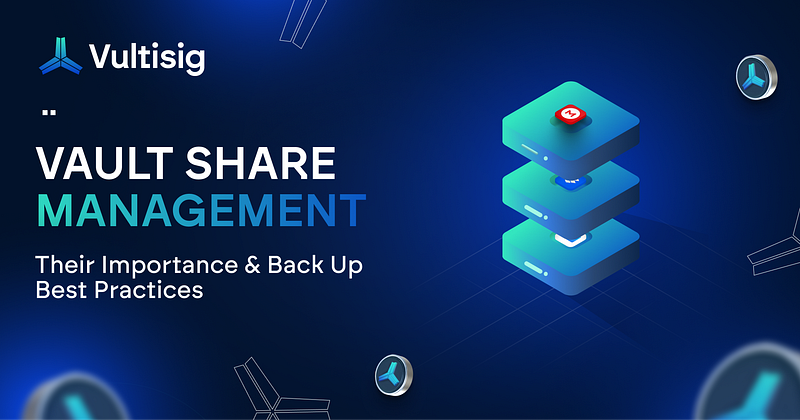
Vault Share Management: Their Importance & Back-Up Best Practices

2025-03-17 — 8 min read
🔒 Overview: What are Vault Shares & Why Do They Exist?
While a term native to Vultisig, “vault shares” simply refers to the backups, i.e. the files, that users download after creating a new vault. They are a core component of Vultisig’s security infrastructure, one that safeguards its user experience. Below, we will explain how to best manage these vault shares, as well as how the type of vault used affects their management. First, though, we need to understand why vault shares exist in the first place, as well as what role they play in Vultisig’s security model — these contexts will help solidify the user-forward significance of vault shares and clarify the many reasons for their proper management.
Vault shares, like the seed phrases of traditional DeFi wallets (only far more evolved in terms of security), exist for the user, particularly, their peace of mind: they are the means by which a user may recover access to their Vultisig vault, should this ever be lost. Vault shares are therefore simply the backstop against those misfortunes of life that may cause one to lose access to a vault. In this way, vault shares immensely strengthen the wallet’s UX; should a Vultisig user ever find the need to recover lost access to a vault, they will find vault shares to be far more than just a nice-to-have; they will realize they are indispensable, and should be managed as such.
This guide will help you understand the importance of proper vault share management and how this can help you maintain access to your Vultisig vaults in perpetuity. In doing so, it will also help you avoid their unintended mismanagement, whether it be through negligence, confusion, or other behaviors that may have historically kept best security practices at a distance. By the end of the writeup, you will fully understand the purpose, role, and significance of Vultisig’s vault shares, as well as other key details, such as how many vault shares each vault type carries, and how to locate and confirm their secured storage.
How Vault Shares Relate to Vault Types
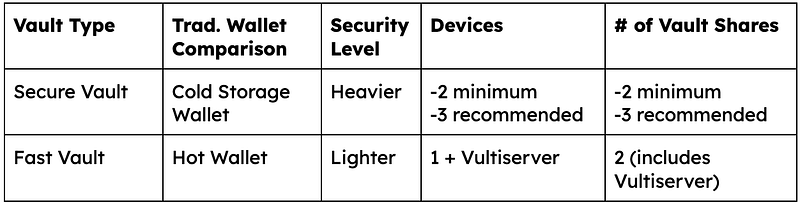
As we know from our last Vultisig-focused article, Vultisig’s Onboarding UI Guide, there are two types of vaults that Vultisig offers its users: Secure Vaults and Fast Vaults. Recall that Secure Vaults are best compared to cold storage wallets, which are well understood in DeFi to boast far stronger security layers than their counterpart: hot wallets. In that article, we compare these hot wallets to Fast Vaults, as its security layer is lighter than the Secure Vault (despite the comparison, Fast Vaults still carry a stronger security model than both hot or cold wallets). Vultisig’s vault types are thus differentiated primarily by their two security levels.
And, as vault shares pertain to secure vault recovery, we might easily and accurately deduce that the amount of vault shares belonging to a vault increases as the vault’s security layer increases. In other words, a Secure Vault typically generates more vault shares than a Fast Vault. While it is technically true, for both vault types, that every device used in vault generation creates a vault share, the amount of devices, and the method of backup that each employs, differs. Let’s take a look.
Secure Vault Vault Shares
Vultisig recommends three devices be used to create a Secure Vault (two at minimum) — if going by the recommended amount, then, a Secure Vault created with three devices will generate three vault shares — one on each device.
Fast Vault Vault Shares
A Fast Vault, on the other hand, requires only one device. With that said, the backup design for a Fast Vault is unique and differs from Secure Vaults: because there is only one device, Fast Vault transactions require a “cosigner” of sorts; this is called the Vultiserver, and it, being part of the vault, also receives a vault share — bringing a Fast Vault’s total vault share amount to two.
🔒 When Do Vault Shares Enter the Picture?
Vault shares don’t exist to you at the beginning or even during the vault creation process, i.e. the first phase of establishing your vault. Not only do vault shares come into the picture individually and on each device well after you’ve created your vault, they become accessible to you only about halfway through the second phase of establishing your vault: the vault backup.
Note: Calling the entire process outlined in this writeup, “creating a vault”, is a bit of a misnomer, as this does not overtly incorporate the just-as-important second phase of backing up a vault. Such is why this article has termed the whole process, from opening the app to securing your vault shares, “establishing a vault”—this terminology includes the entirety of both processes together.
Once the user has backed up, i.e. downloaded, all relevant devices’ vault share files, then each vault share now exists, and now matters. Each vault share will be located and stored on the particular device on which it was downloaded. Downloading the vault shares in itself, however, is not enough— the user must complete one further step for each vault share: storing it off of the original device.
🔒 Vault Share Backup Best Practices
It is understandable at this point to be a bit over the process of establishing your Vultisig vault, which is why here we recommend leaning back in your chair here and reflecting on why this process requires this amount of attention: as Vultisig the world’s most secure digital asset wallet, security is the name of its game. With such a thing, proper setup requires care, and we think that attention paid to the transparent security of your assets is attention worth paying.
So, once you have downloaded your vault share files, there are a few closely connected considerations and actions you must personally take:
Store each vault share off of the devices they were downloaded on. Should this be overlooked and your vault share remains on its original device, if you lose that device, then you can say goodbye to that vault share as well.
As you carry out the above process, ensure you are exporting these vault shares to locations with multi-device access—i.e. email, a cloud, etc. This is so you have multiple routes by which to access your vault shares.
Best practices dictate that when exporting your unique vault shares, that you not only send them off your original device (1) and to locations with multi-device access (2), but also that you send the vault shares to distinct and separate digital locations. Should you fail to execute this last piece of vault share management (i.e. store them all in the same location) and a bad actor gains access to that location, then they effectively have full access to your funds (a scenario akin to a bad actor having your traditional wallet’s seed phrase).
Lastly, confirm the location of each separately and securely stored vault share file; and, in some discreet manner, memorize these locations and ensure that you will never inadvertently delete any of these files.
Note: It is worth remembering that you always have the option available — in your vault’s settings list — to perform additional vault share backups, should you ever wish to do so.
🔒 The Hurdles of Teaching Vault Backup Procedures
While creating up a traditional DeFi wallet is more or less automated (i.e. the Dapp generates both the wallet and a random series of words for you; all you have to do is write them down), Vultisig’s higher security parameters transcend in-app automation. In other words, after having completed Vultisig’s automated prompts, the user still isn’t finished with the app’s security procedures. A few more steps must still be taken, ones that require personal consideration and decision-making; and is why this part of the process cannot be automated:
Consider — all of the digital locations at your disposal, and which among these might secure discrete yet accessible vault share storage through time.
Choose — which location or locations among the many options you will most securely store your vault share files.
Act — with attention and care as move your files to the locations you’ve chosen, afterwards confirming their placement.
Memorize — in some discreet way, the location of these vault share files (or, at the very least, a discreet way to help you recall this information).
🔒 Summary
Rest assured, while Vultisig’s best practices may seem a bit labor-intensive for the new user, vault share management becomes exponentially easier with each newly established vault. For any DeFi user dedicated to implementing optimal security tools, creating Vultisig vaults and performing proper back ups will quickly become second nature. To aid the enthusiasm of learning and practicing the process, just remember that you are learning how to protect yourself with the most secure digital asset technology available.
Do feel free to bookmark this resource if you ever need a refresher on how to manage your Vultisig Vault Share.

Related articles
![How to Swap Crypto on THORChain thumbnail, a THORChain guide]()
Sep. 18, 2026
How to Swap Crypto on THORChain
- Guide
![THORChain Podcast protocol update cover]()
Sep. 17, 2026
THORChain Returns to Shipping: Zcash, Monero and Self-Sufficiency
- Podcast
![NanoGPT and THORChain branding together, representing NanoGPT's accountless AI model marketplace settling crypto payments through THORChain.]()
Sep. 16, 2026
Protocol Spotlight - NanoGPT
- Spotlight
![Thumbnail for THORChain's Investor Relations dashboard on DefiLlama, showing fees, revenue, and income statement charts.]()
Sep. 14, 2026
Introducing THORChain’s DefiLlama Investor Relations Dashboard
- Marketing
![Ecosystem Update Podcast with Station Wallet]()
Sep. 13, 2026
Terra’s Station Wallet Is Back as Vultisig’s Agentic THORChain Wallet
- Podcast
![THORChain Thumbnail for the 2026 guide comparing ten decentralized exchanges across cross-chain support, fees and MEV protection.]()
Sep. 10, 2026
The 10 Best Decentralized Exchanges (DEXs) in 2026
- Guide
![Protocol Update Podcast with Chad Barraford, Kenton and Patriot / Denny]()
Sep. 10, 2026
THORChain Prioritizes Stability Before Monero and New Features
- Podcast
![Thumbnail for THORChain guide explaining how the Advanced Swap Queue and slip-based fees prevent sandwich attacks on swaps.]()
Sep. 7, 2026
How THORChain’s Swap Queue Prevents Sandwich Attacks
- Guide
![Ecosystem Update Podcast with RAVN]()
Sep. 5, 2026
Inside RAVN’s Native $BTC Aggregator and Its THORChain Integration
- Podcast
![State of the Network August 2026 report thumbnail covering THORChain swap volume, fees, active wallets, bonds, Protocol Owned Liquidity, and the affiliate leaderboard.]()
Sep. 4, 2026
State of the Network - August 2026
- Report
![Protocol Update Podcast with Hans, Devel, Chad, Kenton & Denny]()
Sep. 3, 2026
THORChain Churns Again: POL Goes Live, Rujira Resumes and BLO Debate
- Podcast
![THORChain guide thumbnail explaining how to bond RUNE through direct whitelisting, RUNEBond and bRUNE liquid staking, with yield and risk comparisons for each method.]()
Sep. 2, 2026
How to Bond your Rune: a practical guide
- Guide
![THORChain Protocol Spotlight thumbnail for BazaarSwap covering cross-chain aggregation across 360 exchanges, native asset routing and THORChain's role as a core liquidity provider.]()
Aug. 31, 2026
Protocol Spotlight - BazaarSwap
- Spotlight
![Ecosystem Update Podcast with Rujira]()
Aug. 29, 2026
THORChain’s App Layer Rujira Is Paused. Rujira Wants a Clear Restart Path.
- Podcast
![Protocol Update Podcast with Chad Barraford, Kenton and Denny]()
Aug. 27, 2026
THORChain Puts Stability First: Monero & Zcash Delayed, ADR30, AI Agents and Memoless Swaps
- Podcast