In DeFi, privacy is often treated as an optional feature rather than a foundational requirement — a nice-to-have rather than a must-have. Why? Because implementing privacy on public blockchains is notoriously challenging.
Vultisig refuses the easy way out, establishing privacy as an integral part of its wallet’s user experience. In doing so, Vultisig doesn’t just enable privacy; it implements it into its foundation.
Such an approach stands in stark contrast to traditional DeFi wallets, where users typically must sacrifice privacy for access, entrusting centralized custodians with sensitive data.
So, how exactly does Vultisig maintain its privacy-by-default design, and with it, reimagine the entire DeFi wallet user experience?
Below, we unpack the many ways Vultisig secures identities and privatizes activity at a foundational level — and why its unique approach is a step forward for the entire DeFi ecosystem.
🔒 Privacy Pain Points of Traditional DeFi Wallets
To fully understand Vultisig’s solution, it’s useful to drive home why privacy remains rare in DeFi. It’s true that, despite promises of trustless and permissionless financial autonomy, many DeFi wallets quietly collect or share user data (e.g., Metamask, Coinbase Wallet, etc.) — often in ways users never anticipate. For instance, many wallets sell or leak IP addresses (that expose user location) and transaction histories (that reveal trading behavior). To make matters worse, most rely on seed phrases that, while not inherently less private than Vultisig, can be more easily compromised, meaning they carry a higher risk of privacy breaches and lost funds.
In practice, then, “privacy” in DeFi wallets often means little more than superficial remedies, an approach that inevitably results in swaths of users, under the guise of false protection, eventually realizing their privacy has been compromised.
While this risk may seem resigned to the more degen periphery, even the most common DeFi wallet types carry inherent privacy flaws that can expose your data or financial patterns:
1. Multisig Wallets
- On-Chain Visibility: By requiring multiple signers for each transaction, multisig wallets create repetitive on-chain patterns that are easy to identify and track.
- High Gas & Governance Overhead: Coordinating multiple approvals on-chain not only increases transaction costs but can also bog down efficiency, which inadvertently pushes users to storing or sharing data off-chain (often centrally).
2. Hot Wallets
- User Tracking & Metadata Collection: IP addresses, timestamps, and user behaviors are monitored, either for analytics or under the guise of “security”.
- Centralized Custody of Sensitive Data: Most hot wallets rely on centralized servers or custodians that keep key materials or user details on file, raising the risk of data breaches, hacks, or unauthorized third-party access.
Clearly, the majority of DeFi wallets are still riddled with multiple single points of failure, many of which risk user privacy. Whether it’s a multisig contract’s patterns or a hot wallet’s logs, the available rails in today’s DeFi landscape keep this all-important virtue at a distance.
This begs the question: How can a DeFi wallet ensure the security of personal data without sacrificing a convenient user experience?
Vultisig seems to have found an answer. By leveraging within its design THORChain’s Threshold Signature Schemes (TSS), Vultisig eliminates many vulnerabilities that wind up threatening user privacy.
🔒 Core Components of Vultisig’s Privacy-by-Default Architecture
Below are the five key pillars behind Vultisig’s privacy-first design. Let’s break each one down to show how this innovative DeFi wallet safeguards user privacy from every angle.
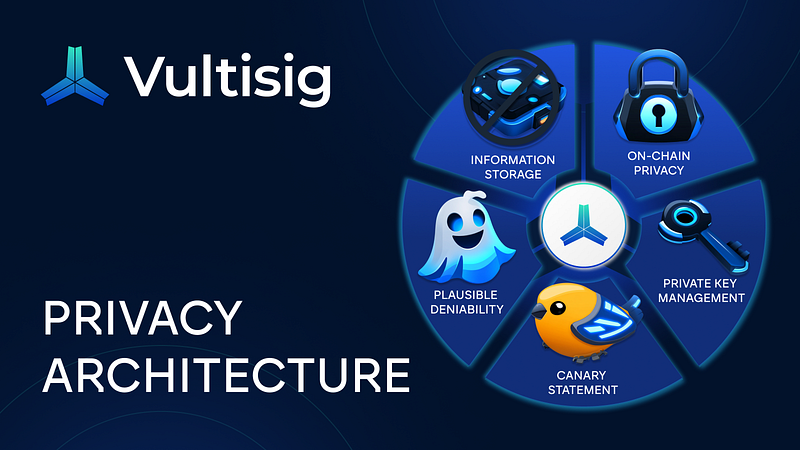
🔒 1. On-chain Privacy
Compared to a traditional multisig design, Vultisig’s TSS holds a number of privacy advantages:
- Non-differentiated: An on-chain Vultisig address is indistinguishable from any other Externally Owned Address (EOA). Whether any specific address is using Vultisig or not, this information remains unknown and undetectable.
- Non-detectable: Traditional Multisigs have a different signature footprint and use higher gas amounts for transactions, which are easily detectable compared to Vultisig’s one, low-fee transaction; in essence, using TSS makes every transaction appear as mundane as can be.
- Why It Matters: By removing identifiable patterns, you stay off the radar of data trackers, front-runners, or any prying eyes attempting to piece together your trading behavior.
🔒 2. Private Key Management
Decentralized Key Management via Threshold Signature Schemes (TSS) is a huge step for decentralization. Here’s how it works:
- “Secure Vault” Shares: All shares are fully self-custodial. Vultisig does not hold any data at all.
- “Fast/Active Vault” Shares: Vultisig (by necessity of offering the VultiServer functionality), only holds a single Vault Share.
- Standard EOAs: Transactions appear on-chain as if they come from a standard externally owned account (EOA), leaving no unique footprints tied back to a single user.
- Why It Matters: This effectively eliminates a single point of failure and disguises any signatures that might otherwise give away your identity.
🔒 3. Information Storage
Vultisig’s stance is “No data, no leaks.” By design, the platform refuses to store any user information:
- No Personal Details: IP addresses, names, real-world locations — none of it is captured or retained.
- Why It Matters: With nothing on record, there’s simply nothing to hack, subpoena, or sell — a major advantage over wallets that keep user data on file.
🔒 4. Plausible Deniability
Deniability here means the ability to claim, truthfully, that you aren’t linked to a specific transaction or wallet. This is an oft-overlooked yet critical aspect of privacy.
- Absence of Proof: Vultisig’s design ensures no direct evidence can link you to any particular vault or transaction. Even though Vultisig’s in-app swap function (serviced by THORChain, Maya Protocol, 1inch, Li.Fi, etc) may use an affiliate tag, (e.g. v0, vi, va) linking the swapper to the on-chain transaction, plausible deniability remains: Anyone can craft transaction memos with the same affiliate tag, even if they are not using Vultisig.
- Even Vultisig Doesn’t Know: Because no central entity holds your complete key or personal data, there’s no trail to follow.
- Why It Matters: This is invaluable in situations where you need to protect your identity or avoid unwanted scrutiny, whether personal, legal, or political.
🔒 5. Canary Statement
On Vultisig’s privacy page, you’ll find a Canary Statement — a subtle indicator of whether the privacy policy has been altered: “In the event of any alterations to this privacy policy, the canary statement will be removed as an indication of such changes. By utilizing Vultisig, users acknowledge and agree to the terms outlined in this Privacy Policy. For any inquiries or concerns regarding privacy matters, please contact the developers in the Discord.”
- Transparency: If the canary disappears, users immediately know something about the privacy policy has changed.
- Community Accountability: This encourages open dialogue, ensuring Vultisig remains faithful to its privacy commitments.
- Why It Matters: This is a voluntary statement made by Vultisig, showcasing the level of transparency and integrity this project abides by and values at its baseline.
🔒 Why All of This Should Matter to You
These privacy-by-default features address real-world concerns for a variety of DeFi users:
- Traders: Execute swaps or market moves without telegraphing your strategies to competitors or front-runners.
- Institutions: Conduct large transactions or treasury operations with minimal on-chain footprint, reducing market manipulation risks.
- Everyone: Enjoy the freedom of DeFi without sacrificing your personal data, transaction history, or peace of mind.
By pulling at the root the common vulnerabilities of transaction visibility, key storage, and personal data collection, Vultisig stands out as a robust and truly private alternative in a landscape where privacy is often little more than an afterthought.
🔒 Call to Action: Secure Your Airdrop
Now that we’ve made sense of the mechanisms and advantages of Vultisig’s privacy-by-default design, it’s time to put them into practice. The $VULT airdrop is currently live, and you can start earning “vulties” (redeemable for $VULT) simply by downloading Vultisig and holding your assets in the wallet.
Important note: The airdrop requires users to register their wallet’s public vault key information, but all information will be purged at the end of the airdrop campaign.
Q: How?
A: For the airdrop to be able to scan and identify valid addresses, you must “register” your wallet by toggling on the chains you wish to enable for the airdrop (users can choose to omit certain blockchains, if desired). At the end of the airdrop campaign, all the users’ information — e.g., public vault key, asset quantity — will be deleted. This step, which confirms your airdrop eligibility without compromising your anonymity, is required.
One more time: Don’t forget to register your wallet for the $VULT airdrop!

Related articles
![How to Swap Crypto on THORChain thumbnail, a THORChain guide]()
Sep. 18, 2026
How to Swap Crypto on THORChain
- Guide
![THORChain Podcast protocol update cover]()
Sep. 17, 2026
THORChain Returns to Shipping: Zcash, Monero and Self-Sufficiency
- Podcast
![NanoGPT and THORChain branding together, representing NanoGPT's accountless AI model marketplace settling crypto payments through THORChain.]()
Sep. 16, 2026
Protocol Spotlight - NanoGPT
- Spotlight
![Thumbnail for THORChain's Investor Relations dashboard on DefiLlama, showing fees, revenue, and income statement charts.]()
Sep. 14, 2026
Introducing THORChain’s DefiLlama Investor Relations Dashboard
- Marketing
![Ecosystem Update Podcast with Station Wallet]()
Sep. 13, 2026
Terra’s Station Wallet Is Back as Vultisig’s Agentic THORChain Wallet
- Podcast
![THORChain Thumbnail for the 2026 guide comparing ten decentralized exchanges across cross-chain support, fees and MEV protection.]()
Sep. 10, 2026
The 10 Best Decentralized Exchanges (DEXs) in 2026
- Guide
![Protocol Update Podcast with Chad Barraford, Kenton and Patriot / Denny]()
Sep. 10, 2026
THORChain Prioritizes Stability Before Monero and New Features
- Podcast
![Thumbnail for THORChain guide explaining how the Advanced Swap Queue and slip-based fees prevent sandwich attacks on swaps.]()
Sep. 7, 2026
How THORChain’s Swap Queue Prevents Sandwich Attacks
- Guide
![Ecosystem Update Podcast with RAVN]()
Sep. 5, 2026
Inside RAVN’s Native $BTC Aggregator and Its THORChain Integration
- Podcast
![State of the Network August 2026 report thumbnail covering THORChain swap volume, fees, active wallets, bonds, Protocol Owned Liquidity, and the affiliate leaderboard.]()
Sep. 4, 2026
State of the Network - August 2026
- Report
![Protocol Update Podcast with Hans, Devel, Chad, Kenton & Denny]()
Sep. 3, 2026
THORChain Churns Again: POL Goes Live, Rujira Resumes and BLO Debate
- Podcast
![THORChain guide thumbnail explaining how to bond RUNE through direct whitelisting, RUNEBond and bRUNE liquid staking, with yield and risk comparisons for each method.]()
Sep. 2, 2026
How to Bond your Rune: a practical guide
- Guide
![THORChain Protocol Spotlight thumbnail for BazaarSwap covering cross-chain aggregation across 360 exchanges, native asset routing and THORChain's role as a core liquidity provider.]()
Aug. 31, 2026
Protocol Spotlight - BazaarSwap
- Spotlight
![Ecosystem Update Podcast with Rujira]()
Aug. 29, 2026
THORChain’s App Layer Rujira Is Paused. Rujira Wants a Clear Restart Path.
- Podcast
![Protocol Update Podcast with Chad Barraford, Kenton and Denny]()
Aug. 27, 2026
THORChain Puts Stability First: Monero & Zcash Delayed, ADR30, AI Agents and Memoless Swaps
- Podcast