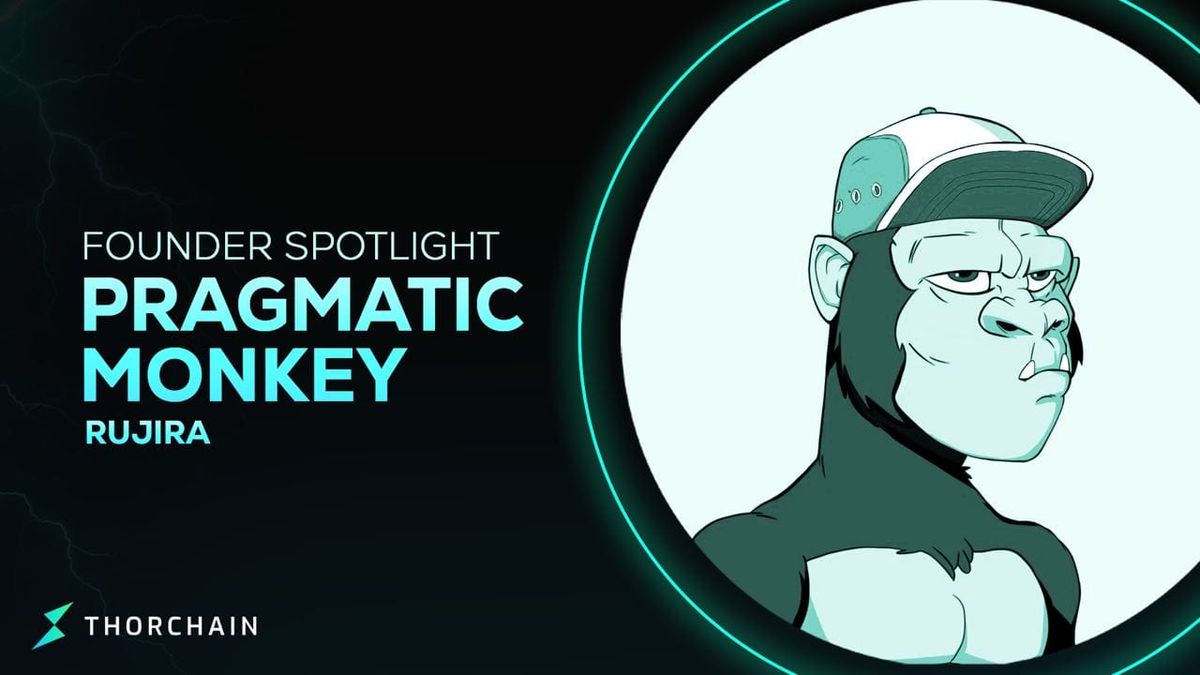
Founder Spotlight - Pragmatic Monkey
Your crypto origin story
You’ve been grinding nonstop on Rujira as THORChain’s flagship app layer. What’s your crypto origin story? How did you first get into crypto and THORChain? And what was the moment that made you decide to start building this DeFi suite?
I got into crypto in March 2016. At the time, I was still working in traditional finance, and my background is in finance. There were a lot of restrictions on what I could trade, and the whole process around traditional assets was frustrating.
I’d heard about Bitcoin before, but it didn’t fully click until I discovered Ethereum. That was the moment I got interested. I liked the idea, and I could trade it freely because nobody around me really cared about crypto back then. So I bought some ETH on Kraken.
For about a year, I didn’t do much. Then the 2017 bull run happened, and around the same time I started to really understand DeFi. The idea of smart contracts and open financial systems really resonated with me. What clicked was the realization that you could build transparent, decentralized software that removes intermediaries and distributes ownership much more broadly.
The real turning point came when I saw the first AMMs like Uniswap v1 and Curve. That completely blew my mind. I was working at a large bank in Canary Wharf, and I could literally compare what these protocols were doing to what entire trading floors were doing in traditional finance. Suddenly, functions that used to generate huge profits for banks could be opened up to anyone on-chain.
That was what really hooked me: the idea that DeFi could democratize access to financial activity and ownership, instead of concentrating it in the hands of a few institutions.
There was also an ideological side to it for me. I had become deeply disillusioned with the traditional financial system. I saw it as a system designed to benefit people who already own assets, while everyone else gets diluted through things like monetary debasement and restricted access to better opportunities. Crypto, for me, represented a chance to build something fairer, more transparent, and more open.
That’s what pulled me in. It was never mainly about money. It was about the possibility of creating a better financial system.
How did Kujira and then Rujira enter the picture?
I was active in DeFi from early on and followed a lot of the major innovations closely. Later, I became active in the Terra ecosystem because it had a lot of differentiated DeFi opportunities.
That’s where I discovered Kujira. Its first product, Orca, was a liquidation engine integrated into Anchor. I thought it was brilliant because it opened up liquidations to ordinary users instead of just MEV bots or insiders. That aligned strongly with my views on DeFi: opening access to financial opportunity and reducing concentration.
I liked the vision and the team, and I started following them closely. Then, on the same day Terra collapsed, Kujira launched its second product, FIN, which later became what is now Rujira Trade: a fully on-chain order book exchange.
After Terra, the team rebuilt as an independent Cosmos chain. Over time I became more and more involved in helping out. I really respected the technical ability and mission-driven mindset of the team, especially Codehans.
Later, after Kujira ran into issues tied to leverage on its own token and resulting bad debt, I was asked to join more directly. Part of my role was helping find a path forward and making sure protocol risk management became much stronger.
Then we met with GP, and that’s when the idea emerged of effectively moving from Kujira to Rujira on top of THORChain’s app layer.
What made THORChain the right foundation?
I knew about THORChain from a distance, but I hadn’t really studied it deeply. What had put me off initially was ThorFi and the reflexive design around RUNE. I thought some of those mechanics were risky.
But when I looked past that and focused on the underlying infrastructure, it became very obvious how powerful it was. THORChain was the only system that let you access native assets across multiple chains in a decentralized way, without bridges or centralized custodians.
That was the breakthrough. On Kujira, we were in Cosmos with very limited liquidity. If you wanted to use something like Bitcoin, you were usually dealing with wrapped Bitcoin, sometimes wrapped through multiple trust layers. It was messy and full of external risks.
THORChain removed those unnecessary assumptions. It gave us a way to build DeFi using native BTC, native XRP, native SOL, and other connected assets in one decentralized environment.
That was the big moment. We realized we finally had the infrastructure we’d been missing. We could take what Kujira had been trying to do and apply it at a much larger, more meaningful scale.
In a strange way, the bad debt crisis ended up creating the conditions for that pivot, and in hindsight it may have been one of the best things that could have happened.
What does your week actually look like as a founder?
I wear a lot of hats, probably more than anyone else on the team. I don’t code directly, I’m not a developer, but I’m deeply involved in protocol design and mechanics. I review and understand everything we build.
A big part of my role is thinking through how the protocol should work: parameters, risk management, interest rate curves, borrow caps, liquidity support, collateral capacity, all of that. I’m also the main person testing products, coordinating testers, reviewing feedback, and turning that into tickets and priorities.
I help define the roadmap and decide what gets built next. We use Linear internally, and there are hundreds of tickets, so prioritization is a major part of the job.
I’m also very involved in analytics: deciding what should be measured, how it should be measured, how it should be presented, and making sure the numbers are correct.
Beyond that, I handle bug bounty reviews, partnerships, ecosystem coordination, tokenomics ideas, referral systems, and user issues when things go wrong.
So the simplest answer is: a bit of everything.
What THORChain feature or philosophy still impresses you most?
The biggest one is secured assets: the ability to do DeFi with native assets from multiple chains without relying on centralized custodians or third-party bridges.
But what’s really exciting is the synergy between THORChain’s base layer and what we’re building on the app layer. Through our architecture, we can tap into base-layer liquidity, improve pricing, internalize arbitrage, and make capital much more efficient.
As we roll out more advanced liquidity strategies like custom and dynamic concentrated liquidity, we’ll be able to facilitate more volume with less capital, improve execution, and create a much more efficient system overall.
The long-term vision is that the app layer doesn’t just add features, it actually improves the performance of THORChain itself.
Where do you see Rujira and THORChain in 18 months?
First, we need to complete the core building blocks: efficient market-making, deeper credit systems, leverage, and advanced strategies.
Then it becomes about accessibility, analytics, and expanding to new user bases, especially chains that don’t have their own DeFi ecosystems.
The key driver is liquidity. In DeFi, your revenue is largely a function of your TVL and how efficiently you use it. So the goal is to build large, sticky, productive liquidity that continuously generates yield.
Everything else: volume, adoption, growth, follows from that.
What chain integration would you most like to see on THORChain?
Monero would be very interesting because of its privacy features and strong community.
But I’m also very excited about chains like Bittensor. Those ecosystems don’t have strong DeFi tooling yet, so we can bring real value by giving their communities access to advanced financial tools.
What Rujira feature are you most excited about?
Dynamic concentrated liquidity. It will make things easier for users, improve pricing, and generate more volume across the system. It’s a major step forward.
Any advice for builders
Right now, the opportunity isn’t really in building the core itself. We learned that scaling contributors too early can slow things down significantly.
The real opportunity is to build on top of the primitives we’re creating. If you can package these tools into useful products or strategies for users, that’s where the value is.
How will you incentivise adoption?
It starts with great products. People come to DeFi to make money, so we need to give them strong tools and opportunities.
Then we improve usability, provide strong analytics, and later introduce gamification systems like Ruji Leagues to reward real economic activity in a sustainable way.