Monero Merged, Reserve Burn, Marketing Update | Podcast #196
64M $RUNE burned, $XMR live on stagenet within days and a Treasury reallocation proposal that could finally put dead pool capital to work. THORSday Podcast #196 is a deep technical update from Chad and Kenton, plus a never-before-told Chris Hemsworth marketing story.

THORSday Community Podcast #196 ft. @CBarraford, @KentonC137 & @patriotsounds | May 7, 2026
By @Raynalytics
TL;DR
- $XMR chain client PR is merged into thornode. Stagenet activation is imminent and mainnet is targeted for late May or early June.
- v3.18 release cuts today, expected live next week. Bundles the dynamic fee model, system income POL, Bifrost readiness for $XMR / $TAO / Polkadot, and a limit-order range extension to 6 months or longer.
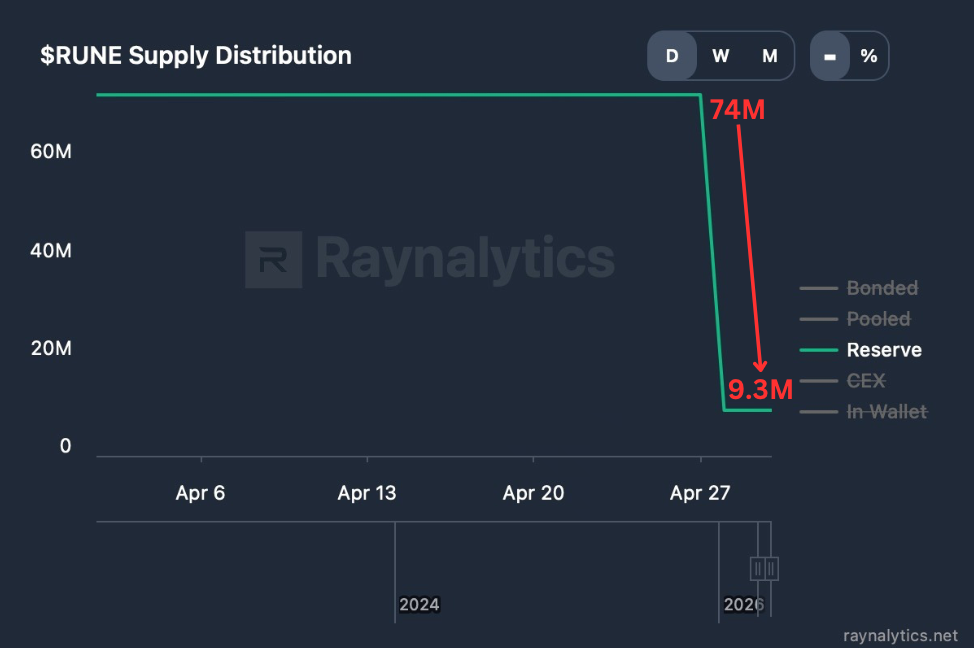
- 64M+ $RUNE burned from the reserve. Total supply now sits just over 360M, with the burn mechanism set to close the small remaining gap.
- @BooneW proposed reallocating dead Treasury liquidity from idle pools into higher-volume pools, and potentially seeding new ones. Chad backs the proposal pending review.
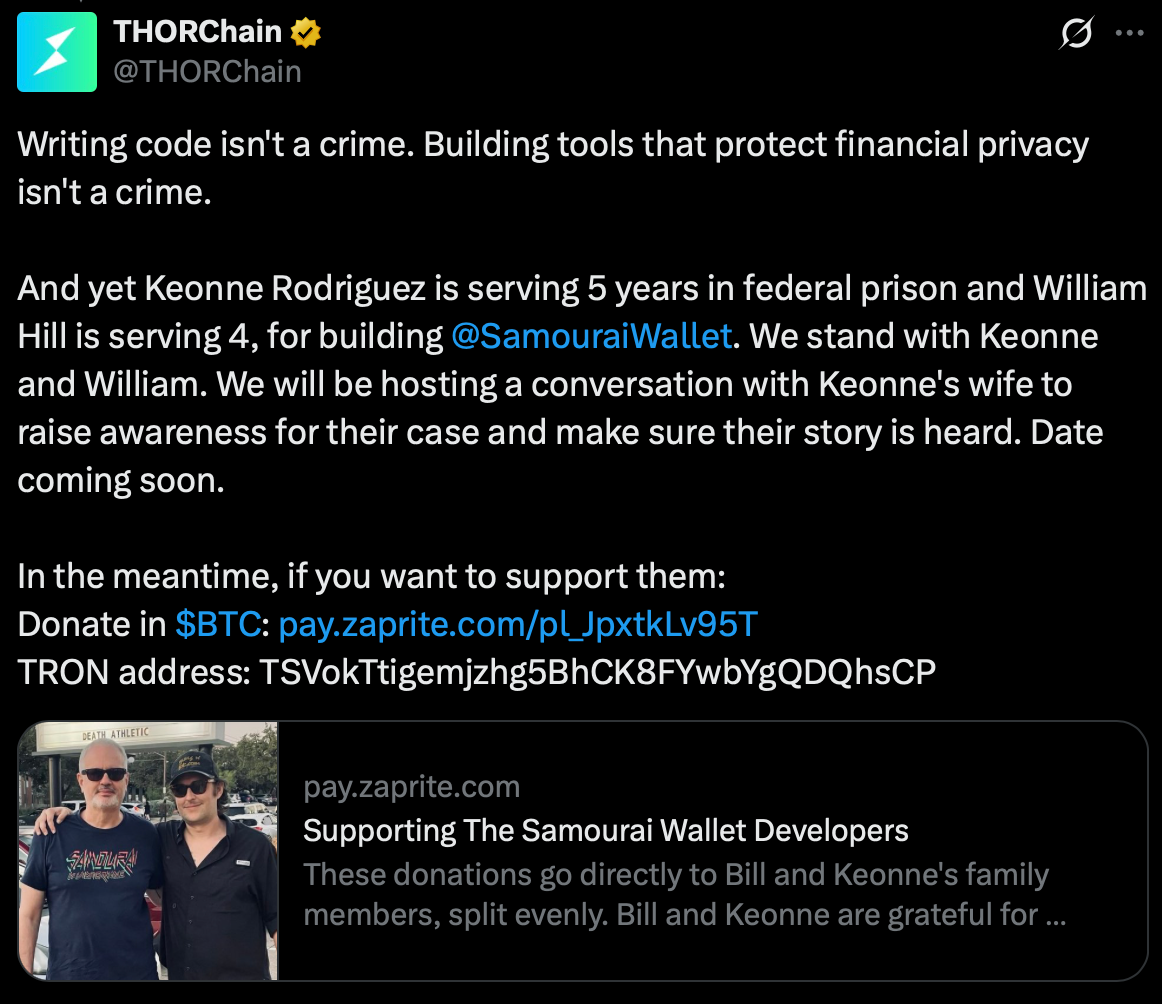
- THORChain is preparing to support Keonne Rodriguez and his co-defendant Bill's Samourai Wallet legal defense by directing the protocol's monthly Twitter ad credit toward the cause.
1. Monero is Merged into Thornode
@BooneW's $XMR chain client pull request has been merged into thornode after extensive review with Chad, @Zly_Dev, and the rest of the dev team. The next step is for the stagenet team to enable the Bifrost scanner. Once that happens and the next churn generates the Monero vault address, the Treasury can seed initial liquidity and the chain goes live for testing.
Stagenet is a real, decentralized environment using real layer-one assets, not a fake-token sandbox. Chad strongly cautioned anyone tempted to test there to keep amounts small. Pools will start around $1,000, the integration is unvalidated, and Chad expects pauses and patches as edge cases surface. Stagenet does not produce the kind of chaos that mainnet does, so the first weeks of mainnet will be the real stress test.
@cakewallet committed to launching $XMR support on day one (per Chad and Kenton's conversations with the Cake team at Bitcoin Vegas), and @EdgeWallet has signaled the same. Multiple other Monero-native wallets have already requested API access.
"I am a proud father." Chad on Boone's Monero merge.
2. v3.18 Release Cutting Now
v3.18 is being cut today and is expected live within a week. The release bundles a remarkable amount in one drop:
- All thornode-side Monero changes are already in. The Bifrost-side release can be cut as a v3.18.x patch at any moment, meaning $XMR mainnet does not need to wait for v3.19. Same path applies to $TAO and Polkadot.
- Dynamic fee model is merged. Initial rollout will flip it on for a single small affiliate to confirm behavior before broader adoption.
- System Income POL is in. Once nodes vote on the percentage, protocol revenue will start naturally rebalancing pools.
- Limit order expiry can finally be extended beyond 3 days, with 6 months to a year now feasible. Chad mentioned a multi-team competition is in flight to build a decentralized limit order frontend, and at least one team is planning to use THORChain primitives instead of building their own.
- A change unlocking zero-bps arbitrage routing for app-layer contracts. Combined with @RujiraNetwork's custom concentrated liquidity (going live within weeks), this should significantly tighten pool-vs-market pricing and improve rapid swap execution.
- A Tor migration around the Doge double-spend fix plus the $XUSK switch are also in.
- @Zcash integration is gated on the next churn, which v3.18 makes more resilient. Chad estimates 2-3 weeks to live $ZEC pools.
The app-layer ARB system is also worth flagging: half the captured arbitrage flows back to the protocol via system income, and half goes to LPs in the contract. Anyone, including individual community members, can provide liquidity to it.
3. 64M+ $RUNE Reserve Burn Complete
The reserve burn is done. Around 64M $RUNE has been removed from the @THORChain reserve. Total supply now sits just over 360M, slightly above the "just under 360M" target due to a small (~200k) rounding discrepancy that the burn mechanism will close on its own.
Kenton is also pushing data platforms (CoinGecko, CoinMarketCap, Token Terminal) to display max supply equal to total supply, since there are no block rewards and the figure is genuinely deflationary. CoinGecko already updated. CoinMarketCap is in progress, with @Liquify_ltd building dedicated API endpoints to feed them.
A small terminology shift: "circulating supply is deflationary" is not strictly accurate while the 9M $RUNE in the protocol-owned reserve still exists. The technically correct framing is that total supply is deflationary.
4. Boone's Treasury Liquidity Reallocation Proposal
Boone pitched a written proposal to reallocate Treasury liquidity from low-volume pools into higher-volume ones, and optionally to seed up to ~25 new pools targeting top-100 assets by market cap and volume. The premise is straightforward: a meaningful fraction of Treasury LP capital is sitting in pools doing nothing, when the same capital deployed against higher-volume tokens would generate yield, drive arbitrage activity, and feed the network's fee base.
Chad supports the direction with two qualifiers. First, withdrawals can only happen from non-locked pools, which Boone has already accounted for. Second, THORChain is asset-agnostic from the protocol's perspective; whether the Treasury actively LPs into memecoin-class assets like $PEPE is a separate Treasury-level decision from whether the protocol supports them.
Kenton flagged that, in practice, Treasury liquidity is partially in a protocol-owned module and partially in live multi-sig wallets, both of which need coordination (alongside a planned re-keying of Treasury wallets that's already pending). Once system income POL ramps up, the Treasury can progressively withdraw LP capital and let protocol-owned liquidity replace it.
"We have capital just sitting there not doing anything. Let's put it in a pool with a token that actually has volume." Kenton.
5. Token Terminal Listing & Industry Fee Normalization
Kenton has a quote in hand from @tokenterminal and is working with the Treasury and @AaluxxMyth on the @Maya_Protocol side to fund the listing.
A subtle but important shift comes with it. Token Terminal calculates fees and revenue using consistent rules across all protocols. Their definition of "revenue" only counts what flows directly to token holders, which means THORChain's reportable revenue will essentially be the 5% burn (the only piece going to all $RUNE holders). The remaining 95% (nodes, $TCY, dev fund, etc.) shows up under "fees" instead.
The upside: THORChain's reported fees will be higher than what's currently shown, because affiliate fees are folded into the same number. The result is an apples-to-apples comparison against Near Intents, which has been booking affiliate volume against its protocol number for some time. Per Kenton's projection, THORChain will rank top-10 by fees on Token Terminal at launch.
Token Terminal is also plumbed into Bloomberg, CoinGecko's financials tab, and an in-progress data deal with Anthropic for Claude. The audience is institutional analysts and Bloomberg terminal users, which makes the methodology shift worth aligning around.
6. STO UX: Combining Slippage and Price Impact
Kenton recently watched a user on STO place a swap with 1% slippage tolerance and lose 20%+ of their trade because price impact (a separate metric) was already 20% before slippage applied. Technically, every number was disclosed correctly. Practically, the UX failed.
Kenton's plan is to combine the two settings: if a user sets 1% as their tolerance, that 1% becomes a hard cap on total deviation from the starting price, regardless of whether the cost comes from price impact or slippage. He is also planning a "did you do a test transaction first?" warning on Mémoist, since the most common loss mode there is misconfigured wallets that a $1 test trade would have caught.
"If you try to make something idiot proof, the universe will just create a bigger idiot." Chad's old co-worker, quoted by Chad.
7. Stables-to-Stables Experiment & The Path Forward
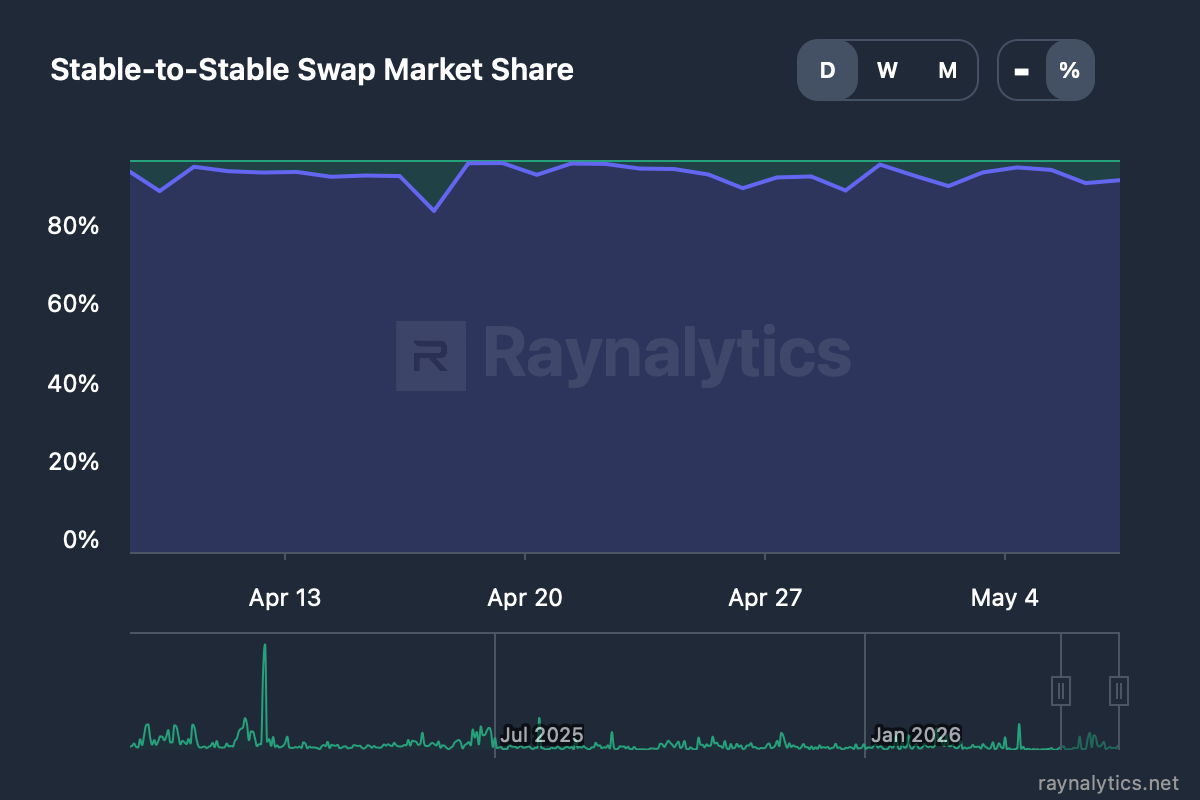
The 2-bps stables-to-stables tier hasn't moved the needle. ChainFlip already runs at ~1 bps and Near runs at 0.1 bps. THORChain charging 2 bps per pool side (4 bps on a double swap) is uncompetitive in that specific narrow lane.
Three paths forward came up:
- Dynamic fee model will likely drop the rate further on its own once it goes live broadly.
- An orbital-style stable pool (a single pool with USDC, USDT, and others on multiple chains, no $RUNE counter-asset) could deliver true single-hop stable-to-stable swaps at sub-1 bps cost. Chad is interested in researching this further. An earlier industry attempt at orbital-pool math did not ship a working implementation, so this is more research direction than spec.
- A SwapKit revshare deal. Chad has a meeting with the SwapKit team to explore a structure where THORChain pays SwapKit a share of fees to capture more of their stable-to-stable volume that currently routes through Near.
Direct wallet integrations (e.g. with @TrustWallet) are the other lever. Cutting out a SwapKit middle-layer fee makes THORChain's own quote naturally more competitive.
8. Huginn Phase 2: Real-Time Mainnet Triage
Chad's Huginn agent is moving toward a much more ambitious next phase. The plan: a binary that monitors live mainnet for unusual events, pings a Discord channel, and then has Huginn automatically pull logs, run analysis using its MCP toolchain, and post a triage thread including findings.
In the most ambitious version, Huginn will not just diagnose, it will draft a pull request to fix what it found. By the time Chad sits down at his keyboard for an incident, the issue is already triaged, documented, and (sometimes) fixed-in-PR awaiting human review. The community benefit is just as significant: nodes can see in real time when something is off and consider responses like a make-pause on a specific chain before any human dev has logged in.
Chad noted this is back-burner relative to getting Monero merged and shipped, but it is the next big Huginn milestone.
9. Marketing Update: Coinbase Lessons & The Hemsworth Story
A meaningful chunk of the episode was on marketing strategy. The shorthand:
Coinbase's ads are the bar. Their best work taps into a real cultural pain point (the financial system isn't working for young Americans) and offers Bitcoin and DeFi as the answer. Chad wants THORChain's commercials to do the same thing one layer down: target the CEX-using crypto audience, surface every pain point of centralized exchanges (KYC breaches, frozen accounts, kidnappings, scams, frauds, high fees), and walk them step-by-step through a Mémoist trade on screen.
The marketing has to be edgy. Both Kenton and Chad were explicit. Mark Mason (@MarkMoneyMason) told Kenton at Bitcoin Vegas that effective marketing is not politically correct, it has to grab attention. Pain resonance and biological imperatives move people. Politeness does not.
Stretch goals. Kenton wants a hockey arena. Chad wants a Super Bowl spot. Both consider it inevitable as the marketing fund grows.
And then Chad shared a story he had never told publicly. A few years back, a friend connected him to director Joe Russo(Avengers: Endgame, Captain America: Civil War, Avengers: Infinity War). Russo runs a marketing firm called Superconductor that uses Marvel actors for major ad campaigns (Benedict Cumberbatch for Tide is one example). They started discussing scripts and concepts to hire Chris Hemsworth as a THORChain spokesperson. Hemsworth (who plays Thor) anchoring a brand called THORChain is, as concepts go, very on-brand.
The Treasury at the time wouldn't fund the multi-million-dollar production cost. Chad later tried to revive it via community fundraising during his step-back from the protocol, but by that point the post-FTX, post-Terra Luna environment had every celebrity steering away from crypto. Chris passed.
The takeaway: it would have been incredible. And it remains on the table for future cycles.
"If a blockchain hall of fame ever exists, THORChain has to be in it." Chad.
10. Samourai Wallet Legal Defense Initiative
Kenton met @KeonneRodriguez's wife at Bitcoin Vegas, and the conversation kicked off a THORChain-led initiative to support Keonne and his co-defendant Bill's Samourai Wallet legal defense. Per Kenton, the combined fines and legal fees run into the millions of dollars.
The plan:
- Use THORChain's $400/month Twitter ad credit (which Twitter policy blocks from promoting the swap interface itself) to instead promote the Samourai legal defense raise.
- Get Keonne's wife on the podcast for a full breakdown of the case.
- Cross-promote @naomibrockwell's recent video on the case, which goes deep on the timeline and includes a direct interview with Keonne.
Per Kenton, the DOJ withheld FinCEN findings (FinCEN explicitly disagreed with the DOJ's framing) from the defense and only disclosed them after specific request. He called the pattern "sketchball" and noted the situation contradicts US Attorney General Todd Blanche's stated position at Bitcoin Vegas that the DOJ is not targeting coders.
This will be an ongoing topic for THORChain over the coming months and possibly years.
"These guys stand for everything THORChain stands for, and everything crypto in general stands for. The least we can do is help them raise awareness." Kenton.
11. Shoutout: Ursa9R
Denny gave an extended thank-you to Ursa, formerly of Nine Realms, who is no longer obligated to contribute to THORChain but continues to help with mainnet issues including a couple this past week. Chad seconded it and joked he would resort to dog kidnapping to keep Ursa around.
Also worth noting from the same arc: @RunemirQi's tweet about coming back from a year offline, rejoining 30 different crypto Discords, and finding all of them ghost towns except THORChain's. Chad called it a strong indicator of product-market fit.
12. Takeaways / What to Watch
- $XMR mainnet target: late May / early June. Stagenet activation expected within days of v3.18 going live.
- v3.18 release cutting today, live next week. Dynamic fee model, system income POL, Bifrost readiness for $XMR / $TAO / Polkadot, and the limit-order range extension to 6 months are all in this drop.
- $ZEC integration: 2-3 weeks post-v3.18, gated on the next successful churn.
- Dash integration code merged and waiting on the v3.19 cycle. @TheDesertLynx joins the show on Saturday.
- Treasury reallocation review in progress. Watch for an ADR if the proposal goes the protocol-side route.
- Token Terminal listing funding pending. Once live, expect THORChain to rank top-10 by fees on the platform.
- Huginn Phase 2 in development. Real-time mainnet triage and auto-PRs are the long-term roadmap.
- Active votes for nodes: the $TOR anchor swap, the $XUSK switch, and ADR26 (dynamic fee model). Bond providers should chase down their node operators in the THORnode mainnet channel.
"Don't wrap your $BTC." Denny.
More @THORChain data, check out Raynalytics
Follow @Raynalytics for more Weekly Analytics and Podcast recaps.
Full replay on YouTube.