State of the Network - February 2026
Welcome to the February edition. This month, we track security, liquidity, volume, fees, user activity, and supply across THORChain.
February delivered mixed signals. Volume tracked toward $882M through month end, down from January's $1.07B, following the broader consolidation in the market. But February also brought meaningful developments for THORChain: Solana integration finally arrived with progressive rollout, limit orders launched, and TCY buyback resumed.
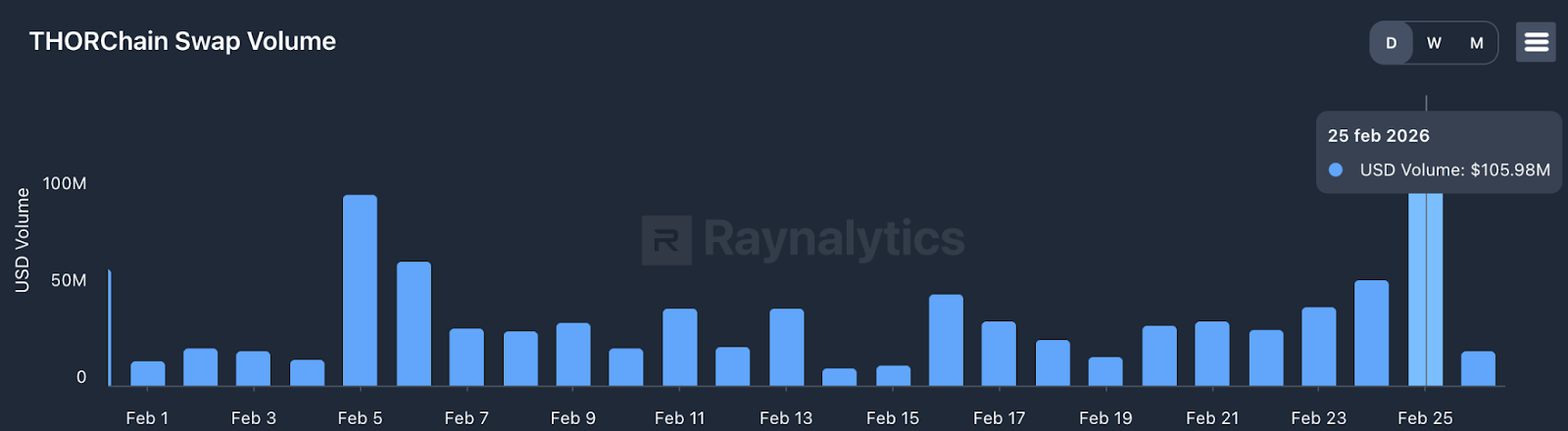
This month, two days broke through $100M in volume: February 5th hit $100M and February 25th reached $106M, proving infrastructure capacity remains ready when demand suddenly appears. Between those spikes, activity stayed muted as broader crypto markets traded sideways.
Volume and Fees
Large swaps
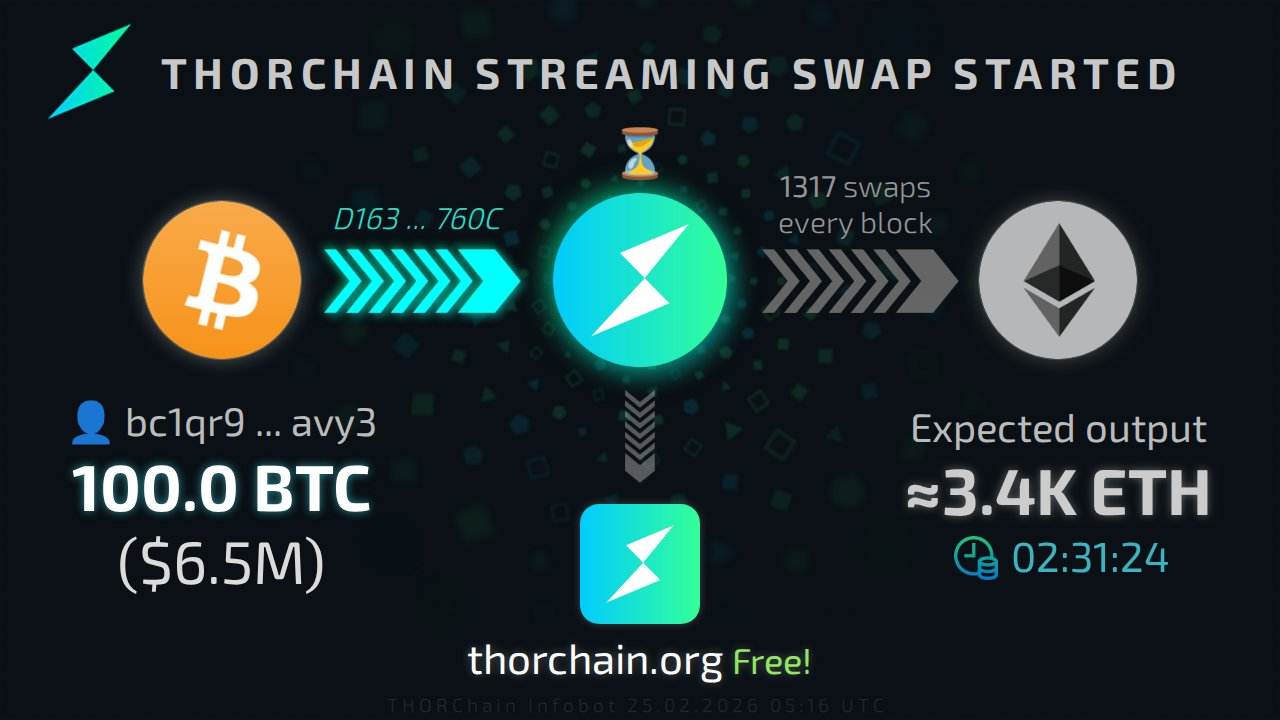
February saw significant concentrated activity through thorchain.org's native interface, with particularly notable swaps of 50, 88, and 100 BTC all converting to ETH and landing at the same Ethereum address.The 100 BTC transaction alone represented $6.5M. Routing through thorchain.org rather than affiliate interfaces means zero affiliate fees. Every basis point flows directly to the protocol: node operators, liquidity providers, TCY holders, burns, and treasury.
When you're moving millions, fee optimization matters. Some users clearly understand this. Affiliates provide value through user experience and wallet integration, but they're optional. Anyone can interact with the infrastructure directly and save on costs.
General volume
February delivered more balanced activity than January's volatility. Daily volume stayed remarkably consistent in the $20 to 40M range throughout most of the month, with only two days breaking above the $100M threshold: February 5th hit $100M and February 25th reached $106M.
Swap Paths
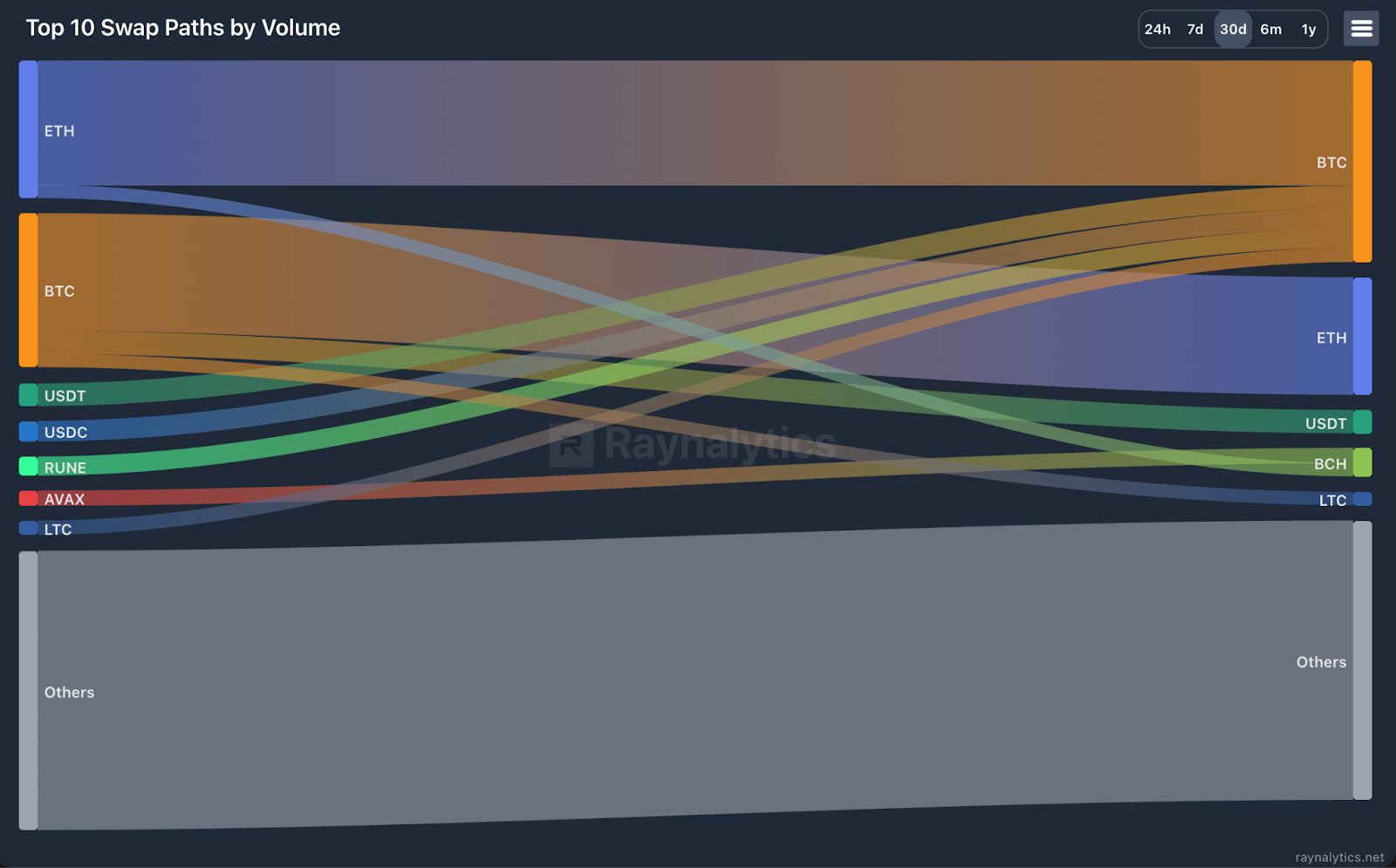
BTC to ETH and ETH to BTC continue dominating swap paths, representing the overwhelming majority of volume. Stablecoins USDC and USDT appear frequently in the top routes, primarily as intermediary assets or exit points during volatile periods. BCH and WBTC make appearances but remain marginal compared to the core BTC/ETH flows.We might see a shift soon though as Solana pools deepen and more interfaces integrate SOL.
Fees collected
February generated just over $1M in total system income, matching January's revenue despite lower overall volume. Fee generation stayed remarkably consistent throughout the month, typically ranging between $20K to $50K daily with three notable spikes.
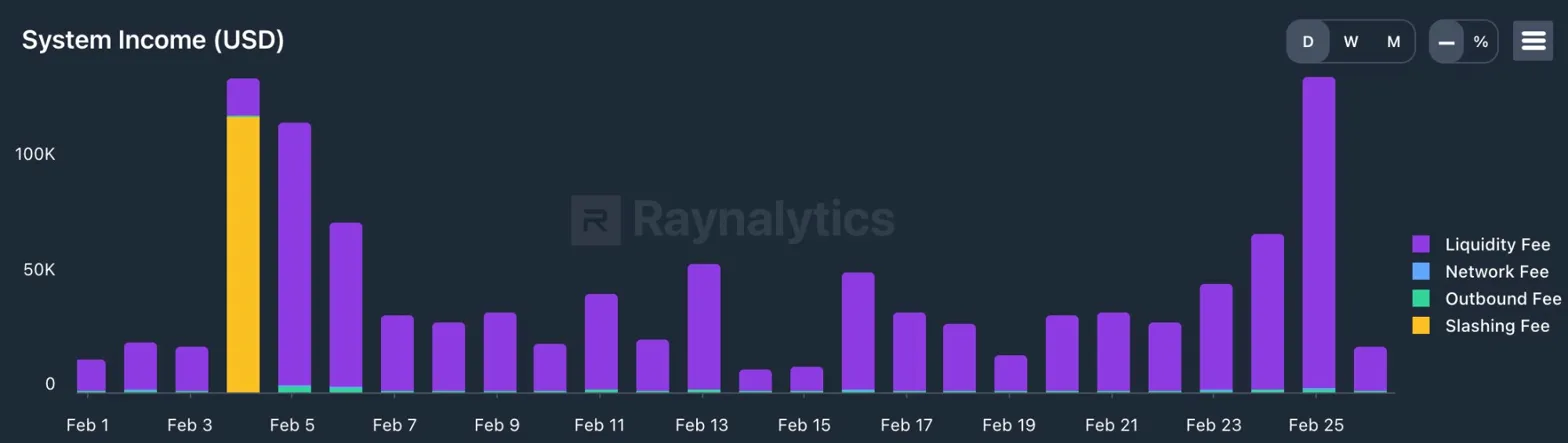
$1M monthly in protocol revenue remains solid, especially during crypto's prolonged sideways action. Let’s not forget that most DeFi protocols don't generate revenue at all but THORChain keeps delivering it month after month regardless of market conditions.
TCY and RUNE Yield
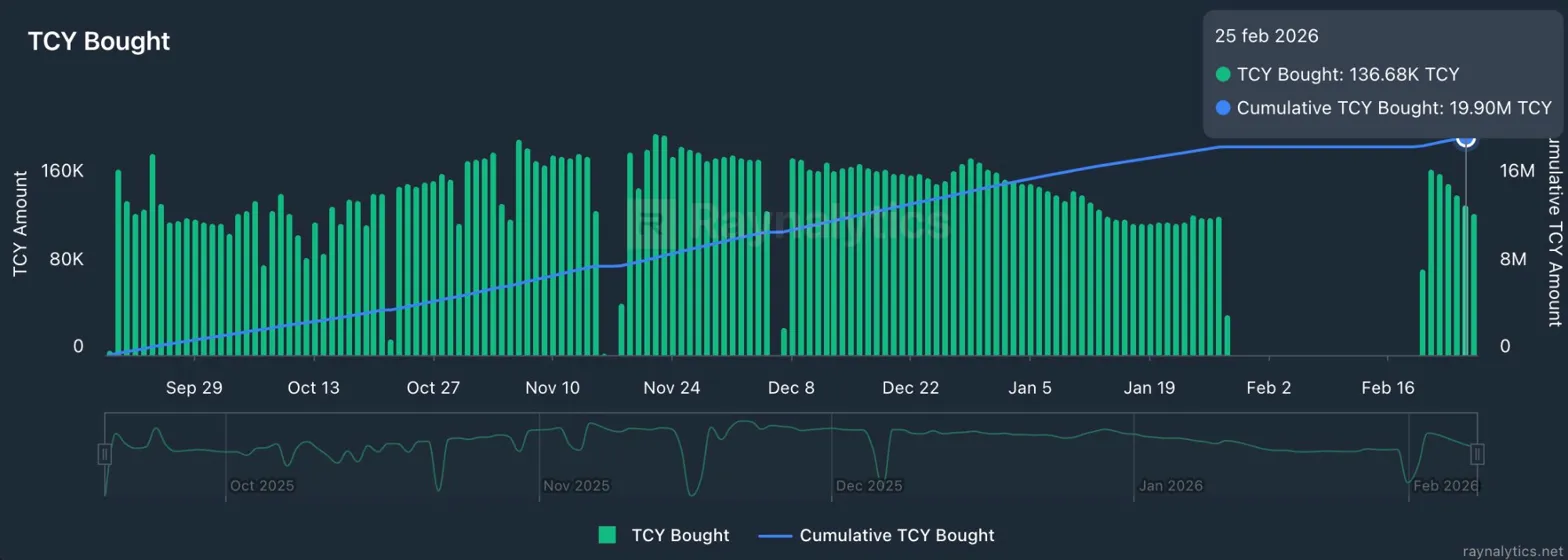
February marked the resumption of TCY buyback operations. The protocol began with daily buybacks ranging from 80K to 160K TCY. Cumulative purchases reached 19.90M TCY by February 25th.
The buyback works through the $5M Treasury Buy Program. This mechanism serves dual purposes: supporting price stability while reducing circulating supply. With 210M total TCY supply and approximately 176M circulating, each buyback incrementally shifts tokens from public circulation to protocol reserves.
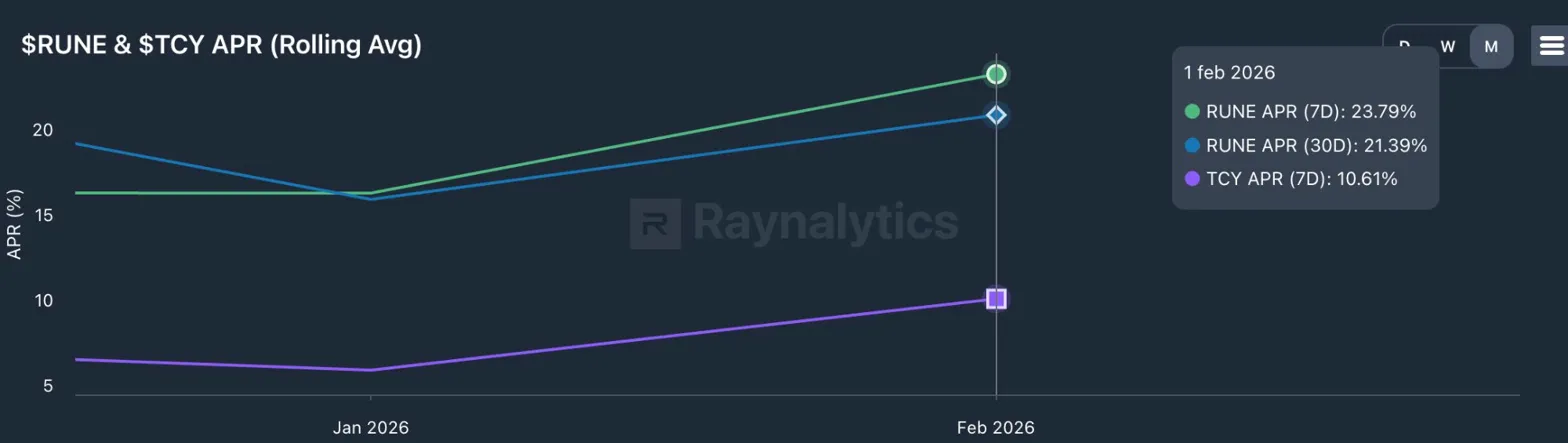
Yields moved in the right direction throughout February. RUNE APR climbed from roughly 16% at the start of January to 21.39% by month's end on a 30-day rolling average, with the 7-day rate hitting 23.79% as February closed. TCY followed a similar trajectory, rising from around 6% to 10.61% on the 7-day metric. February proved that even quiet months can deliver improving returns when protocol mechanics function properly.
Retention and User Acquisition
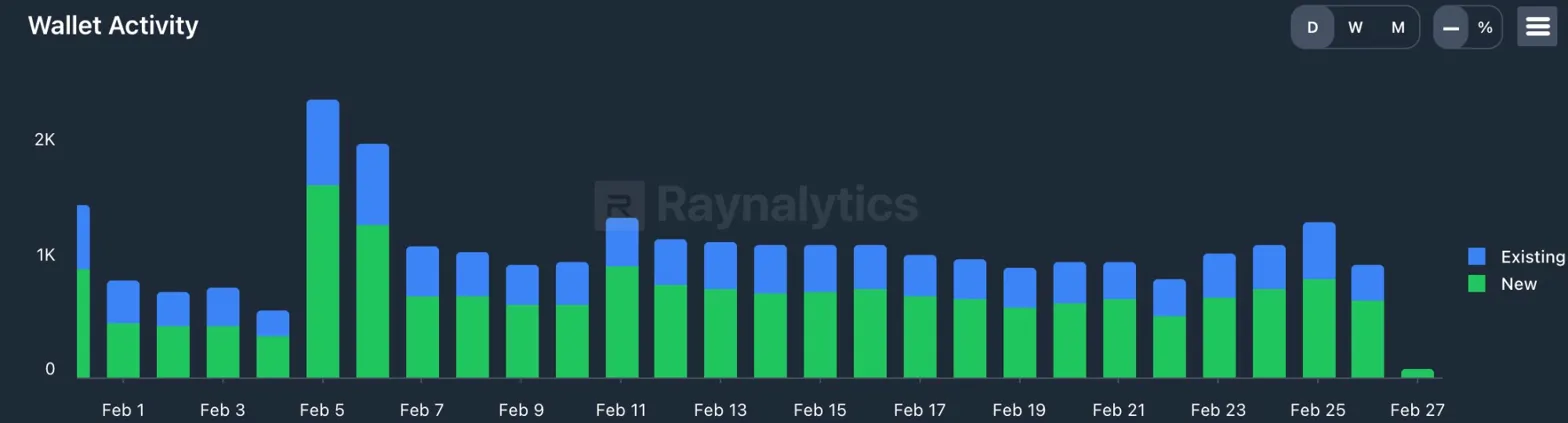
February brought 19.2K new wallets to THORChain while maintaining solid returning user activity throughout the month. The chart shows a healthy mix of blue (existing users) and green (new wallets) across most days, demonstrating that both acquisition and retention continued functioning despite quiet markets.
Security and Supply
Bonds
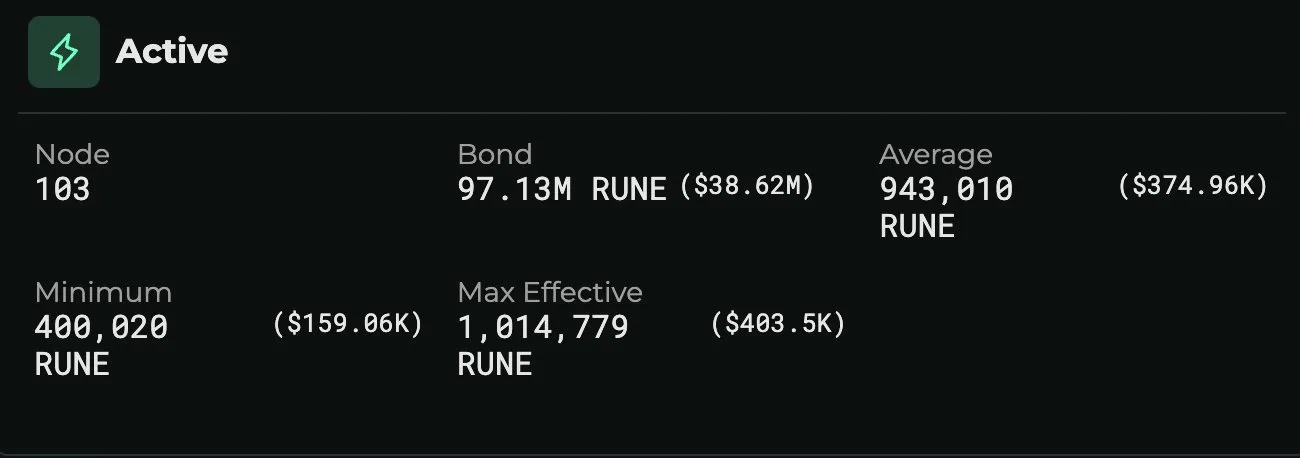
Node count held stable at 103 throughout February, maintaining the same level as January's close. Total bonded capital dropped slightly to 97.13M RUNE valued at $38.62M, down from January's $53.29M. This decline reflects RUNE's price compression during the month rather than nodes unbonding capital or operators exiting.
The average bond per node sits at $374.96K, down from January's $517K purely due to price movement. Node operators maintained their RUNE positions through the downturn, keeping capital locked and securing the network despite reduced yields in the first half of February.
The minimum bond requirement sits at 400,020 RUNE ($159.06K), while the maximum effective cap reached 1,014,779 RUNE ($403.5K). With 103 active nodes against maximum capacity of 120, the network operates with room for expansion when conditions improve and additional operators decide participation makes economic sense.
If you're holding RUNE and wondering what to do with it, bonding to a node remains one of the most direct ways to earn protocol revenue and participate in the growth of the network. By bonding, you're securing infrastructure that processes real cross-chain swaps, and you earn a proportional share of the fees those swaps generate.
February introduced bRUNE, THORChain's liquid staking derivative that trades queue times for instant liquidity. Unlike typical LSDs where you wait days to unbond, bRUNE offers immediate exits through market pricing. The mechanism splits deposits 90% to bonded nodes earning yield and 10% to a liquid buffer for withdrawals. You accept slippage for instant access instead of guaranteed 1:1 redemption after waiting periods. For RUNE holders wanting yield participation with flexibility, bRUNE provides that option.
Supply
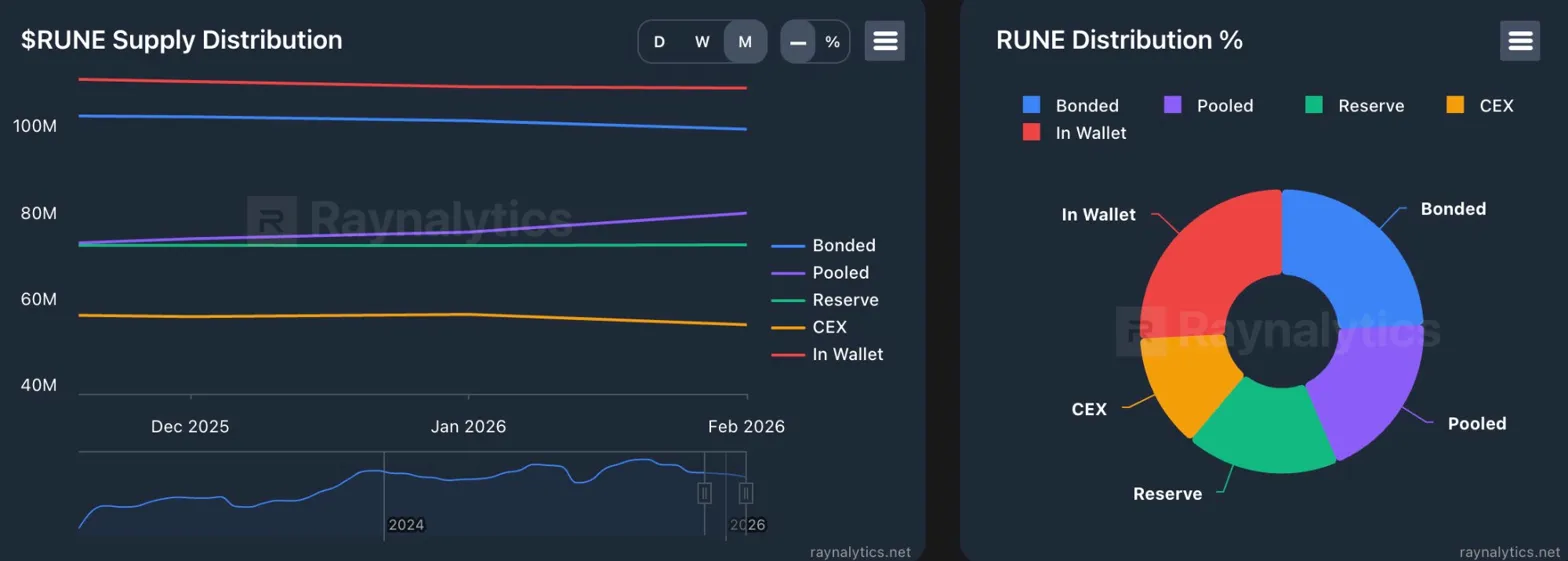
Supply distribution remained structurally healthy throughout February. Bonded RUNE held around 97M, pooled liquidity approximately 80M, reserve near 72M, and CEX balances roughly 54M. Nearly half the circulating supply actively secures the network or provides cross-chain liquidity, while less than 13% sits on exchanges. The slow migration away from CEX into productive protocol usage continued, demonstrating participant conviction even through quiet market conditions.
Burn
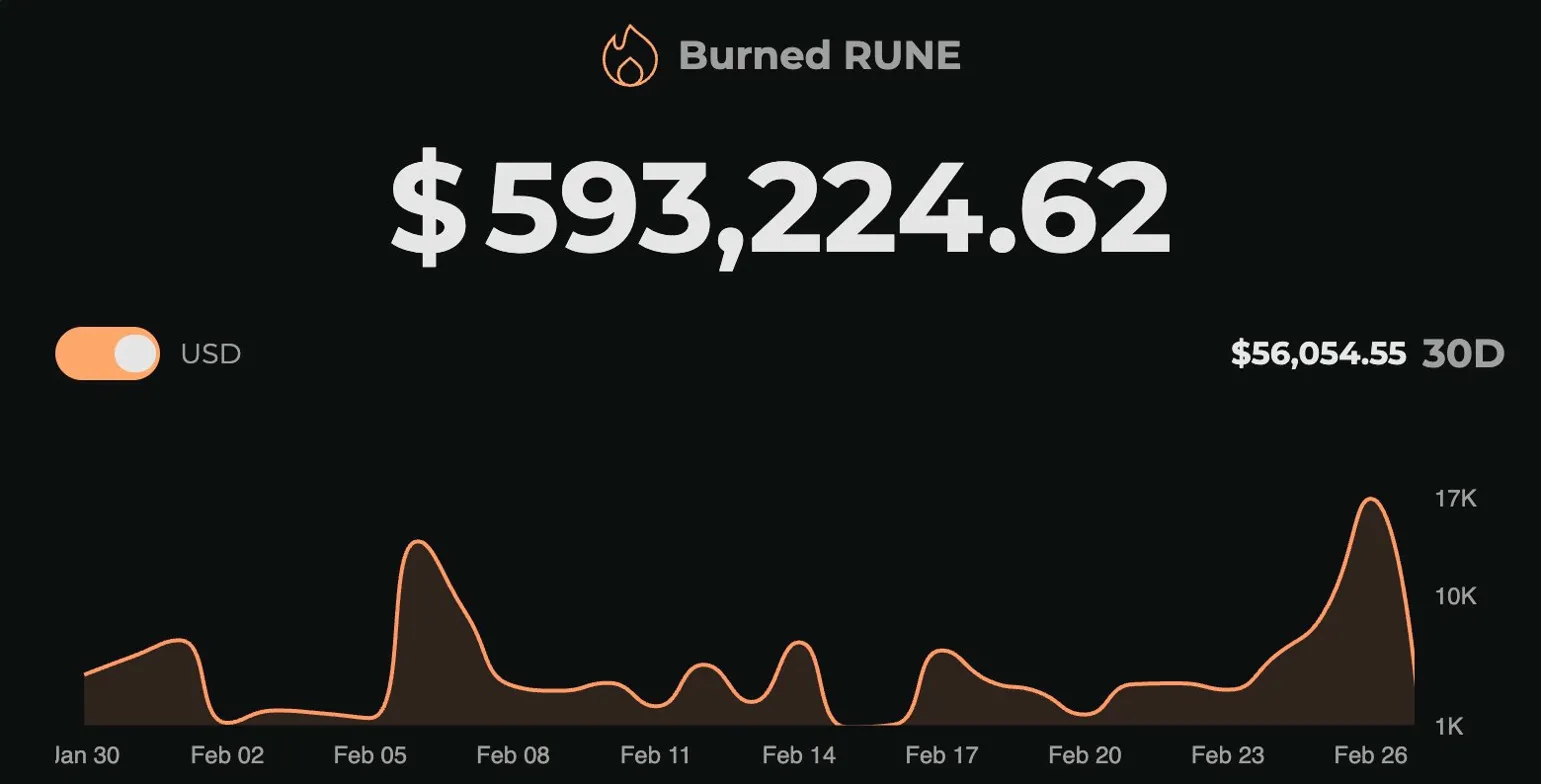
February burned $56K in RUNE, up from January's $48K despite lower overall volume. The chart shows two clear spikes: February 5th and February 25th, both coinciding with the $100M volume days. Daily burns otherwise held steady between $1K to $3K, reflecting baseline fee generation. The mechanism continues operating automatically, removing 5% of system income from circulation regardless of market conditions.
Frontends
Leaderboard by Fees
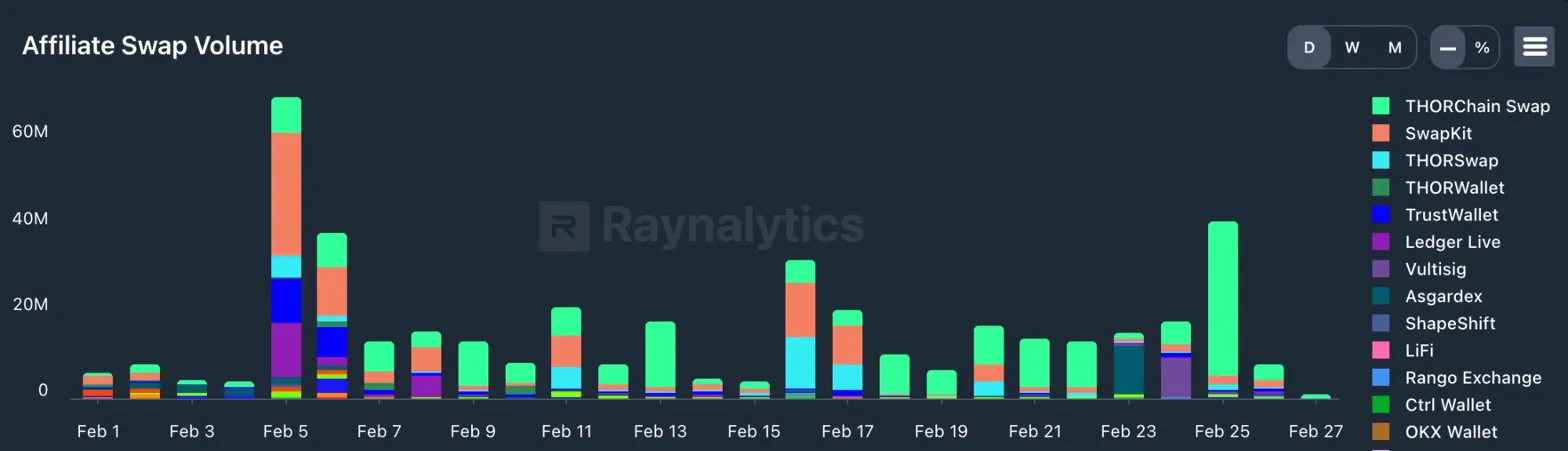
February's affiliate distribution shows interesting patterns. THORChain Swap (green, the native frontend) dominated on the three highest volume days: February 5th, 6th, and 25th. SwapKit (coral) maintained consistent presence throughout the month, processing steady baseline volume. TrustWallet (blue) appeared regularly but less prominently than in previous months.
The native frontend's spikes demonstrate sophisticated users optimizing for fee efficiency during large transactions. When moving significant capital, saving 10 to 15 basis points in affiliate fees matters. Those three green dominated days represent millions in volume choosing the direct route.
Key Takeaways
February closed as a building month. Volume compressed to $882M from January's $1.07B, but the protocol kept shipping: Solana integration launched, limit orders went live, and TCY buyback resumed. Despite reduced activity, the network generated over $1M in revenue and improved yields, with RUNE APR reaching 21.39% and TCY hitting 10.61% by month's end.
User acquisition continued with 19.2K new wallets while retention held steady. Node operators maintained 103 validators with $38.62M bonded through price compression. The native frontend dominated high volume days as sophisticated users optimized for fee efficiency, validating the permissionless model where both casual and power users find their optimal path.
The protocol proved it can maintain operations, generate meaningful revenue, and ship features regardless of trading conditions. When volume returns, the foundation is stronger.
If there are specific metrics or themes you want included in future editions, drop your requests in the comments. We'll add the most relevant ones next month.
Data Sources: RuneTools, THORCharts, THORChain Explorer, Raynalitics, Dune
– – – – – – – – – – – – – – –
Swap now 👉 swap.thorchain.org
Official website 👉 thorchain.org
🔽 Follow THORChain 🔽
X (Twitter) / LinkedIn / Reddit / TikTok / Instagram / Facebook / Blog
🔽 Join the community 🔽
Telegram / Discord / Discord (Developers)
– – – – – – – – – – – – – – – – –