Tokenisation is going to happen. In my view, it is not really a question of if. It is a question of how open the system will be, how much control governments and institutions will try to keep, and what kind of infrastructure ends up underneath it all.
The reason tokenisation is inevitable is pretty simple. Blockchain-based systems are faster, cheaper, more programmable, and more efficient than many of the legacy market structures we still use today. Traditional finance still operates within limited market hours and depends on layers of intermediaries, slow settlement, and unequal access.
Even now, firms that can place their infrastructure closest to the exchange still have an advantage. That may be accepted as normal, but it is not ideal. If stocks, bonds, credit, or commodities can move onto infrastructure that is always online and accessible through software, then that is naturally where the world is heading over time.
In this article, I want to lay out how I think this transition will unfold and paint a picture of the role THORChain could potentially play as tokenisation takes shape.
The State of Tokenisation and Where It Is Heading
If we look at which assets have been tokenised today and the scale of the market, we can already clearly see that the direction is upward. Despite broader market downturns, the size of RWAs onchain has continued to grow, with the total RWA market cap onchain already sitting at around $21.476 billion.
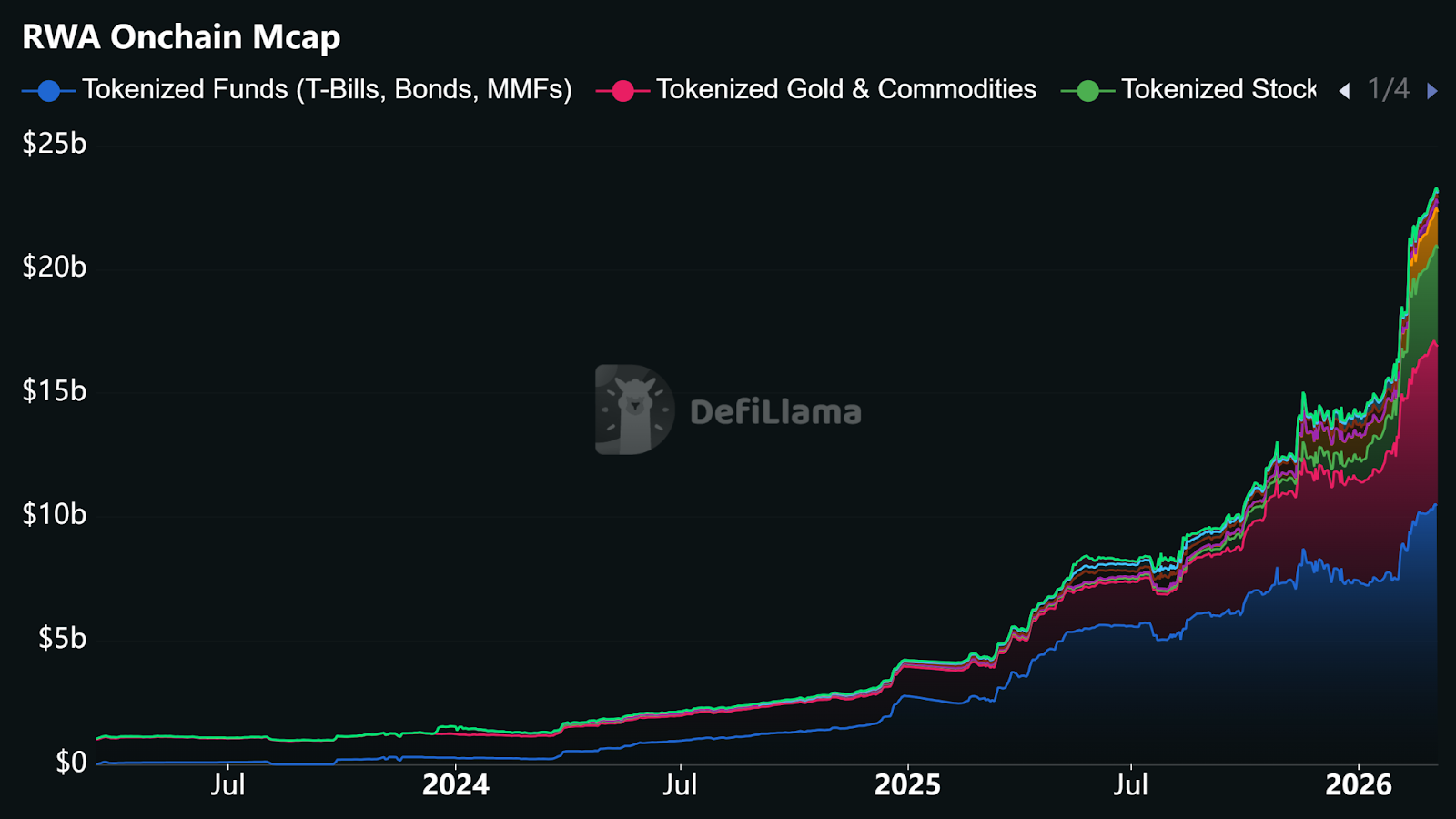
When we look at the types of assets that have moved onchain, three categories clearly dominate the market: tokenised funds, tokenised gold and commodities, and tokenised stocks and equities. That is, of course, if we exclude stablecoins, which still represent the largest category of real-world assets onchain.
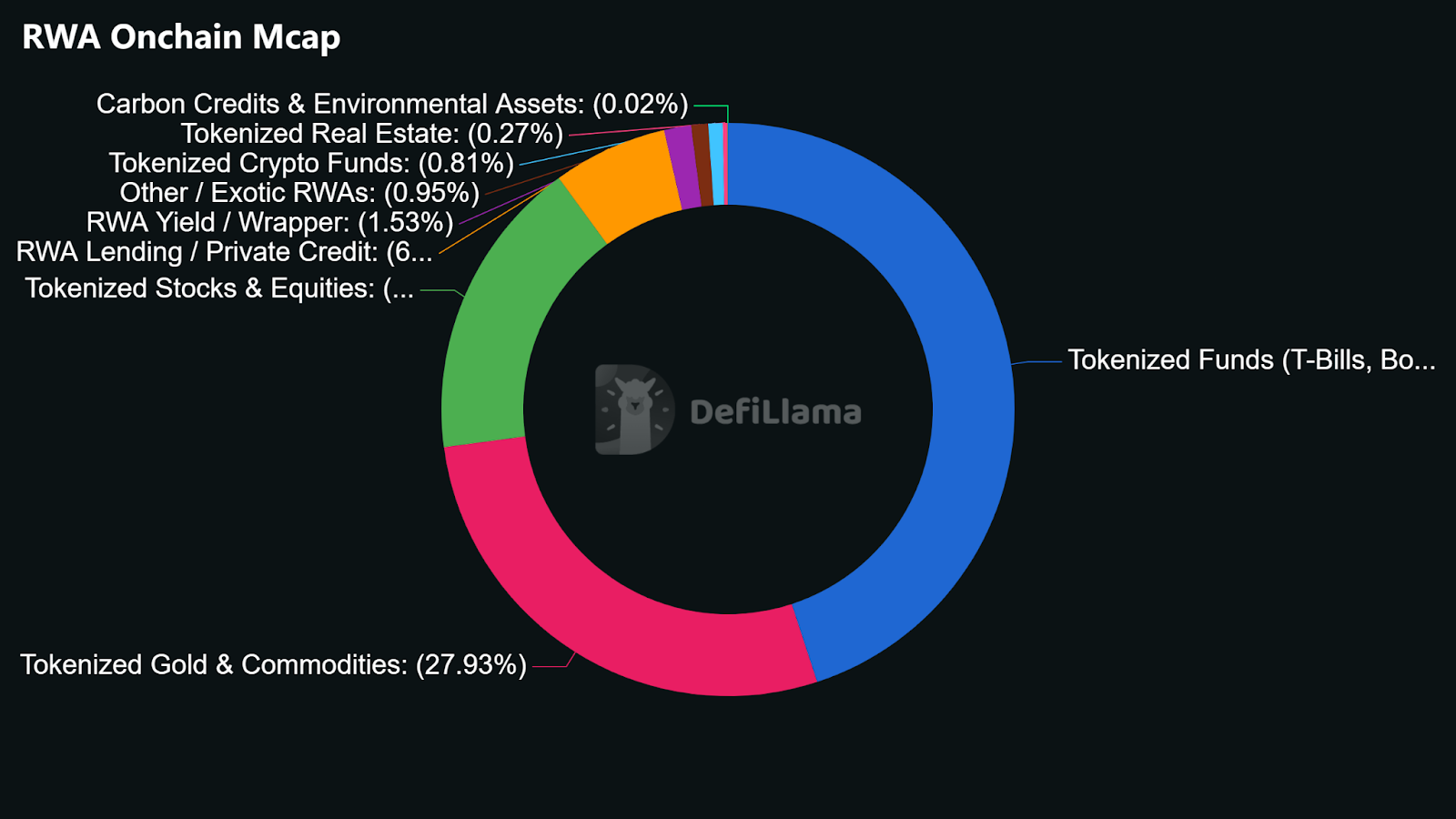
At the moment, the market remains relatively small compared to the scale of traditional finance. But the direction of travel is clear. As more institutions experiment with tokenised financial products and infrastructure continues to mature, the number of assets coming onchain will likely continue to expand.
I see tokenisation as both a win for traditional finance and a win for crypto. It is a win for traditional finance because it upgrades the rails. It is a win for crypto because it normalises blockchain technology for the wider world.
Once people get used to holding assets onchain, trading assets onchain, and transferring assets onchain, the mental barrier falls away. The public becomes more familiar, more comfortable, and more confident with blockchain systems in general.
What the Future of Tokenisation Could Look Like
Right now, tokenisation is still one large experiment. Issuers, institutions, and corporations are all trying to figure out the best way to approach it, whether that means launching permissioned systems or building on permissionless infrastructure. But over the long term, I think there are really two directions this can go.
One path is that governments or large institutions build heavily controlled systems. The other is that tokenised assets live on existing public blockchains that are already open and liquid.
If governments want total control, they may create entirely new blockchains or tightly permissioned environments for assets like stocks, bonds, and other real-world assets. In that kind of system, you may not be able to generate a wallet freely. Instead, you would likely need to go through some form of KYC just to gain access.
There could be restrictions on who is allowed to hold certain assets, who can trade them, and which jurisdictions are even permitted to participate. That version of tokenisation would still modernise financial infrastructure, but it would be very different from the open and permissionless vision that crypto was originally built around.
The other path is that institutions build on public infrastructure that already exists. If tokenised assets end up on chains like Base, Solana, or other open networks, then the opportunity becomes much larger. Once assets exist on interoperable public rails, they can interact with the broader crypto economy. They can be exchanged, routed, and priced against open assets in a much more fluid and efficient way.
To me, that is the bigger long-term story. As more assets come onchain, exchange infrastructure becomes increasingly important. The ability to move between assets is always one of the most valuable parts of any financial system.
The velocity of money matters, and so does the number of entry and exit points available. The healthier an asset ecosystem is, the easier it is for participants to move in and out of it. That principle applies whether the asset is Bitcoin, gold, oil, equities, or anything else. The more valuable an asset becomes, the more important the infrastructure is that allows people to exchange it freely.
What Tokenisation Could Mean for THORChain
With RWAs taking the crypto industry by storm and more institutions exploring tokenised assets, many people naturally start wondering how this could tie into THORChain. The short answer is that today the impact is still limited, but the long-term implications could be far more significant.
In the current moment, tokenisation does not benefit THORChain in a major direct way yet. The main reason is that we still do not know what kind of infrastructure institutions will ultimately use. If tokenised real-world assets end up living on closed, permissioned blockchains where wallets require approval and participation is tightly controlled, then THORChain will largely sit outside of that system.
A permissionless protocol cannot meaningfully integrate with an environment that does not allow open access in the first place.
However, if tokenised assets are issued on chains that THORChain can integrate with, then the opportunity changes completely. If stocks, bonds, commodities, or other RWAs reside on public chains, THORChain can serve as a conduit between those assets and the broader crypto space.
At that point, the conversation moves beyond simple crypto to crypto swaps. Instead, you start to see the possibility of moving directly between tokenised real-world assets and permissionless assets like Bitcoin. In practice, that could mean a world where something like Apple stock can be exchanged against Bitcoin in a decentralised, cross-chain, nearly instantaneous way.
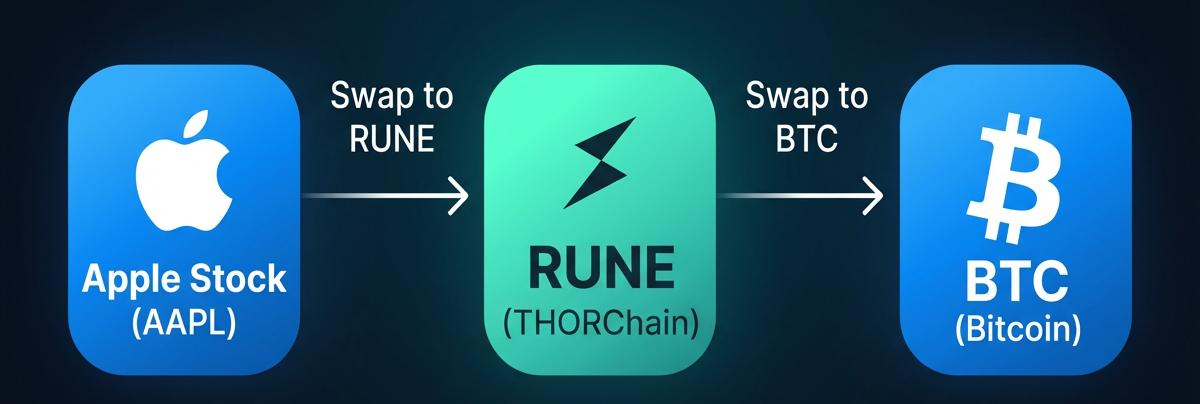
More broadly, as more assets come onchain, liquidity will naturally become more fragmented across chains and ecosystems. When that happens, the ability to move value between assets becomes more important. The more entry and exit points an asset has, the healthier the overall system becomes.
This is where THORChain fits naturally. Its entire purpose is to move value between blockchains in a decentralised way. If the world moves toward tokenised assets on public rails, then the need for neutral cross-chain liquidity infrastructure will only grow.
Conclusion
Tokenisation will likely take years to fully play out, but the direction is already clear. More assets are moving onchain, more institutions are experimenting with blockchain infrastructure, and the financial system is slowly becoming more digital and more interconnected.
As that happens, the number of assets and chains will continue to grow. And when markets fragment across different systems, the ability to move value between them becomes increasingly important.
That is where THORChain fits into the picture. It was built around the idea that assets should be able to move freely between blockchains without relying on centralised intermediaries. If more real-world assets eventually live on public rails, then the need for neutral cross-chain liquidity infrastructure naturally grows alongside them.
– – – – – – – – – – – – – – – – –
– Stay updated on THORChain –
– – – – – – – – – – – – – – – – –
Swap now 👉 swap.thorchain.org
Official website 👉 thorchain.org
🔽 Follow THORChain 🔽
X (Twitter) / LinkedIn / Reddit
TikTok / Instagram / Facebook / Blog
🔽 Join the community 🔽
Telegram / Discord / Discord (Developers)
– – – – – – – – – – – – – – – – –

Related articles
![How to Swap Crypto on THORChain thumbnail, a THORChain guide]()
Sep. 18, 2026
How to Swap Crypto on THORChain
- Guide
![THORChain Podcast protocol update cover]()
Sep. 17, 2026
THORChain Returns to Shipping: Zcash, Monero and Self-Sufficiency
- Podcast
![NanoGPT and THORChain branding together, representing NanoGPT's accountless AI model marketplace settling crypto payments through THORChain.]()
Sep. 16, 2026
Protocol Spotlight - NanoGPT
- Spotlight
![Thumbnail for THORChain's Investor Relations dashboard on DefiLlama, showing fees, revenue, and income statement charts.]()
Sep. 14, 2026
Introducing THORChain’s DefiLlama Investor Relations Dashboard
- Marketing
![Ecosystem Update Podcast with Station Wallet]()
Sep. 13, 2026
Terra’s Station Wallet Is Back as Vultisig’s Agentic THORChain Wallet
- Podcast
![THORChain Thumbnail for the 2026 guide comparing ten decentralized exchanges across cross-chain support, fees and MEV protection.]()
Sep. 10, 2026
The 10 Best Decentralized Exchanges (DEXs) in 2026
- Guide
![Protocol Update Podcast with Chad Barraford, Kenton and Patriot / Denny]()
Sep. 10, 2026
THORChain Prioritizes Stability Before Monero and New Features
- Podcast
![Thumbnail for THORChain guide explaining how the Advanced Swap Queue and slip-based fees prevent sandwich attacks on swaps.]()
Sep. 7, 2026
How THORChain’s Swap Queue Prevents Sandwich Attacks
- Guide
![Ecosystem Update Podcast with RAVN]()
Sep. 5, 2026
Inside RAVN’s Native $BTC Aggregator and Its THORChain Integration
- Podcast
![State of the Network August 2026 report thumbnail covering THORChain swap volume, fees, active wallets, bonds, Protocol Owned Liquidity, and the affiliate leaderboard.]()
Sep. 4, 2026
State of the Network - August 2026
- Report
![Protocol Update Podcast with Hans, Devel, Chad, Kenton & Denny]()
Sep. 3, 2026
THORChain Churns Again: POL Goes Live, Rujira Resumes and BLO Debate
- Podcast
![THORChain guide thumbnail explaining how to bond RUNE through direct whitelisting, RUNEBond and bRUNE liquid staking, with yield and risk comparisons for each method.]()
Sep. 2, 2026
How to Bond your Rune: a practical guide
- Guide
![THORChain Protocol Spotlight thumbnail for BazaarSwap covering cross-chain aggregation across 360 exchanges, native asset routing and THORChain's role as a core liquidity provider.]()
Aug. 31, 2026
Protocol Spotlight - BazaarSwap
- Spotlight
![Ecosystem Update Podcast with Rujira]()
Aug. 29, 2026
THORChain’s App Layer Rujira Is Paused. Rujira Wants a Clear Restart Path.
- Podcast
![Protocol Update Podcast with Chad Barraford, Kenton and Denny]()
Aug. 27, 2026
THORChain Puts Stability First: Monero & Zcash Delayed, ADR30, AI Agents and Memoless Swaps
- Podcast