Every swap on THORChain pays a minimum fee, a floor set in basis points beneath the standard slip fee. Until now, that floor was a single number applied network-wide, regardless of who was swapping or why.
That works fine as long as demand behaves the same way everywhere which is not the case. Indeed, some flow reaches THORChain because it's committed to the route, whether that's a wallet integration with no other routes or just a loyal user. However, other flow is aggregator-routed, comparing prices across venues on every single swap and leaving the moment THORChain costs even slightly more.
A fixed floor forces a choice between the two, and there's no good answer. Set it low and the protocol gives away revenue on the flow that would have stayed regardless. Set it high and the protocol pushes out exactly the price-sensitive flow that a lower fee could have won.
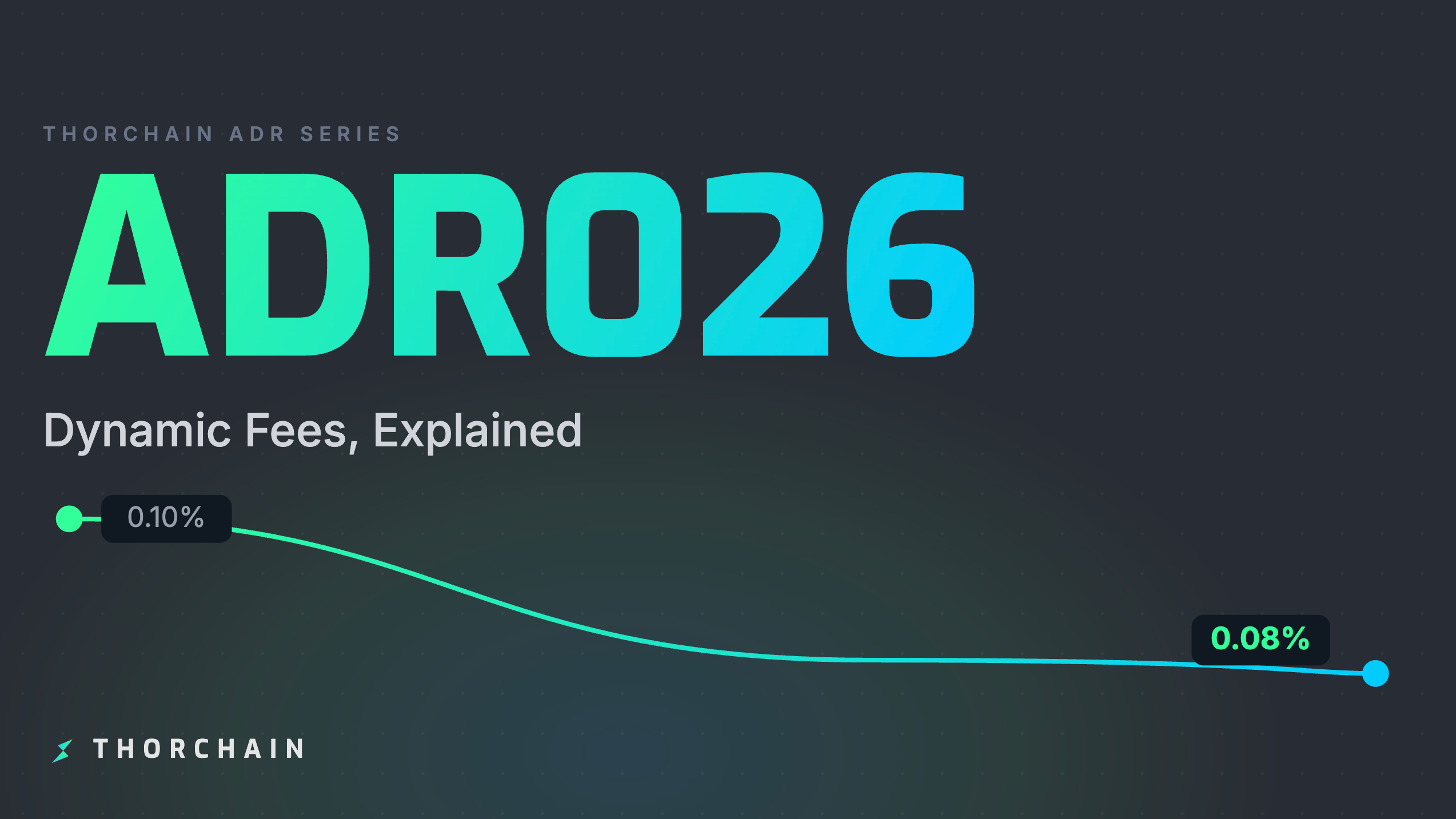
ADR-026 replaces that single floor with one that adjusts itself, per partner and per trading pair, once every 24 hours. Let’s dive in.
How the floor worked before ADR-026
Every swap on THORChain pays a slip fee, the portion of the liquidity fee that scales with how much a trade moves the pool. Beneath that sits a minimum, governed by the Mimir parameter L1SlipMinBps, which stops the fee from falling too low on deep pools where slip alone wouldn't cover much. On mainnet, that minimum sat at roughly 10 basis points, the same for every swap regardless of pair or partner.
The minimum fee on any swap followed a simple formula: swap size multiplied by the floor in basis points, divided by 10,000. A $10,000 swap against a 10bps floor paid a $10 minimum regardless of whether the pool had capacity to charge less, or whether a competing venue was quietly winning that flow at a lower price.
That single number never adjusted itself. It took a governance vote to move it, and any change applied to the entire network at once. There was no way to lower the floor on a route the protocol was losing to a competitor without also lowering it on routes where the protocol already had the volume locked in.
What ADR-026 changes
ADR-026 replaces the single network-wide floor with one unique to each pairing of THORName and trading pair. Each floor moves independently, adjusted once every 24 hours rather than by governance vote.
The adjustment runs on a revenue feedback loop rather than a volume target. Each cycle, it checks whether the last move on that floor raised or lowered actual fee revenue in dollar terms:
- If revenue rises, the floor keeps moving in the same direction.
- If revenue falls, it reverses.
- If the change in revenue is under 10%, the floor holds where it is.
Note: Denominating revenue in dollars rather than RUNE matters here as a swing in the RUNE price shouldn’t affect the fee adjustment.
The moves are deliberately small and bounded, one basis point per cycle, within limits set by governance in advance. This means that no single adjustment can shock a route or move it out of line overnight.
In the end, the direction the floor takes over time reflects the type of flow on that route. Where THORChain is losing price-sensitive flow to a rival, the loop eases the floor down until volume returns and revenue stabilises. Where THORChain is the only real venue for a pair, the loop does the opposite, moving the floor up as long as revenue keeps climbing.
Example: Take a $10,000 swap on a competitive pair, where the floor starts at 10bps, a $10 minimum. A rival undercuts the route, flow drops, and fee revenue falls. The loop responds by easing the floor down to 9bps, and revenue rises as volume returns. Since that move raised revenue, the next cycle pushes the floor down again, to 8bps. Revenue then holds roughly stable, moving by about 5%, well under the 10% threshold that would trigger another change, so the floor settles there.
Eligibility and rollout
The dynamic floor isn't open to every swap by default. Governance whitelists specific THORNames, the on-chain identities behind THORChain's frontends, wallets, and aggregator partners, before their fee floor starts adjusting. Everyone outside that whitelist keeps the standard fixed floor.
Also, it is worth noting that the mechanism applies only to native L1-to-L1 swaps, and only where the swap carries a registered THORName.
As for security, two safety rails sit around the rollout. A master switch can disable the entire mechanism instantly across the network if something behaves unexpectedly. And before a partner goes live, a monitor mode observes their swap behaviour first, without changing any fees, so the contributors can see how the loop would have responded before it starts moving real numbers.
Conclusion
ADR-026 turns a single fixed fee into something closer to price discovery, letting THORChain undercut where it is losing routes and hold firm where it is not, steered by actual revenue rather than a fixed assumption about what the market will bear.
This upgrade should be seen as a two-directional lever, not a discount mechanism: the same loop that eases fees on competitive routes also raises them where we're already the only real venue.
Let’s see how it plays out on real data and volume in the coming weeks as it goes live.

Related articles
![State of Network - September 2026 thumbnail.]()
Oct. 6, 2026
State of the Network - September 2026
- Report
![State of the Network August 2026 report thumbnail covering THORChain swap volume, fees, active wallets, bonds, Protocol Owned Liquidity, and the affiliate leaderboard.]()
Sep. 4, 2026
State of the Network - August 2026
- Report
![THORChain State of the Network July 2026 thumbnail covering the first full month of post-restart volume, fees, yield, dynamic fee pilot data and user acquisition.]()
Aug. 26, 2026
State of the Network - July
- Report
![THORChain v3.20 protocol upgrade article thumbnail covering Monero and Zcash integration progress, Solana and BNB trading resumption, the Stable Reserve and Protocol Owned Liquidity activation.]()
Aug. 24, 2026
THORChain Protocol Upgrade v3.20
- Report
![A technical deep dive into the May 2026 THORChain exploit, explaining how the vulnerability was executed and how it was mitigated.]()
Aug. 6, 2026
THORChain Exploit Report #3
- Report
![ADR031 - The Path Forward With Rujira]()
Jul. 29, 2026
ADR031 - The Path Forward With Rujira
- Report
![THORChain ADR-029 article thumbnail explaining the REVSHARE mechanism, how the protocol pays affiliates from its own swap revenue and what that means for partner onboarding and quote competitiveness.]()
Jul. 24, 2026
ADR-029 Affiliate Revenue Share
- Report
![THORChain Q2 2026 report thumbnail.]()
Jul. 17, 2026
THORChain Quarterly Report - Q2 2026
- Report
![THORChain Exploit Report #2 Thumbnail]()
Jul. 3, 2026
THORChain Exploit Report #2
- Report
![]()
Jul. 1, 2026
State of the Network - June
- Report
![THORChain v3.19.0 protocol upgrade article thumbnail covering Monero support, affiliate revenue share, DASH InstantSend and the TSS security patches behind the network restart.]()
Jun. 9, 2026
Protocol Upgrade - V3.19.0
- Report
![]()
Jun. 1, 2026
State of the Network - May
- Report
![THORChain May 15, 2026 Exploit Report #1]()
May. 20, 2026
THORChain Exploit Report #1
- Report
![]()
May. 12, 2026
THORChain Protocol Upgrade v3.18
- Report
![THORChain's State of the Network: April 2026]()
May. 1, 2026
State of the Network - April
- Report