THORChain Still Paused, Monero Targeted for Month-End, and the Limit Order Debate
2026-06-04 — 11 min read
- Podcast
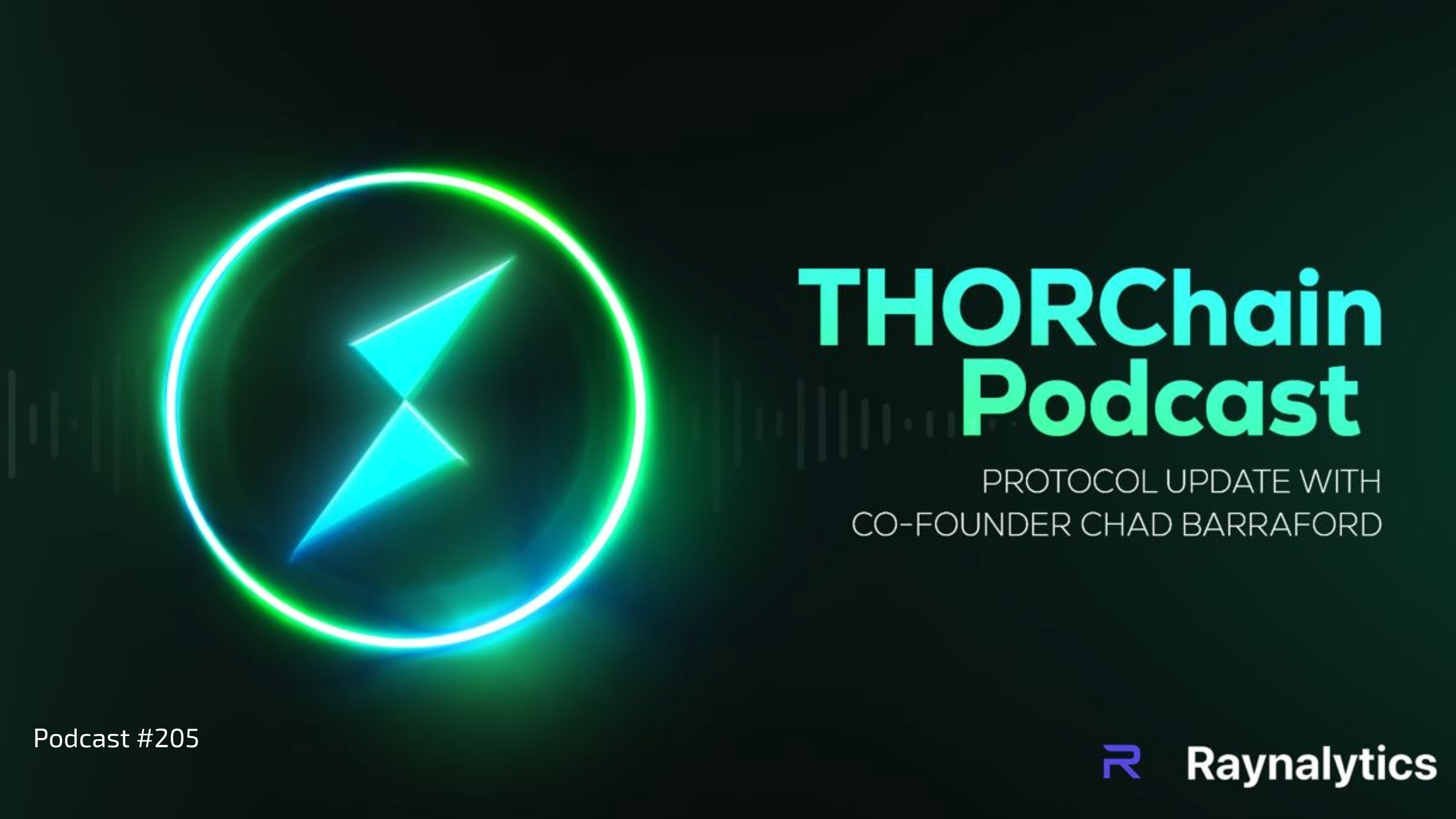
THORChain Community Podcast #205 ft. Chad Barraford, KentonC137 & patriotsounds | June 4, 2026 | Watch the full episode on YouTube
By Raynalytics
TL;DR
- The network is still paused. v3.19 was cut and the team hoped to start the validator voting process today or tomorrow. The exploit fix itself was done early on, the extra time is going into verifying every other vault is safe before churning.
- $XMR is targeted for the end of this month. Zcash is next in line, pending a one-line Bifrost change to handle a recently disclosed Zcash vulnerability.
- Chad floated free stablecoin swaps as a loss leader to win integrations and drive volume into $BTC, $ETH, and other pools.
- A proposed base-layer limit order model (from node operator Devel) sparked a long, candid debate with the Rujira team over whether it strengthens the base layer or duplicates work already built on the app layer.
- New on STO: two more API keys issued (18 total), 30 languages live, and dedicated pool and affiliate pages on the way.
1. The Restart: Correctness Over Speed
The question everyone keeps asking got a direct answer: no, the network is not back yet.
"We're not going for speed here necessarily, we're going for correctness, we're going for safety." (Chad)
v3.19 was cut a few days ago, the Maya team found a couple of small bugs in testing that got patched, and the plan had been to push v3.19 to mainnet or start the validator vote. Then the team spotted another potential issue and opted to spend a little extra time plugging it. As Chad put it, late is forgivable, wrong is not.
The exploit fix itself was finished early, around the start of that week. What is taking longer is everything after plugging the hole. The team had to assume other vaults could be targeted even without evidence, and built a new verification step inside Bifrost to rule that out: alongside key generation and key signing, there is now a third step, key verify, to confirm the other vaults are safe before churning.
The restart is then a multi-step sequence: get close to 100% of nodes onto v3.19, unhalt signing, enable churning, churn to fresh vaults, move all the funds over, then resume LP actions, trading, and secured assets. That itself takes a couple of days once it starts.
2. $XMR by Month-End, Zcash Next
On the chain roadmap, Chad's best estimate for Monero is end of this month, with the caveat that the timeline depends on how many bugs surface in testing.
New chains require churning, and churning requires the v3.19 patch, so the privacy-coin rollout was gated behind the restart. Zcash is actually next in the queue, and it may slip slightly because a critical vulnerability was recently discovered in Zcash and the new patch breaks things for integrators. THORChain's fix is small, a one-line change in Bifrost, but it has to ship before Zcash can be turned on.
The other holdup for Monero is almost poetically on-brand: getting hold of test $XMR is hard.
"It's actually kind of hard to get your hands on a stack of $XMR, which is kind of the problem that we're solving in a manner of speaking." (Chad)
A thousand dollars' worth of $XMR is roughly enough for proper testing, and the team is working to get some into the pipeline. Both Cake Wallet and Unstoppable Wallet came up as easy ways to acquire it, with Seth suggested as a quick source.
3. Free Stablecoin Swaps: The Loss Leader Idea
One of the bigger strategic ideas on the show was offering stablecoin-to-stablecoin swaps for free.
The logic is straightforward business: stablecoins are blowing up, competition for that flow (LayerZero, NEAR, Coinbase's bridge) has compressed fees to one or two bps, and THORChain earns only roughly 10% of its income from stablecoins anyway. So the proposal is to treat stable swaps as a loss leader.
"If it costs you four dollars to make a cheeseburger, you sell it for three dollars at a loss, and then you sell a coke and a bag of chips and you make money on the coke and the chips." (Chad)
The payoff is integrations. Free swaps are an easy pitch to wallets and partners, and once a wallet integrates for stables, it has by default integrated for $BTC, $ETH, and every other pool. Kenton added the BD angle: a prominent wallet ecosystem they spoke with is focused on stablecoin payments, and the ability to convert any stablecoin on any chain for free greatly raises the odds of them building on THORChain. In his view, stablecoins are the gateway drug for crypto going mainstream.
The implementation is the tricky part, since you cannot really charge zero fees on an AMM. Options discussed included a curve-style stable pool, an intents-style one-to-one design using the enshrined Oracle, and a tightly ranged CCL position on the app layer. The consensus: it costs nothing to run the experiment, and the fee can simply be turned back on if it does not work.
4. The Limit Order Debate: Base Layer vs App Layer
The most charged part of the episode was a proposal from Devel, a THORChain node operator, to add limit orders directly into the base-layer AMM. Boone joined specifically to champion it, arguing it could be the solution for paying LP fees without LP rewards.
"I'm a base layer maxi, and so to the extent that the app layer is good for the base layer, I am fully supportive." (Boone)
The mechanic: rather than a separate order book, you interrupt the AMM price curve at a chosen point, insert liquidity at a flat price, and once it is consumed the curve continues. Because that liquidity is not part of the AMM, swaps filled against it pay no slippage, only the fee, roughly halving the cost for those fills. Market makers get paid by the price delta rather than emissions, putting concentrated liquidity exactly where it is wanted for free, which Boone argues solves the LP reward problem outright.
Pragmatic Monkey pushed back hard. From the Rujira side, this reads as direct competition, not collaboration: an order book is already the center of everything they have built on the app layer over two years, and replicating it on the base layer would force a rewrite of nearly every contract and risk the security of the base-layer pools.
"Let's collaborate. We are building those stuff already. Let's grow it together instead of trying to take what is good and put it on the base layer." (Pragmatic Monkey)
He raised a concrete technical objection too: matching many liquidity sources means looping through the order book, and doing that on-chain for every base-layer swap creates a loop inside a loop that no chain could handle. His preferred path keeps the complexity on the app layer, upgrades the virtualization strategy with rapid swap so it can act as counterparty inside the same block, and makes the base-layer router aware of app-layer liquidity.
Chad stayed largely neutral, making sure he understood the proposal and noting that on-chain, very few people actually use the existing limit swaps today. He had to leave after nearly three hours, with the resolution being that the real discussion belongs in ADR29, with actual devs in the room. Denny's role throughout was to keep urging both sides to talk by voice rather than over text, on the view that much of the distance between the camps came from arguing in writing.
5. POL, LP Rewards, and the Churn Window
Running underneath the limit order fight was a broader liquidity question. For about six months, with the pendulum skewed by secured assets and the app layer, essentially all rewards have gone to nodes and LPs have earned close to nothing. Kenton's framing: the last six months are not normal or healthy, with rewards slammed entirely toward nodes while the pools get zero, and it is not sustainable.
The technically-not-zero detail: the LP reward code still works. If $RUNE pumped and the bond became worth more than the assets it secures, the pendulum would swing back and LPs would earn again. But in today's landscape that is not the case, which is pushing the conversation toward a cleaner model: turn off public LP adds entirely and let the protocol own the liquidity, growing POL by trimming a percentage off node rewards over time.
The team also covered the three-day churn window, an arbitrary holdover. Chad said he would be open to a week, which would also save meaningful gas since every churn costs hundreds of transactions to move assets between vaults. The tradeoff is how long a node operator is locked in before getting their bond back, currently around six months at roughly a hundred nodes.
6. STO Updates and Affiliate Tooling
On the swap interface, Chad reported two more API keys issued in the past week, bringing the total to 18, with more expected as new BD features ship.
The interface now supports around 30 languages, with a community translation effort running through a Google spreadsheet for native speakers to refine the AI translations. Chad's pick for the one he is most excited about: Nigerian Pidgin, on the view that THORChain should be huge in Nigeria.
Several new pages are in progress. A pool page will let people connect a wallet to add and withdraw liquidity easily, which matters most for the new layer ones joining THORChain. An affiliate page and dashboard will let partners generate their code, grab a widget for their site, and track the fees their THORName has collected, all behind a login tied to the API key. Joel Valenzuela was flagged for the pool page, with Dash heading to the app layer once it goes live.
7. App Layer Yield: A One-Click Staking Vision
Joel's broader interest was end-user experience, specifically a one-click stake button: deposit a single asset like Dash, choose to hold value in the native asset or a USD balance, pick whether yield accumulates or auto-pays, done. The context is that Dash masternodes require a thousand units, and a pooled-node service many smaller holders relied on was recently shut down by European regulators.
Pragmatic Monkey walked through what the app layer can already deliver. With CCL live, you can deposit secured Dash, pair it with a stablecoin, set a price range and a spread, and earn from volatility while the position market-makes. AutoRujira can then automate claiming and routing that yield, even streaming it back to a native Dash address on a schedule, effectively a synthetic staking product. His pitch: what most people come to crypto for is to make money, and the app layer's edge is differentiated ways to put an asset to work. He framed Dash and Zcash as strong starting communities, both with engaged holders and, in Zcash's case, real capital and rising volatility, but few native DeFi options yet.
Joel also explained why connecting these UTXO communities has been hard: most $BTC, Dash, and litecoin wallets cannot interact with THORChain interfaces because they lack a connect-wallet feature. His route around it is BIP-21, the 2012 payment-URI standard, which lets a QR code carry an address and amount, and he is getting it implemented into the Dash wallets alongside THORDex. Chad flagged a catch: BIP-21 supports only a local message, not an on-chain memo, so it cannot carry an add-liquidity instruction directly. The good news is that THORChain's old savers logic, which accepted a memo-less deposit and assumed intent, could be reused to route a plain inbound deposit into a single-sided LP add.
8. The Fake News Problem
Earlier in the show, Kenton walked through the press fallout from the exploit. He got The Defiant to add a clarification noting the bug bounty program had ended a year before the submission in question, and that the disclosed bug had nothing to do with the actual exploit. The PR advice was not to write rebuttals but to save the firepower for when trading resumes. Chad was blunt about bug-bounty grandstanding: most exploit claims projects receive are not real, and making a public scene is the fastest way to get ignored.
"If you are making a public scene about some exploit, that is a good cause for me to be very much uninterested in giving you any money at all." (Chad)
The wider point was media literacy: outlets published phishing links during the incident and claimed reach-outs to THORChain that never happened. The takeaway, in Kenton's words, was not to take it personally, since the same treatment lands on every project, so the noise is worth a grain of salt.
What to Watch
- The restart sequence. v3.19 to mainnet, validator voting, then the multi-step churn-and-resume process. Hopefully days away.
- $XMR by end of month, Zcash next once the one-line Bifrost change ships.
- ADR29. The base-layer limit order vs app-layer debate moves to formal discussion with devs.
- Free stablecoin swaps. Watch for an experiment on the app layer, easily reversible if it underperforms.
- Pool and affiliate pages on STO, plus continued progress on POL and the churn-window question.
More THORChain data, check out raynalytics.net
Follow Raynalytics for more Weekly Analytics and Podcast recaps.

Related articles
![Protocol Update Podcast with Chad Barraford, Kenton and Denny]()
Oct. 15, 2026
SwapKit Rev-Share Week One: Early Data Looks Promising, v3.21 and Monero Next
- Podcast
![Ecosystem Update Podcast with Zano]()
Oct. 10, 2026
Zano’s Recovery Plan and the Road to THORChain
- Podcast
![Protocol Update Podcast with Chad Barraford, Kenton and Patriot]()
Oct. 8, 2026
Chad's Unchained Podcast Debrief, Rev-Share and Monero
- Podcast
![Ecosystem Update Podcast with Houdini Swap]()
Oct. 3, 2026
Houdini Swap on THORChain Explained: What It Means for Users and Treasury Revenue
- Podcast
![Protocol Update Podcast with Chad Barraford, Kenton and Denny]()
Oct. 1, 2026
Can or Should THORChain Censor Transactions?
- Podcast
![Protocol Update Podcast with Chad Barraford, Kenton, Devel and Boone]()
Sep. 24, 2026
Inside the Houdini Swap Debate: THORChain’s Treasury, Privacy and Revenue
- Podcast
![Ecosystem Update Podcast with Radix]()
Sep. 19, 2026
Radix and THORChain: Building Trust for the Agentic Future
- Podcast
![THORChain Podcast protocol update cover]()
Sep. 17, 2026
THORChain Returns to Shipping: Zcash, Monero and Self-Sufficiency
- Podcast
![Ecosystem Update Podcast with Station Wallet]()
Sep. 13, 2026
Terra’s Station Wallet Is Back as Vultisig’s Agentic THORChain Wallet
- Podcast
![Protocol Update Podcast with Chad Barraford, Kenton and Patriot / Denny]()
Sep. 10, 2026
THORChain Prioritizes Stability Before Monero and New Features
- Podcast
![Ecosystem Update Podcast with RAVN]()
Sep. 5, 2026
Inside RAVN’s Native $BTC Aggregator and Its THORChain Integration
- Podcast
![Protocol Update Podcast with Hans, Devel, Chad, Kenton & Denny]()
Sep. 3, 2026
THORChain Churns Again: POL Goes Live, Rujira Resumes and BLO Debate
- Podcast
![Ecosystem Update Podcast with Rujira]()
Aug. 29, 2026
THORChain’s App Layer Rujira Is Paused. Rujira Wants a Clear Restart Path.
- Podcast
![Protocol Update Podcast with Chad Barraford, Kenton and Denny]()
Aug. 27, 2026
THORChain Puts Stability First: Monero & Zcash Delayed, ADR30, AI Agents and Memoless Swaps
- Podcast
![Ecosystem Update Podcast with Unstoppable Wallet]()
Aug. 22, 2026
Unstoppable Wallet Adds $RUNE, $TCY and $RUJI, With a Stablecoin Wallet Next
- Podcast