xolosArmy Wants eCash ($XEC) on THORChain: Chain Client Ready, Liquidity Next

2026-06-20 — 10 min read
- Podcast
THORChain x xolosArmy Podcast #210 ft. Fernando, KentonC137 & Patriotsounds | June 20, 2026 | Watch the full episode on YouTube
By Raynalytics
TL;DR
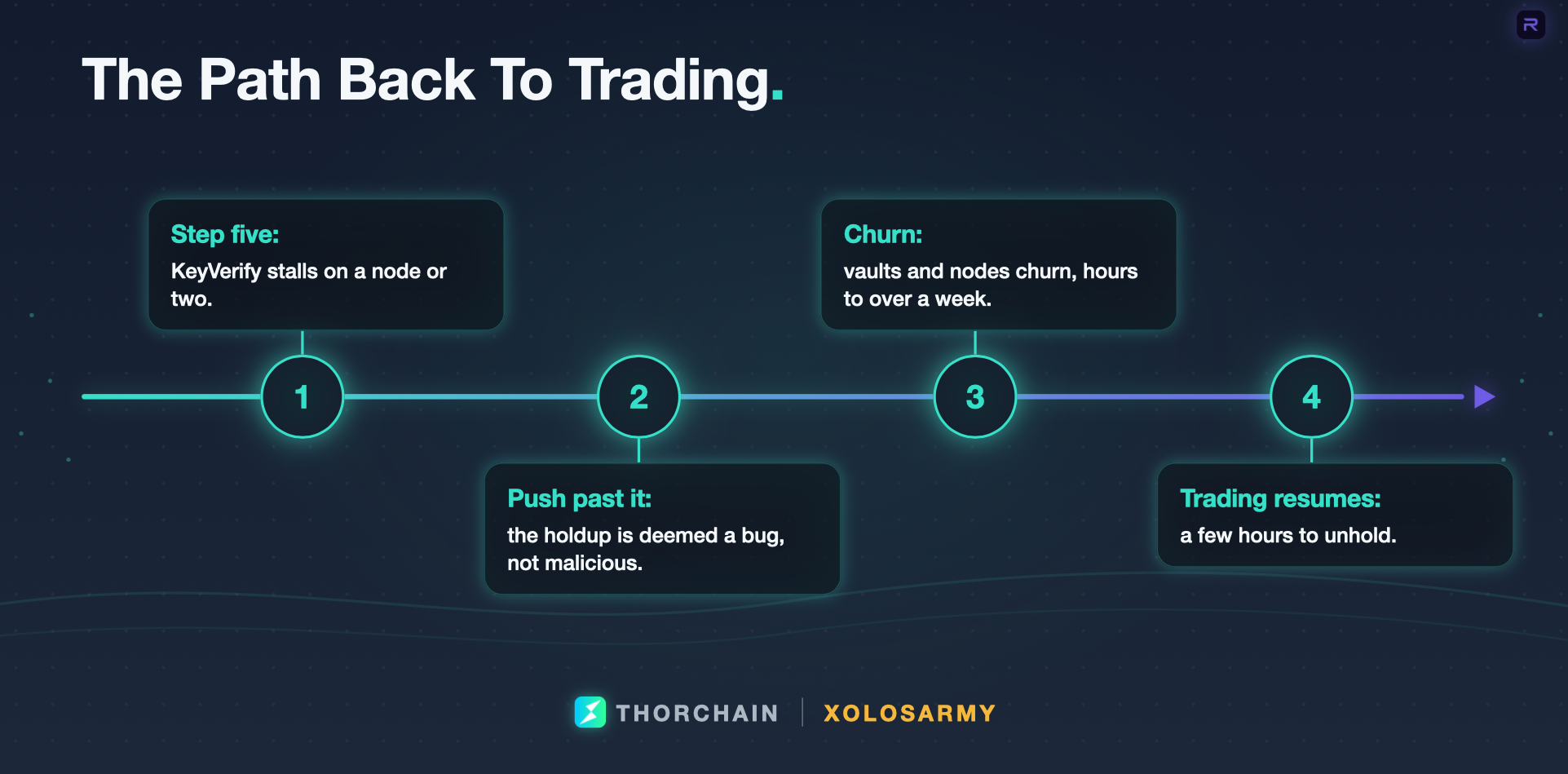
- THORChain is still paused while it recovers from the exploit. The restart is on step five, the KeyVerify step is not working on a node or two, and Chad Barraford has signaled the team will likely push on without it. Churning the vaults is the next hurdle before trading resumes.
- eCash ($XEC) is lining up to join THORChain through a community-led push, not a foundation mandate. Fernando and the xolosArmy network out of Mexico did the work to build the chain client.
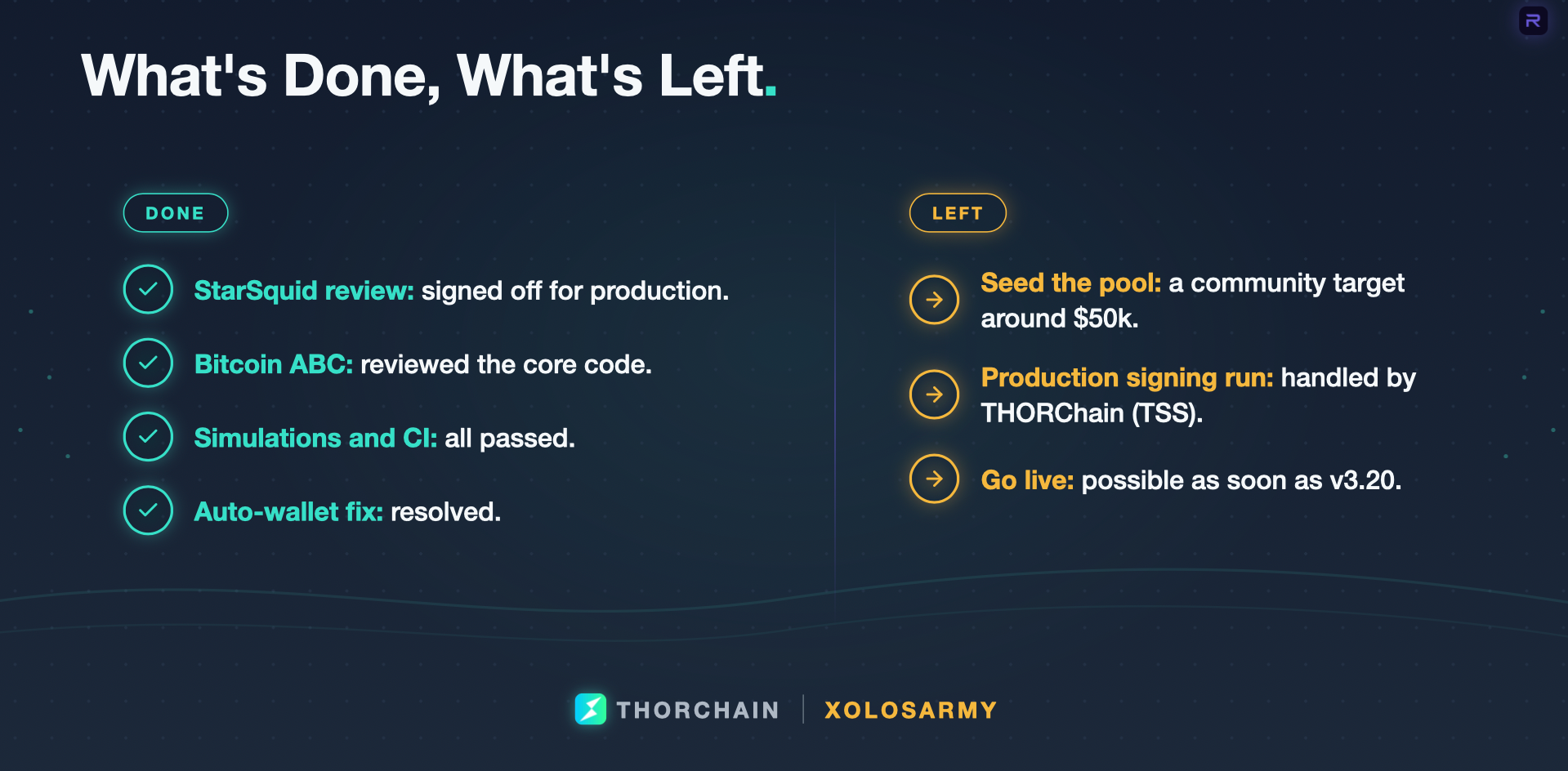
- The chain client is reviewed and ready. StarSquid signed off and says it can go to production, Bitcoin ABC put a developer on the code, and the only outstanding fix has been resolved. It could land as soon as v3.20, roughly four to six weeks out.
- Liquidity is the last step. Under the protocol-owned liquidity model THORChain is moving toward, the eCash community would seed the initial pool (a target around $50k), accept impermanent loss, and let the protocol become the majority provider and net buyer over time.
- eCash's pitch is sovereign liquidity: subsecond Avalanche finality on a UTXO base, and a permissionless venue for holders who cannot reach US exchanges.
1. Restart Watch: Step Five, KeyVerify, and What Is Left
Before the interview, Kenton and Denny gave the update regulars tuned in for. THORChain is still paused and working through the recovery, currently on step five of the restart.
The sticking point is KeyVerify, the one-time vault verification step, which is not completing on one or two nodes. Chad Barraford, THORChain's lead dev, has said the team will likely push forward without it: it was a valiant attempt, but it is simply not working, and the protocol needs to come back online. The team is highly confident the holdup is a bug in the process rather than anything malicious, the same class of issue that makes churns stall for days. As Kenton put it, the odds that another node operator is a bad actor are very, very small.
"If KeyVerify is simply not working, we can't hack it together. We'll just push forward." (Kenton)
Once the team moves on, the next hurdle is churning the vaults and nodes, which can take a few hours, a few days, or occasionally over a week. After that, it is a matter of hours to unhold and resume trading. Denny was clear he is done giving time predictions, since they have not worked out so far. The honest read: close, but gated on a churn that runs on its own schedule.
2. Meet xolosArmy: eCash's Community-Led Bid
The interview itself was a study in DIY crypto, audio gremlins and all. Fernando's connection cut in and out for much of the show, which he laughed off as part of the xolosArmy media style and Denny called charming. What came through clearly was the conviction.
Fernando is based in Mexico and has been in crypto since 2017. He came up through the Bitcoin Cash ($BCH) community, then moved to eCash about two years ago to follow what he sees as the original peer-to-peer electronic cash path, rather than chasing DeFi. xolosArmy is the network he is building around it: open-source, verifiable, permissionless tools, increasingly assembled with the help of AI. Crucially, this eCash push is grassroots. There is no official foundation driving it, just community members who filed the merge request to put eCash on THORChain themselves.
"Open, verifiable, open source, permissionless, deterministic." (Fernando, on the xolosArmy ethos)
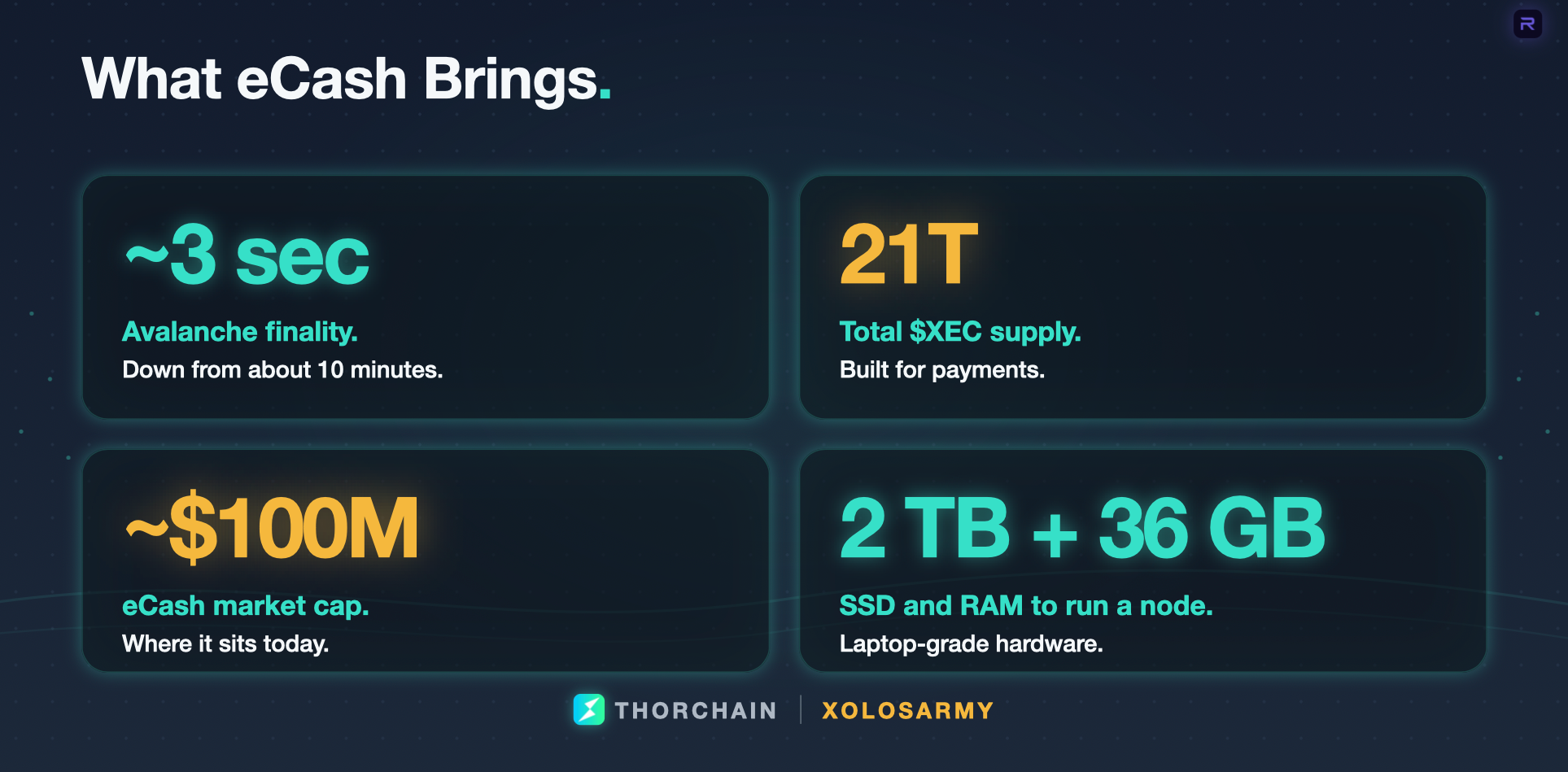
The motivation is liquidity that does not depend on a handful of exchanges. eCash carries roughly a $100M market cap, but Fernando argued that relying on centralized venues for that liquidity is fragile in a world adding new rules and censorship by the day, which is exactly why permissionless UTXO rails matter to him.
3. What eCash Brings: UTXO Roots, Avalanche Finality
eCash sits in the Bitcoin lineage. It traces from Bitcoin to Bitcoin Cash to eCash, the latter forking after the split between Bitcoin Cash and Bitcoin ABC over the IFP, a dev-funding mechanism that takes a slice of miner rewards. Bitcoin ABC now leads eCash development.
Technically, eCash keeps the UTXO model and proof of work, then layers Avalanche consensus on top for speed. That combination is what Fernando kept coming back to: a pre-consensus that finalizes transactions in about three seconds, giving subsecond finality and protection against reorgs and double-spends while leaving miners less work to do. He contrasted it with chains where you wait hours for confirmations.
"We are literally permissionless money that travels as fast as the internet." (Fernando)
A few other details for node operators and users. eCash counts in two decimal places rather than satoshis, a deliberate choice so people transact in whole units of $XEC for everyday payments, with a total supply of 21 trillion $XEC. Running a node is cheap: roughly a 2TB SSD and 36GB of RAM, comfortably handled by a ThinkPad laptop, using Chronik as the indexer. Subnets are on the roadmap, Avalanche subnets that could host privacy, enterprise, or DAO logic and move native eCash between layer 1 and the subnet without bridges, but Fernando was candid that the documentation from Bitcoin ABC is not out yet, so subnets remain theoretical for now.
4. The Chain Client Is Ready, Liquidity Is the Last Step
On the integration itself, the hard part is largely done. StarSquid reviewed the chain client end-to-end and said it can go to production; the only fix he flagged was that a wallet was not being created automatically, which Fernando has since resolved. Bitcoin ABC also put a developer on the core code to review it, and Fernando's local simulations and CI all passed. The production signing run sits with THORChain's side (the TSS), not with Fernando, so the remaining work is on the protocol.
The timing could be quick. Kenton floated landing eCash as soon as v3.20, roughly a four-to-six-week window, and both hosts were eager to move fast rather than delay.
That leaves liquidity, and here the conversation connected to THORChain's broader shift. Kenton explained the protocol is moving toward a protocol-owned liquidity model: rather than paying yield to liquidity providers, the yield goes to the protocol, which becomes the liquidity provider itself.
"Instead of sending yield to LPs, the yield goes to the protocol and the protocol becomes a liquidity provider." (Kenton)
In practice, that means the eCash community would need to seed the initial pool. Kenton put the sweet spot around $50k (you could start at $25k, $100k would be great), enough to handle the majority of $XEC volume without much slippage. Seeders would face impermanent loss and would not earn yield, but they keep self-custody, and the plan is for the protocol to add to the pool over time and become the majority provider, so seeders can eventually withdraw and recoup capital. Denny framed that impermanent loss as the real cost of getting on THORChain, far cheaper than a centralized exchange listing that can run 30 to 100 grand plus a percentage of token supply. Better still, because the protocol keeps depositing through the POL mechanism, it becomes a net buyer of eCash rather than a venue siphoning supply.
xolosArmy plans to raise the seed through a community-funded campaign using a deterministic crowdfunding primitive: pledges release only when strict conditions are met, and return to backers automatically if the target is missed, with no human in the loop. It would be funded around the project's $RMZ token, and Fernando noted Bitcoin ABC may contribute as well. The main friction, everyone agreed, is simply coordination, and Fernando offered to line up a direct contact to keep communication clean.
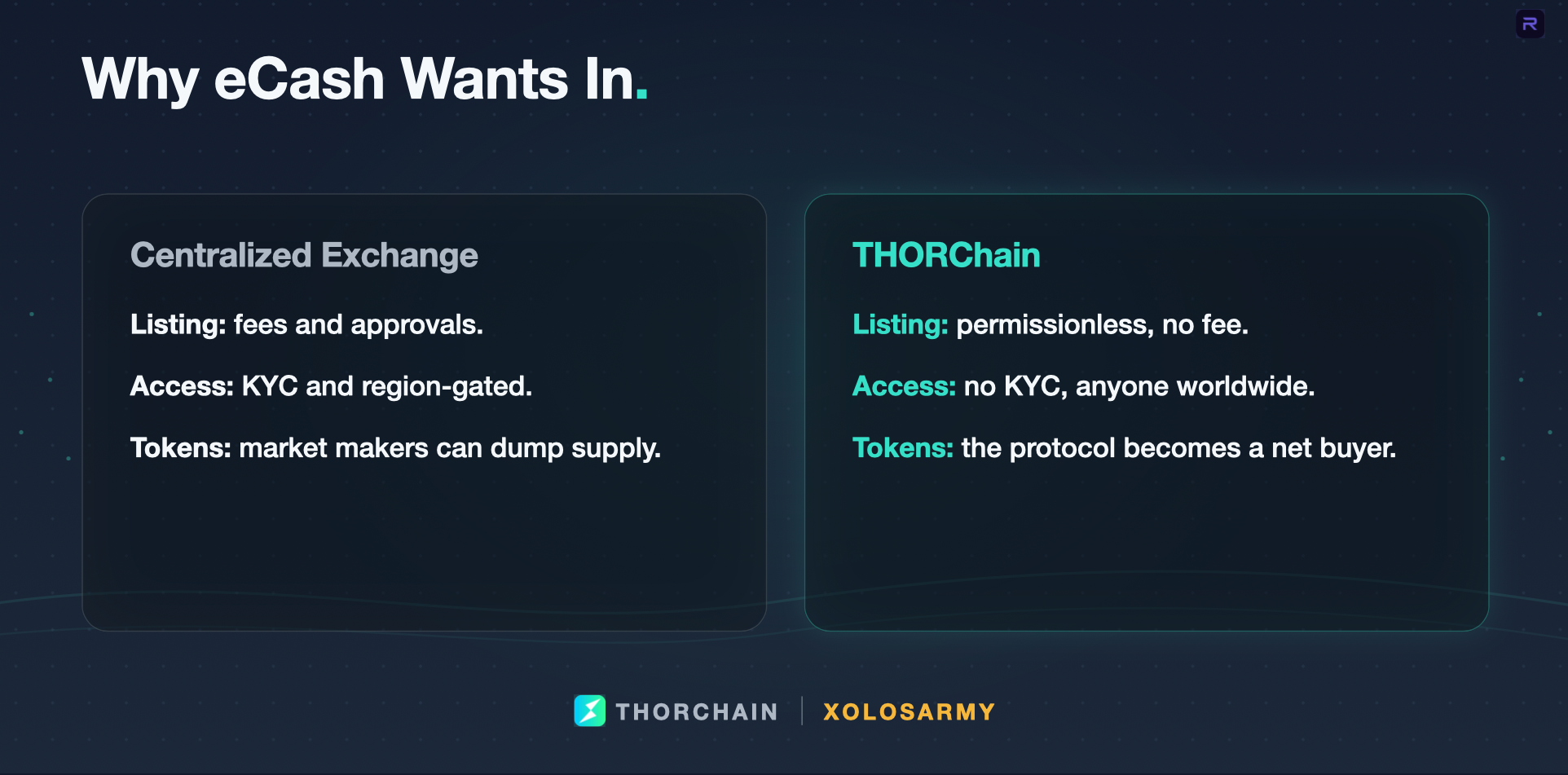
5. Why eCash Wants In: Sovereign Liquidity Beyond the Exchanges
The strategic case is the one THORChain makes to every chain, but it lands harder for a community coin. eCash has holders and stakers worldwide protecting the network, many of whom cannot get onto US exchanges (Binance lists only wrapped $XEC, and no US exchange accepts native eCash). Putting eCash on THORChain gives those holders a permissionless, worldwide venue, accessible to anyone with a wallet through THORChain Swap, with no account and no KYC.
That is the network effect THORChain keeps betting on: passionate communities that, once connected, become some of its best marketers. Denny leaned into the framing hard.
"We are not a gatekeeper. We open the gates. We open the gates for everybody." (Denny)
Before Fernando rejoined, the hosts riffed on a thought experiment that captures the appeal: could a new token launch only on THORChain, skip the market-maker arrangements that take a chunk of supply and dump it, and let price discover along the pool's curve? They acknowledged the open questions (a project would have to provide all the liquidity itself, and price would track the pool rather than an external market), but the underlying point stood: a permissionless listing with no gatekeeper and no forced selling is a genuinely different deal than a centralized exchange.
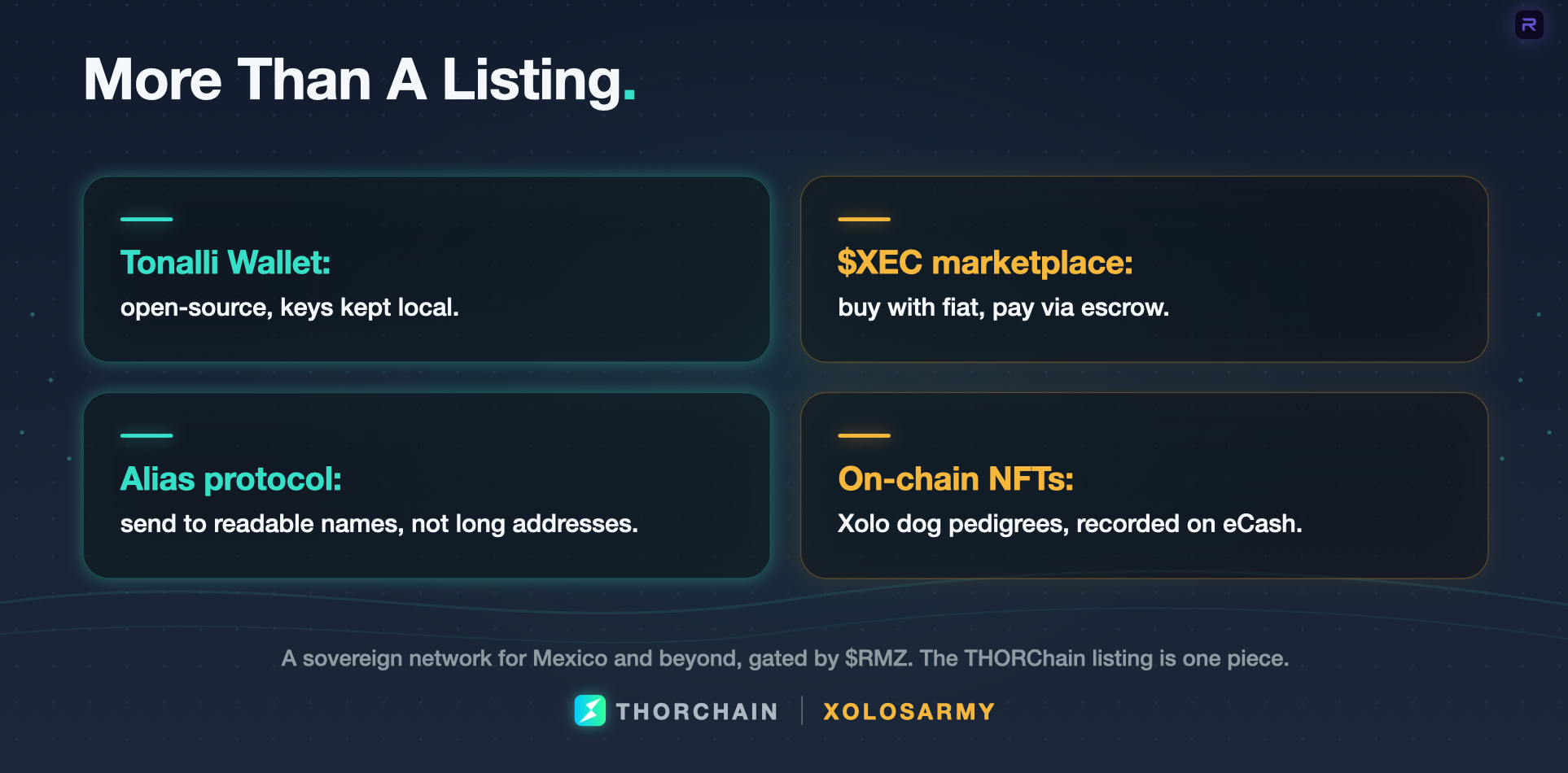
6. The Bigger Vision: A Sovereign Network for Mexico and Beyond
eCash on THORChain is one piece of something Fernando frames in much larger terms. xolosArmy is building a marketplace where people can buy goods with fiat and pay providers in $XEC for services, settled through deterministic escrow, useful for Mexican gig workers (think Uber drivers and Airbnb hosts) who are heavily taxed. The same escrow logic, he argued, could one day let AI agents hire humans in the physical world and pay out on completion, with no trusted middleman. Around that sit Tonalli Wallet (open-source, keys kept local), an alias protocol so users send to readable names instead of long addresses, and even on-chain NFTs recording the pedigrees of Xolo dogs via IPFS and OP_RETURN. The $RMZ token gates the ecosystem, a key to open the door rather than a speculative chip.
The name carries the mission. xolosArmy comes from Xolotl, the Aztec god of the underworld who guides souls, and the sun, through the dark toward rebirth. Fernando casts the project the same way, as a guide toward a more sovereign era.
"We have the technology to free humankind." (Fernando)
Denny tied it back to Kenton's recurring line about banking the unbanked, and to the broader observation that Mexico has become a crypto hotbed, home to teams like Maya Protocol, THORChain's sister fork, and Moca. The throughline of the episode: THORChain wants to open its gates to exactly these communities, and eCash is lining up to walk through.
What to Watch
- The restart. Churning is the last big hurdle; watch the THORChain Discord for trading resuming. No firm date, by design, the team has stopped predicting.
- eCash on THORChain. A possible v3.20 target, roughly four to six weeks out, gated on the liquidity raise. Watch for the chain client landing in an update and for xolosArmy's funding campaign.
- The liquidity model in practice. Seeding the eCash pool is an early real-world test of the protocol-owned liquidity approach for bootstrapping new chains.
- Upcoming guests. The interview series continues with privacy-minded names next, including Amir Taaki, followed by Bazaar Swap.

More THORChain data, check out raynalytics.net
Follow Raynalytics for more Weekly Analytics and Podcast recaps.

Related articles
![Ecosystem Update Podcast with Depouch]()
Aug. 1, 2026
Inside depouch: Direct THORChain Swaps Built for Simplicity
- Podcast
![Monero Gets a Soft Launch as THORChain's v3.20 Enters Testing and ADR31 Passes]()
Jul. 30, 2026
Monero Gets a Soft Launch as THORChain's v3.20 Enters Testing and ADR31 Passes
- Podcast
![THORChain and Pirate Chain podcast thumbnail featuring anarchy_dot_gov, KentonC137, and Patriotsounds discussing $ARRR listing on THORChain]()
Jul. 25, 2026
Pirate Chain Wants Off Centralized Exchanges: Next Ask Is an $ARRR Pool on THORChain
- Podcast
![THORChain Podcast #219 thumbnail.]()
Jul. 23, 2026
Dynamic Fees Take THORChain From 6% to 33.5% of ShapeShift Volume, With ADR29 Rev-Share Up Next
- Podcast
![THORChain x Liquidy Ecosystem Podcast #218 thumbnail.]()
Jul. 18, 2026
Inside Liquidy’s $700K Treasury: Market Making, Governance and Smarter Rujira Swaps
- Podcast
![THORChain Community Podcast #217 thumbnail featuring Devel, Boone, Kenton and Patriotsounds discussing base-layer limit orders, Monero's final review stage and post-exploit volume recovery.]()
Jul. 16, 2026
Devel's Limit Orders Could Make THORChain Swaps Up to 4x Cheaper, at No Cost to the Protocol
- Podcast
![THORChain x Vultisig Ecosystem Podcast #216 thumbnail featuring paaao from Vultisig and Patriotsounds discussing seedless MPC vaults, THORChain routing, Station Wallet and agentic signing.]()
Jul. 11, 2026
Vultisig’s Agentic Future: Secure AI Wallets, Rujira, and THORChain
- Podcast
![THORChain Community Podcast #215 thumbnail featuring Aaluxx from Maya Protocol, Eric from Moca, Randy Bechtold and Patriotsounds discussing the exploit, v3.20 and the Monero launch timeline.]()
Jul. 9, 2026
Aaluxx on the Exploit, the Churn, and Why Two DEXes Beat One
- Podcast
![THORChain x BazaarSwap Ecosystem Podcast #214 thumbnail featuring Flynn Jameson and Nikita Anikeev of BazaarSwap, Kenton and Patriotsounds discussing native cross-chain routing and the THORChain integration.]()
Jul. 4, 2026
Why BazaarSwap Chose THORChain for Native Asset Routing
- Podcast
![THORChain Community Podcast #213 thumbnail featuring Chad Barraford, Randy Bechtold and Patriotsounds discussing dynamic fees, Monero's launch timeline and revenue share.]()
Jul. 2, 2026
THORChain Turns On Dynamic Fees for Symbiosis, With More Affiliates Next
- Podcast
![THORChain Community Podcast #212 thumbnail featuring Boone, Kenton and Patriotsounds debating ADR29 minimum swap fees for Monero and THORChain's fee strategy.]()
Jun. 28, 2026
Boone’s ADR29 Gives THORChain a New Fee Lever for Monero
- Podcast
![THORChain Community Podcast #211 thumbnail featuring Chad Barraford, Kenton and Patriotsounds discussing the network restart, Monero timeline and Protocol Owned Liquidity debate.]()
Jun. 25, 2026
THORChain Is Back: Monero Nears Mainnet, and POL Takes Center Stage
- Podcast
![THORChain Community Podcast #209 thumbnail featuring Chad Barraford, Kenton and Patriotsounds discussing the network restart timeline, Monero launch and Protocol Owned Liquidity.]()
Jun. 18, 2026
THORChain's Restart Is Days Away: Dynamic Fees, Rev-Share, and Protocol-Owned Liquidity
- Podcast
![THORChain x NanoGPT Ecosystem Podcast #208 thumbnail featuring Milan Dereede discussing NanoGPT's integration with Kenton and Patriotsounds.]()
Jun. 13, 2026
NanoGPT Coming to THORChain: Every AI Model, No KYC, Paid in Crypto
- Podcast
![THORChain Community Podcast #207 thumbnail featuring Chad Barraford, Kenton and Patriotsounds discussing the network restart timeline, chain integrations and POL fee split.]()
Jun. 11, 2026
THORChain Eyes Trading by Midweek: Chad Maps the Final Restart Steps, With Zcash and Monero Queued
- Podcast