Dynamic Fees Take THORChain From 6% to 33.5% of ShapeShift Volume, With ADR29 Rev-Share Up Next
2026-07-23 — 15 min read
- Podcast
THORSday Community Podcast #219 ft. CBarraford, KentonC137 & Patriotsounds | July 23, 2026 | Watch the full episode on YouTube
By Raynalytics
TL;DR
- The first meaningful dynamic fee data is in: THORChain went from 6.1% of ShapeShift's routed swap volume in June to 33.5% by mid-July, its largest route, with weekly fees up roughly 7x. Chad's repeated caveat: early data, small sample, messy baseline.
- ADR29 rev-share sat near 50% approval at recording, roughly 20 node votes short of two-thirds with none against. SwapKit wants it to win more of Ledger's swap marketplace and could flip it on about a week after approval.
- ADR31 voting is unanimous so far for option 1, keeping the Rujira relationship as is, and the discussion openly turned to whether $RUNE and $RUJI eventually have to merge.
- v3.20 is being cut now and should reach the network within a week or two, carrying every known Monero fix, the dynamic-fee kickstart patch, and the POL income switch. Zcash and $XMR still wait on the churn; Bittensor's $TAO comes after Monero.
- Chad detailed his concerns with Devel's base-layer limit orders, MEV chief among them, and is pushing tip-based priority as the fix while his due diligence continues.
1. Dynamic Fees Are Working: ShapeShift Went From 6.1% to 33.5%
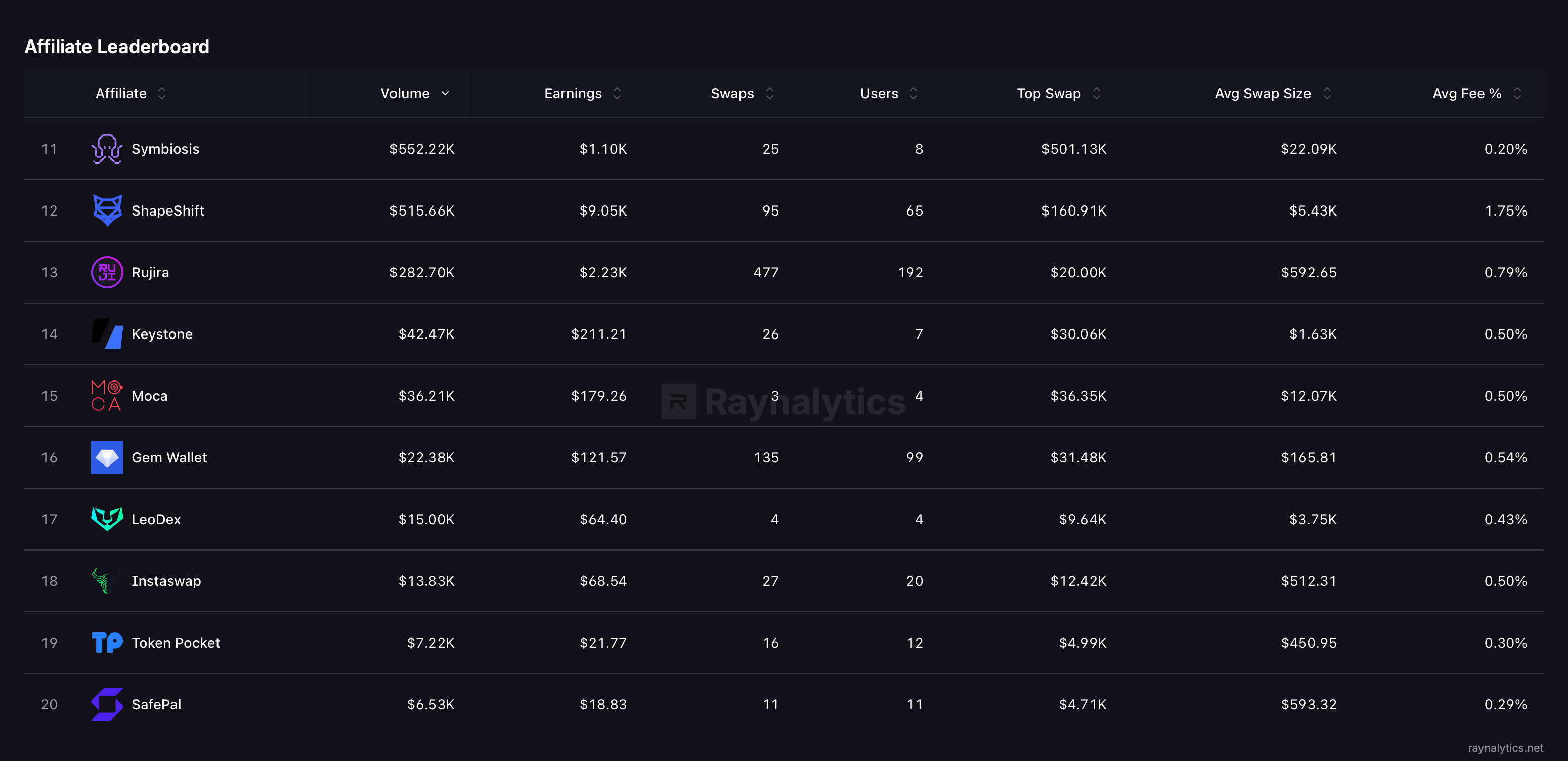
Chad came with data and presented it live off Ray's Affiliates Leaderboard on raynalytics.net. Since the dynamic fee model went live, ShapeShift has become its cleanest test: of the roughly $700K in ShapeShift volume and $10K in fees THORChain saw over the last 90 days, about $500K and $9K landed in the last 30 alone.
ShapeShift's own numbers agree. A provider split the team shared with Chad showed THORChain winning just 6.1% of ShapeShift's swap volume in June, about $341K, while Chainflip and NEAR Intents took roughly 90% between them at around $2.5M each. The mid-July screenshot, two weeks into the month, showed THORChain as ShapeShift's largest route at 33.5%, edging Chainflip by about $1,500, with NEAR Intents at 20%. Fees went from about $2,000 across four June weeks to roughly $7,000 in two July weeks, with volume running 4 to 5x higher. Chad hedged every number: THORChain was offline for part of the June baseline, which flatters the comparison, and nothing should be concluded from a sample this small.
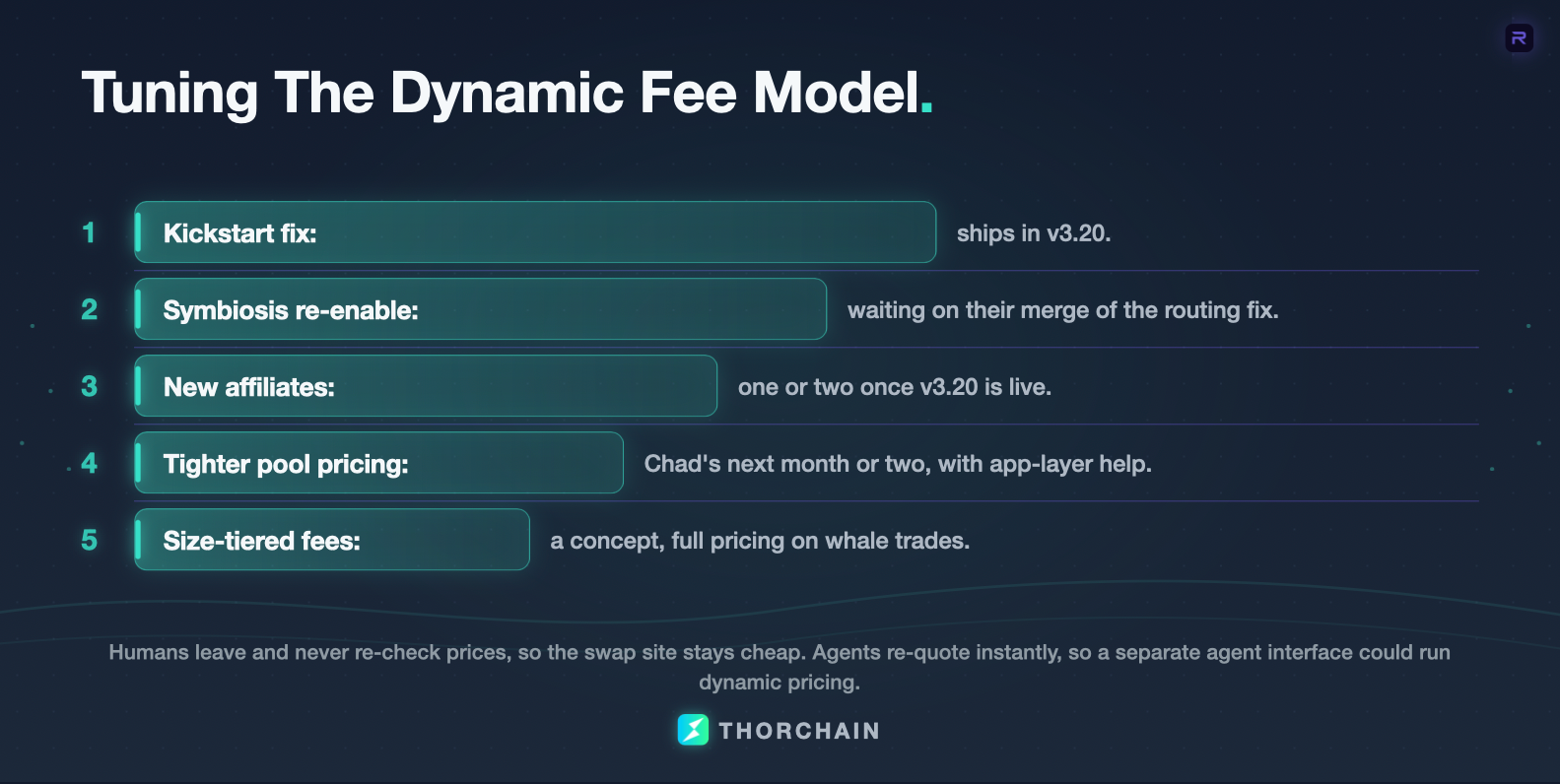
Symbiosis, the model's first affiliate, is paused over a bug on their side, not the model. Their router pre-swaps $ETH into $USDC on Uniswap before quoting THORChain, which then needs a double swap out, three swaps where a direct $ETH deposit needs one route; Chainflip's $USDC-based pools make the same flow look like a single hop. Chad wrote the fix for their open-source codebase himself; once merged, they get switched back on. Even handicapped, Symbiosis routed $552K of its $800K in 90-day volume during the 30 dynamic-fee days. One bug did surface on THORChain's side: the feature does not fully activate until an organic trade trips it. The fix ships in v3.20.
"We've gone from dreadful last to the top volume for the exchange, which is kind of the point of the feature: to maximize not so much volume necessarily, but fee generation. It's actually doing a pretty darn good job." (Chad)
2. Tuning the Model: Tighter Pools, a Size Tier, and the Swap-Site Question
Chad's own analysis surfaced the next constraint: Chainflip's concentrated liquidity keeps its $BTC pool hugging the market price, while THORChain holds within about 20 bps but never gets truly tight, forcing the model to price lower to win quotes. His goal over the next month or two is tighter tracking, and he pointed to a Rujira app-layer design, part of the unfinished ADR27 work, as the likely tool once ADR31 settles.
Then there is size. Chainflip and NEAR Intents cap trades around 20 $BTC, Chad estimated; THORChain takes any size. He floated a third dimension: above some threshold, maybe $100K, skip the discounting and charge something like 50 bps, because THORChain is the only venue for whale flow like the $32M trade it cleared a few months ago. That would make Cryptoactuary very happy; he has been banging that drum for years. The counterweight is fragmentation: slicing data by affiliate, pair, and size shrinks every sample until noise swamps signal, especially on a $5M-a-month affiliate like ShapeShift, so today's implementation stays deliberately simple. After v3.20, Chad plans one or two more affiliates, ideally teams that share metrics the way ShapeShift did, with Edge Wallet name-checked as a larger integration worth testing.
The sharp split was over THORChain Swap itself. Chad is tempted by the no-competition case: with no rival quote on the interface, the fee should drift up from 10 bps until the market pushes back, settling maybe at 15 or 20. Kenton is firmly against, because THORChain Swap's users are humans, not routing algorithms, and he wants its pricing ground lower over time to fight centralized exchanges, not raised.
"That is a human being sitting there looking at THORChain, and if they see the high price: okay, I'm just going to go somewhere else. They're never going to come back to check if the price is lower. We've lost that user for good, or at least for maybe a couple years." (Kenton)
Agents are the exception both accept: an agent re-quotes 20 interfaces instantly, so dynamic pricing works on it. Chad sketched a separate JSON interface for agents, possibly monetized through x402, the Coinbase-launched standard for per-call $USDC micropayments over HTTP. Agents are tiny today, but he expects them to be "90% of transactions on crypto" within a few years.

3. ADR29 Rev-Share: About 20 Votes Out, and SwapKit's Ledger Play
ADR29 sat near 50% approval at recording, about 20 node votes short of two-thirds, with none against. You can track the live vote count on Ray's governance tracker on raynalytics.net, and Chad will ping node operators Monday to push both open ADRs across the line.
After criticisms from Scorch in Discord, Kenton re-ran the mechanics. Rev-share works like an Amazon referral link: the swapper pays the same price either way, and the interface earns a kickback out of THORChain's fee instead of stacking its own on top. Fee-stacking is how every integration monetizes today, and Kenton called it the industry's handicap: 20% pricier than a centralized exchange is survivable, a thousand times pricier is not. He would not be surprised if rev-share becomes the default new-partner model within five years; one frontend he has courted for months only wants rev-share, and that deal pushed the ADR forward.
Existing partners are excluded for now, since converting them would only cut revenue without adding volume; the spirit is new integrations. The exception is SwapKit. Inside Ledger's marketplace, SwapKit competes with dozens of swap providers; rev-share lets it quote tighter, taking say 1 bps up front instead of 7 and recovering the rest from the kickback, and every quote it wins that way must route through THORChain, because the rev-share only exists on THORChain flow. SwapKit already pushes about $34M a month through the protocol. Chad spoke with Oleg this week: SwapKit's code is close, and they could flip it on about a week after the vote passes, starting around 10 to 20%. Because that playbook does not fit Trust Wallet inside SwapKit's stack, Trust Wallet may become a dynamic-fee candidate instead.
Chad promised process around all of it: each enablement announced with its percentage and reasoning, monitored, and reverted if fees fall. He called it a surgical tool, more artillery for Randy's BD work; asked on stream whether Batman is Randy, Denny confirmed: "Randy is our lead in BD. Randy is Batman. Yes."
Meanwhile the funnel fills itself: 44 affiliates have signed up through the new self-serve affiliate page on THORChain Swap, maybe seven or eight of them spam, with zero promotion. The page provisions an API key and widget, lets a platform set its fee and payout asset ($BTC, $ETH, stables, or $XMR once live), and tracks earnings; it is gated only to stop spam, and anyone can still integrate permissionlessly on their own infrastructure.

4. ADR31 Trends Unanimous While the Merge Question Surfaces
ADR31 formalizes THORChain's relationship with Rujira now that the app layer's one-year non-compete, from the ADR20 era, expired in May. About 20% of nodes had voted by showtime, all for option 1, continue as is, which Chad also backs. Pragmatic Monkey authored it, and Denny credited the enormous effort while noting that community members still surfaced angles he had missed, POL among them. His conclusion: a two-token ecosystem with split revenue is wildly complicated by nature.
Kenton, who fought ADR20 wanting a permissionless app layer, now backs Rujira's curated model: THORChain Swap taught him the value of one polished front end, and permissioned deployment keeps a bug's blast radius contained when only a highly aligned team ships contracts.
Then the merge talk. Kenton believes $RUNE and $RUJI eventually have to merge, because two tokens make value accrual a mess for the institutional money he expects to study THORChain. Chad walked the mechanics out loud: $RUJI's market cap sits around $10M to $15M, so buying out holders might take an ADR that mints that much $RUNE, and acquiring the token really means acquiring the team, which he would probably end up managing; the treasury, a finite budget that pays developers, cannot fund it. Chad even mused about acquiring Maya Protocol someday for its developers, who already work on THORChain daily, while conceding nobody knows whether Aaluxx or either community wants that. All of it was thinking out loud, not a plan.
Chad also made the case for today's split: no ERC20 has ever out-accrued Ethereum; separate tokens isolate risk, a lesson from THORFi's bad debt hitting $RUNE directly; and a separate codebase lets the app layer iterate fast on CosmWasm while THORNode moves slow on purpose. Denny backed option 1, wants both communities thinking about a medium-term path to one ecosystem, would accept a slight premium for Rujira holders in any merge, and is, in his words, violently against divorce.
The ADR backlog got housekeeping too: after ADR31 comes the unfinished WASM-fee piece of ADR27, then ADR30 from Annie at Liquify, letting node operators delegate responsibilities, with zero pushback so far. Four or five more sit behind those; Kenton's message to would-be proposers: help finish the current votes before filing new ones.
"The code is not what makes a protocol successful. It's the community." (Denny)
5. v3.20 Is Days Out: Monero Patched, Zcash Queued, POL Ready
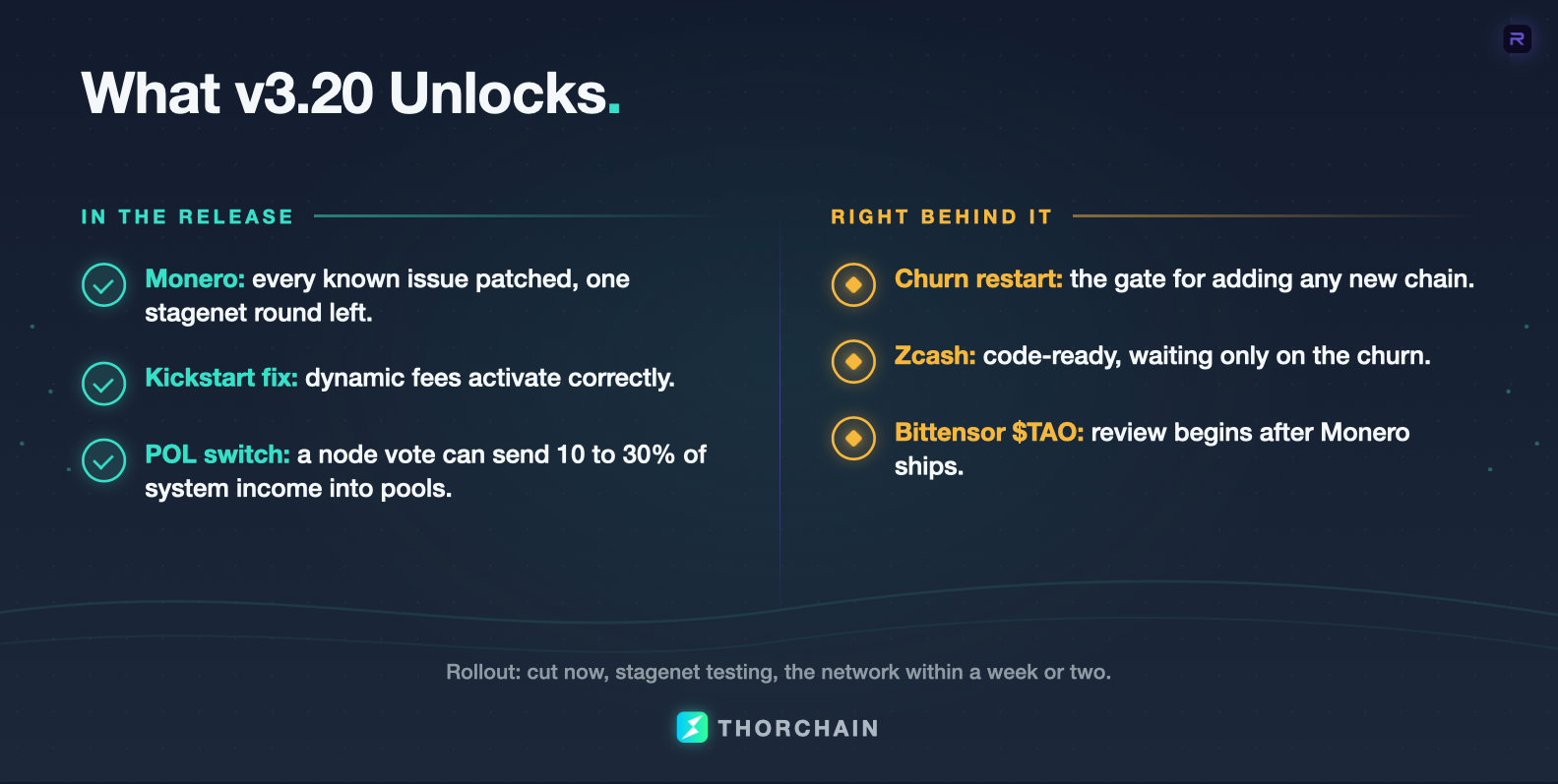
Why has the protocol felt rough since the hack? Chad's answer credits the team for a hard stretch heads-down in that fallout: on a six-week release cycle, post-restart problems were found and patched quickly but sat undeployed. v3.20 was due to be cut around the day of the episode, then tested on stagenet, then rolled to the network within a week or two, after which he expects things to run significantly smoother.
The same release carries the latest hardening for Monero, whose integration neared mainnet in June. More developers joined the $XMR push and kept finding and patching edge cases.
"v3.20, to the best of my knowledge in this moment, has everything patched that we're aware of that needs to be patched." (Chad)
One more round of manual stagenet testing remains, and then the gate is the churn, which must restart before any chain can be added. Zcash needs no new code at all and is blocked purely by the churn, so $ZEC and $XMR might even go live together. Bittensor's $TAO client is largely written and deliberately queued behind Monero's review, roughly six weeks after $XMR ships.
v3.20 also flips on POL's plumbing: a patch makes the system-income mimir operational, so a node vote can direct a share of income, 10% and 30% were floated, into protocol-owned liquidity. That answers Oleg's relayed request to deepen the roughly $100K $USDT pool on TRON for better execution: deployments would start with $TRX as the gas asset, likely cover the TRON $USDT pool via a whitelist mimir, and probably reach Solana and the other newer pools. Two birds, one stone, as Chad put it.
Rapid swaps have run cleanly at two intra-block sub-swaps, so Chad plans a node vote this week or next to raise the cap to three, then step toward five. On Monero comms, Kenton is weighing handing one journalist the launch scoop, using the press to spread the message Denny keeps hammering: the pool starts small, bugs are likely, give it a month or two to bake.
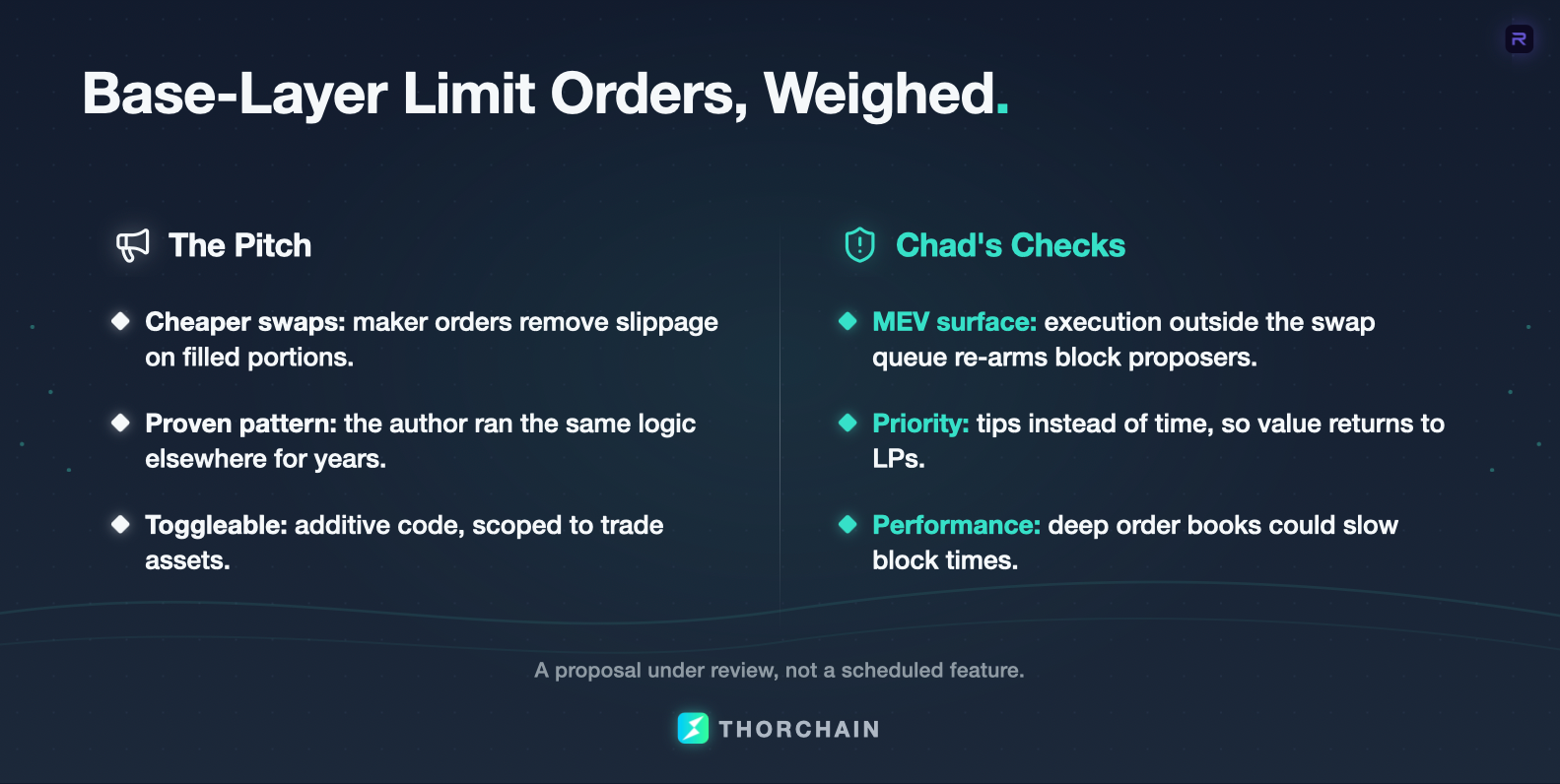
6. Devel's Limit Orders: Chad Likes the Ambition, Not the MEV Surface
A listener asked about pairing dynamic fees with the base-layer limit orders Devel pitched in depth last week. Chad has now spent real time on the proposal, modeling included, and returned with specific concerns rather than a verdict.
First, ordering: as drafted, limit orders execute first, the AMM second, cancellations third, quietly demoting the AMM; Devel seems open to changing that. Second, MEV. THORChain's swap queue means block order is not execution order, the code decides, which is why sandwich attacks do not work here; the only MEV left is excluding a trade from a block for the next proposer, mostly harmless. Limit orders executing around that queue would hand block proposers a real lever again. Chad was frank about the incentives, transparency over shade: Devel is a good operator, but he also runs nodes and arbitrage bots, and a mis-designed version "does very well to line his pockets" at someone else's cost. Devel's draft fills orders by price then time; Chad is pushing Bitcoin-style tips instead, so competition for priority pays the protocol and its LPs rather than leaking away.
App-layer developers flagged performance too, since deep order books could slow block times, and Chad wants their math-heavy review before anything moves. The feature also would not fix the pool-price tightness problem from his own analysis. Untested code, trade-asset scope, unquantified upside: the ROI-versus-complexity question stays open.
"I don't have a dog in this fight. I don't make more money or less money because this feature gets added or not. I'm just thinking what makes the best sense for the protocol, not necessarily what makes the best sense for a few individuals." (Chad)
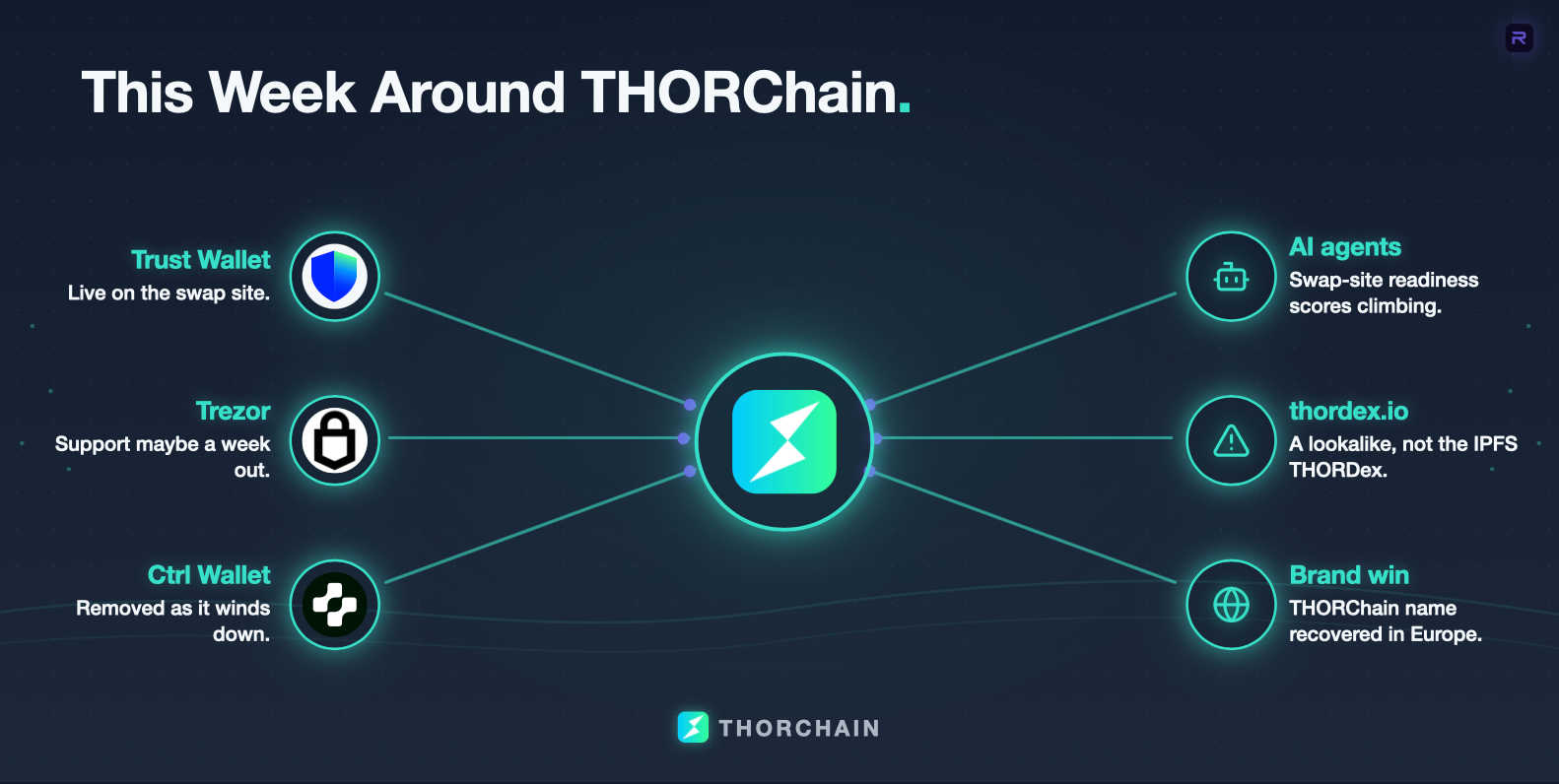
7. Roundup: Trust Wallet Goes Live, a Copycat Warning, a Brand Win
The wallet lineup on THORChain Swap shuffled: Ctrl Wallet came off as it winds down, Trust Wallet went live, with Kenton asking testers to report anything broken, and Trezor could be done as soon as next week, helped by a C-suite Trezor contact Chad and Randy met at Toronto's Blockchain Futurist Conference. Chad also gave a main-stage talk there and met a Bitcoin documentary maker who wants THORChain in his series.
On AI, Robinhood opened its platform to agents, and Kenton fired the news at the THORChain Swap team, who were already building the same thing. AI-readability scores have climbed from zero toward 50 to 100% depending on the tool, and Kenton asked the community to poke the sites with AI and report what fails.
Two PSAs. A lookalike at thordex.io is not THORDex, the IPFS-hosted frontend the community knows: it mimics THORDex's old header art, charges a 2% affiliate fee, and has no reachable socials. Denny would call it a scam outright; Kenton was more careful; both said avoid it until its operators surface. On the flip side, MiraDex, a small frontend at miradex.io, quietly made a user whole out of pocket after a transaction issue on a THORChain route, and Denny publicly thanked them and invited them on. One caution from Chad: MetaMask currently flags the domain, plausibly a false positive of the kind THORChain itself just cleared off a third-party scam blacklist, but click carefully regardless.
A quieter win: THORWallet closed out a multi-year European legal fight and recovered the THORChain brand name from a squatter who registers protocol names, with The Graph doing the heavy lifting in the underlying case and Marcel Harmann carrying THORChain's side. And the marketing engine keeps spinning: Kenton's DeFi Llama dashboard is nearly done, tied to a year-long marketing agreement and newsletter articles; Jane Butterfly is helping translate THORChain content for distribution in China; and MarketAcross is driving the get-articles-everywhere PR push.
What to Watch
- v3.20: cut imminently, stagenet next, the network within a week or two. Expect a smoother protocol and the dynamic-fee kickstart fix.
- The chain queue: the churn restarts after v3.20. Zcash could go live alongside Monero, and Bittensor's $TAO review starts once $XMR ships, roughly six weeks out.
- ADR29 and ADR31: Chad pings node operators Monday; ADR29 needs about 20 more votes. If it passes, SwapKit could turn rev-share on within about a week at 10 to 20%.
- Dynamic fees, round two: Symbiosis returns once it merges Chad's fix, one or two new affiliates follow v3.20, and next THORSday is already framed as a revenue check-in. Track it on the dynamic fees dashboard.
- POL and rapid swaps: a post-v3.20 node vote can send 10 to 30% of system income into pools, starting with $TRX, TRON $USDT, and Solana; a separate vote raises intra-block sub-swaps from two to three, then toward five.
- Saturday: Daniel from Pirate Chain ($ARRR) joins the podcast.
More THORChain data, check out raynalytics.net
Follow Raynalytics for more Weekly Analytics and Podcast recaps.

Related articles
![THORChain x Liquidy Ecosystem Podcast #218 thumbnail.]()
Jul. 18, 2026
Inside Liquidy’s $700K Treasury: Market Making, Governance and Smarter Rujira Swaps
- Podcast
![THORChain Community Podcast #217 thumbnail featuring Devel, Boone, Kenton and Patriotsounds discussing base-layer limit orders, Monero's final review stage and post-exploit volume recovery.]()
Jul. 16, 2026
Devel's Limit Orders Could Make THORChain Swaps Up to 4x Cheaper, at No Cost to the Protocol
- Podcast
![THORChain x Vultisig Ecosystem Podcast #216 thumbnail featuring paaao from Vultisig and Patriotsounds discussing seedless MPC vaults, THORChain routing, Station Wallet and agentic signing.]()
Jul. 11, 2026
Vultisig’s Agentic Future: Secure AI Wallets, Rujira, and THORChain
- Podcast
![THORChain Community Podcast #215 thumbnail featuring Aaluxx from Maya Protocol, Eric from Moca, Randy Bechtold and Patriotsounds discussing the exploit, v3.20 and the Monero launch timeline.]()
Jul. 9, 2026
Aaluxx on the Exploit, the Churn, and Why Two DEXes Beat One
- Podcast
![THORChain x BazaarSwap Ecosystem Podcast #214 thumbnail featuring Flynn Jameson and Nikita Anikeev of BazaarSwap, Kenton and Patriotsounds discussing native cross-chain routing and the THORChain integration.]()
Jul. 4, 2026
Why BazaarSwap Chose THORChain for Native Asset Routing
- Podcast
![THORChain Community Podcast #213 thumbnail featuring Chad Barraford, Randy Bechtold and Patriotsounds discussing dynamic fees, Monero's launch timeline and revenue share.]()
Jul. 2, 2026
THORChain Turns On Dynamic Fees for Symbiosis, With More Affiliates Next
- Podcast
![THORChain Community Podcast #212 thumbnail featuring Boone, Kenton and Patriotsounds debating ADR29 minimum swap fees for Monero and THORChain's fee strategy.]()
Jun. 28, 2026
Boone’s ADR29 Gives THORChain a New Fee Lever for Monero
- Podcast
![THORChain Community Podcast #211 thumbnail featuring Chad Barraford, Kenton and Patriotsounds discussing the network restart, Monero timeline and Protocol Owned Liquidity debate.]()
Jun. 25, 2026
THORChain Is Back: Monero Nears Mainnet, and POL Takes Center Stage
- Podcast
![THORChain x xolosArmy Ecosystem Podcast #210 thumbnail featuring Fernando of xolosArmy, Kenton and Patriotsounds discussing eCash's chain client integration with THORChain.]()
Jun. 20, 2026
xolosArmy Wants eCash ($XEC) on THORChain: Chain Client Ready, Liquidity Next
- Podcast
![THORChain Community Podcast #209 thumbnail featuring Chad Barraford, Kenton and Patriotsounds discussing the network restart timeline, Monero launch and Protocol Owned Liquidity.]()
Jun. 18, 2026
THORChain's Restart Is Days Away: Dynamic Fees, Rev-Share, and Protocol-Owned Liquidity
- Podcast
![THORChain x NanoGPT Ecosystem Podcast #208 thumbnail featuring Milan Dereede discussing NanoGPT's integration with Kenton and Patriotsounds.]()
Jun. 13, 2026
NanoGPT Coming to THORChain: Every AI Model, No KYC, Paid in Crypto
- Podcast
![THORChain Community Podcast #207 thumbnail featuring Chad Barraford, Kenton and Patriotsounds discussing the network restart timeline, chain integrations and POL fee split.]()
Jun. 11, 2026
THORChain Eyes Trading by Midweek: Chad Maps the Final Restart Steps, With Zcash and Monero Queued
- Podcast
![THORChain Podcast #206 thumbnail.]()
Jun. 6, 2026
The Stablecoin That Survived a 95% Crash: Zephyr Comes to THORChain
- Podcast
![THORChain Podcast #205 thumbnail featuring co-founder Chad Barraford.]()
Jun. 4, 2026
THORChain Still Paused, Monero Targeted for Month-End, and the Limit Order Debate
- Podcast
![THORChain Podcast #204 thumbnail, presented by Raynalytics]()
May. 30, 2026
More Than a Block Explorer: Deving.zone Turns THORChain Into a Living Map
- Podcast