THORChain Turns On Dynamic Fees for Symbiosis, With More Affiliates Next
2026-07-02 — 10 min read
- Podcast
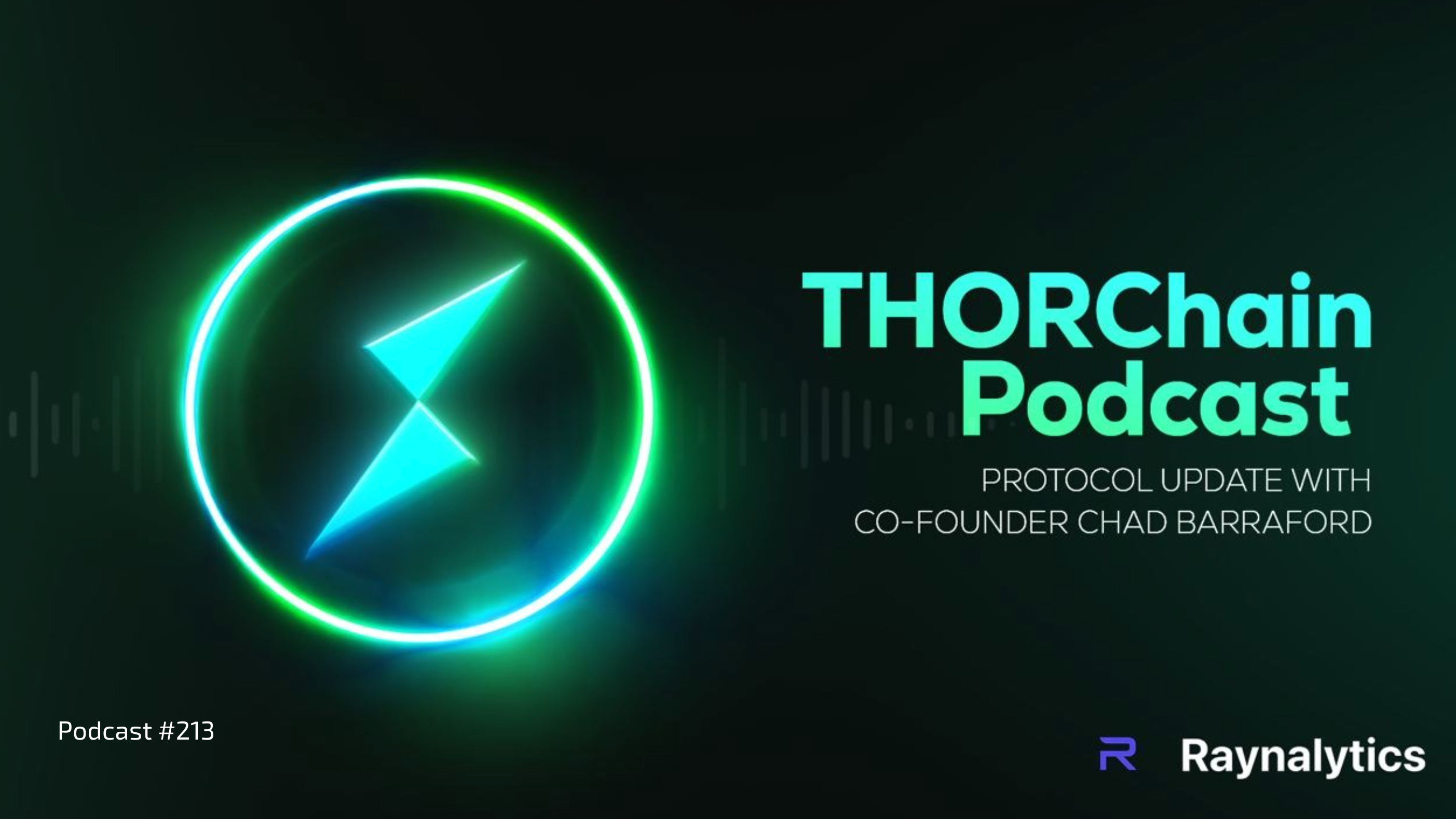
THORSday Community Podcast #213 ft. CBarraford, Randy_Bechtold & Patriotsounds | July 2, 2026 | Watch the full episode on YouTube
By Raynalytics
TL;DR
- THORChain's dynamic fee model (ADR-27) is live, switched on first for Symbiosis. A small bug turned up and is easy to patch, and Chad and Randy are now qualifying five to six more affiliates to test next.
- While reviewing Symbiosis, Chad found their frontend routes orders through an extra double swap (three trades in total), which helps explain the thin volume THORChain sees from them. He has already opened a roughly 200-line pull request to their open-source code.
- Monero is close. Chad's rough estimate for v3.19.4 is one to two weeks, with the usual "we know that's a meme" caveat. When it lands the pool will be shallow, so keep early swaps small.
- Chad floated removing the churn requirement for adding new chains, which could let a chain like $ZEC go live through a simple Mimir flip instead of waiting on a churn.
- A revenue-share ADR is heading to a node vote, and SwapKit plans to pass its share straight into lower fees to win more volume through the wallets it serves.
1. Dynamic Fees Go Live, Starting With Symbiosis
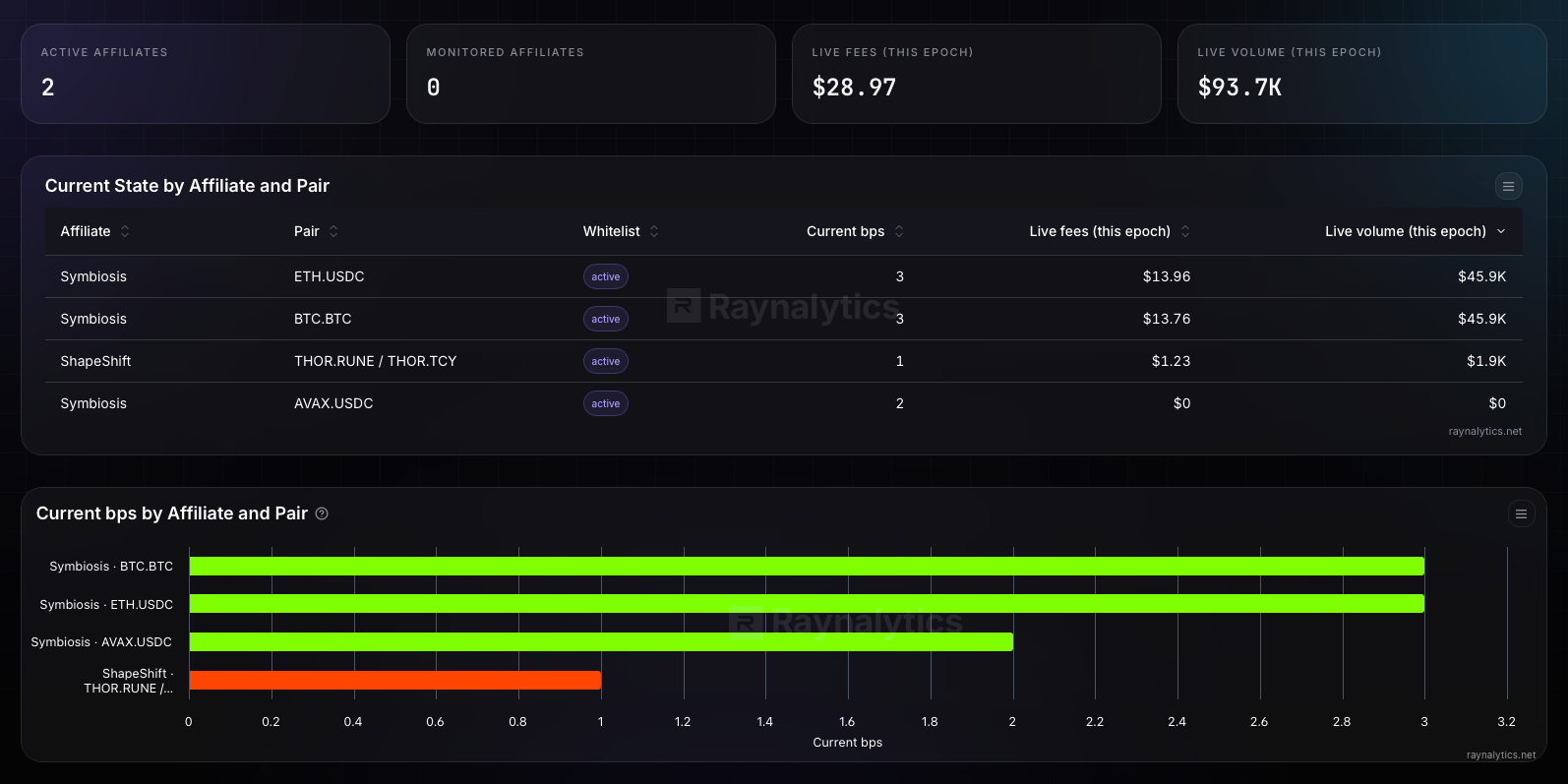
The headline this week: after a long road to the votes, the dynamic fee model (ADR-27) finally passed and is live. THORChain switched it on first for Symbiosis. A small bug surfaced quickly, but Chad was clear it is an easy patch, not a dealbreaker.
The more revealing find came from looking under the hood. When Chad reviewed how Symbiosis routes a trade such as $ETH to $BTC, he saw their interface does the first leg itself ($ETH to $USDC through an aggregator like Kyber or 0x), sends the $USDC to THORChain, and then THORChain has to double swap $USDC into $BTC. That is three trades along the route, and the stacked fees are part of why THORChain sees so little volume from them. For contrast, $USDC is Chainflip's base asset, so it does a single swap and can charge less.
Rather than shrug, Chad read their open-source code and opened a pull request, a roughly 200-line change now in review with the Symbiosis team.
"I just assumed all the affiliates are all set up and it's all fine, and I didn't really consider that until I saw it and I'm like, wait, this doesn't make any sense." (Chad)
The experiment is trying to answer two questions: does the code work as intended, and does the feature actually generate more fees for a given affiliate. To find out, Chad and Randy are qualifying five to six more affiliates, with names like ShapeShift and Edge Wallet coming up as deep-dive targets, using a short list of questions to pick the best next testbed. As confidence grows, more affiliates get switched on. You can follow the dynamic fee experiment as it unfolds on raynalytics.net.
2. Monero Is Close, and the Pool Will Start Small
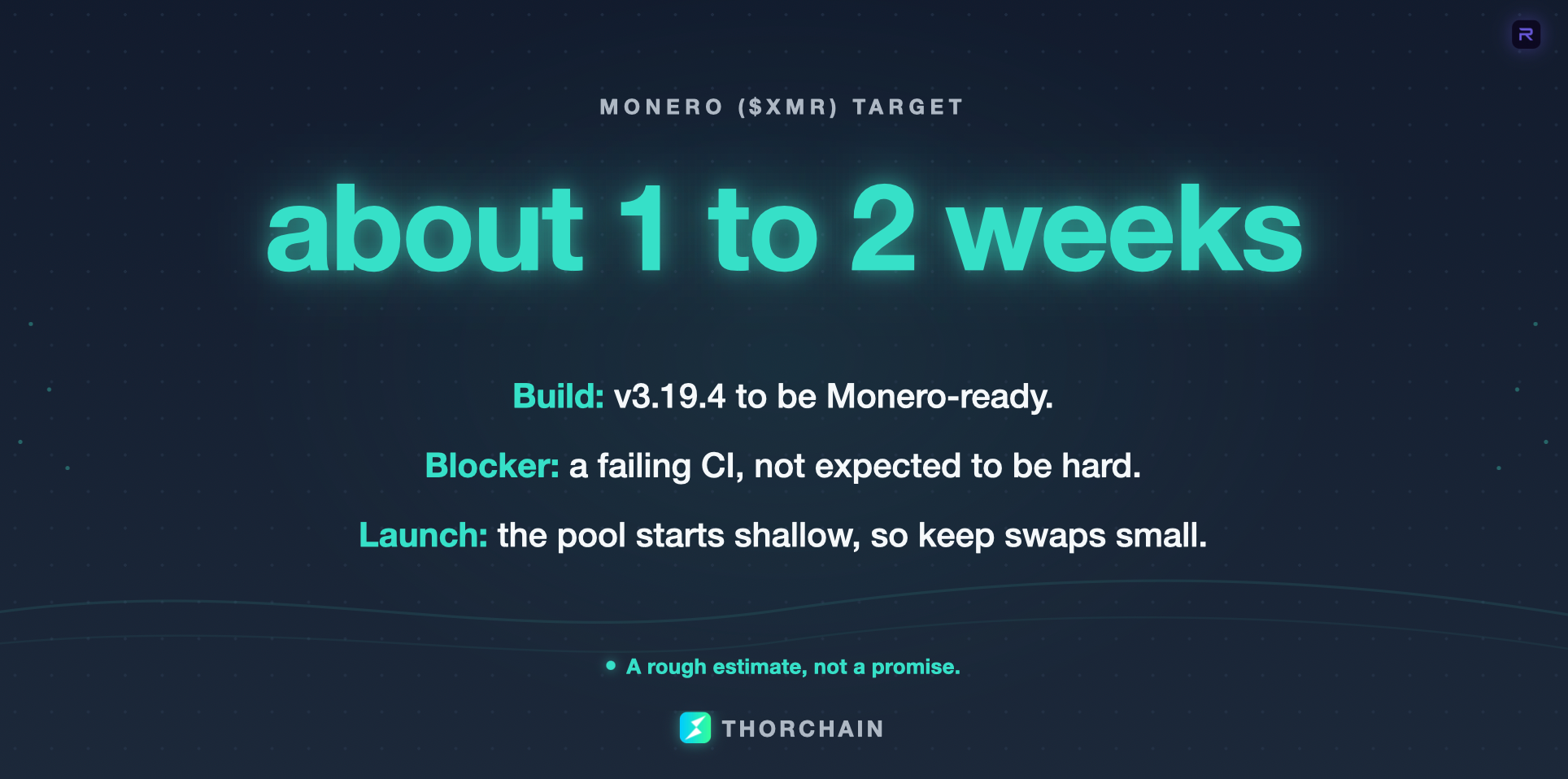
Monero remains the most anticipated chain client on the roadmap. The team ran a deep audit of the Serai code, found dozens of things to fix, and in fixing them broke a few others, which added up to more than 30 changes. To be Monero-ready, the team may need to ship v3.19.4. The current blocker is a failing CI, which Chad does not expect to be hard to resolve; the slower part is getting the approvals and reviews to merge.
His honest estimate is one to two weeks, delivered with the usual caveat.
"If we could wave a magic wand and add $XMR right now, I would be waving it." (Chad)
One reminder for launch day: liquidity will be shallow, only a few thousand dollars deep at first. Do not attempt six-figure swaps. Start with $50 to $100, and expect the occasional bug or pause while the chain settles in. That caution is exactly why the team is taking the extra time in testing. When $XMR does go live you will be able to trade it on THORChain Swap, just keep the size small to start.
3. A Plan to Add Chains Without Churning
Zcash is ready in many respects, but it is stuck behind churning. Adding a new chain currently requires a churn, and a Solana-related bug has kept the network from churning cleanly. Chad's response was to question the requirement itself.
"I'm not sure we actually need to churn in order to add support for a particular chain." (Chad)
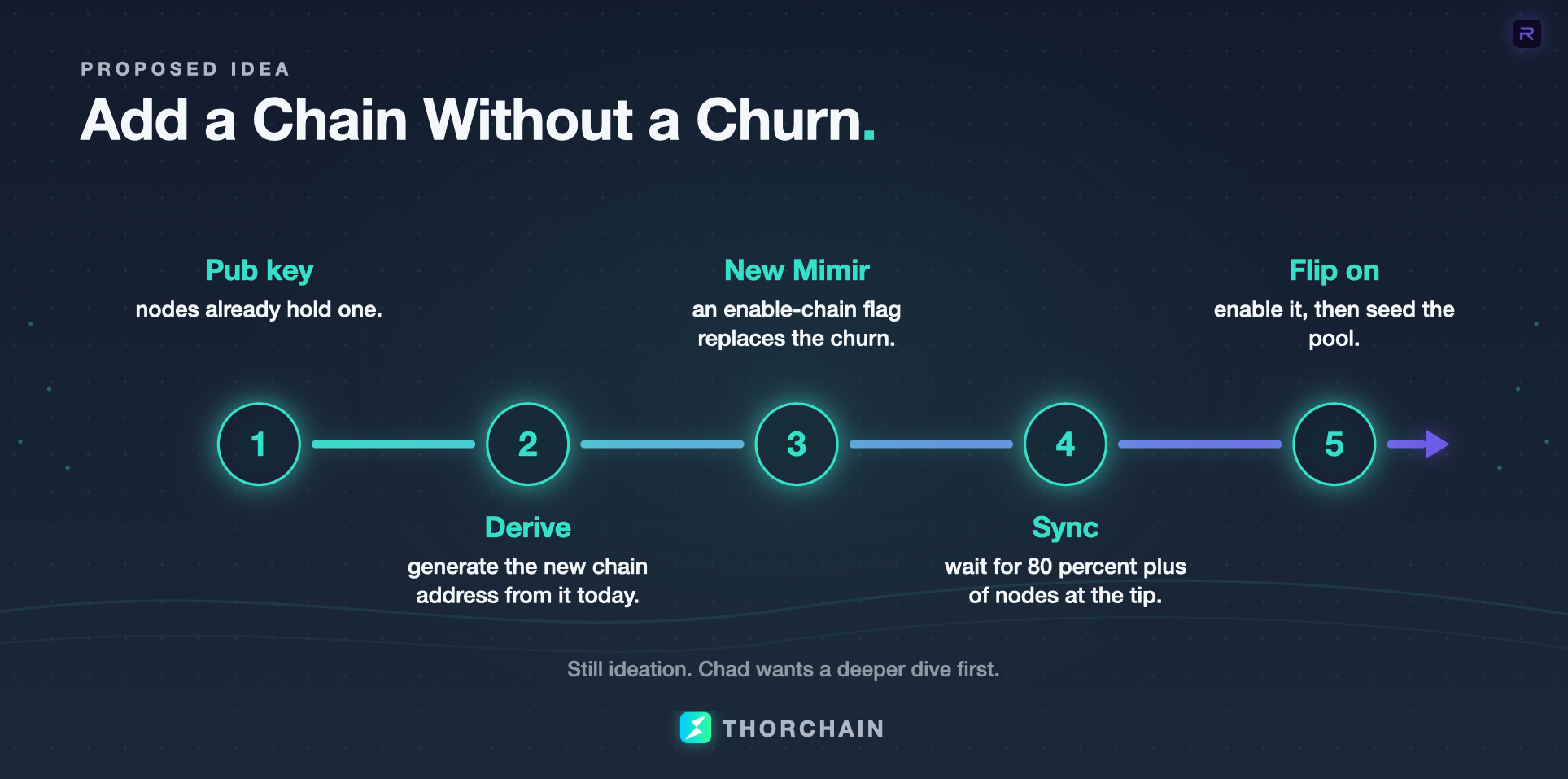
His reasoning: THORChain nodes already hold a public key, and an address for a new chain like $ZEC or $XMR can be derived from that key today. Instead of a churn-controlled process, adding a chain could become Mimir-controlled. Spin up a new Mimir, say enable Zcash, get 80 percent or more of nodes synced to the chain's tip, then flip it on and seed the pool. Being in the middle of a churn would not block it.
This is still ideation, and Chad wants a deeper dive before committing. The related opt-in chain client work sits in a draft pull request on the back burner for now, behind the dynamic fee model and post-exploit cleanup.
4. Revenue Share Heads to a Vote, and SwapKit's Clever Use of It
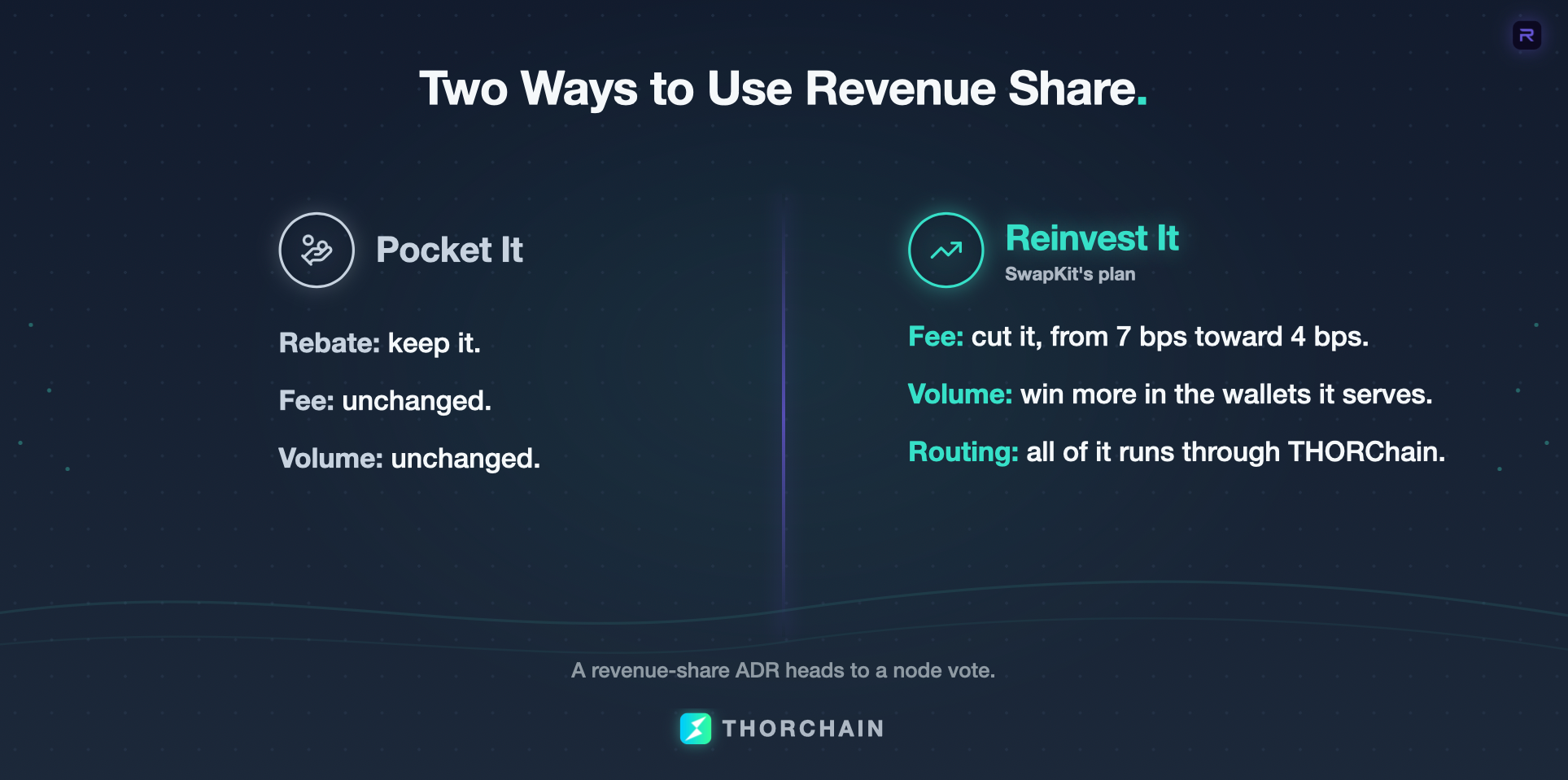
Separate from dynamic fees, revenue share gives the business development team a different tool: the ability to hand a chosen affiliate a slice of the revenue their trades generate, for example 20 percent, as an incentive to bring more flow. A dedicated revenue-share ADR is heading to a node vote.
SwapKit has a clever plan for it. Instead of pocketing the rebate, they intend to pour it back into lower fees, trimming their own take (for instance from 7 bps toward 4 bps) so they can win a larger share of the volume inside the wallets they serve, where they compete against many other swap providers. More trades for SwapKit means more volume routed through THORChain.
There is one very specific snag. SwapKit's THORName contains an unusual character that Mimir will not accept, so the feature cannot be enabled for them until a small patch ships in v3.20. Chad's fix will be a simple hardcoded alias rather than a complex rebuild.
Consider this the PSA of the episode: if you are registering a THORName and might want revenue share later, keep it simple and avoid unusual characters.
5. AI Agents Are the Next Big Swap Customer
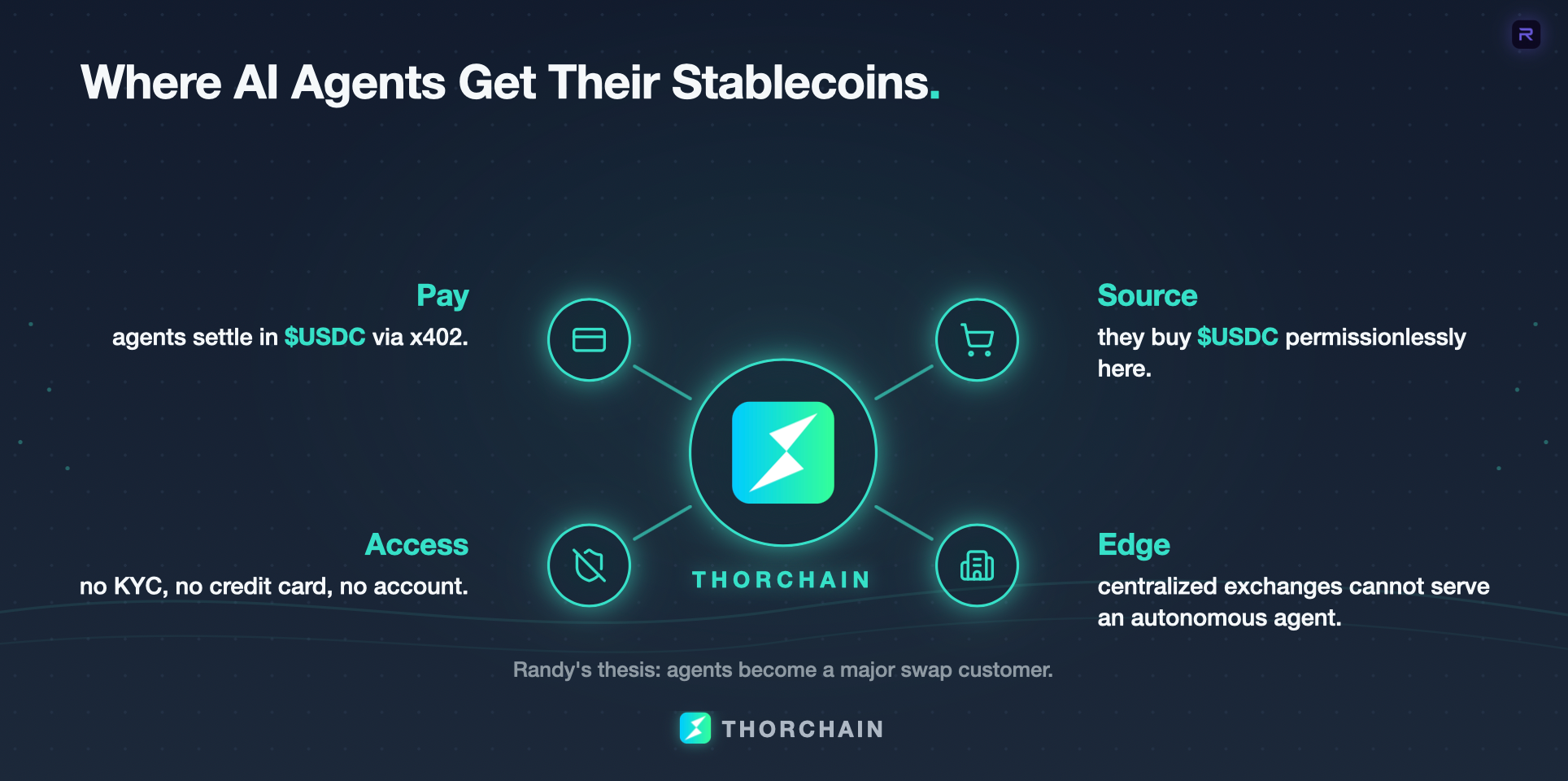
Randy's biggest conviction is that AI agents will become major THORChain users, and his logic runs through x402, the emerging payment standard for agents, where payments are mostly settled in $USDC. If agents hold everything except $USDC, they need a permissionless place to get it, and that place is THORChain. Agents can source $USDC through the protocol and use it to swap, while centralized exchanges cannot realistically serve an autonomous agent.
"KYC and an AI agent is ridiculous on a centralized exchange. It's a non-starter." (Chad)
Chad has handed the deeper x402 and ERC-8004 work to another developer, and sees it tying directly into the free stable-swap idea, since agents gravitate to whatever is cheapest and most efficient. Both were candid that they would not personally hand an agent their wallet yet, because the tooling is not there. The direction, though, is clear.
On a related audience question, whether you could someday buy a Huginn kit and let an AI run a node for you, Chad's answer was not yet. The last mile is the hard part, a hallucination could delete your keys, and hosting the agent somewhere introduces a centralization risk. He was warmer on the smaller idea of AI-assisted alerting, though he noted the node launcher already ships with monitoring that operators simply need to configure.
Huginn made a cameo of its own. It accidentally flipped a protocol-owned liquidity Mimir from operational to economic, and the change slipped through code review, with the fix riding along in v3.20. As Chad put it, technology makes mistakes too, and the speed Huginn adds is worth the occasional slip.
6. BD Update: Re-engaging Partners, ERC-20s, and TradFi
Randy's day job is reconnecting with partners THORChain has worked with over the years and chasing new wallets and aggregators. He put out an open call: if you think there is a project THORChain should be integrated with and isn't, tell him, because he will chase anyone.
On listings, there are still major ERC-20 tokens without pools, and Randy singled out Morpheus as a great project and founder he would like to see listed. On the events front, he and Chad are heading to the Futurist Blockchain Conference in Toronto on July 21 and 22, where Chad is one of the main speakers.
The most interesting thread was TradFi. Robinhood launched its own chain, an Arbitrum L2, the same day this episode aired, using DEXes like Uniswap as swap partners, and Randy's question was simple: why not THORChain? The path starts with connecting to their chain, then leaning on the one thing THORChain does that others cannot, which is Bitcoin. The catch is that THORChain will not bend its principles to win that business.
"They might not fit the ethos of crypto, but at the end of the day I don't care. I just want them to swap on THORChain." (Randy)
Chad did pour some cold water on one recurring request. Asked about listing stocks, he thinks it is unlikely: representing stocks on-chain is legally fraught by default, and anyone doing it through a proper process would more likely pick Base or Solana. Stocks are government-controlled assets by design, and that is not where THORChain fits.
7. The Moat Is the Point
The through-line of the episode was THORChain's permissionless, no-KYC, censorship-resistant design, and why it is now the advantage rather than the hard road it once was.
Chad drew a parallel to Erik Voorhees, whose privacy-first Venice AI just raised $65 million and reached unicorn status. Voorhees sits in the same position THORChain does, a permissionless alternative to a handful of centralized giants, and Chad noted that much of what Voorhees says about Venice can be pointed straight at THORChain.
"We took the hard path. We forged it, and we're not going anywhere." (Chad)
Decentralization is moving in the right direction too. Five new nodes joined at once, with more on the way, and the exploit pause meant a batch of operators were ready and dropped together. Denny highlighted one operator who is giving up all of his own bps to help others get online, specifically because $XMR is coming. Kenton was out this week getting some well-earned rest, but the message from Randy, Chad, and Denny was consistent: the moat is not going anywhere, and if anything it is getting wider.
What to Watch
- Dynamic fees: Which affiliates get switched on next, and whether the model actually lifts revenue.
- Monero: v3.19.4 is the target, roughly one to two weeks out, followed by a deliberately shallow launch.
- Revenue share: The ADR heads to a node vote, with SwapKit's lower-fee experiment waiting on the v3.20 patch.
- Faster chain adds: Whether Chad's churn-free, Mimir-based method for adding chains gets built.
- v3.20: Bundles the SwapKit THORName alias fix and the corrected protocol-owned liquidity Mimir.
More THORChain data, check out raynalytics.net
Follow Raynalytics for more Weekly Analytics and Podcast recaps.

Related articles
![Protocol Update Podcast with Chad Barraford, Kenton, Devel and Boone]()
Sep. 24, 2026
Inside the Houdini Swap Debate: THORChain’s Treasury, Privacy and Revenue
- Podcast
![Ecosystem Update Podcast with Radix]()
Sep. 19, 2026
Radix and THORChain: Building Trust for the Agentic Future
- Podcast
![THORChain Podcast protocol update cover]()
Sep. 17, 2026
THORChain Returns to Shipping: Zcash, Monero and Self-Sufficiency
- Podcast
![Ecosystem Update Podcast with Station Wallet]()
Sep. 13, 2026
Terra’s Station Wallet Is Back as Vultisig’s Agentic THORChain Wallet
- Podcast
![Protocol Update Podcast with Chad Barraford, Kenton and Patriot / Denny]()
Sep. 10, 2026
THORChain Prioritizes Stability Before Monero and New Features
- Podcast
![Ecosystem Update Podcast with RAVN]()
Sep. 5, 2026
Inside RAVN’s Native $BTC Aggregator and Its THORChain Integration
- Podcast
![Protocol Update Podcast with Hans, Devel, Chad, Kenton & Denny]()
Sep. 3, 2026
THORChain Churns Again: POL Goes Live, Rujira Resumes and BLO Debate
- Podcast
![Ecosystem Update Podcast with Rujira]()
Aug. 29, 2026
THORChain’s App Layer Rujira Is Paused. Rujira Wants a Clear Restart Path.
- Podcast
![Protocol Update Podcast with Chad Barraford, Kenton and Denny]()
Aug. 27, 2026
THORChain Puts Stability First: Monero & Zcash Delayed, ADR30, AI Agents and Memoless Swaps
- Podcast
![Ecosystem Update Podcast with Unstoppable Wallet]()
Aug. 22, 2026
Unstoppable Wallet Adds $RUNE, $TCY and $RUJI, With a Stablecoin Wallet Next
- Podcast
![Protocol Update Podcast with Chad Barraford, Kenton and Denny]()
Aug. 20, 2026
v3.20 Voting Is Underway. Should THORChain’s TSS Library Remain Open Source?
- Podcast
![Ecosystem Update Podcast with Dash]()
Aug. 15, 2026
Inside Dash’s Zcash Orchard Upgrade and Its THORChain Potential
- Podcast
![Protocol Update Podcast with Chad Barraford, Kenton, Denny and Oleg Petrov]()
Aug. 13, 2026
THORChain is Close to v3.20: FROST, DKLS, SwapKit Rev-Share and Dynamic Fees
- Podcast
![Ecosystem Update Podcast with Morpheus]()
Aug. 8, 2026
Morpheus Maps Decentralized AI, $MOR Inference and a Planned THORChain Pool
- Podcast
![Protocol Update Podcast with Hans and Pragmatic Monkey]()
Aug. 6, 2026
Rujira and THORChain Align on the App Layer: ADR31, CCL, and the Road to Perps
- Podcast