THORChain x BazaarSwap Podcast #214 ft. FlynnTheMaestro, Nikita Anikeev, KentonC137 & Patriotsounds | July 4, 2026 | Watch the full episode on YouTube
By Raynalytics
TL;DR
- BazaarSwap has integrated THORChain into a meta-DEX that compared routes across 163 blockchains and 41,100 tokens at the time of the episode. Users can compare output, cost, speed, and provider instead of accepting a single quote.
- The team chose THORChain because it can route native Layer 1 assets without conventional bridges or wrapped tokens. In the live demo, THORChain became especially competitive as the example $ETH-to-$BTC swap grew larger.
- BazaarSwap is ready to add THORChain's future $XMR pool as a route, but the pool is not live yet. Early liquidity is expected to be shallow, and THORChain itself remains public even when the destination asset is private.
- TON swaps are already in beta through STON.fi, while a Telegram mini app and AI-directed routing remain planned features.
- BazaarSwap currently adds no separate platform fee. A token, Rujira integration, execution ratings, deeper analytics, and possible fees for more complex AI routes are all future plans without firm timelines.
Introduction
BazaarSwap does not want users opening a dozen tabs to find one trade. The product is a meta-DEX aggregator: it compares the aggregators, exposes multiple routes, and lets the user decide whether best output, lower cost, faster execution, or a preferred provider matters most.
The project grew out of Decentr's attempt to let customers pay for software with whatever wallet, chain, or token they already held. CEO and co-founder Flynn Jameson and Decentr CTO and co-founder Nikita Anikeev joined the podcast to demonstrate the working interface, explain the THORChain integration, and map out where the product is headed next.
1. One Interface, Multiple Routes
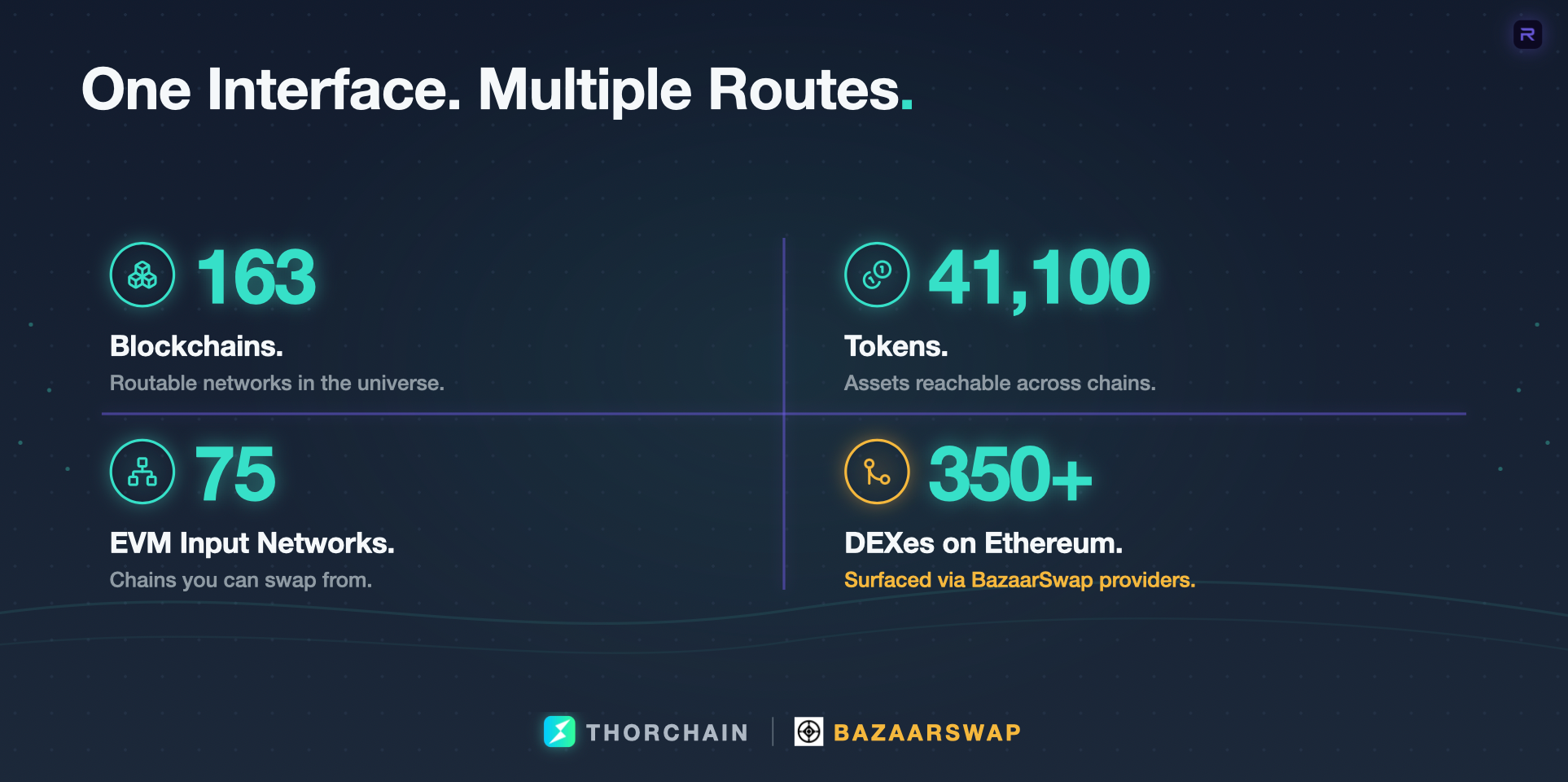
At the time of the demo, BazaarSwap supported 75 EVM networks on the input side, 163 blockchains in total, and 41,100 tokens. Through its providers, the interface could reach more than 350 DEXes on Ethereum alone.
The important part is not just the size of that inventory. When a user enters a trade, BazaarSwap displays the available providers alongside the expected output, exchange rate, gas cost, estimated time, and any platform fee. The routes are ordered by output, but the user can still choose a different one.
"We want to give the users as much choice as possible." (Nikita)
That visibility is meant to address a weakness in many aggregators: the user receives one recommended quote without seeing what the competing routing systems found. BazaarSwap currently aggregates providers including Squid, Rango, Rubic, and THORChain, which in turn connect to hundreds of individual venues.
There are limits to what the interface knows today. BazaarSwap does not yet track quoted output against final execution across its entire route universe. Nikita said transaction ratings and deeper analytics could come later, but doing that properly requires substantial data infrastructure. For now, the value proposition is comparison and choice, not a guarantee that every displayed estimate will execute exactly as quoted.
2. Why THORChain Earned a Place in the Router
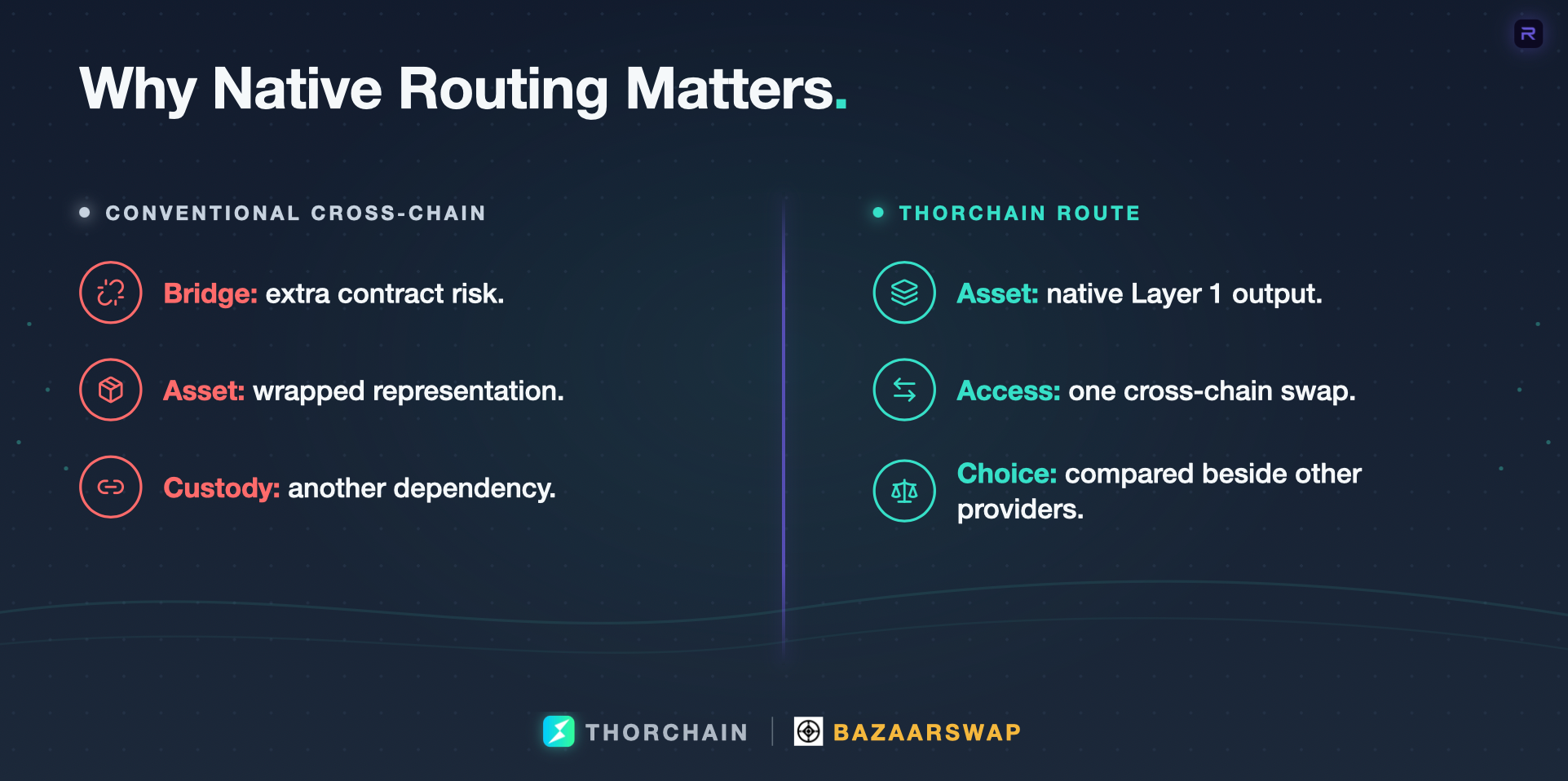
The guests were explicit about why they integrated THORChain. Most cross-chain systems still depend somewhere on a bridge, a wrapped asset, or a custodian. THORChain lets BazaarSwap offer routes between native assets on their own chains.
"THORChain is just superior to everything else out there." (Flynn)
The live demonstration made the distinction concrete. In one changing market snapshot, a roughly 10 $ETH swap into native $BTC showed THORChain with the highest output and lowest cost. When Flynn increased the example to 100 $ETH, worth roughly $177,000 during the recording, THORChain was the only route BazaarSwap displayed. Those quotes were momentary rather than permanent benchmarks, but they illustrated where deep native liquidity and streaming swaps can matter.
Anything THORChain exposes through its API can flow into BazaarSwap's comparison layer. That means BazaarSwap does not need to recreate THORChain's swap mechanics. It can present the route beside competing providers and let price, speed, and user preference decide.
"We view THORChain as the true purists in the room." (Flynn)
Flynn tied that description to THORChain maintaining its native-asset design through years of difficult development. BazaarSwap still supports routes that use bridges or wrapped assets when those are the available options. Adding THORChain gives users a clearly different path, especially for assets such as native $BTC that do not fit neatly into EVM-only liquidity.
3. Ready for Monero, With Important Caveats
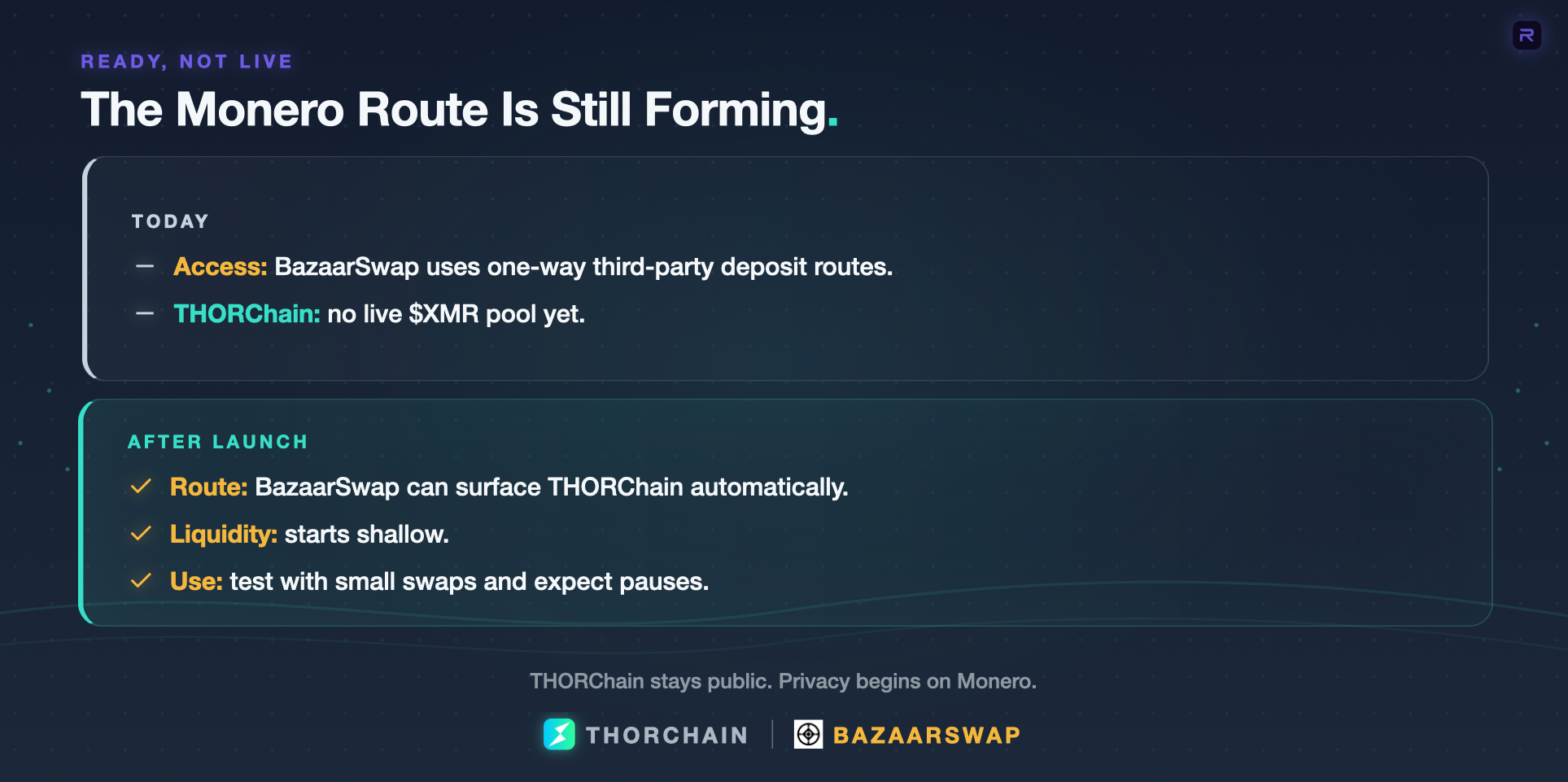
Privacy assets are one of the strongest reasons BazaarSwap wants broad route coverage. The interface already supports one-way $XMR deposits through third-party providers and routes Zcash's $ZEC through NEAR Intents. Once THORChain's Monero pool is live and has usable depth, BazaarSwap expects it to appear as another route automatically.
That is readiness, not a launch announcement. The $XMR pool was still forthcoming during this episode. Denny repeated the early-use warning: expect shallow liquidity, possible pauses, and bugs while the chain client settles. Start with roughly $50 to $100 rather than attempting a large swap. When it is ready, the pool will also be accessible through THORChain Swap.
The technical path owes a great deal to Luke Parker of Serai, who open-sourced the FROST threshold-signature work, and community developer Boone, who has helped build the chain client.
Kenton also corrected an important misconception. THORChain is public. A swap into $XMR does not make the visible THORChain side private; the privacy-preserving behavior occurs on Monero after the asset reaches that network. BazaarSwap can improve access to the route, but it does not change that boundary.
4. TON Today, AI-Directed Routing Tomorrow
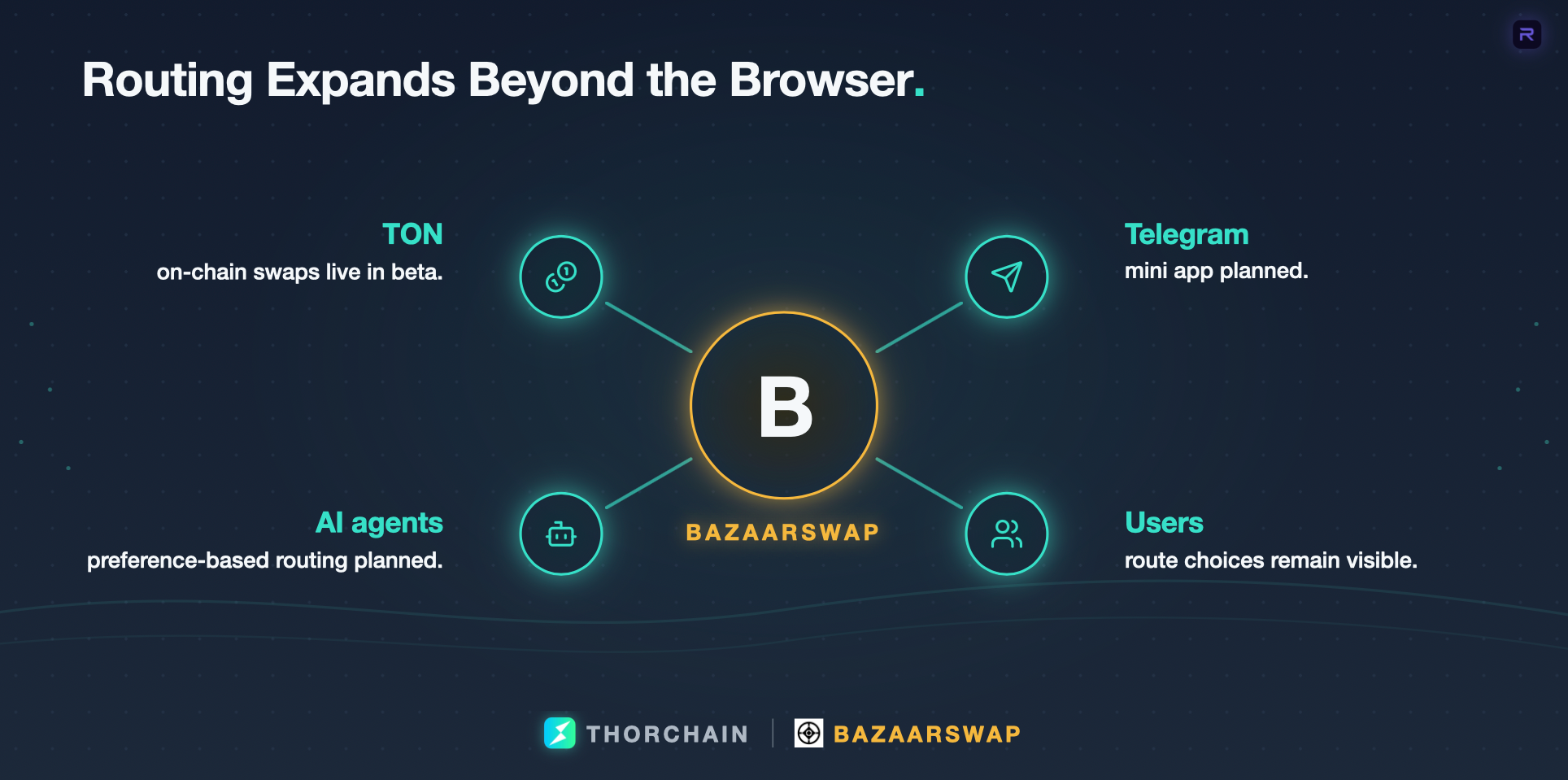
BazaarSwap's newest live addition was TON. The team demonstrated on-chain TON swaps through STON.fi, with the integration still labeled beta. Cross-chain stablecoin routes were also being connected from TON to Ethereum, BNB Chain, Base, Polygon, Arbitrum, and Avalanche.
The distribution opportunity is Telegram. A BazaarSwap mini app is planned so a user could swap inside Telegram through its embedded TON wallet without visiting another site or completing a separate wallet connection. That mini app was not live during the episode.
AI agents are the other major roadmap. Humans may care about provider reputation or prefer a familiar route even when it is not the absolute cheapest. An automated agent is more likely to optimize for price, speed, or another programmed rule across a much larger number of transactions.
"We want to bring everything together and make it as simple as possible for both humans and AI agents to swap." (Flynn)
The interface does not yet hand route selection to an AI agent. Nikita described a future system that could watch the market and act according to the user's preferences. The important design principle is that those preferences and route options remain visible rather than disappearing into a black box.
5. From Fiat Entry to DeFi Primitives
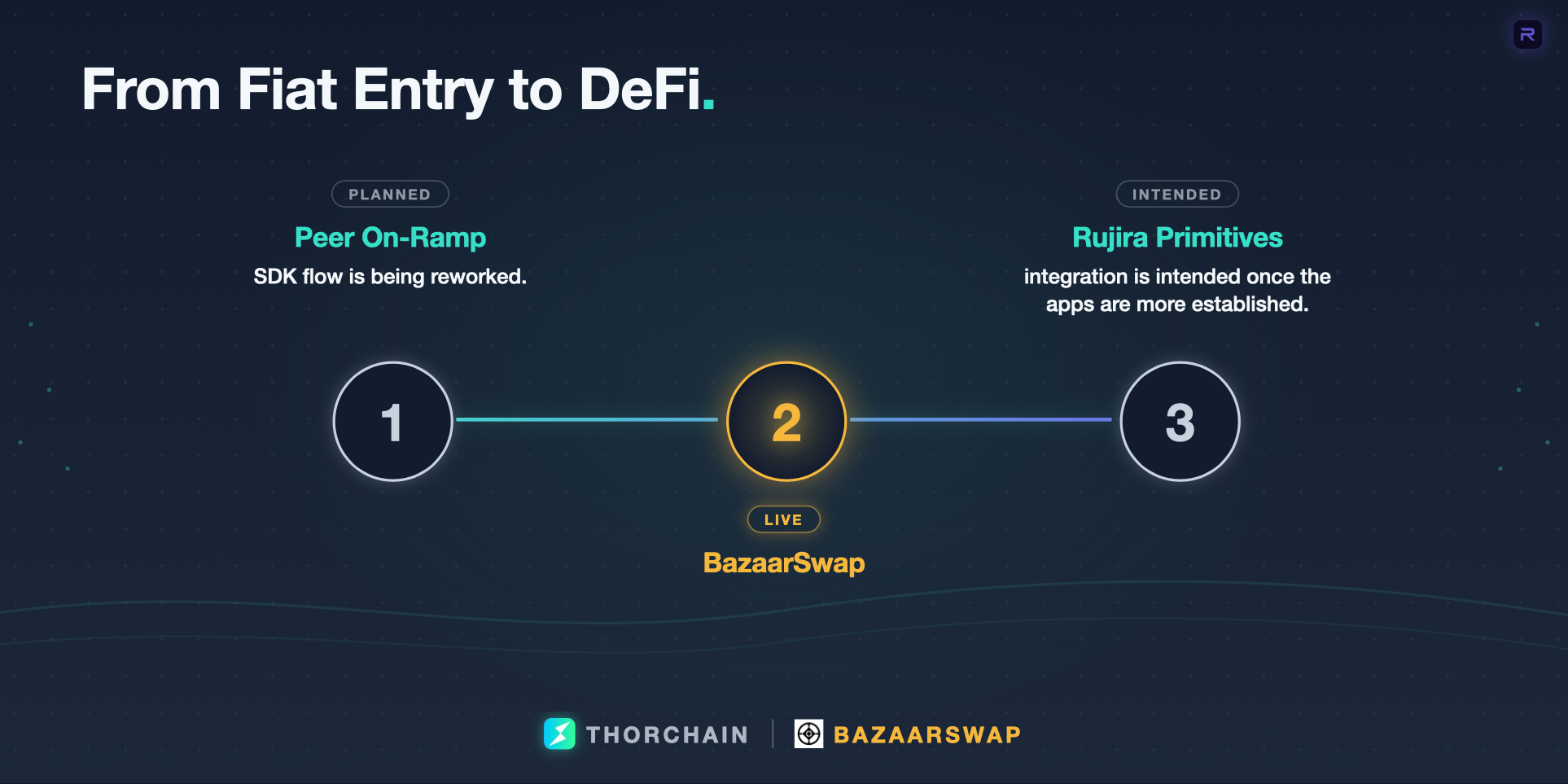
The larger BazaarSwap plan extends beyond swaps. The team has been working with Peer on a fiat-to-crypto SDK flow, although that integration is being reworked after Peer deprecated a browser-wallet component. The intended journey is fiat into a stablecoin, crypto-to-crypto routing through BazaarSwap, then access to DeFi applications.
That final layer is where Rujira could fit. BazaarSwap is monitoring Rujira's lending, concentrated liquidity, launchpad, stablecoin, and perpetuals work, with the intention of integrating selected primitives once they are more established. This is a stated plan, not a completed integration.
The business model is also still taking shape. BazaarSwap currently adds no separate fee beyond what the underlying provider charges. If it later chains multiple aggregators together for more complex AI-directed routes, the team may introduce its own fee and display it transparently. A BazaarSwap token is planned, but there is no announced chain or timeline.
THORChain may add another incentive. Denny described an early revenue-share system being tested that could give high-volume integrators a portion of THORChain's side of the revenue in addition to their chosen affiliate fee. The details were not final, but the model could reward BazaarSwap for sending more native-asset flow without worsening execution for users.
6. Choice Is the Product
BazaarSwap's thesis is that fragmented liquidity is not solved by declaring one route the winner forever. It is solved by placing credible routes beside each other, exposing the tradeoffs, and letting users or their agents choose.
"It's always about options. We don't want you to be given only one choice, because that's not a choice." (Flynn)
THORChain fits that thesis because it adds something structurally different to the menu: native cross-chain liquidity without forcing every asset through a wrapped representation. BazaarSwap provides the comparison layer. THORChain provides a route that becomes difficult for bridge-based alternatives to match when native assets and larger swaps matter most.
What to Watch
- Route quality: Whether BazaarSwap adds quote-versus-execution tracking and user ratings.
- Monero: When THORChain's $XMR pool goes live, how quickly it becomes reliable enough for BazaarSwap routing, and how cautiously users treat the shallow launch phase.
- AI agents: When preference-based automated routing moves from roadmap to a usable product.
- Telegram: Whether the planned BazaarSwap mini app can turn TON's embedded wallet distribution into swap activity.
- DeFi expansion: Progress on the Peer on-ramp rework, Rujira primitives, a BazaarSwap token, and THORChain's proposed integrator revenue share.

More THORChain data, check out raynalytics.net
Follow Raynalytics for more Weekly Analytics and Podcast recaps.

Related articles
![Ecosystem Update Podcast with Houdini Swap]()
Oct. 3, 2026
Houdini Swap on THORChain Explained: What It Means for Users and Treasury Revenue
- Podcast
![Protocol Update Podcast with Chad Barraford, Kenton and Denny]()
Oct. 1, 2026
Can or Should THORChain Censor Transactions?
- Podcast
![Protocol Update Podcast with Chad Barraford, Kenton, Devel and Boone]()
Sep. 24, 2026
Inside the Houdini Swap Debate: THORChain’s Treasury, Privacy and Revenue
- Podcast
![Ecosystem Update Podcast with Radix]()
Sep. 19, 2026
Radix and THORChain: Building Trust for the Agentic Future
- Podcast
![THORChain Podcast protocol update cover]()
Sep. 17, 2026
THORChain Returns to Shipping: Zcash, Monero and Self-Sufficiency
- Podcast
![Ecosystem Update Podcast with Station Wallet]()
Sep. 13, 2026
Terra’s Station Wallet Is Back as Vultisig’s Agentic THORChain Wallet
- Podcast
![Protocol Update Podcast with Chad Barraford, Kenton and Patriot / Denny]()
Sep. 10, 2026
THORChain Prioritizes Stability Before Monero and New Features
- Podcast
![Ecosystem Update Podcast with RAVN]()
Sep. 5, 2026
Inside RAVN’s Native $BTC Aggregator and Its THORChain Integration
- Podcast
![Protocol Update Podcast with Hans, Devel, Chad, Kenton & Denny]()
Sep. 3, 2026
THORChain Churns Again: POL Goes Live, Rujira Resumes and BLO Debate
- Podcast
![Ecosystem Update Podcast with Rujira]()
Aug. 29, 2026
THORChain’s App Layer Rujira Is Paused. Rujira Wants a Clear Restart Path.
- Podcast
![Protocol Update Podcast with Chad Barraford, Kenton and Denny]()
Aug. 27, 2026
THORChain Puts Stability First: Monero & Zcash Delayed, ADR30, AI Agents and Memoless Swaps
- Podcast
![Ecosystem Update Podcast with Unstoppable Wallet]()
Aug. 22, 2026
Unstoppable Wallet Adds $RUNE, $TCY and $RUJI, With a Stablecoin Wallet Next
- Podcast
![Protocol Update Podcast with Chad Barraford, Kenton and Denny]()
Aug. 20, 2026
v3.20 Voting Is Underway. Should THORChain’s TSS Library Remain Open Source?
- Podcast
![Ecosystem Update Podcast with Dash]()
Aug. 15, 2026
Inside Dash’s Zcash Orchard Upgrade and Its THORChain Potential
- Podcast
![Protocol Update Podcast with Chad Barraford, Kenton, Denny and Oleg Petrov]()
Aug. 13, 2026
THORChain is Close to v3.20: FROST, DKLS, SwapKit Rev-Share and Dynamic Fees
- Podcast