Morpheus Maps Decentralized AI, $MOR Inference and a Planned THORChain Pool

2026-08-08 — 8 min read
- Podcast
THORChain x Morpheus Podcast #224 ft. DJohnstonEC, KentonC137 & Patriotsounds | August 8, 2026 | Watch the full episode on YouTube
By Raynalytics
TL;DR
- Morpheus is a decentralized inference marketplace for open-weight AI models. It does not train models or operate as a conventional AI company. Providers supply compute, users and agents consume inference, and the protocol routes sessions between them.
- $MOR can be staked toward an inference provider. David Johnston described that as a way to give a persistent agent access to compute without a recurring card charge, while rewarding the provider selected by the stake.
- Morpheus says its Gateway made access far simpler than running a peer-to-peer node. Johnston said network usage accelerated after the Gateway launch and that the network had processed 39 billion tokens at the time of the recording.
- THORChain is planning to whitelist the $MOR ERC-20 contract in v3.20 so liquidity can be created. The pool was not live at recording time, and the update was still delayed.
- Johnston sees agent-friendly, permissionless payment rails as a natural fit for programmable intelligence. Kenton said THORChain's website had been improved from an agent-readiness score of zero to 100 after their earlier conversation.
Introduction
AI is becoming more capable, more useful and more central to how people work. David Johnston's argument is that the infrastructure behind it should not be controlled by a few companies, funded by a few credit-card subscriptions or dependent on hardware most people cannot afford.
Johnston joined Kenton and Denny to explain Morpheus, a community-built marketplace that connects users and agents with providers of open-weight AI inference. The conversation ranged from the origins of decentralized applications and the mechanics of $MOR staking to private inference, personal agents and the planned, but not yet live, $MOR pool on THORChain.
1. From Decentralized Applications to Smart Agents
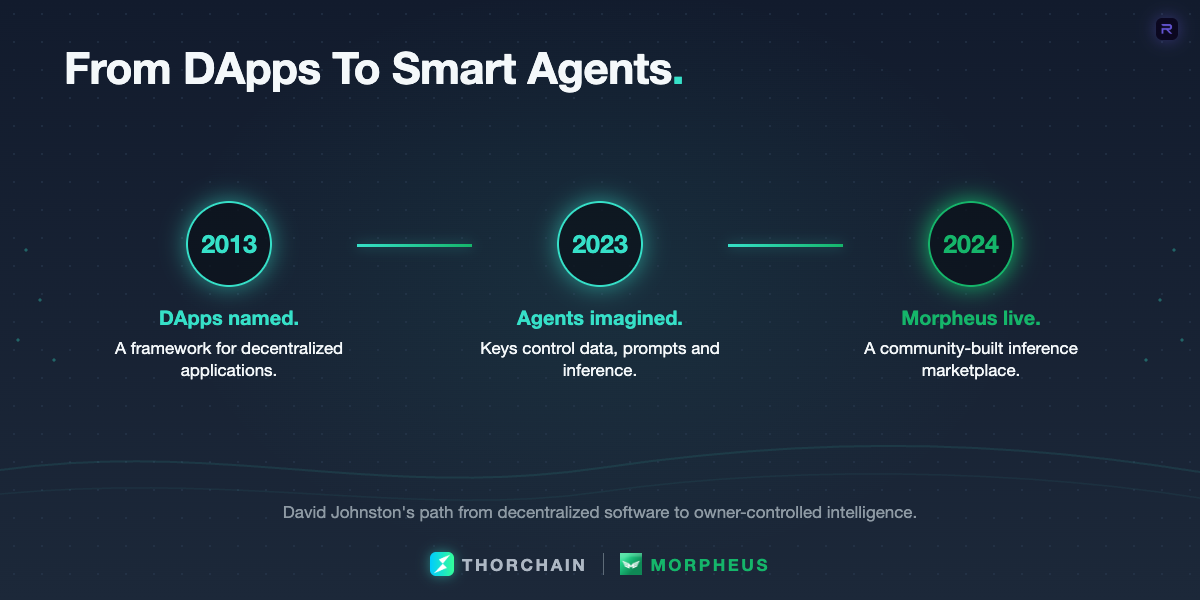
Johnston has been in Bitcoin since 2012 and published The General Theory of Decentralized Applications in 2013. He said that paper introduced the term "DApps," later adopted in Ethereum's own language around smart contracts and decentralized applications.
That background shaped his approach to AI. Bitcoin's open-source code, peer-to-peer network, blockchain and native token became a framework he wanted to apply again, this time to intelligence. His early smart-agent work started from a simple ownership principle: a person's keys should control the data, prompts, inference access and agent that act on their behalf.
"Not your keys, not your AI." (David Johnston)
Morpheus took shape when contributors known as Trinity and Neo published a paper in 2023 arguing that personal agents needed a network, not merely a hobbyist machine. Johnston said that insight brought together builders including Erik Voorhees and grew into a community that launched the protocol in 2024.
The goal is not to replace every model builder. Morpheus focuses on the layer that lets an end user or agent reach the model and compute they choose.
2. A Marketplace for Open-Weight Inference
Morpheus is not another closed-model provider. A compute provider can connect a GPU fleet, an inference API or a model such as DeepSeek to the marketplace. The protocol's routing layer then connects that provider with users who want inference.
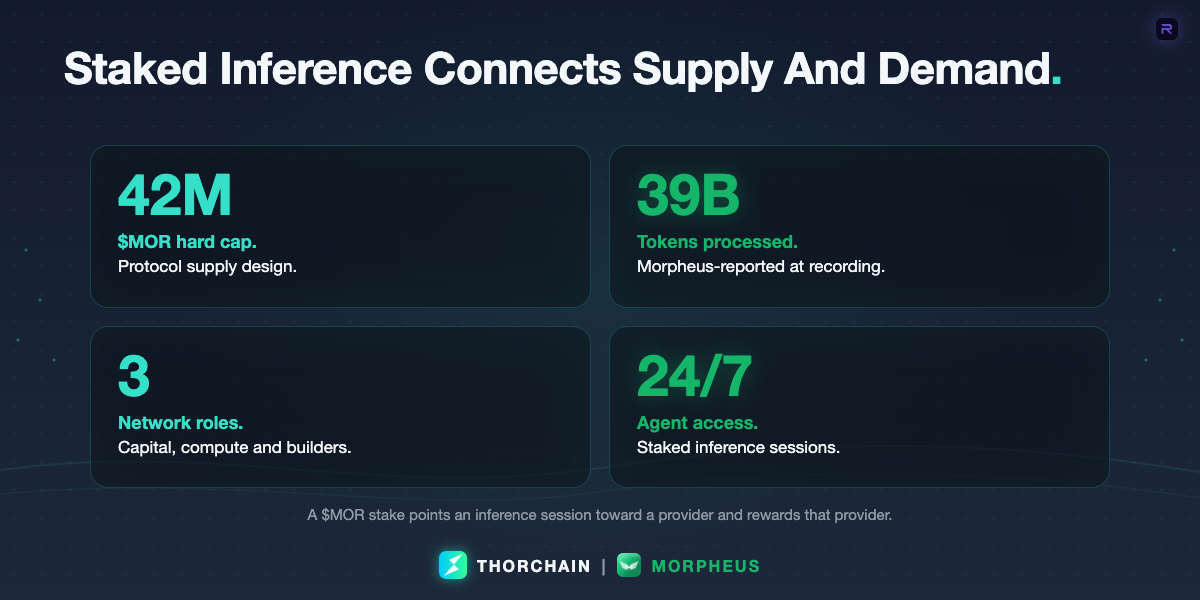
Johnston described Morpheus as a set of smart contracts on Ethereum, Arbitrum and Base, rather than a company training its own models. He said there is no foundation, no premine and no central team directing the network, only contributors, capital providers, compute providers and builders.
"Morpheus is not training any models. It's not building any models." (David Johnston)
That distinction also explains the role of $MOR. A holder can stake $MOR toward a specific provider to obtain inference. At the end of a session, the provider selected by that stake receives the reward. Johnston compared the result to an access and settlement layer: the agent has a budget for brain power, and the provider has a clear incentive to keep serving it.
For a persistent agent, the model is meant to remove the recurring-payment fragility of a card-connected service. Johnston said an agent supplied with $MOR can keep staking for inference and continue operating as infrastructure, rather than disappearing when a subscription or local machine fails.
"If I have $MOR tokens and I give them to my agent, it never runs out of brain power." (David Johnston)
Johnston said Morpheus has a 42 million $MOR hard cap and a recycling mechanism that returns part of previously burned and locked supply as future block rewards. The claim is a long-lived incentive system without minting new tokens. That is a protocol design explanation, not a promise about token value.
3. Open Models Need Accessible, Private Compute
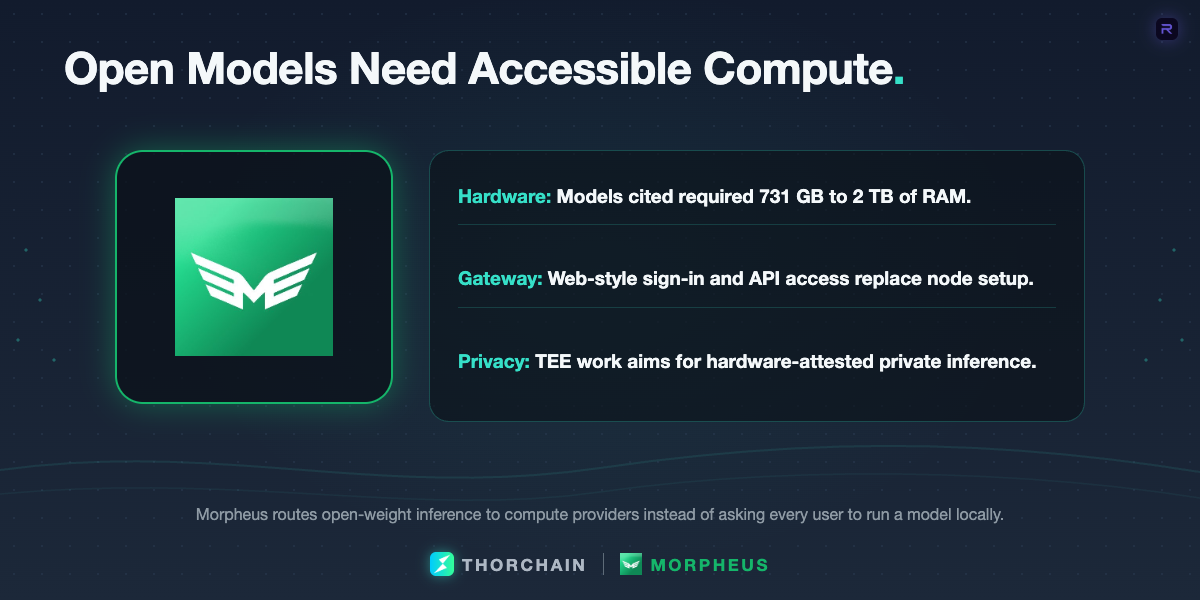
Running a model locally can be private, but it is not always practical. Johnston used the size of current open-weight models to make the point: one DeepSeek model discussed on the show needed 731 GB of RAM, while another model cited needed 2 TB. Most people do not have that hardware, and many people globally access the internet only through a phone.
The marketplace is designed to make that gap usable. Providers can offer excess GPU capacity, while consumers can choose models without paying a proprietary-model margin. Morpheus says the Gateway then removes much of the peer-to-peer-node setup: users can sign in, create a key and access inference through a familiar web interface. Credit-card access remains an option, but Johnston presented self-managed $MOR staking as the more sovereign route.
He said the Gateway launch materially increased usage, and that Morpheus had processed 39 billion tokens by the recording. He also described monthly usage moving from roughly 1 billion, then 3 billion, 7 billion and 16 billion tokens as open-weight models became more competitive. Those are Morpheus-reported network figures discussed on the podcast, not independently verified on-chain metrics.
Privacy is another part of the roadmap. Johnston pointed to trusted execution environments that aim to keep a request encrypted until it reaches the GPU, so even a compute provider cannot read the underlying text. The TEE work is a developing privacy approach, not a blanket claim that every inference path is already private.
"Programmable money is perfectly set up to connect with programmable intelligence." (David Johnston)
4. $MOR Is Planned for THORChain, Not Live Yet
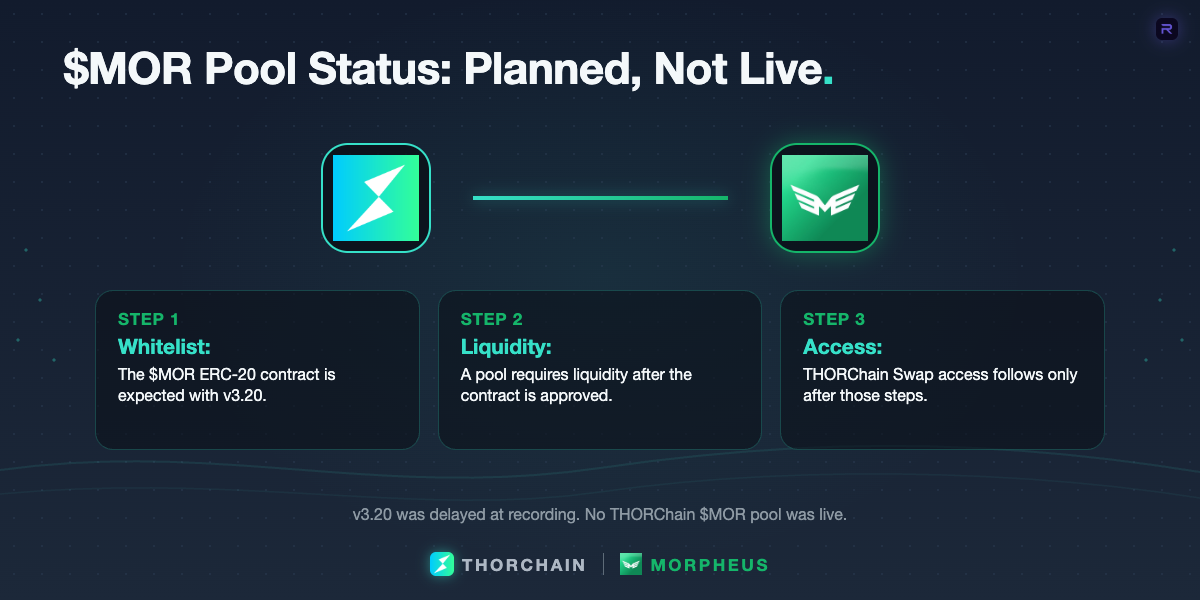
The immediate THORChain connection is a planned $MOR pool. Johnston and THORChain contributors had already discussed putting the ERC-20 asset on the protocol, and Kenton said the required contract whitelist was expected to ship with v3.20.
That matters because an ERC-20 whitelist is the technical prerequisite for creating the pool, not the pool itself. The update had been delayed, the $MOR contract was still awaiting whitelist status, and no THORChain $MOR liquidity pool was live at recording time. Kenton hoped the release would arrive within roughly two weeks, but he framed that as an expectation rather than a commitment.
The status follows earlier v3.20 coverage in the Podcast #221 recap. For now, people seeking $MOR were directed to decentralized venues on Base and Arbitrum. Any future pool would make it possible to access the asset through THORChain Swap, subject to the whitelist, liquidity creation and the release completing.
"The easier we can make this for people, the more it's going to give people access to this." (David Johnston)
5. Agents, Open Access and THORChain's Payment Rails
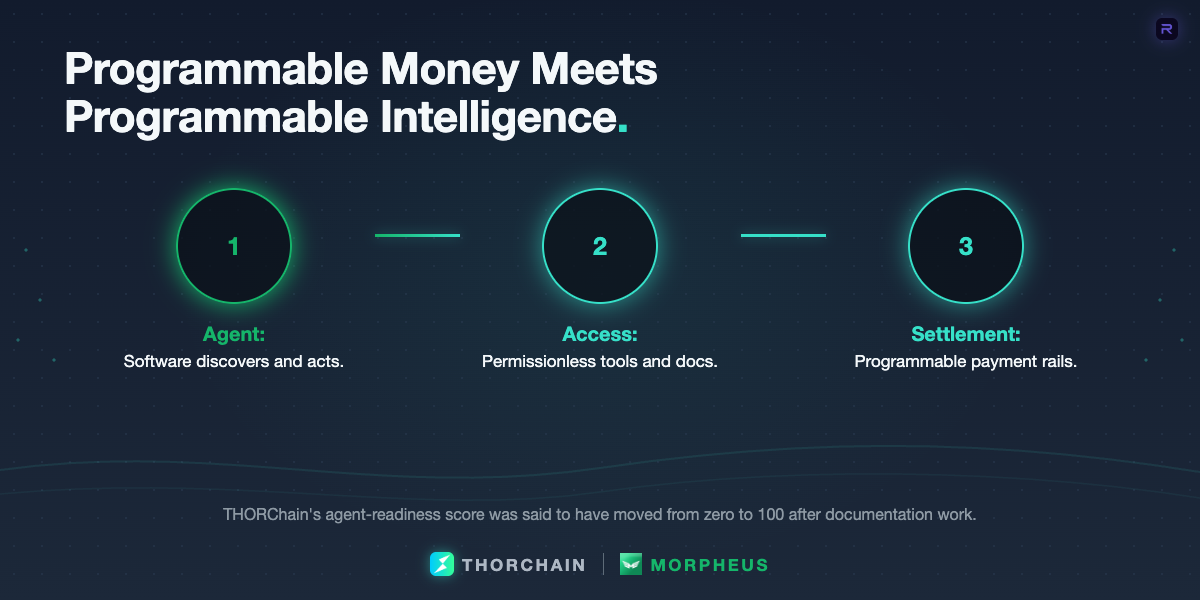
Johnston's broader thesis is that future agents will need services they can discover and use without waiting for a wire transfer, opening a centralized account or handing sensitive credentials to a third party. He expects decentralized exchanges and other permissionless tools to suit that environment because they are programmable and can settle quickly.
He said the future of trading will be heavily agent-driven, calling THORChain's native-asset design particularly relevant to that future. Kenton said he had followed Johnston's earlier advice on agent readiness, moving THORChain's site from a score of zero to 100 on an agent-readiness tool by improving documentation and machine-readable access.
The podcast also distinguished between an agent that assists a person and one that acts without a user's interest in mind. Johnston's view is that personal agents should remain extensions of their owners, with the user deciding how their data, prompts and funds are used.
"You can own an AI or you can be farmed by AI. Those are your choices." (David Johnston)
Morpheus will not decide whether that future arrives, and a future THORChain pool is not a deployment of agent trading. The shared direction is narrower and more concrete: open inference needs payment rails, and permissionless rails need interfaces and documentation that software agents can use.
What to Watch
- v3.20 and the whitelist: whether the $MOR ERC-20 contract is added, then whether liquidity is actually created. The pool remains planned, not live.
- Gateway adoption: whether simplified sign-in and API access continue to broaden Morpheus beyond node operators and self-hosted setups.
- Private inference: how Morpheus's TEE roadmap develops, and which providers support hardware-attested privacy.
- Open-weight model competition: whether model quality, cost and available compute continue moving more AI usage toward open infrastructure.
- Agent-ready THORChain tooling: whether machine-readable documentation and permissionless interfaces translate into practical agent integrations.

More THORChain data, check out raynalytics.net
Follow Raynalytics for more Weekly Analytics and Podcast recaps.

Related articles
![Protocol Update Podcast with Chad Barraford, Kenton, Devel and Boone]()
Sep. 24, 2026
Inside the Houdini Swap Debate: THORChain’s Treasury, Privacy and Revenue
- Podcast
![Ecosystem Update Podcast with Radix]()
Sep. 19, 2026
Radix and THORChain: Building Trust for the Agentic Future
- Podcast
![THORChain Podcast protocol update cover]()
Sep. 17, 2026
THORChain Returns to Shipping: Zcash, Monero and Self-Sufficiency
- Podcast
![Ecosystem Update Podcast with Station Wallet]()
Sep. 13, 2026
Terra’s Station Wallet Is Back as Vultisig’s Agentic THORChain Wallet
- Podcast
![Protocol Update Podcast with Chad Barraford, Kenton and Patriot / Denny]()
Sep. 10, 2026
THORChain Prioritizes Stability Before Monero and New Features
- Podcast
![Ecosystem Update Podcast with RAVN]()
Sep. 5, 2026
Inside RAVN’s Native $BTC Aggregator and Its THORChain Integration
- Podcast
![Protocol Update Podcast with Hans, Devel, Chad, Kenton & Denny]()
Sep. 3, 2026
THORChain Churns Again: POL Goes Live, Rujira Resumes and BLO Debate
- Podcast
![Ecosystem Update Podcast with Rujira]()
Aug. 29, 2026
THORChain’s App Layer Rujira Is Paused. Rujira Wants a Clear Restart Path.
- Podcast
![Protocol Update Podcast with Chad Barraford, Kenton and Denny]()
Aug. 27, 2026
THORChain Puts Stability First: Monero & Zcash Delayed, ADR30, AI Agents and Memoless Swaps
- Podcast
![Ecosystem Update Podcast with Unstoppable Wallet]()
Aug. 22, 2026
Unstoppable Wallet Adds $RUNE, $TCY and $RUJI, With a Stablecoin Wallet Next
- Podcast
![Protocol Update Podcast with Chad Barraford, Kenton and Denny]()
Aug. 20, 2026
v3.20 Voting Is Underway. Should THORChain’s TSS Library Remain Open Source?
- Podcast
![Ecosystem Update Podcast with Dash]()
Aug. 15, 2026
Inside Dash’s Zcash Orchard Upgrade and Its THORChain Potential
- Podcast
![Protocol Update Podcast with Chad Barraford, Kenton, Denny and Oleg Petrov]()
Aug. 13, 2026
THORChain is Close to v3.20: FROST, DKLS, SwapKit Rev-Share and Dynamic Fees
- Podcast
![Protocol Update Podcast with Hans and Pragmatic Monkey]()
Aug. 6, 2026
Rujira and THORChain Align on the App Layer: ADR31, CCL, and the Road to Perps
- Podcast
![Ecosystem Update Podcast with Depouch]()
Aug. 1, 2026
Inside depouch: Direct THORChain Swaps Built for Simplicity
- Podcast