Monero on THORChain Waits on v3.21.1, SwapKit Rev-Share and 2-Second Blocktime

2026-10-22 — 13 min read
- Podcast
THORSday Community Podcast #244 ft. CBarraford, KentonC137 & Patriotsounds | October 22, 2026 | Watch the full episode on YouTube
By Raynalytics
TL;DR
- v3.21 was about 13 hours from adoption. Chad expects to cut v3.21.1 next week once two more pull requests merge, and once the paused churn resumes, $XMR is ready to launch.
- In its second week, SwapKit Rev-Share spent $841.60 in credits on swaps that earned THORChain $3.72K in fees, a 4.4x return that held steady as spending doubled.
- Chad is turning block time into an adjustable mimir so THORChain can step down from 6 seconds to 2 seconds one second at a time, and step back up without a new binary.
- About 20% of nodes have started voting to end rewards to liquidity pools. Kenton wants a formal ADR, while Denny and Chad made the case for protocol-owned liquidity (POL) instead.
- Chad unveiled Visual Review, a tool that turns any code change into an explainer page, and the solvency checker halted a small IBC exploit on its own at a loss of about $800.
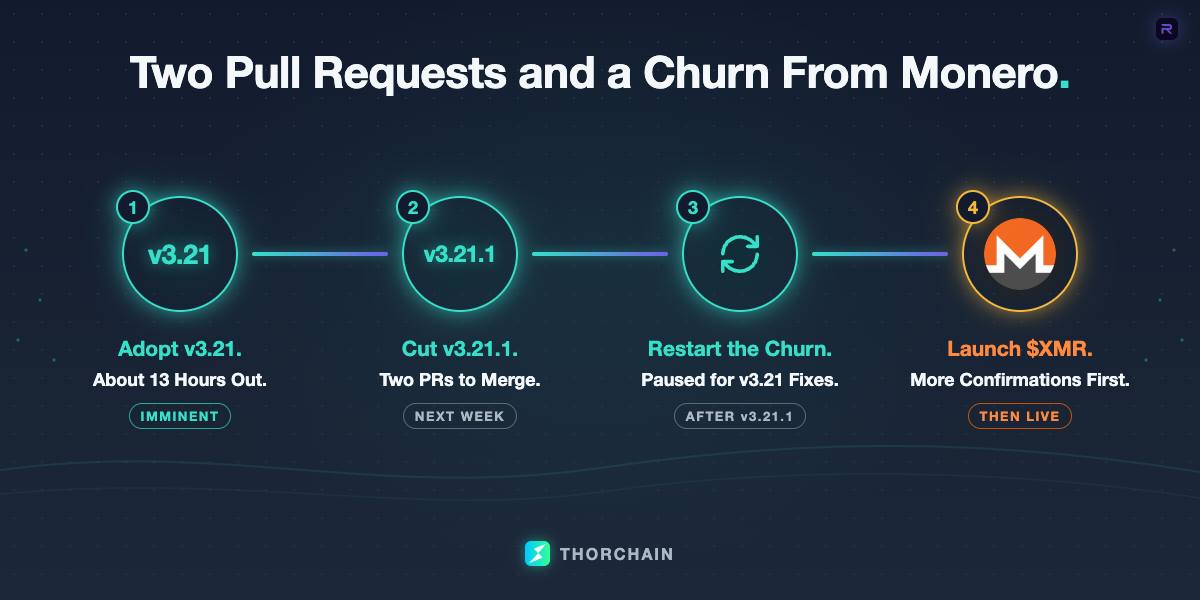
1. Monero Is Two Pull Requests and a Churn Away
At recording time, v3.21 was roughly 13 hours from adoption. Chad said two more pull requests need to merge before the team can cut v3.21.1, which he expects next week. The churn is currently paused for issues that v3.21 fixes, so the remaining sequence is: adopt v3.21 and v3.21.1, restart the churn, and launch Monero.
"Once that's out and the churn is churning, we're live." (Chad)
A community member asked whether THORChain could be a reorg target, citing the Qubic selfish-mining incidents on Monero. Chad said it comes down to confirmation counting. He described a method JP created years ago: wait enough blocks that the block rewards in that window exceed the value coming into the protocol. More confirmations mean slower trades, but because THORChain has no decentralized competition for $XMR and competes mainly with centralized exchanges, speed matters less at launch. Chad leans toward a higher confirmation count to start, with the exact number still to be researched. For contrast, he recalled Erik Voorhees telling him that ShapeShift used a single confirmation on Bitcoin for its whole history without a reorg incident.
Shielded Zcash addresses are not coming soon. Chad used AI to generate a full implementation in about 12 hours, but it added roughly 20,000 to 30,000 lines of code, and the devs pushed back on the complexity. What tipped Chad was Maya Protocol's data: only about 15% of its Zcash volume uses shielded addresses. The Zcash community is also working on rotating transparent addresses, which Chad expects would need no changes on THORChain's side. He will be at Zcash Foundation's Zcon7 in Cancún next week.
Beyond Monero, BSC is now on Router v6 alongside Base and Avalanche, and churnless chain additions are targeted for the next release or the one after. Asked about Zano, Chad said it is still well back in the queue. He named Substrate-based chains, Bittensor's $TAO and Dash as the short list after Monero, which he called by far the hardest chain THORChain has integrated.
2. SwapKit Rev-Share Holds at 4.4x in Week Two
Chad returned to Ray's SwapKit Revenue Share dashboard for a second weekly check-in. Under the 20% Rev-Share, SwapKit has accrued $7.03K in credits and spent $841.60 of it on quote discounts, leaving a $6.19K balance. Swaps carrying those discounts earned THORChain $3.72K in fees, a 4.4x return, slightly below the 4.6x of week one. The discounted swaps added up to $1.96M in volume across 778 swaps, an average of about $2,500 each.
Chad's summary was that the numbers held. Spending roughly doubled over twice the time, and the ratio barely moved, which the hosts called a great sign.
The open question is still scale. Chad expects SwapKit to raise its spending after v3.21, and the hosts noted that the release fixes an affiliate code bug that should let SwapKit add more partners. If the ratio stays around 4.4x to 4.5x, he said raising the share from 20% to 25% would create the flywheel discussed last week, where every dollar SwapKit spends returns more than a dollar to its bucket, until SwapKit's market saturates. Week one is covered in last week's recap.
3. Should THORChain End LP Rewards?
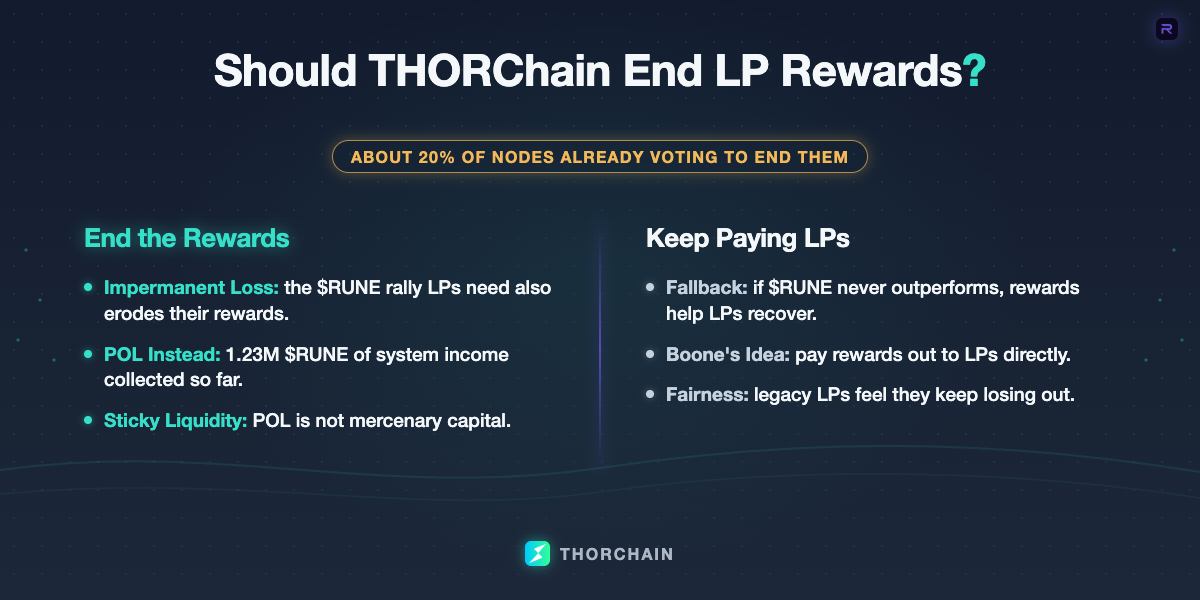
Kenton raised a vote already in motion: roughly 20% of nodes, about 27, have started voting to cancel rewards going to liquidity pools. Because it would be a big change to THORChain's economics, he suggested someone write a formal ADR.
The backdrop: for months the incentive pendulum sent nearly all rewards to nodes, then 20% of system income began flowing to POL. Now the pendulum is swinging back, and rewards are reaching legacy LPs again. Kenton's concern is that LPs need $RUNE to outperform to break even, but that same outperformance erodes the value of their accumulating rewards through impermanent loss. He believes POL should replace LPs over time. He also steelmanned the other side: if $RUNE never outperforms enough, those rewards could help pay LPs back. Boone has proposed paying rewards out to LPs directly to shield them from impermanent loss, and wrote in chat that most LPs would not benefit from rewards at current prices because synth leverage is so severe.
Denny, speaking as an LP, backed POL over LP rewards. Ray's POL Income dashboard shows 1.23M $RUNE of system income collected for POL, about $791,500 at current prices. Kenton added that $RUNE tracks volume, volume needs liquidity, and THORChain has lost roughly 75% to 80% of its liquidity since THORFi. He would end the rewards if it were his call, while acknowledging that node operators are also struggling on low yields. Node income is tracked on Ray's THORChain Financials page.
"We are grinding our way out of this hole. It's happening." (Denny)
Chad favored POL because it is not mercenary capital. If there were another hack, POL would likely be first in line to absorb losses, rather than the Treasury, which paid for most past incidents. He said he wished THORChain had launched with both streaming swaps and POL from day one. For background, see the recap covering POL's launch.
4. A Gradual Path to 2-Second Blocks
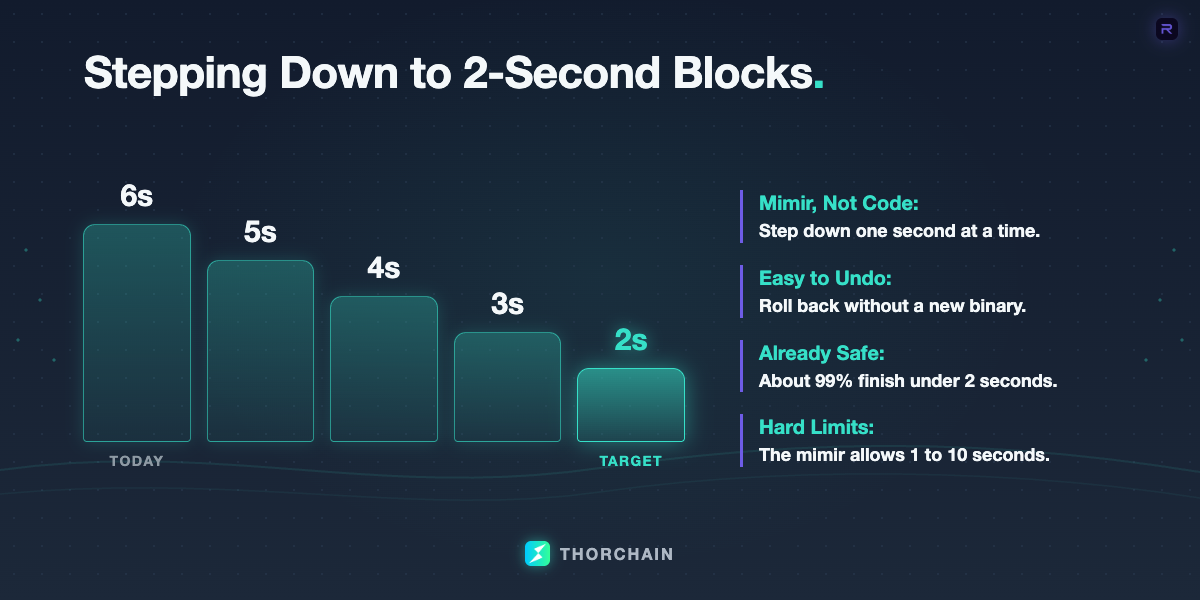
Chad is revisiting 2-second blocks. The original code was merged about a year and a half ago, then pulled back because a hard switch felt risky and difficult to undo. His new approach is to make block time a mimir rather than a code change, so THORChain can move one step at a time and roll back if needed without releasing a new binary.
"We can walk it down from 6 seconds, what it is now, to 5 seconds to 4 seconds to 3 seconds to 2 seconds." (Chad)
His analysis of mainnet suggests 2 seconds is a safe target: about 99% of blocks already complete in under 2 seconds. Around 1.5 seconds might be possible with Cosmos SDK performance gains, but Chad would be cautious. The mimir will be hard-coded to a range of 1 to 10 seconds, and going below 1 second would mean forking or replacing CometBFT, the consensus layer underneath.
On paper, the benefits are clear: streaming swaps would execute three times faster, arbitrage bots would rebalance pools more often, and the Rujira app layer would gain from faster blocks. Chad wants to measure how much of that shows up in practice before pushing lower, and hopes to move ahead within the next month or two. The idea first resurfaced in last week's recap.
5. The Quote-Versus-Fill Test Gets Cheaper
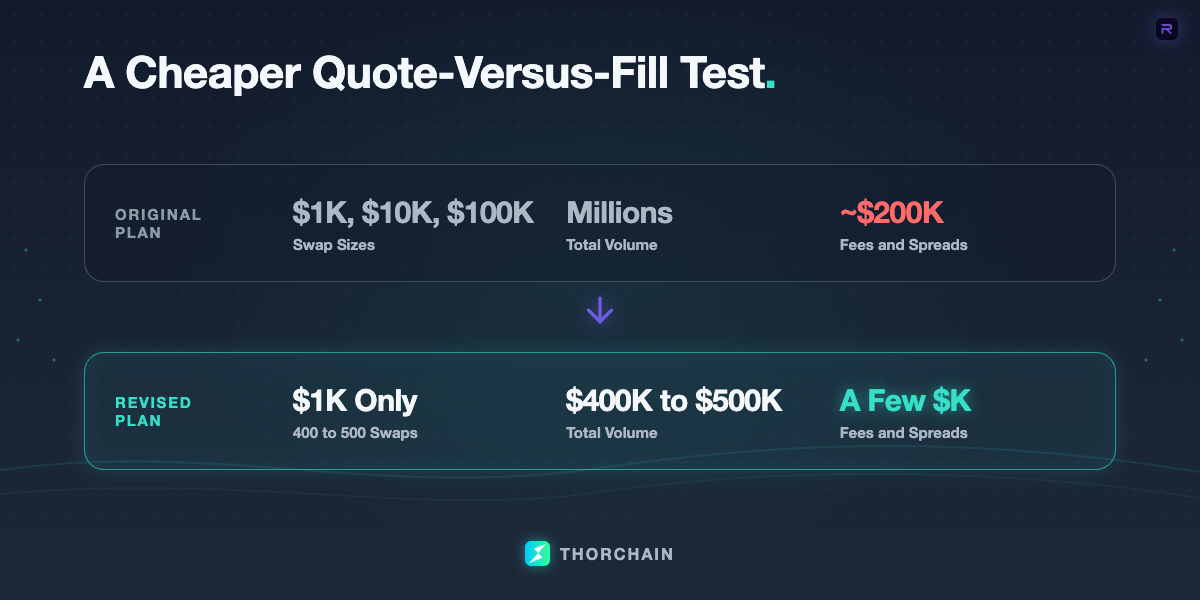
The test proposed last week, comparing swap providers' quotes with what users actually receive, is moving forward with Treasury support. Kenton said he and Ray are working out the procedure, and credited Ray for running the numbers. The original plan of $1,000, $10,000 and $100,000 swaps would have meant a few million dollars in volume and, once fees and spreads were included, a cost of a couple hundred thousand dollars. The revised plan uses only $1,000 swaps: around 400 to 500 of them, roughly $400,000 to $500,000 in volume, for a cost of a few thousand dollars. Kenton said THORChain already wins larger quotes, and the low end of the size curve is where it misses volume, so that is the range worth studying.
On marketing, Kenton listed THORChain on a no-KYC exchange directory and asked the community to leave a review. THORChain will appear on the directory's exchange list once it has an XML quote feed, which Liquify agreed to build. He also asked the Unstoppable Wallet devs about Tor (.onion) and I2P addresses for THORChain Swap and set up a THORChain page on Bitcointalk.
Kenton's focus remains AI search. thorchain.org sits in the top 500 of about 120,000 sites on an AI-visibility tracker, though still at a B grade, and new affiliates requesting API keys say they found THORChain through ChatGPT, Claude or Google search. He is also looking into ChatGPT's new advertising, which could open a paid channel crypto lacks on Google.
After a press outlet turned a post about a 140 $RUNE Zcash pool bug into a negative story, Kenton said issues will still be disclosed on Discord and GitLab, but the main X account does not need to spotlight every minor bug.
6. Visual Review Turns Code Changes Into Explainers
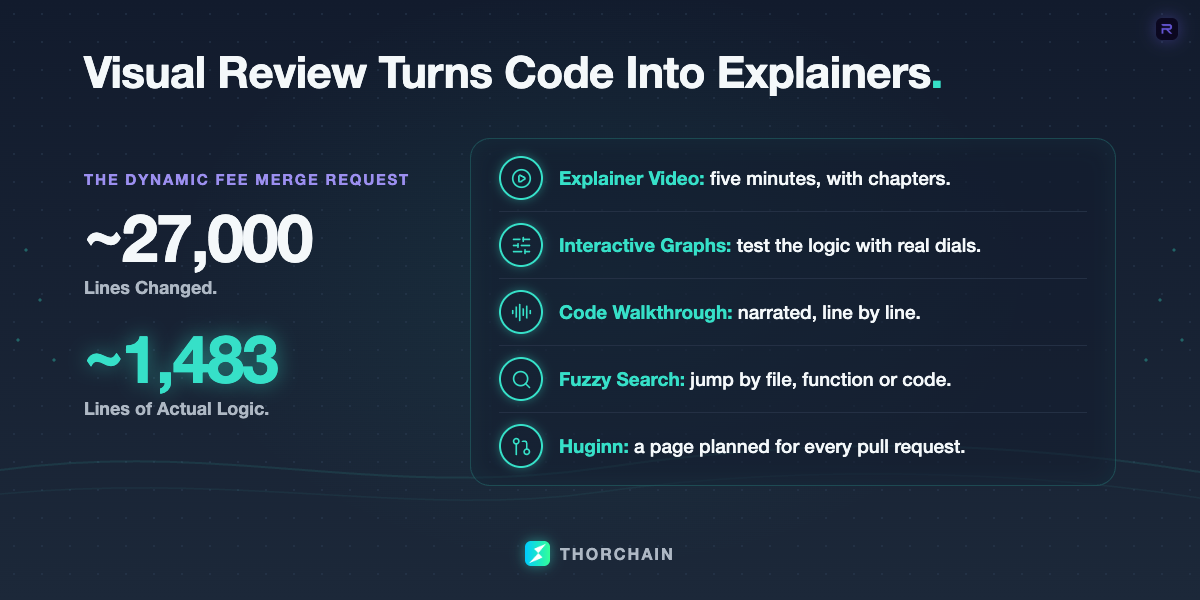
Chad unveiled Visual Review, a skill he built that turns a code change into a web page explaining it visually. He showed it on his dynamic fee merge request. The page includes a five-minute explainer video with chapters, interactive graphs, and a narrated walkthrough of every changed line, with fuzzy search by file name, function or snippet of code. The goal is to let anyone, technical or not, understand a change before it merges.
"It's my attention and my focus that is the most valuable resource in this process." (Chad)
The merge request he showed runs to about 27,000 lines, of which roughly 1,483 are logic changes; the rest are tests and documentation. Huginn will generate these pages automatically, with a button at the top of each pull request. Chad has open-sourced the skill on GitLab, and Kenton added a Visual Review link to the thorchain.org footer during the show.
The dynamic fee change itself replaces the current step search, which moves 1 bps at a time, with a bracket search. Instead of trying 1, 2, 3, 4 and 5 bps, the model jumps from 1 bps to 20 bps, then tests the midpoint and narrows in. Bigger jumps make the market's reaction clearer and reach the best fee in fewer epochs. The change also lets the team switch an affiliate such as Symbiosis off and on to reset its data. Chad hopes to merge it for v3.22.
7. The Solvency Checker Stops an IBC Exploit
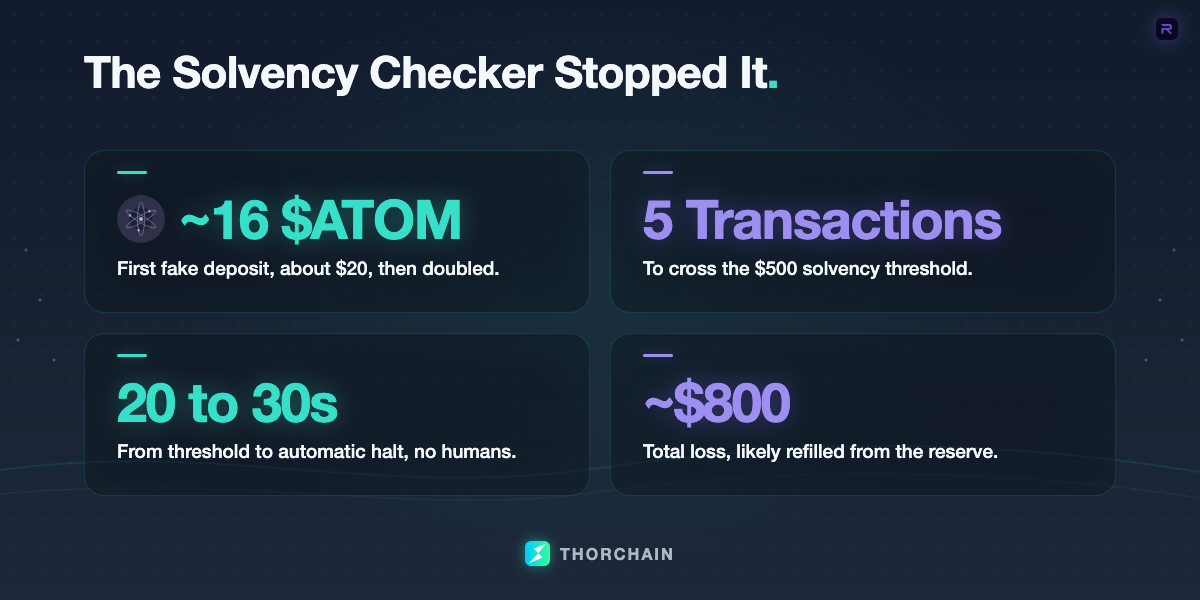
THORChain had what Chad called a tiny mini hack this week. A bug in the IBC implementation let an attacker make THORChain believe it had received $ATOM it never received. The first fake deposit was about 16 $ATOM, roughly $20, sent with a bad memo that triggered a refund. The attacker kept doubling that amount across five transactions.
The solvency checker only acts once a shortfall reaches $500, a buffer that avoids halting the chain over small discrepancies. Once that line was crossed, it halted things within about 20 to 30 seconds, with no human involvement, after an attack lasting seven or eight minutes. Chad expects the roughly $800 shortfall to be refilled from the reserve, probably in the next release. In chat, a viewer offered to open a merge request setting the threshold at $42,069.
"It's a success story in my mind, even though it's only $800." (Chad)
Chad also wants more math-based safety checks. AI recently helped solve how to account for synthetics in LUVI, a measure that separates pool earnings from price moves and should almost always rise, so it can now act as an invariant that flags broken pool accounting without knowing the cause. LUVI checks were added to regression testing last week, and Chad plans to add them to mainnet code eventually, though it is not a top priority.
A community member also asked why the reserve holds about 25M $RUNE. Chad was not sure and suspects it relates to accounting from the summer hack. Kenton thought a store migration in v3.21 might address it. Long term, Chad said, the reserve would have a cap, with anything above it paid out as system income.
8. Faster CI and Huginn's Growing Role
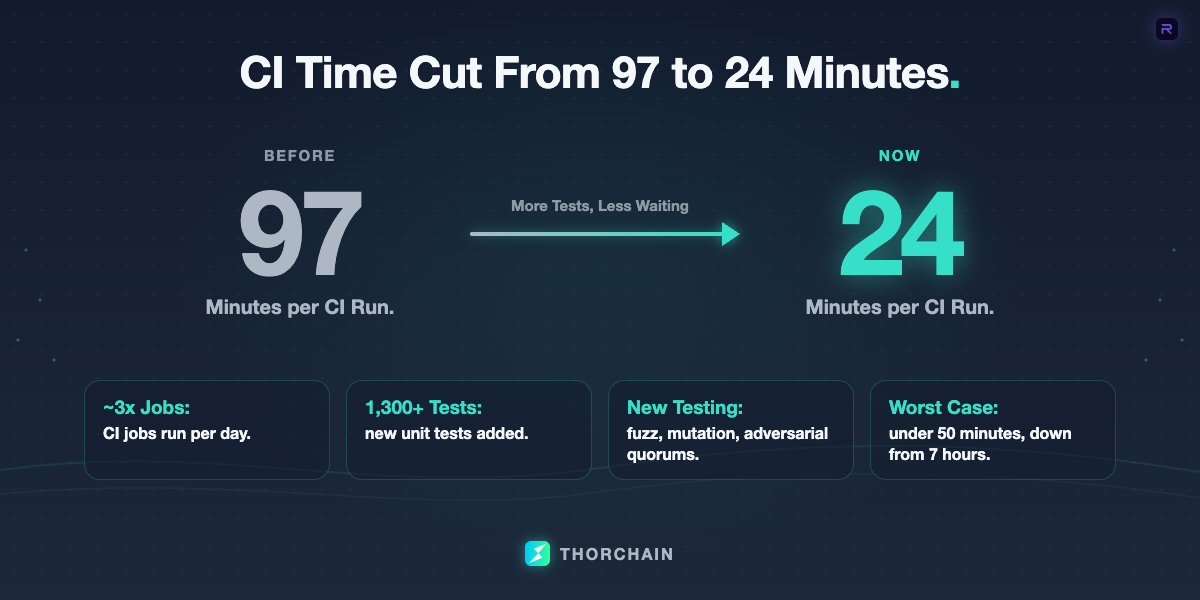
Chad shared a summary of recent changes to THORChain's continuous integration (CI), the automated tests every code change must pass. The team now runs nearly three times as many CI jobs per day, has added more than 1,300 unit tests, and introduced fuzz testing, mutation testing and adversarial-quorum testing. Typical CI time fell from 97 minutes to 24 minutes, and even the worst cases now finish in under 50 minutes, down from waits as long as seven hours.
Asked whether a large language model could formally verify the THORChain stack using Lean, Chad said Lean is a language for mathematical proofs and he does not think it applies to code. Instead, Huginn reviews every change and continuously audits the codebase, tracking which files it has scanned. By Chad's count, Huginn has found more security issues in the past year than every human contributor combined, by orders of magnitude, and it currently reports only the two highest priority levels. A full audit by the security team also turned up a few dozen issues, which are being addressed.
The bottleneck is human review. A community developer recently opened six or seven merge requests; generating one can take five minutes, while reviewing it can cost several engineers 45 minutes each. Chad estimated THORChain could merge 10 to 20 times more code per release without that constraint, though he stressed humans still review everything. Huginn now runs on its own Treasury-funded accounts, which freed Chad's own AI usage for projects like Visual Review.
"If you write code without having AI involved in that process, you're probably doing it wrong." (Chad)
What to Watch
- v3.21 adoption, the v3.21.1 cut expected next week, and the churn resuming ahead of the $XMR launch.
- Whether SwapKit scales its Rev-Share spending after v3.21, whether the return holds near 4.4x, and whether the share moves to 25%.
- Whether an ADR on ending LP rewards is written, and how many nodes join the vote.
- The 2-second block mimir, hoped for within the next month or two.
- The dynamic fee bracket search in v3.22, and Visual Review pages on every pull request.
- The quote-versus-fill test, once Kenton and Ray finalize the procedure.
- Kenton's quarterly report, which he hopes to work on this weekend.
- Chad at Zcon7, a possible technical Rujira session with Pragmatic Monkey or CodeHans, and Chad's planned appearance on Joel Valenzuela's show.
- Schedule changes: Zodl on Friday, October 23, and the Saturday show moving an hour later.

More THORChain data, check out raynalytics.net
Follow Raynalytics for more Weekly Analytics and Podcast recaps.

Related articles
![Protocol Update Podcast with Chad Barraford, Kenton and Denny]()
Oct. 15, 2026
SwapKit Rev-Share Week One: Early Data Looks Promising, v3.21 and Monero Next
- Podcast
![Ecosystem Update Podcast with Zano]()
Oct. 10, 2026
Zano’s Recovery Plan and the Road to THORChain
- Podcast
![Protocol Update Podcast with Chad Barraford, Kenton and Patriot]()
Oct. 8, 2026
Chad's Unchained Podcast Debrief, Rev-Share and Monero
- Podcast
![Ecosystem Update Podcast with Houdini Swap]()
Oct. 3, 2026
Houdini Swap on THORChain Explained: What It Means for Users and Treasury Revenue
- Podcast
![Protocol Update Podcast with Chad Barraford, Kenton and Denny]()
Oct. 1, 2026
Can or Should THORChain Censor Transactions?
- Podcast
![Protocol Update Podcast with Chad Barraford, Kenton, Devel and Boone]()
Sep. 24, 2026
Inside the Houdini Swap Debate: THORChain’s Treasury, Privacy and Revenue
- Podcast
![Ecosystem Update Podcast with Radix]()
Sep. 19, 2026
Radix and THORChain: Building Trust for the Agentic Future
- Podcast
![THORChain Podcast protocol update cover]()
Sep. 17, 2026
THORChain Returns to Shipping: Zcash, Monero and Self-Sufficiency
- Podcast
![Ecosystem Update Podcast with Station Wallet]()
Sep. 13, 2026
Terra’s Station Wallet Is Back as Vultisig’s Agentic THORChain Wallet
- Podcast
![Protocol Update Podcast with Chad Barraford, Kenton and Patriot / Denny]()
Sep. 10, 2026
THORChain Prioritizes Stability Before Monero and New Features
- Podcast
![Ecosystem Update Podcast with RAVN]()
Sep. 5, 2026
Inside RAVN’s Native $BTC Aggregator and Its THORChain Integration
- Podcast
![Protocol Update Podcast with Hans, Devel, Chad, Kenton & Denny]()
Sep. 3, 2026
THORChain Churns Again: POL Goes Live, Rujira Resumes and BLO Debate
- Podcast
![Ecosystem Update Podcast with Rujira]()
Aug. 29, 2026
THORChain’s App Layer Rujira Is Paused. Rujira Wants a Clear Restart Path.
- Podcast
![Protocol Update Podcast with Chad Barraford, Kenton and Denny]()
Aug. 27, 2026
THORChain Puts Stability First: Monero & Zcash Delayed, ADR30, AI Agents and Memoless Swaps
- Podcast
![Ecosystem Update Podcast with Unstoppable Wallet]()
Aug. 22, 2026
Unstoppable Wallet Adds $RUNE, $TCY and $RUJI, With a Stablecoin Wallet Next
- Podcast