THORChain x Zano Podcast #242 ft. Mr_Kwibs, KentonC137 & patriotsounds | October 10, 2026 | Watch the full episode on YouTube
By Raynalytics
TL;DR
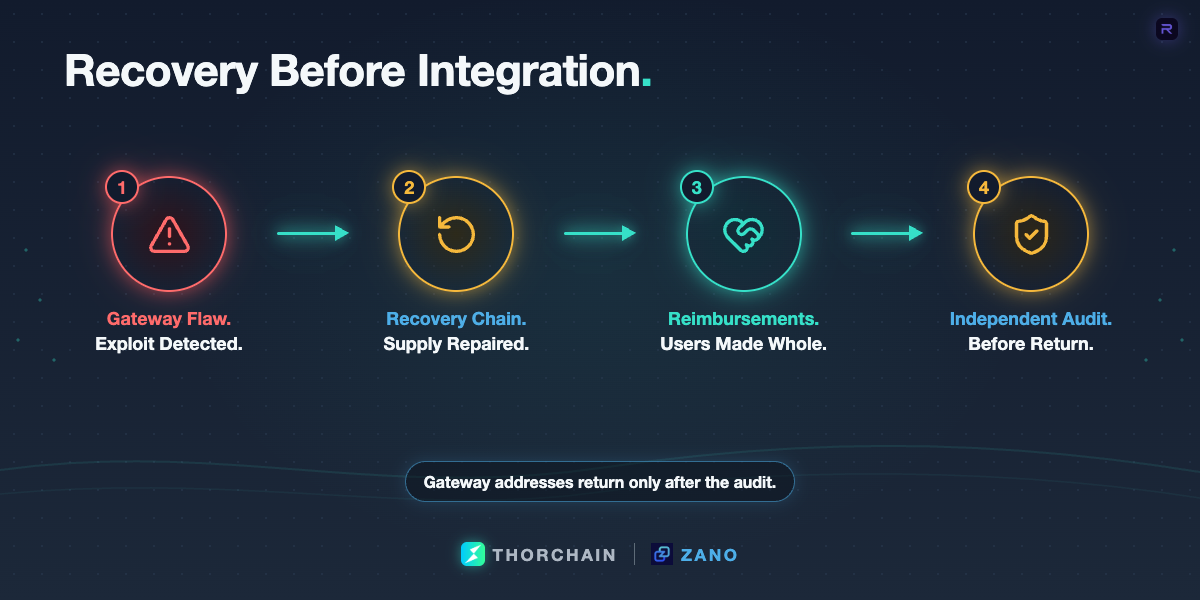
- Zano said it is restoring gateway addresses only after an additional independent audit, following an exploit that led the project to roll back to the Hard Fork 6 point and reimburse affected users.
- Confidential Assets are Zano’s attempt to make amounts, addresses, and asset types private by default. $fUSD is one live example, but it is currently a third-party stablecoin with a centralized mint-and-burn point.
- Gateway addresses are the technical bridge between Zano’s private UTXO model and the public balance checks a future THORChain integration would need. They are not active for THORChain today.
- A THORChain-to-Zano swap would be publicly visible on THORChain. Privacy begins only after funds leave THORChain and move within Zano.
- Zano’s longer roadmap includes the Zano Execution Layer and Zenith, but the guests put the recovery audit and gateway-address return ahead of any integration timeline.
Introduction
The conversation was not a launch announcement. It was a progress report on a privacy chain that is repairing a serious failure while keeping its interoperability plans intact. Zano’s team joined Kenton and Denny to explain the exploit, the recovery approach, why $fUSD matters to the project’s Confidential Assets thesis, and why gateway addresses are the prerequisite for a future THORChain route.
The key distinction throughout the episode was status. Zano’s recovery chain is operating, reimbursements were described as nearly complete, and gateway-address code has been fixed. But the team still wants an outside audit before reactivating that capability. A Zano pool on THORChain, and any later consideration of $fUSD, remain dependent on that work.
1. Recovery Comes Before Integration
Zano’s co-founder described an exploit in its gateway-address implementation, introduced after Hard Fork 6. The team said a missing cryptographic validation let attackers exploit the system first in August and then again in September. The issue was not in the chain’s core private-transaction design, but in the gateway layer that connects a private chain to systems needing visible balances.
The response was a recovery chain beginning again from the Hard Fork 6 point, rather than accepting an inflated supply. The team said it has been reimbursing affected users with support from the development fund, personal funds, and voluntary community contributions. It also said most exchanges and services had completed the recovery process by the time of the recording.
Zano has also opened donations to its development fund. Anyone wishing to contribute can send $ZANO or $fUSD using the options in that official update.
"We are making everyone whole." (Quinten)
That recovery does not mean the gateway system is being rushed back. The guests said the code is fixed, but they want a further audit from a trusted external party before setting a new activation date. Their estimate was at least two to three months for the activation process once the audit and release path begin. That was an estimate, not a delivery promise.
The sequencing matters for THORChain. Gateway addresses are the feature Zano designed to make external integrations workable. Until they return, the chain-client work cannot move from an architectural discussion to a live pool.
2. Confidential Assets Put $fUSD Inside Zano’s Privacy Model
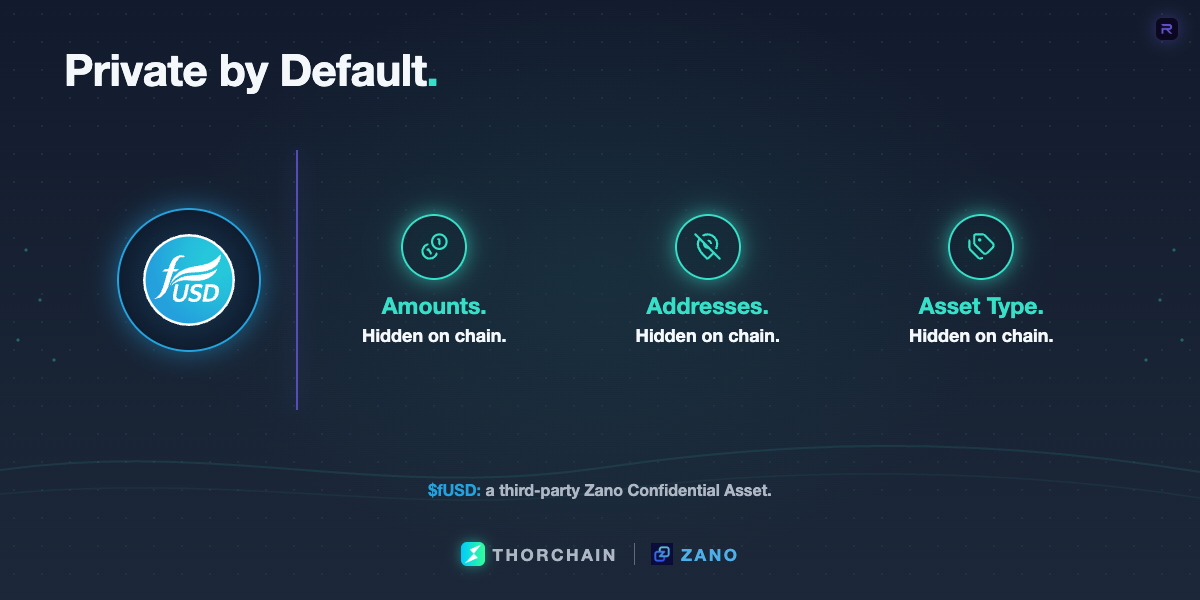
Zano positions itself as a privacy-by-default layer 1. Its core claim is broader than private balances: normal transfers conceal the amount, receiver, and asset type. That same model extends to Confidential Assets, which let builders issue assets on Zano without exposing those properties on-chain.
$fUSD, or Freedom Dollar, is the example discussed most directly. It is a third-party stablecoin built on Zano, not an asset issued by the Zano team. Quinten said it was overcollateralized with $ZANO, with roughly 6.8 million $fUSD in circulation and close to $8 million of $ZANO reserves at the time of the conversation.
The guests were clear about the trade-off in its current form. The asset is private, but minting and burning are still controlled from one wallet. The planned Zano Execution Layer could eventually support programmable lending, borrowing, and a more decentralized collateral-and-minting model. Those are aspirations for future infrastructure, not features live on the private base layer today.
"The answer is like double no." (Zano co-founder, on a blacklist function)
The point was not that every application built on Zano is automatically decentralized. It was that the base chain does not provide a selective freeze or blacklist mechanism for Confidential Asset transfers. That distinction became central after the hosts discussed the temporary freezing of some TRON $USDT vaults on THORChain.
3. Gateway Addresses Are the Bridge to THORChain
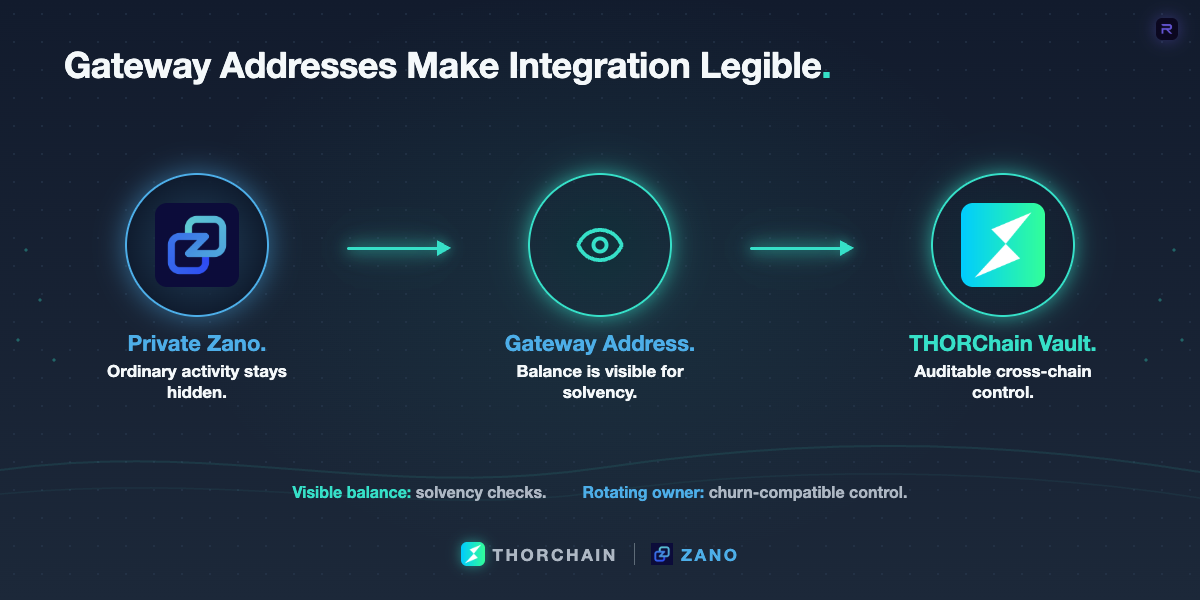
Private chains are difficult to integrate because an external protocol still needs to verify what it controls. THORChain vaults continuously check balances for solvency. Zano’s regular UTXO model deliberately hides those details, so the team designed gateway addresses as a special, more transparent account-based entry point for bridges, exchanges, and decentralized systems.
For a potential Zano chain client, that means a THORChain vault could see and verify the balance in its gateway address while ordinary Zano transfers retain the chain’s privacy properties. The guests also described a way to rotate the gateway owner key without moving all assets to a newly created address, which better matches THORChain’s recurring vault churn.
StarSquid is continuing the chain-client work once gateway addresses are restored. The teams said the remaining adjustment is compatible with THORChain’s model, but it still requires implementation and testing. No mainnet date was given.
"If you swap to Zano on THORChain, you have not achieved privacy." (Denny)
That is an important boundary for readers. A THORChain swap remains public like every other THORChain swap. A user seeking Zano’s privacy properties would need to take a separate action after receiving Zano, within the Zano network itself. The prospective integration would add permissionless access to the asset, not turn THORChain into a mixer.
4. The Roadmap Separates Recovery, Speed, and Programmability
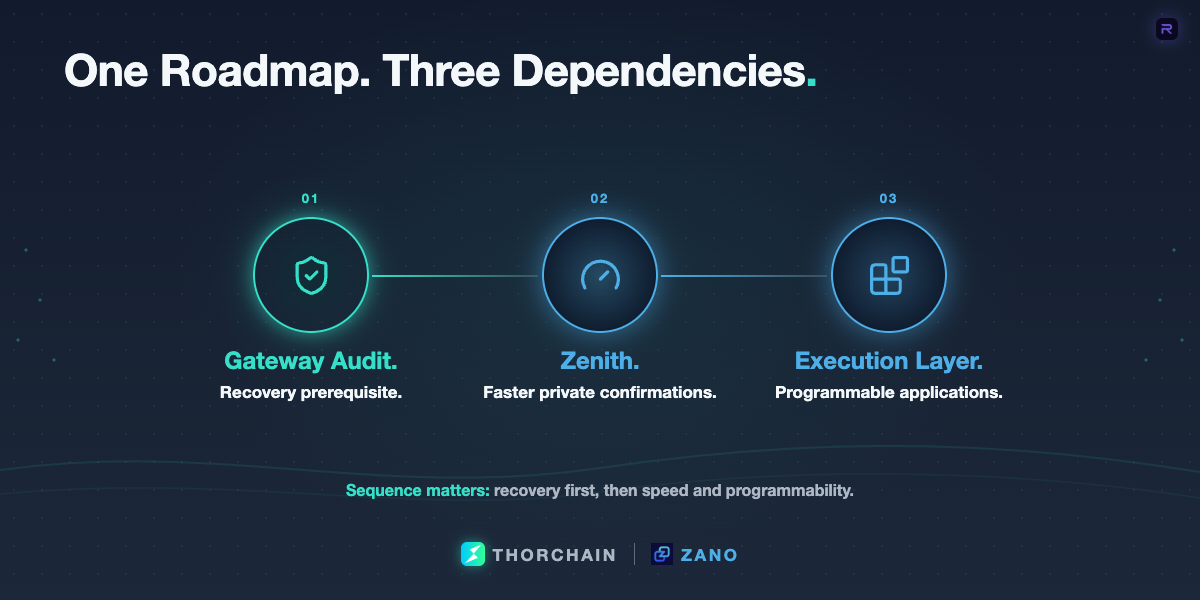
The recovery work comes first, but Zano also outlined two longer-term technical tracks. Zenith is the planned move from the current hybrid proof-of-work and proof-of-stake model to a pure proof-of-stake consensus system built on Zarcanum. The guests said they are targeting roughly 15 to 20 second blocks and five to 10 confirmations, which could reduce the current roughly 10-minute re-spend wait to about one minute or a little more.
"You can be private and fast." (Quinten)
The second track is the Zano Execution Layer, or ZEL. It is intended as a separate EVM-compatible environment, linked to Zano through a threshold-signature bridge. The private base layer would remain the home for confidential transfers and assets, while programmable applications such as lending and collateralized stablecoin logic could live in the execution layer.
Neither track changes the immediate priority. Gateway addresses must return after audit before a Zano-to-THORChain integration can proceed, and the guests said the execution-layer work depends on those addresses too. The roadmap is directionally clear, but its stages are not interchangeable with a launch date.
5. Why Zano Sees THORChain as a Long-Term Access Route
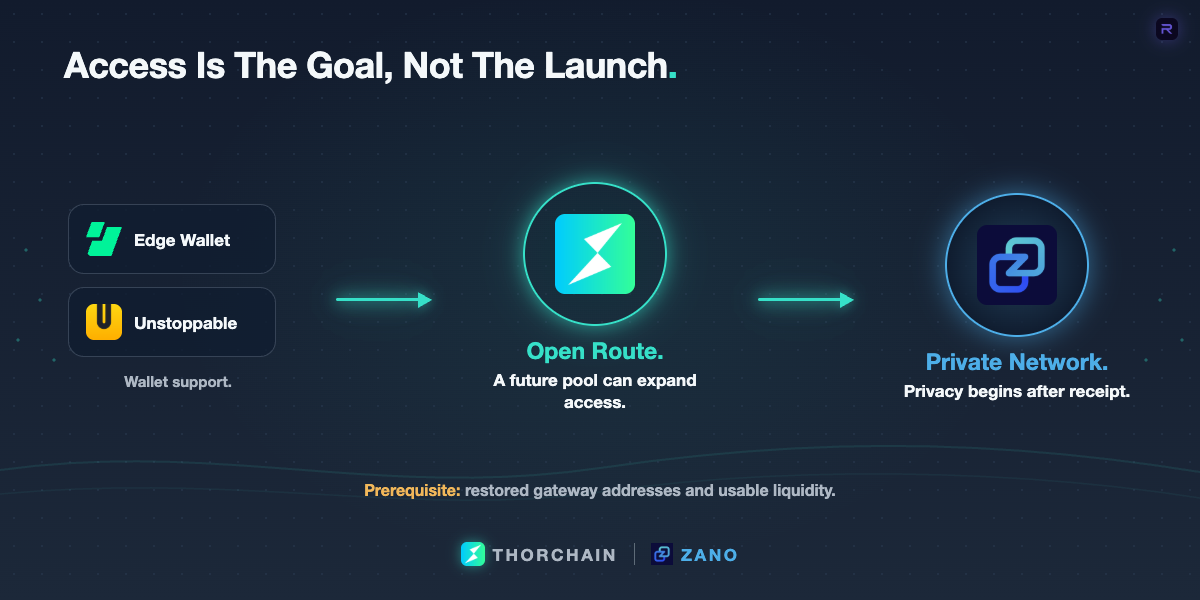
The practical case for a future Zano pool was access. Quinten said Zano had lost some routes as centralized providers changed policies and several exchanges ceased operations. The point was not a recommendation to bypass any platform’s rules. It was that access dependent on a small number of centralized services can disappear when their policies or operations change.
The team sees a permissionless THORChain pool as a more durable route, particularly because Zano is already supported by wallets such as Edge Wallet and Unstoppable Wallet. If the chain client and pool are eventually live, those wallet integrations could potentially offer Zano trading through THORChain rather than relying on a single external liquidity source.
The guests said the team and major holders would be willing to bootstrap liquidity, but that is an intention rather than a funded pool announcement. They also described a possible future $fUSD integration as an option for THORChain to consider only after Zano itself is in place.
"THORChain needs you as well." (Denny)
The episode’s broader thesis was that permissionless access and private assets are complementary, but they are not the same thing. THORChain can provide an open route to a native asset. Zano can provide privacy once value is on its network. The recovery work and gateway audit are what stand between that thesis and a live integration.
What to Watch
- Whether Zano completes its independent gateway-address audit and announces a reactivation path without sacrificing the recovery team’s stated caution.
- Whether StarSquid and the THORChain team can complete, test, and review the chain-client work after gateway addresses return.
- Whether prospective liquidity providers formalize a Zano pool plan, including sufficient depth for a useful market rather than only a symbolic listing.
- Whether Zenith and the Zano Execution Layer move from architecture to tested releases, especially for faster confirmations and more decentralized stablecoin logic.
- Whether $fUSD becomes a candidate for further interoperability only after the underlying Zano route is operating reliably.

More THORChain data, check out raynalytics.net
Follow Raynalytics for more Weekly Analytics and Podcast recaps.

Related articles
![Protocol Update Podcast with Chad Barraford, Kenton and Patriot]()
Oct. 8, 2026
Chad's Unchained Podcast Debrief, Rev-Share and Monero
- Podcast
![Ecosystem Update Podcast with Houdini Swap]()
Oct. 3, 2026
Houdini Swap on THORChain Explained: What It Means for Users and Treasury Revenue
- Podcast
![Protocol Update Podcast with Chad Barraford, Kenton and Denny]()
Oct. 1, 2026
Can or Should THORChain Censor Transactions?
- Podcast
![Protocol Update Podcast with Chad Barraford, Kenton, Devel and Boone]()
Sep. 24, 2026
Inside the Houdini Swap Debate: THORChain’s Treasury, Privacy and Revenue
- Podcast
![Ecosystem Update Podcast with Radix]()
Sep. 19, 2026
Radix and THORChain: Building Trust for the Agentic Future
- Podcast
![THORChain Podcast protocol update cover]()
Sep. 17, 2026
THORChain Returns to Shipping: Zcash, Monero and Self-Sufficiency
- Podcast
![Ecosystem Update Podcast with Station Wallet]()
Sep. 13, 2026
Terra’s Station Wallet Is Back as Vultisig’s Agentic THORChain Wallet
- Podcast
![Protocol Update Podcast with Chad Barraford, Kenton and Patriot / Denny]()
Sep. 10, 2026
THORChain Prioritizes Stability Before Monero and New Features
- Podcast
![Ecosystem Update Podcast with RAVN]()
Sep. 5, 2026
Inside RAVN’s Native $BTC Aggregator and Its THORChain Integration
- Podcast
![Protocol Update Podcast with Hans, Devel, Chad, Kenton & Denny]()
Sep. 3, 2026
THORChain Churns Again: POL Goes Live, Rujira Resumes and BLO Debate
- Podcast
![Ecosystem Update Podcast with Rujira]()
Aug. 29, 2026
THORChain’s App Layer Rujira Is Paused. Rujira Wants a Clear Restart Path.
- Podcast
![Protocol Update Podcast with Chad Barraford, Kenton and Denny]()
Aug. 27, 2026
THORChain Puts Stability First: Monero & Zcash Delayed, ADR30, AI Agents and Memoless Swaps
- Podcast
![Ecosystem Update Podcast with Unstoppable Wallet]()
Aug. 22, 2026
Unstoppable Wallet Adds $RUNE, $TCY and $RUJI, With a Stablecoin Wallet Next
- Podcast
![Protocol Update Podcast with Chad Barraford, Kenton and Denny]()
Aug. 20, 2026
v3.20 Voting Is Underway. Should THORChain’s TSS Library Remain Open Source?
- Podcast
![Ecosystem Update Podcast with Dash]()
Aug. 15, 2026
Inside Dash’s Zcash Orchard Upgrade and Its THORChain Potential
- Podcast