v3.20 Voting Is Underway. Should THORChain’s TSS Library Remain Open Source?
2026-08-20 — 7 min read
- Podcast
THORSday Community Podcast #227 ft. CBarraford, KentonC137 & patriotsounds | August 20, 2026 | Watch the full episode on YouTube
By Raynalytics
TL;DR
- The acceptance vote for v3.20 was underway, with the hosts expecting adoption to unblock a sizeable release and several follow-on protocol actions. It was not live yet at the time of the show.
- ADR29 has passed. THORChain and SwapKit intend to test the rev-share arrangement only after the integration side is ready, then keep or stop it based on whether it benefits both parties.
- A community discussion is exploring whether the TSS library should stay open source after the Maya Protocol exploit. Chad’s preference is to retain public verifiability and improve the signing stack, not depend on secrecy.
- The treasury was described as having roughly $15 million when LP positions are included. A proposal to move the dev fund allocation from 5% to 10% is a temperature check, not an ADR or enacted change.
- Kenton highlighted work with Ray, Dune and Numia intended to move THORChain data updates from daily to hourly, giving public analytics a more current cadence.
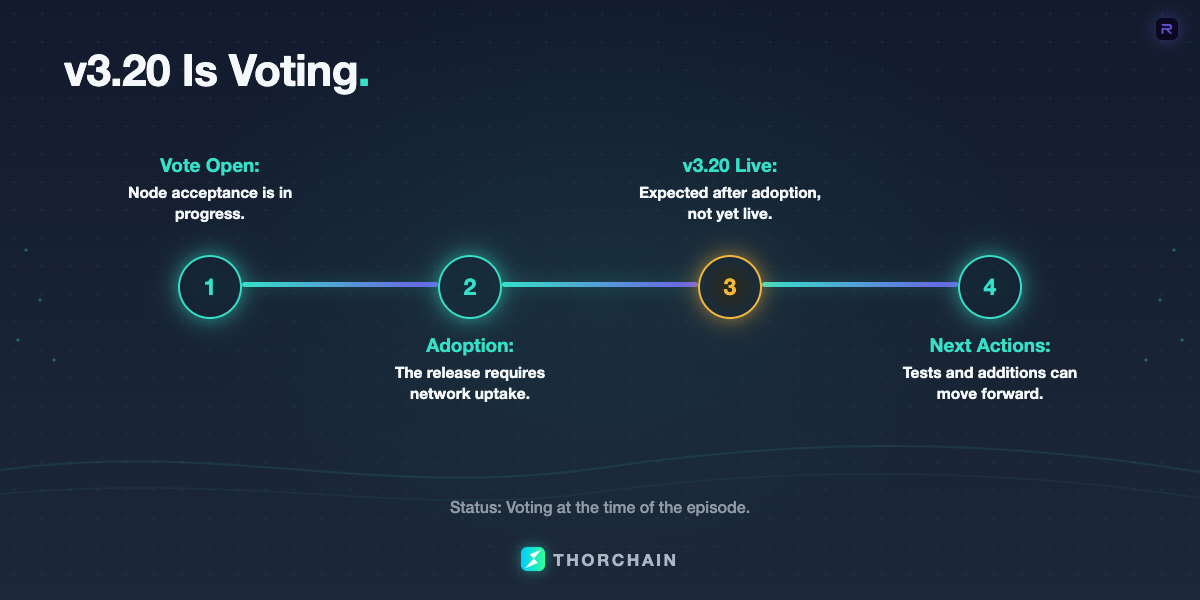
1. v3.20 Is Voting, Not Yet Live
The node acceptance vote for v3.20 was in progress when the episode was recorded. Chad said acceptance was around 50% and the team expected the release could go live in roughly five days if adoption continued. That was an expectation, not a launch confirmation.
The update is broad. The group pointed to stability work, Solana fixes, more robust API calls, deterministic swap-queue ordering, protocol-owned-liquidity changes and a large collection of edge-case fixes. Chad Barraford later said the release had 53 merged code changes. The practical significance is that several items have been waiting on the version’s adoption before they can move forward.
"We had 53 code changes merged into this release." (Chad Barraford)
For users, the immediate message is status discipline. The release was voting. New-chain additions, further dynamic-fee testing and rev-share activation were subsequent work, not features already switched on.
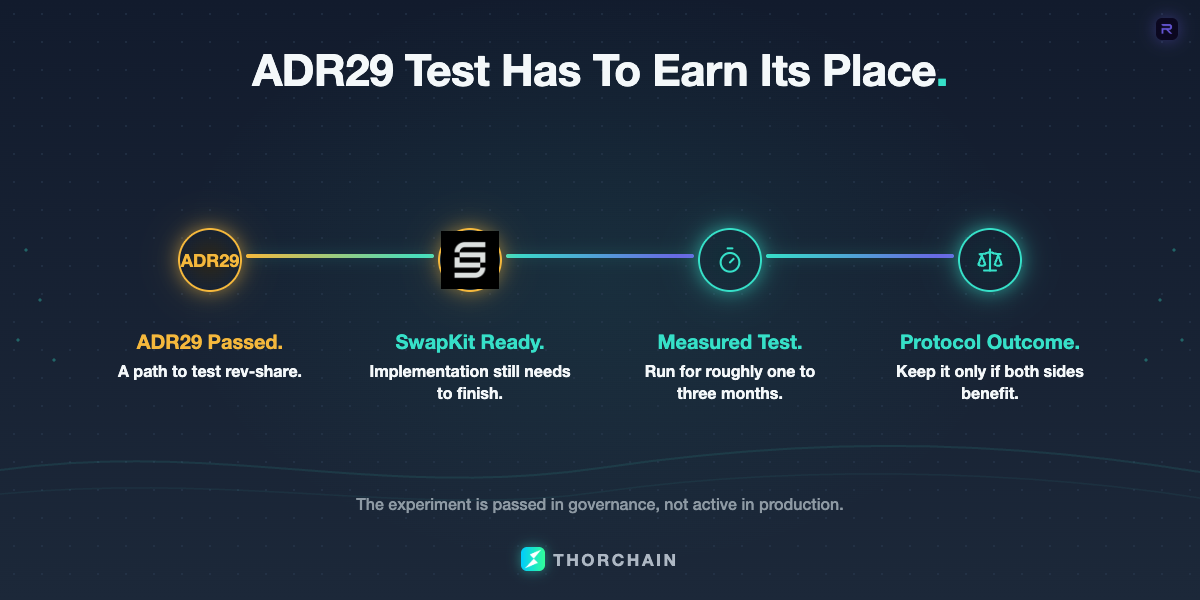
2. ADR29 Passed. The SwapKit Test Still Has to Earn Its Place
ADR29 has passed, giving SwapKit and THORChain a path to test rev-share. The proposal was covered in depth when it was still upcoming in Podcast #219. This episode moved the status forward, but not all the way to a live rollout.
Chad said he had been working with Oleg Petrov and the SwapKit team. Their estimate was one or two weeks on their side, after which the parties could turn the arrangement on and run it for roughly one to three months. The test has a simple success condition: it must generate a worthwhile result for the protocol as well as for SwapKit. If it does not, it can be turned off.
"The pressure is on them to make this work, not only for them, but to make it work for us as well." (Chad Barraford)
That framing matters. Rev-share is not a permanent entitlement and the episode did not claim the experiment was already delivering volume or revenue. It is a controlled attempt to give an integration partner room to improve competitiveness while checking the result from THORChain’s side.
The same conversation covered dynamic fees. Earlier pilots exposed routing mistakes at integration partners, including extra hops and rapid-swap handling issues. Chad’s view was that even a test that fails can reveal where a route is losing trades, then inform the next design.
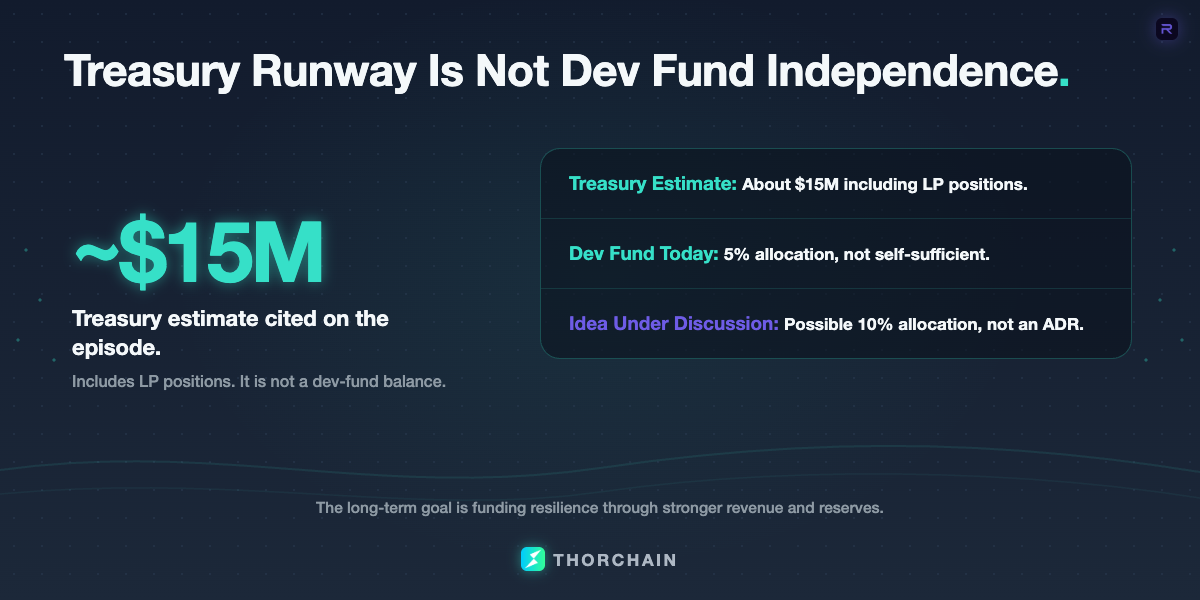
3. Treasury Runway Is Not the Same as a Self-Sufficient Dev Fund
The treasury discussion began with a distinction that is easy to blur. The dev fund currently contributes some income, but the treasury remains the main source of monthly spending. Chad estimated the treasury at around $15 million when LP positions are included, alongside cash, over-solvency recoveries and other assets. He did not agree with the idea that the protocol had only six months of runway.
"The majority of the money being spent every month is coming from treasury versus the dev fund." (Chad Barraford)
A community document was floating a possible increase in the dev fund’s allocation from 5% to 10%. The speakers repeatedly treated it as an early temperature check, not an imminent ADR. Even a doubled allocation would not fully fund salaries and ecosystem work today, but it could reduce dependence on treasury spending and create more runway.
That left the larger strategic question open: what should the protocol do with revenue in a lean market? Chad argued that a future strong market should be used to build a stablecoin reserve for the next downturn. He also raised the possibility of replacing the 5% $RUNE burn with a treasury or dev-fund allocation, while acknowledging the wider distribution and node-operator trade-offs that any change would create.
"My one of my long-term goals is to get the dev fund to be self-sufficient." (Chad Barraford)
The point was not that a funding decision had been made. It was that the protocol has time to discuss a more durable funding model, instead of treating a headline runway estimate as the full picture.
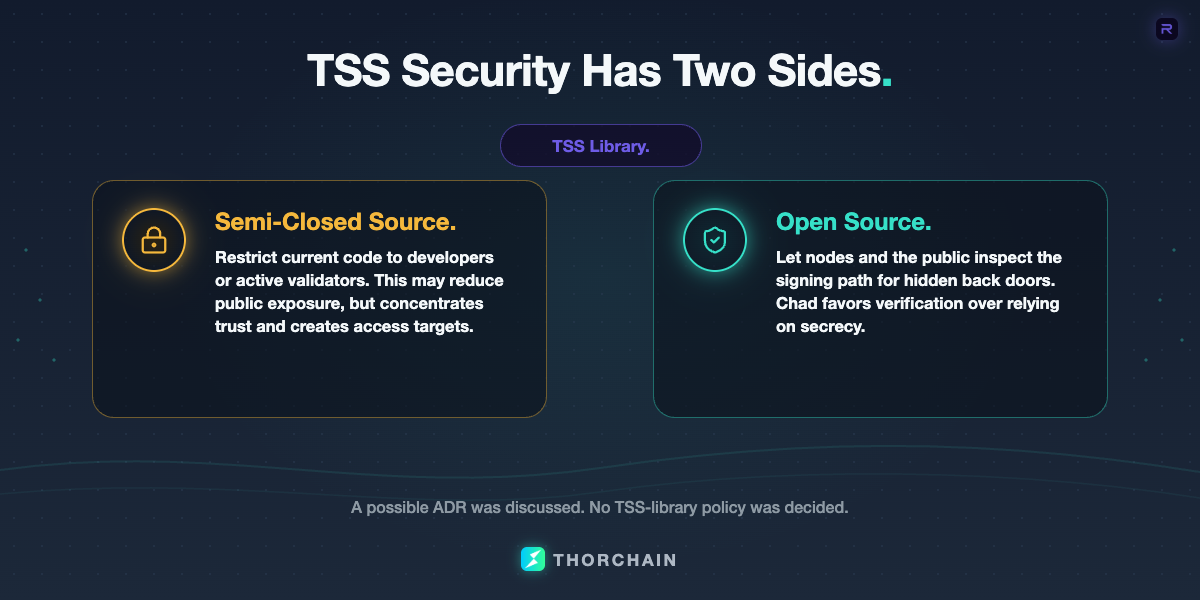
4. Open Source Is a Security Choice, Not Just a Default
After the recent Maya Protocol exploit, the group turned to a difficult question: should THORChain’s threshold-signing-system, or TSS, library be gated to developers and nodes, delayed before publication, or remain fully open source?
Chad’s view was clear. Closing the library could make it harder for an outside attacker to point an LLM at the current code, but it also reduces the public’s ability to inspect the signing path and detect a malicious back door. Limiting access to active validators does not remove the trade-off, because those validators could still inspect the code or become an access target.
"We are an open source project. We don’t like trust." (Chad Barraford)
The hosts did not present a decision. They discussed an ADR to let the community debate the question, potentially followed by a node vote. Chad said he would respect a two-thirds node decision to close the library, even though he prefers keeping it public. A three-month delayed-open-source model also came up, but he questioned whether it would prevent a malicious insider from keeping a harmful change out of the delayed repository.
The narrow issue is the TSS library, not a declaration that all THORChain code is about to become closed source. The debate is about balancing public auditability against a changing threat model.
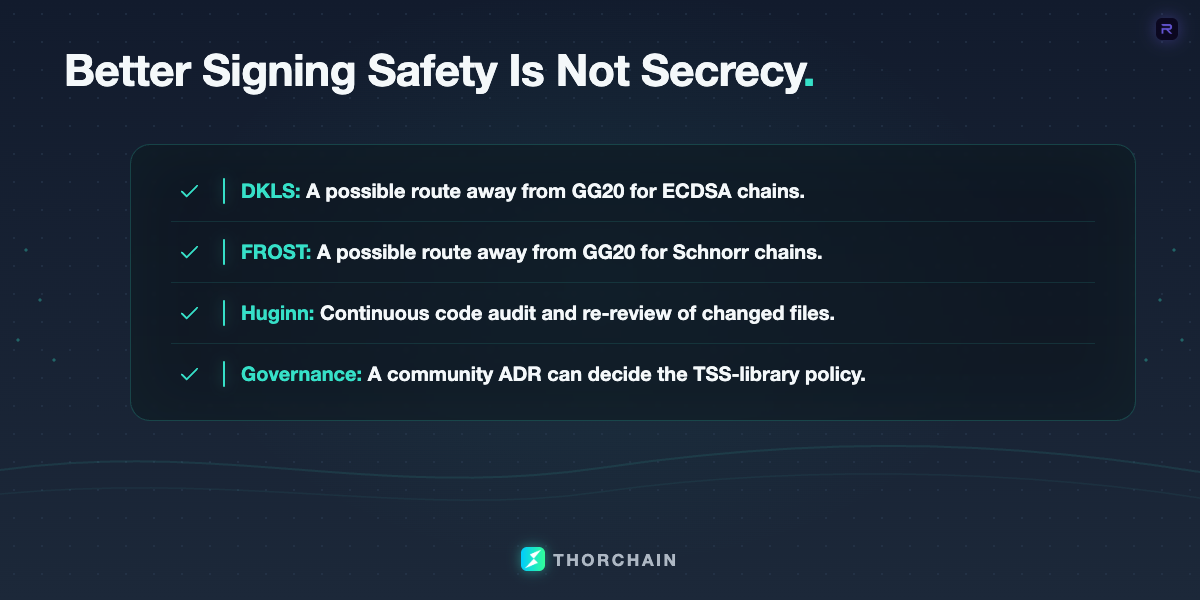
5. Better Signing Safety Needs More Than Hidden Code
The alternative discussed on the show was to strengthen the system itself. Chad pointed to moving away from GG20 toward DKLS or FROST, potentially using multiple signature systems. He also described Huginn, THORChain’s automated audit process, which checks changed files continuously and re-examines the codebase when newer models become available.
"We just have to be better about how we secure the assets." (Chad Barraford)
Huginn had reportedly found and fixed about 350 issues, with another roughly 150 in its queue. That is useful automation, but Chad was explicit that it is not a guarantee. It did not find the exploit used in the prior THORChain incident, and he did not expect any current model to find every future vulnerability.
The episode also carried a quieter usability and data thread. The team is considering a support widget, additional wallet support and referral-link tracking at THORChain Swap. Kenton also credited Raynalytics for work with Dune and Numia that should make the public data feed refresh hourly rather than daily. These are not substitutes for core security work, but they show the broader effort to make the protocol easier to use and easier to measure while the v3.20 vote proceeds.
What to Watch
- v3.20 acceptance: whether the node vote completes and the release is adopted. Its status on this episode was voting, not live.
- ADR29 implementation: whether SwapKit completes its side of the work, then what a one-to-three-month rev-share test shows for both SwapKit and THORChain.
- Dev-fund discussion: whether the 5%-to-10% idea develops beyond a community temperature check, and how the community weighs it against burns, node allocations and treasury reserves.
- TSS governance: whether an ADR is written for the open-versus-closed-source question, and whether the debate stays focused on the TSS library’s specific trade-offs.
- Signing and audit work: progress on DKLS, FROST, and Huginn’s ongoing code review as the team looks for defenses that do not rely on obscurity.
More THORChain data, check out raynalytics.net
Follow Raynalytics for more Weekly Analytics and Podcast recaps.

Related articles
![Ecosystem Update Podcast with Houdini Swap]()
Oct. 3, 2026
Houdini Swap on THORChain Explained: What It Means for Users and Treasury Revenue
- Podcast
![Protocol Update Podcast with Chad Barraford, Kenton and Denny]()
Oct. 1, 2026
Can or Should THORChain Censor Transactions?
- Podcast
![Protocol Update Podcast with Chad Barraford, Kenton, Devel and Boone]()
Sep. 24, 2026
Inside the Houdini Swap Debate: THORChain’s Treasury, Privacy and Revenue
- Podcast
![Ecosystem Update Podcast with Radix]()
Sep. 19, 2026
Radix and THORChain: Building Trust for the Agentic Future
- Podcast
![THORChain Podcast protocol update cover]()
Sep. 17, 2026
THORChain Returns to Shipping: Zcash, Monero and Self-Sufficiency
- Podcast
![Ecosystem Update Podcast with Station Wallet]()
Sep. 13, 2026
Terra’s Station Wallet Is Back as Vultisig’s Agentic THORChain Wallet
- Podcast
![Protocol Update Podcast with Chad Barraford, Kenton and Patriot / Denny]()
Sep. 10, 2026
THORChain Prioritizes Stability Before Monero and New Features
- Podcast
![Ecosystem Update Podcast with RAVN]()
Sep. 5, 2026
Inside RAVN’s Native $BTC Aggregator and Its THORChain Integration
- Podcast
![Protocol Update Podcast with Hans, Devel, Chad, Kenton & Denny]()
Sep. 3, 2026
THORChain Churns Again: POL Goes Live, Rujira Resumes and BLO Debate
- Podcast
![Ecosystem Update Podcast with Rujira]()
Aug. 29, 2026
THORChain’s App Layer Rujira Is Paused. Rujira Wants a Clear Restart Path.
- Podcast
![Protocol Update Podcast with Chad Barraford, Kenton and Denny]()
Aug. 27, 2026
THORChain Puts Stability First: Monero & Zcash Delayed, ADR30, AI Agents and Memoless Swaps
- Podcast
![Ecosystem Update Podcast with Unstoppable Wallet]()
Aug. 22, 2026
Unstoppable Wallet Adds $RUNE, $TCY and $RUJI, With a Stablecoin Wallet Next
- Podcast
![Ecosystem Update Podcast with Dash]()
Aug. 15, 2026
Inside Dash’s Zcash Orchard Upgrade and Its THORChain Potential
- Podcast
![Protocol Update Podcast with Chad Barraford, Kenton, Denny and Oleg Petrov]()
Aug. 13, 2026
THORChain is Close to v3.20: FROST, DKLS, SwapKit Rev-Share and Dynamic Fees
- Podcast
![Ecosystem Update Podcast with Morpheus]()
Aug. 8, 2026
Morpheus Maps Decentralized AI, $MOR Inference and a Planned THORChain Pool
- Podcast