THORChain Puts Stability First: Monero & Zcash Delayed, ADR30, AI Agents and Memoless Swaps
2026-08-27 — 8 min read
- Podcast
THORSday Community Podcast #229 ft. CBarraford, KentonC137 & patriotsounds | August 27, 2026 | Watch the full episode on YouTube
By Raynalytics
TL;DR
- THORChain has put new launches on an initial one-to-two-week pause to prioritize stability after v3.20 and the pending v3.20.1 hotfix. Zcash, $XMR, protocol-owned liquidity deployment and the SwapKit rev-share test are all delayed, not cancelled.
- The team traced the immediate instability to app-layer calls through non-deterministic API endpoints. A temporary app-layer pause remains technically possible, but no decision to use it was made during the episode.
- ADR30 was at 38% approval when recorded. It would let node operators delegate selected administrative commands without handing over control of funds.
- THORChain is considering what an AI-native protocol interface should look like. An unpublicized MCP server already exists in GitLab, while a command-line wallet for agents is only a possible direction.
- Memoless registrations were paused after a spam attempt. The team is weighing pricing, rate limits and registration-design changes, while stressing that a user must still follow the correct inbound flow.
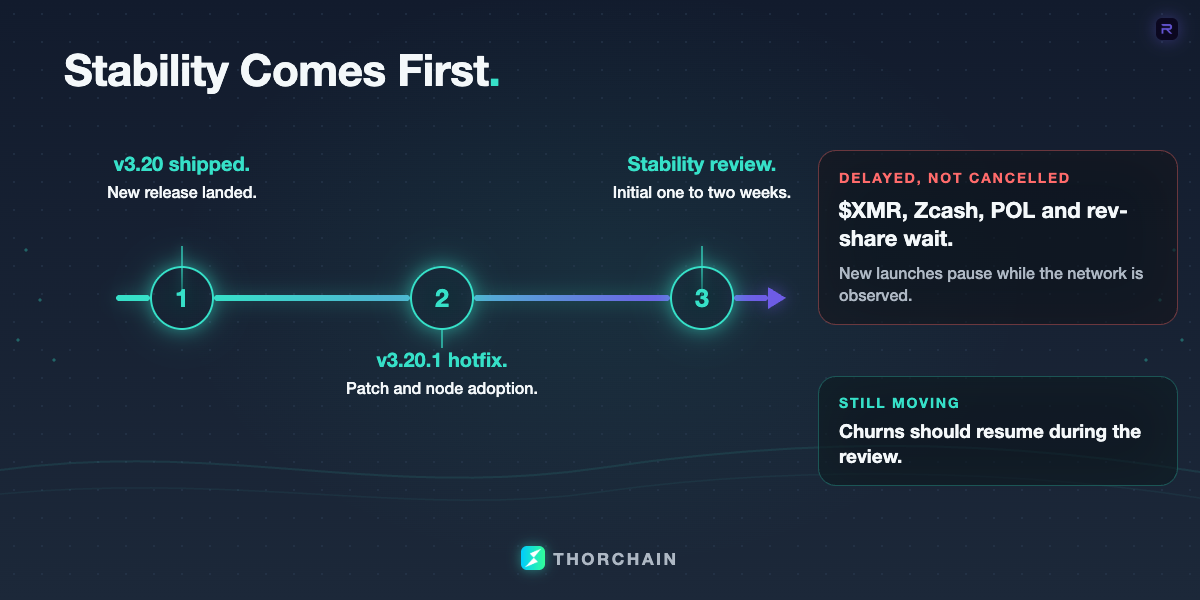
1. Stability Comes Before the Next Launch
THORChain had just shipped v3.20, but the episode opened with the harder follow-up: the network needed a v3.20.1 hotfix and a period of focused stability work before the roadmap could advance again.
Chad Barraford said the immediate issue came from the Rujira app layer sometimes querying API endpoints whose results could vary between requests. That variation can change gas consumption. In a consensus system, even a tiny difference in execution is unacceptable, so the team chose to pause new work while it fixed the current failure mode and watched the chain closely.
"We've had too much instability recently to just kind of keep on slogging forward." (Chad)
The current patch was expected within roughly 24 hours, contingent on testing and node adoption. But the broader pause is not merely a hotfix window. The team wants at least one or two weeks to assess stability, then decide whether it can resume the roadmap or needs more time.
That means Zcash and Monero are waiting, alongside new feature rollouts, protocol-owned liquidity deployment and rev-share. The message is deliberately cautious: $XMR and Zcash are delayed, not abandoned. Churns should still resume during the stability period, but new chain launches are not the near-term priority.
The community also asked whether the app layer itself could be paused temporarily. Chad confirmed that it is technically possible, but said the team did not yet think it was necessary. The identified patch may be enough, though that judgment could change as more information arrives.
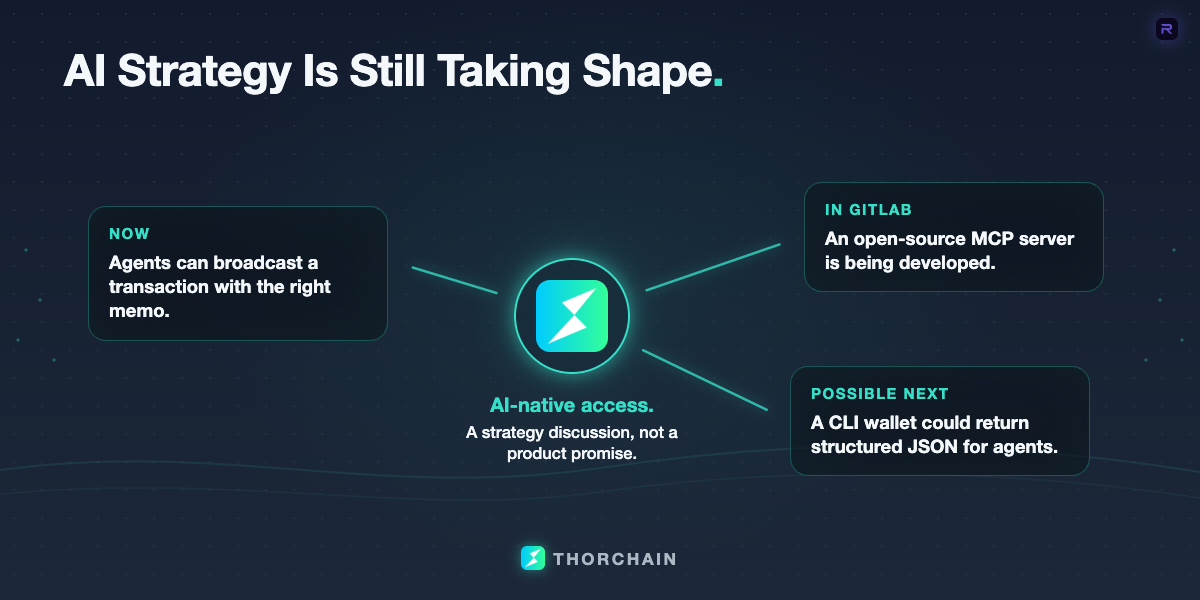
2. AI Strategy Is Still Taking Shape
Before the technical updates, Denny highlighted a self-funded AI video from French Chad that had reached nearly 9,000 impressions. The anecdote led into a broader question: if agents increasingly initiate crypto activity, what should THORChain build for them?
Kenton said work on AI-engine optimization was beginning to show results in AI search. Chad took the longer view. He expects agents to account for a growing share of transactions, but he does not think the correct protocol strategy is obvious yet.
"The hard thing is figuring out what our strategy should be in that context." (Chad)
Some ingredients already exist. Chad said a developer has been working on an open-source MCP server in THORChain's GitLab, though it had not been publicized. Agents can already broadcast a transaction with the necessary memo, so basic agent use does not require a new protocol feature.
The more ambitious possibility is an AI-friendly, command-line wallet with structured JSON output. Instead of asking an agent to operate a graphical wallet, it could hold assets, inspect transaction history and submit transactions through an interface designed for software. That idea is not a product commitment, and it may not be THORChain-specific. It is a direction the team is evaluating as the capabilities and economics of AI change.
Chad also clarified the role of Huginn. It is designed to operate independently, not as a chat assistant that a developer prompts directly. A GitLab issue can be assigned to Huginn, which then works through that task on its own schedule.
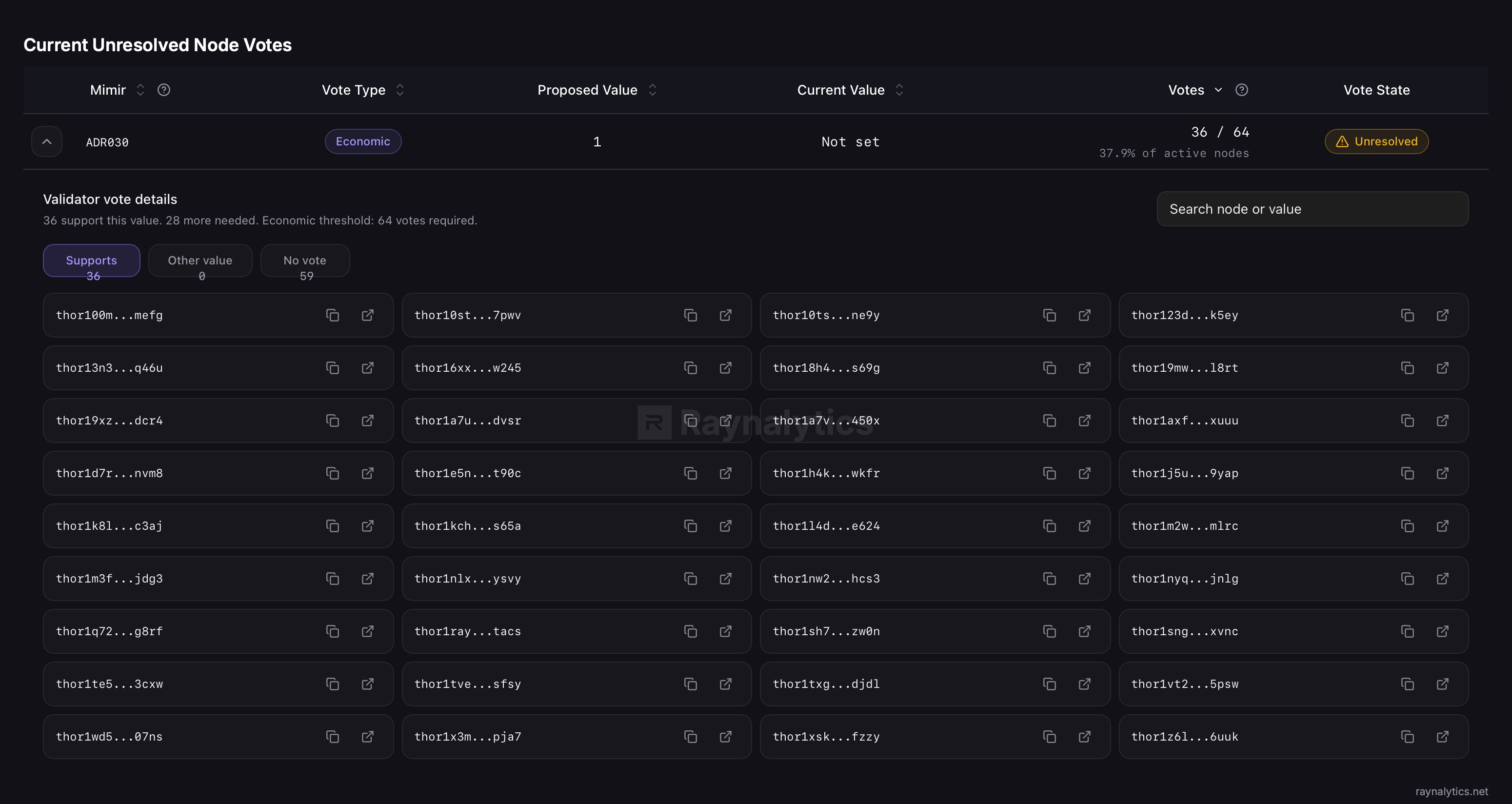
3. ADR30 Separates Operations From Fund Control
ADR30 was at 38% approval during the show. The proposal would let a node operator delegate selected operational commands to another address without giving that address control of the node's funds or private keys.
That makes it a quality-of-life change rather than an economic redesign. An operator could split routine duties among people or systems while retaining the key material that matters for custody. The proposal was associated with Liquify, and Chad said he saw no material protocol-design risk beyond the normal need to implement and review the code correctly.
"The security, all that remains the same." (Chad)
The vote was not presented as complete. Operators and bond providers still need time to review proposals, coordinate internally and vote. The conversation also returned to a possible future ADR that would require validators to participate in ADR votes, including an abstain option, so governance does not remain idle by default.
Other proposals remain in the queue, including free stablecoin swaps, per-asset minimum fee settings and Devel's limit-order idea. They can wait. The team was clear that stability outranks adding more work to the release path.
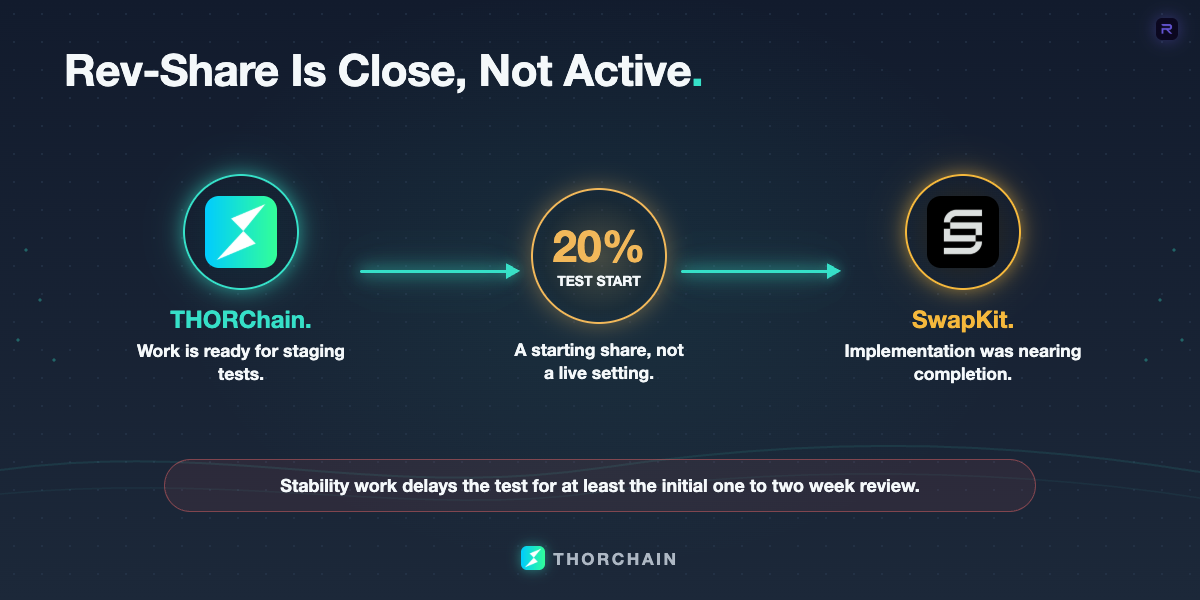
4. SwapKit Rev-Share Is Close, but Not Active
The planned rev-share arrangement with SwapKit is technically close on both sides. Chad said THORChain's work is ready for additional staging tests, while SwapKit's implementation was nearing completion. Under the proposed test, a portion of fees would go to a SwapKit-controlled bucket, where the partner could use it to compete for more external wallet flow.
"We'll start with 20%, we'll see how that goes." (Chad)
That 20% figure is a starting point for a test, not a live setting. The team intends to judge the arrangement by the resulting data, then increase, decrease or stop it if the outcome does not justify the share.
Rev-share can be enabled through an operational Mimir vote, which ordinarily needs three agreeing nodes. But no activation should be read into that mechanism. The same stability pause affecting $XMR and Zcash also pushes the rev-share test back by at least one or two weeks.
The episode also touched on protocol-owned liquidity. v3.20 was meant to help direct system income into selected pools, but that work is now subject to the same pause. The team may later prioritize stablecoins, $XMR, Zcash or other pools, but no new allocation is expected while stability work takes precedence.
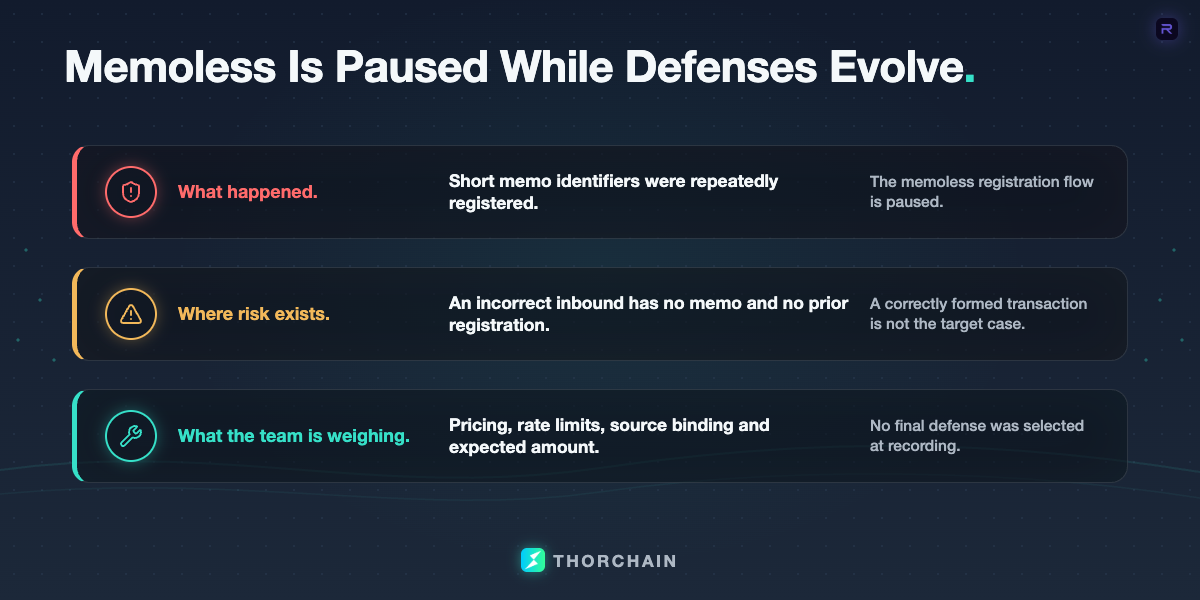
5. Memoless Swaps Are Paused While the Team Reworks Defenses
The memo registration feature used for memoless swaps was turned off after someone began repeatedly registering short memo identifiers in an attempt to capture an incorrectly sent inbound transaction. Each pool has roughly 100,000 possible identifiers, and the attacker tried to flood that space with registrations.
Chad's key distinction was important: the attempt can only succeed when someone sends funds to THORChain without including a memo and without registering the intended memo first. It is not a conventional compromise of a correctly formed THORChain Swap.
"The protocol gained money in this particular attack as of now." (Chad)
The attacker pays to keep registrations active and, at the time of the episode, was operating at a loss. That does not make the design question irrelevant. The team is deciding whether to restart the feature as it is, make registrations more expensive as space fills, cap registrations per block, bind a registration more closely to the sending address, or include the expected amount in the registration. Each option creates different wallet and user-experience edge cases.
For now, the status is a pause and an active design discussion, not a finalized fix. The practical guidance remains the same: use an interface that constructs the transaction correctly, read its warnings and send a small test transaction before committing a meaningful amount. Self-custody gives users control, but it also makes transaction discipline non-optional.
What to Watch
- v3.20.1 and uptime: whether the hotfix is adopted cleanly and the team sees the stable operation it wants before reopening the roadmap.
- New-chain timing: when Zcash and $XMR return to the launch queue after the initial one-to-two-week stability review.
- ADR30: whether the delegation proposal clears its node vote and how quickly the remaining governance queue moves afterward.
- AI interfaces: whether the MCP server is publicized, and whether the agent-friendly command-line wallet concept becomes a concrete build.
- Memoless redesign: which registration defense the team chooses and when THORChain Swap can safely re-enable the flow.
More THORChain data, check out raynalytics.net
Follow Raynalytics for more Weekly Analytics and Podcast recaps.

Related articles
![Ecosystem Update Podcast with Zano]()
Oct. 10, 2026
Zano’s Recovery Plan and the Road to THORChain
- Podcast
![Protocol Update Podcast with Chad Barraford, Kenton and Patriot]()
Oct. 8, 2026
Chad's Unchained Podcast Debrief, Rev-Share and Monero
- Podcast
![Ecosystem Update Podcast with Houdini Swap]()
Oct. 3, 2026
Houdini Swap on THORChain Explained: What It Means for Users and Treasury Revenue
- Podcast
![Protocol Update Podcast with Chad Barraford, Kenton and Denny]()
Oct. 1, 2026
Can or Should THORChain Censor Transactions?
- Podcast
![Protocol Update Podcast with Chad Barraford, Kenton, Devel and Boone]()
Sep. 24, 2026
Inside the Houdini Swap Debate: THORChain’s Treasury, Privacy and Revenue
- Podcast
![Ecosystem Update Podcast with Radix]()
Sep. 19, 2026
Radix and THORChain: Building Trust for the Agentic Future
- Podcast
![THORChain Podcast protocol update cover]()
Sep. 17, 2026
THORChain Returns to Shipping: Zcash, Monero and Self-Sufficiency
- Podcast
![Ecosystem Update Podcast with Station Wallet]()
Sep. 13, 2026
Terra’s Station Wallet Is Back as Vultisig’s Agentic THORChain Wallet
- Podcast
![Protocol Update Podcast with Chad Barraford, Kenton and Patriot / Denny]()
Sep. 10, 2026
THORChain Prioritizes Stability Before Monero and New Features
- Podcast
![Ecosystem Update Podcast with RAVN]()
Sep. 5, 2026
Inside RAVN’s Native $BTC Aggregator and Its THORChain Integration
- Podcast
![Protocol Update Podcast with Hans, Devel, Chad, Kenton & Denny]()
Sep. 3, 2026
THORChain Churns Again: POL Goes Live, Rujira Resumes and BLO Debate
- Podcast
![Ecosystem Update Podcast with Rujira]()
Aug. 29, 2026
THORChain’s App Layer Rujira Is Paused. Rujira Wants a Clear Restart Path.
- Podcast
![Ecosystem Update Podcast with Unstoppable Wallet]()
Aug. 22, 2026
Unstoppable Wallet Adds $RUNE, $TCY and $RUJI, With a Stablecoin Wallet Next
- Podcast
![Protocol Update Podcast with Chad Barraford, Kenton and Denny]()
Aug. 20, 2026
v3.20 Voting Is Underway. Should THORChain’s TSS Library Remain Open Source?
- Podcast
![Ecosystem Update Podcast with Dash]()
Aug. 15, 2026
Inside Dash’s Zcash Orchard Upgrade and Its THORChain Potential
- Podcast