THORChain Churns Again: POL Goes Live, Rujira Resumes and BLO Debate
2026-09-03 — 10 min read
- Podcast
THORSday Community Podcast #231 ft. codehans1, Devel484, CBarraford, KentonC137 & patriotsounds | September 3, 2026 | Watch the full episode on YouTube
By Raynalytics
TL;DR
- THORChain completed a long-awaited churn, but the stability focus continues for another week before reassessment. Monero remains built and working on stagenet, with its mainnet launch still waiting. A Gaia pause interrupted the next churn during the show.
- Protocol-owned liquidity is active, with 20% of system income being routed toward POL. Denny showed almost $22,000 on day three, with deposits going into the TRON $USDT pool.
- Rujira's app layer has resumed with two contracts still disabled. Hans wants emergency halts followed by prompt contact with the affected team and a clear route to resolution.
- Devel argues base-layer limit orders could improve quotes and execution for all swappers. Chad and Hans question the complexity and priority; Rujira's oracle-based DCL offers another approach to keeping trading value inside the ecosystem.
- Chad is building better metrics and log access for AI-assisted maintenance. Kenton reported stronger AI discovery, while ADR30's delegated node permissions still needed more votes.
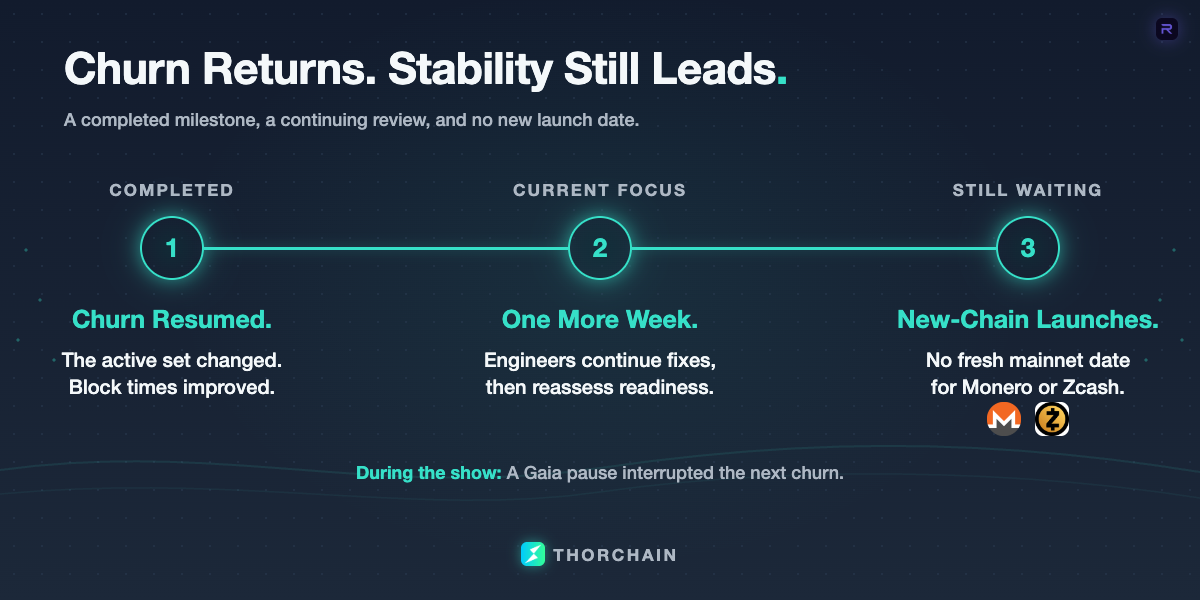
1. Churn Returns, but Stability Still Sets the Pace
THORChain finally churned again, bringing relief after the extended disruption. Devel said the change in the active node set immediately improved average block times by about 300 milliseconds as troubled nodes left and healthy ones entered.
That progress does not end the stability-first period discussed last week. Chad's Thursday engineering call favored another week of focused fixes, followed by reassessment. Outstanding Solana issues were one reason to continue.
"I'm hesitant to say that we've completed our stability without achieving stability." (Chad)
For Monero followers, the message was explicit: the integration is built, functioning and working on stagenet. The team has not abandoned it. Monero and Zcash remain behind the decision to resume adding chains, with no new launch date given.
During the show, a Gaia pause complicated the next churn. Chad said a security concern was being investigated; details were still emerging. It illustrated a dependency he wants to revisit: adding a chain currently requires a churn. As more chains and signing schemes make that process more complex, he wants to remove avoidable dependencies on it. That is a proposed direction, not a completed redesign.
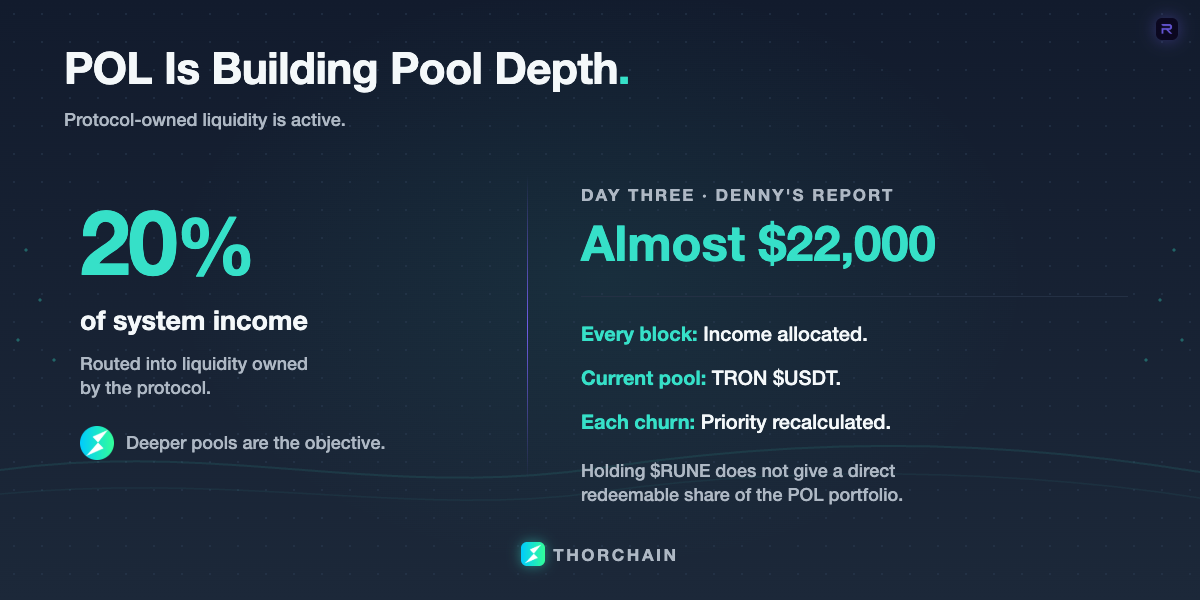
2. POL Starts Building Pool Depth Every Block
Protocol-owned liquidity, or POL, supplied the week's other concrete milestone. The setting was 20% of system income, and Denny showed almost $22,000 accumulated on day three. Allocations happen every block; the current destination was the TRON $USDT pool.
The discussion described pool selection as being recalculated each churn cycle, directing new liquidity toward an eligible pool based on its activity. The purpose is to build depth that stays under protocol ownership. Raynalytics' POL Income dashboard tracks the allocations, deposits and pool priorities.
"Its only interest is to just supply more liquidity and more depth to the pools." (Chad)
Denny explored whether this made THORChain resemble an ETF or an index fund. Chad drew a boundary around that analogy: holding $RUNE does not give someone a direct redeemable share of the POL portfolio. The intended benefit is indirect, through deeper pools, more useful trading capacity and the fees that activity can generate.
Kenton floated a possible future distribution to $TCY holders if POL became sufficiently large. Chad treated that as an option, not a commitment. Treasury rebalancing was also raised, including Oleg's suggested $500,000 move toward TRON stablecoin liquidity. No allocation decision was announced.
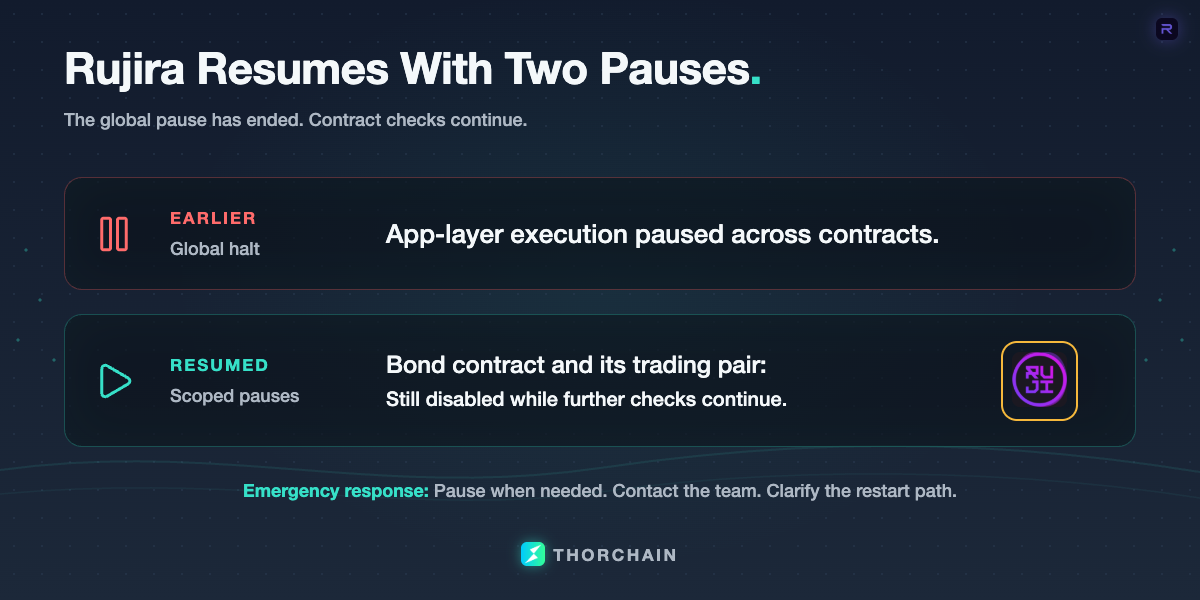
3. Rujira Resumes With Two Contracts Still Paused
There is a material update to Saturday's discussion of the app-layer pause: Rujira is running again. Hans said the bond contract and its trading pair remained disabled while the team double-checked the relevant query paths.
He said the non-determinism issue had been fixed in v3.20, with further checks intended to establish that nothing remained. The broader lesson concerns separation: complex financial logic can sit on the app layer, but the base-layer queries it calls must still behave deterministically and contract execution must be bounded.
Hans accepted that emergency controls need to be usable immediately. His proposed follow-through was to pull the lever when necessary, contact the relevant team, and establish a clear path to resolution.
"We weren't really sure what the correct process to get things reenabled was." (Hans)
The group also discussed malicious use of pause powers. Chad described counter-votes and possible governance action against offending nodes; these were responses to a hypothetical attack, not an announced automatic penalty.
Hans explained one safeguard in Rujira's credit-account design: collateral can still be sent to a position's address when app-layer execution is paused, including supported secured assets. That can help protect a position during market moves, but it does not restore every action. App-layer-only positions cannot necessarily be sold while their contracts are halted.
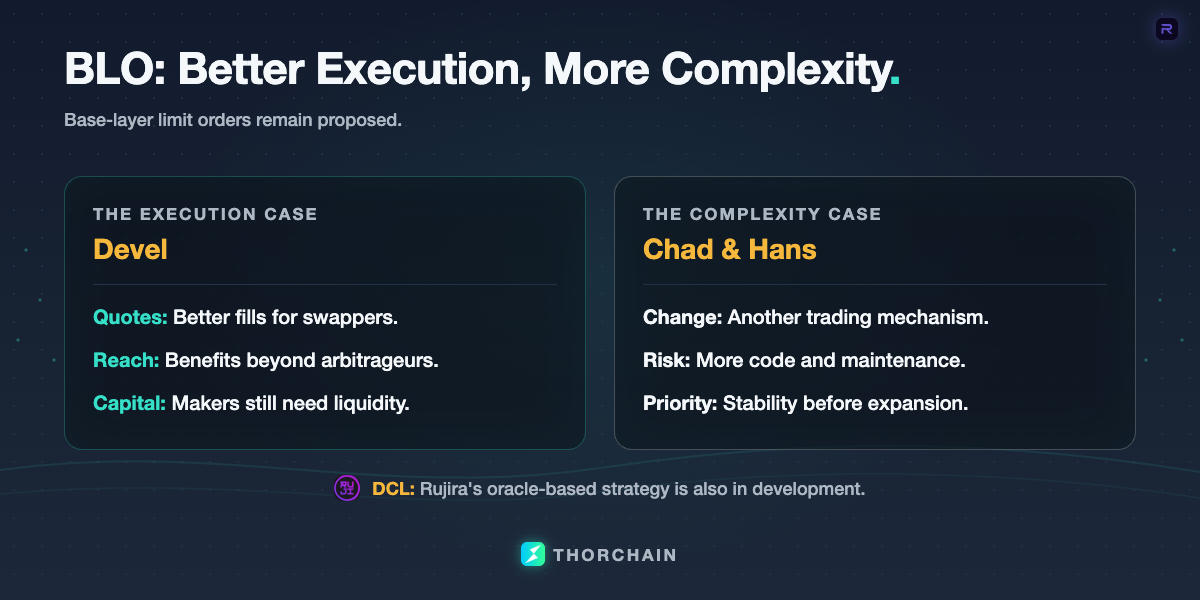
4. BLO's Promise Meets the Cost of More Complexity
Devel's base-layer limit-order proposal, or BLO, produced the episode's longest debate. The disagreement centered on whether the execution benefits justify adding another trading mechanism alongside THORChain's AMM pools.
Chad evaluates a feature by implementation effort, risk and expected return. BLO would add code, maintenance obligations and operational questions about how two liquidity mechanisms interact. He remains open to it, but gives it a lower priority while stability work continues. Hans shared those concerns, drawing on years of building on-chain order books and the pitfalls of rounding, iteration limits and execution time.
Devel's case is that the initial users may be a small group of arbitrageurs, while the beneficiaries are everyone whose swaps reach the base layer.
"It improves the quote, it improves the result, it improves the speeds, it reduces refunding." (Devel)
He said existing limit swaps have details that make them unattractive for arbitrageurs. BLO is designed around that workflow, with the aim of winning more quotes for ordinary users. Devel and the Maya Protocol team would likely provide much of the implementation, although core review and testing would still be necessary.
Oleg Petrov from SwapKit supplied a concrete example through chat: a user wanted a fast $20 million swap involving shallow pools. BLO could let market makers post liquidity and serve it in smaller chunks. Chad challenged the assumption that enough capital would be waiting there. Devel agreed that makers would need time to reallocate funds. The example shows the opportunity and the unresolved liquidity problem; it is not a claim that BLO already solves large swaps.
Hans also explained Dynamic Concentrated Liquidity, or DCL, which Rujira is developing. Instead of quoting only along a fixed curve, it uses the strategy's average entry price and THORChain's enshrined oracle price to adjust bids and asks. Its aim is to retain more trading profit and liquidity within the ecosystem.
Devel questioned whether external arbitrageurs would capture opportunities before the oracle-driven strategy reacts. Hans welcomed the resulting price competition. Neither DCL's profitability nor BLO's adoption was presented as proven. The designs could also interact: Hans said the app layer could use base-layer order functionality if it becomes available.
5. AI Maintenance Needs Better Visibility
Hans and Chad agreed that agents can already use open blockchain interfaces. An agent can generate keys and broadcast transactions; a special agent-branded chain is not a prerequisite. A convenient cross-chain command-line wallet could help, but Hans noted that agents can also work with multiple existing tools.
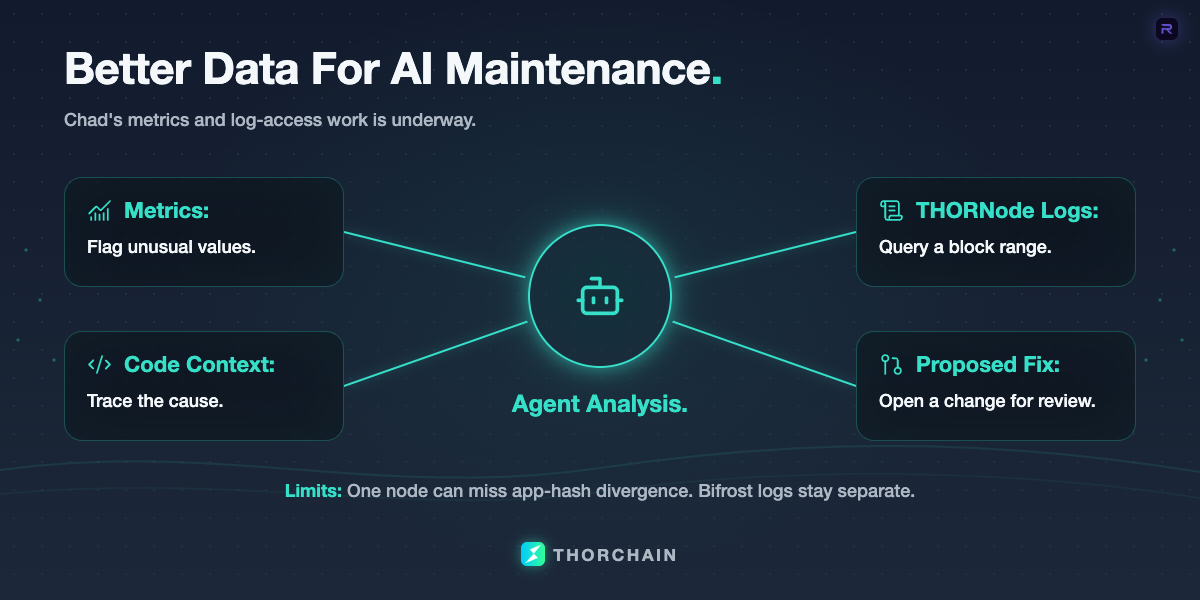
Chad's immediate work is more operational. He wants protocol metrics pushed into Midgard, where statistical analysis can flag unusual values. An agent could then connect those anomalies to code and logs, investigate causes and potentially open a proposed fix.
The second piece is a THORNode API for querying logs over a block range. Together, these would give developers and agents more context without requiring every investigator to run a node. Devel said he already uses a restricted MCP server to give an agent log access, and had built monitoring that notified him when a churn succeeded.
There are limits. Data from one node may not explain why another node has a different app hash. Bifrost logs also remain a separate operator-controlled source. Chad discussed possible private, opt-in sharing later, while stressing that sensitive log contents require care. Broader visibility is work underway, not a deployed autonomous maintenance system.
6. Better AI Discovery, but a Weak August Fee-Test Sample
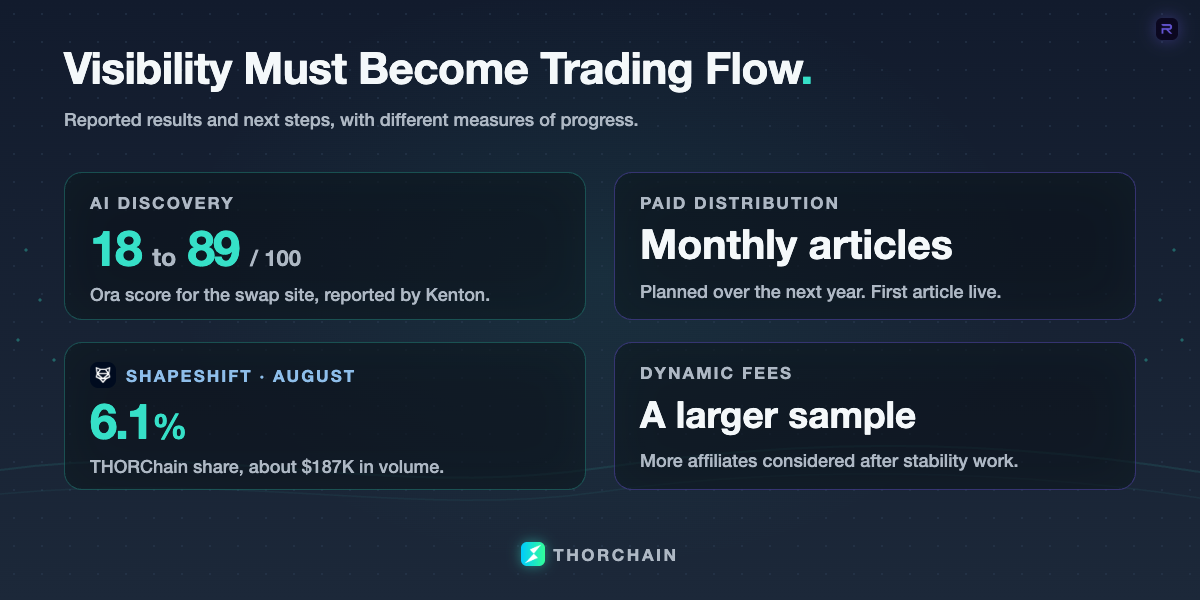
Kenton showed the swap site's score on Ora, reporting an improvement from 18/100 two months earlier to 89/100. He credited SEO work and the Unstoppable Wallet developers, and said he and Randy were now seeing daily API-key requests, including projects finding THORChain through AI search. Some requests were spam or individual inquiries, so this is evidence of visibility, not a count of signed integrations.
He is also replacing older “liquidity protocol” descriptions with “decentralized exchange” where possible, so search systems associate THORChain with a term people actually use.
"We have to stop inventing words that nobody uses." (Kenton)
Distribution work continues through DeFi Llama: the first paid article has launched, with roughly monthly articles planned over the next year. Blockworks also announced its dashboard. Referral tracking links were still being finished.
On execution, Kenton reported fixes for THORChain Swap, including $USDT allowance handling and THORName address entry. He asked users to retest Bitcoin Taproot flows, including a reported Ledger issue, rather than treating every route as independently verified.
The dynamic-fee experiment had a less encouraging month. Chad reported roughly $187,000 of ShapeShift volume for THORChain in August, about 6.1% of the total. He considered the sample too small for a strong conclusion and wants to add higher-volume affiliates after the stability period, with Edge Wallet mentioned as a possibility. Better discovery and better routing economics still need to turn into sustained flow.
7. ADR30 and the Next Wave of Node Operators
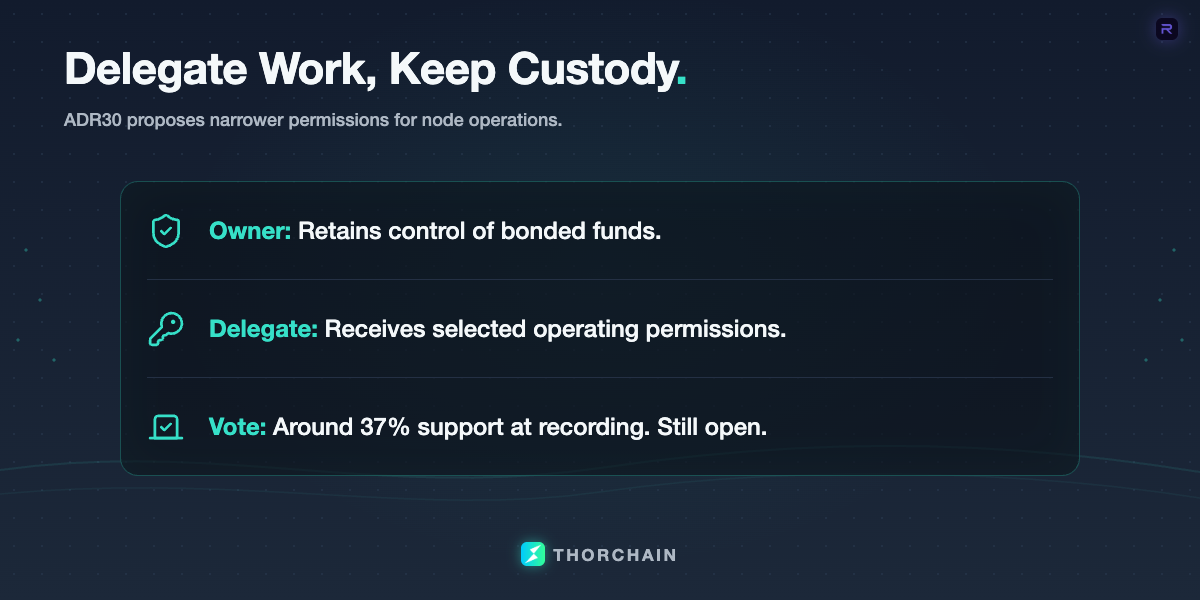
ADR30 remained around 37% support during the recording. The Liquify proposal would let a node owner delegate selected tasks to other addresses without handing over the key controlling the bond. A team could separate routine operation from custody, making the setup more practical for professional infrastructure providers. The vote was still open; follow it on the governance tracker.
The standby queue was another sign of activity. Denny highlighted Runetard for helping bond providers become independent node operators and encouraged other multi-node operators to consider doing the same.
The group was cautious about accelerating churn merely to clear the backlog. Chad and Devel preferred gradual changes while reliability improves. Devel also highlighted the rule that the lowest-bonded node no longer has to leave unless the active set is at capacity, allowing smaller operators to remain when they perform well.
What to Watch
- Next Thursday's stability review: whether remaining issues are resolved enough to resume new-chain launches, including Monero and Zcash.
- POL deployment: how much income accumulates, where deposits land and how pool priorities change across churn cycles.
- Rujira's remaining pauses: completion of the contract checks and clearer communication around future emergency halts.
- BLO and DCL evidence: implementation review, testing, execution benefits and how much liquidity each design can attract.
- AI maintenance tooling: delivery of metrics and log access, with clear boundaries around operator-specific data.
- Conversion into flow: whether AI discovery, paid distribution and a broader dynamic-fee sample produce sustained activity.
- ADR30 and node growth: further votes, successful churns and independent operators entering the active set.
More THORChain data, check out raynalytics.net
Follow Raynalytics for more Weekly Analytics and Podcast recaps.

Related articles
![Protocol Update Podcast with Chad Barraford, Kenton and Denny]()
Oct. 15, 2026
SwapKit Rev-Share Week One: Early Data Looks Promising, v3.21 and Monero Next
- Podcast
![Ecosystem Update Podcast with Zano]()
Oct. 10, 2026
Zano’s Recovery Plan and the Road to THORChain
- Podcast
![Protocol Update Podcast with Chad Barraford, Kenton and Patriot]()
Oct. 8, 2026
Chad's Unchained Podcast Debrief, Rev-Share and Monero
- Podcast
![Ecosystem Update Podcast with Houdini Swap]()
Oct. 3, 2026
Houdini Swap on THORChain Explained: What It Means for Users and Treasury Revenue
- Podcast
![Protocol Update Podcast with Chad Barraford, Kenton and Denny]()
Oct. 1, 2026
Can or Should THORChain Censor Transactions?
- Podcast
![Protocol Update Podcast with Chad Barraford, Kenton, Devel and Boone]()
Sep. 24, 2026
Inside the Houdini Swap Debate: THORChain’s Treasury, Privacy and Revenue
- Podcast
![Ecosystem Update Podcast with Radix]()
Sep. 19, 2026
Radix and THORChain: Building Trust for the Agentic Future
- Podcast
![THORChain Podcast protocol update cover]()
Sep. 17, 2026
THORChain Returns to Shipping: Zcash, Monero and Self-Sufficiency
- Podcast
![Ecosystem Update Podcast with Station Wallet]()
Sep. 13, 2026
Terra’s Station Wallet Is Back as Vultisig’s Agentic THORChain Wallet
- Podcast
![Protocol Update Podcast with Chad Barraford, Kenton and Patriot / Denny]()
Sep. 10, 2026
THORChain Prioritizes Stability Before Monero and New Features
- Podcast
![Ecosystem Update Podcast with RAVN]()
Sep. 5, 2026
Inside RAVN’s Native $BTC Aggregator and Its THORChain Integration
- Podcast
![Ecosystem Update Podcast with Rujira]()
Aug. 29, 2026
THORChain’s App Layer Rujira Is Paused. Rujira Wants a Clear Restart Path.
- Podcast
![Protocol Update Podcast with Chad Barraford, Kenton and Denny]()
Aug. 27, 2026
THORChain Puts Stability First: Monero & Zcash Delayed, ADR30, AI Agents and Memoless Swaps
- Podcast
![Ecosystem Update Podcast with Unstoppable Wallet]()
Aug. 22, 2026
Unstoppable Wallet Adds $RUNE, $TCY and $RUJI, With a Stablecoin Wallet Next
- Podcast
![Protocol Update Podcast with Chad Barraford, Kenton and Denny]()
Aug. 20, 2026
v3.20 Voting Is Underway. Should THORChain’s TSS Library Remain Open Source?
- Podcast