Rujira and THORChain Align on the App Layer: ADR31, CCL, and the Road to Perps

2026-08-06 — 11 min read
- Podcast
THORChain x Rujira Podcast #223 ft. codehans1, PragmaticMonkey, KentonC137 & Patriotsounds | August 6, 2026 | Watch the full episode on YouTube
By Raynalytics
TL;DR
- ADR31 renewed the app-layer alignment between THORChain and Rujira and changed revenue routing: 33.34% goes to a jointly owned POL fund, 33.33% directly to THORChain, and 33.33% to $RUJI stakers. THORChain retains about 50% economic exposure because it owns half the POL fund.
- Rujira's tighter virtualization strategy is now trading closer to THORChain's base-layer pool prices. Pragmatic Monkey said its share of overlapping THORChain volume has recently moved from below 1% to roughly 1.5%, with some days near 2%.
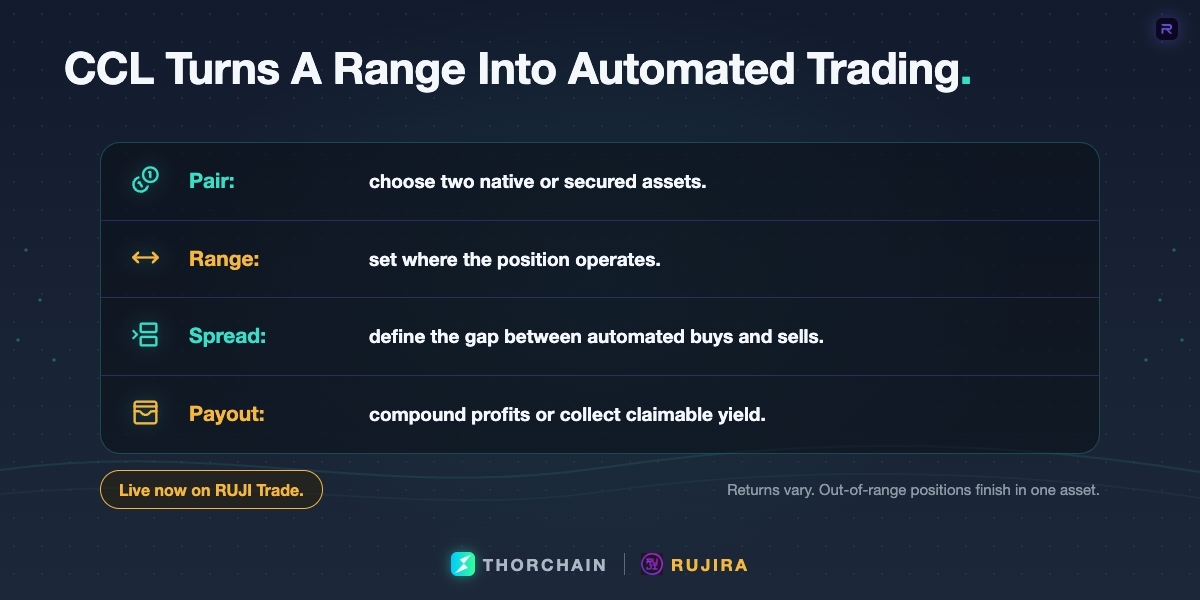
- Custom Concentrated Liquidity (CCL) is live. Users choose a pair, price range and spread, then FIN automatically places and replaces orders as the market moves.
- Dynamic Concentrated Liquidity (DCL), leveraged liquidity positions, perpetual markets and a new synthetic stablecoin are still being built. Pragmatic Monkey framed the perps timeline as months, not weeks or years.
- The Kujira chain has shut down after a small exploit accelerated its planned retirement, but the team, products and community continue through Rujira on THORChain.
Introduction
Rujira's order books are live, Custom Concentrated Liquidity positions are earning trading fees, the link to THORChain's base-layer pools has tightened, and the next products are forming around that foundation.
Rujira is THORChain's smart-contract app layer, combining order books, lending and automated market making around native cross-chain liquidity. Contributors Hans and Pragmatic Monkey joined Kenton and Denny to explain ADR31, captured arbitrage, CCL, DCL, perps and the planned stablecoin, then reflected on the Kujira chain's end.
1. ADR31 Renews the App-Layer Mandate
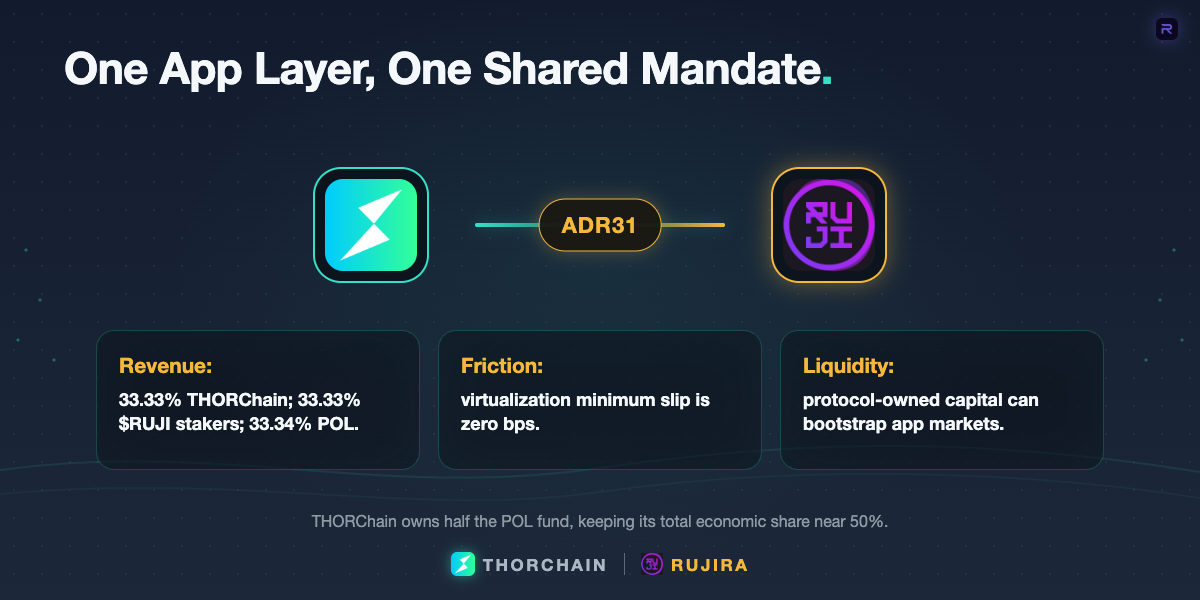
ADR20 formalized Rujira's original relationship with THORChain after development had already begun. ADR31 renews that roughly one-year arrangement and updates the revenue routing. Of app-layer revenue, 33.34% goes to a POL fund owned equally by Rujira and THORChain, 33.33% goes directly to THORChain, and 33.33% goes to $RUJI stakers. THORChain therefore retains about 50% economic exposure through its direct share plus half the POL fund.
The vote also did more than extend an existing deal. As covered in the Podcast #221 recap, it reduced the minimum slip applied to Rujira's virtualization strategy to zero bps. That lowers friction between the app-layer order books and THORChain's base-layer pools. ADR31 also established protocol-owned liquidity as a way to bootstrap the products and markets that cannot rely on existing THORChain pool depth.
Hans described the result as a mandate to keep building a decentralized financial platform around real spot assets, direct deposits and open-source applications.
"To be able to come together and solidify the relationship, and have this cohesive team and community moving forward together, creates a really powerful foundation." (Hans)
The agreement aligns the teams, economics and liquidity strategy. It does not make every planned product live.
2. How the Order Book Captures Arbitrage Revenue
Rujira Trade's FIN order book aggregates user orders, CCL positions and a virtualization strategy that follows THORChain's base-layer pool prices every block.
When those sources overlap, FIN matches them and captures the price difference as arbitrage profit. Trading fees provide one revenue stream, while the overlap provides another. Both flow into ADR31's three-way revenue routing.
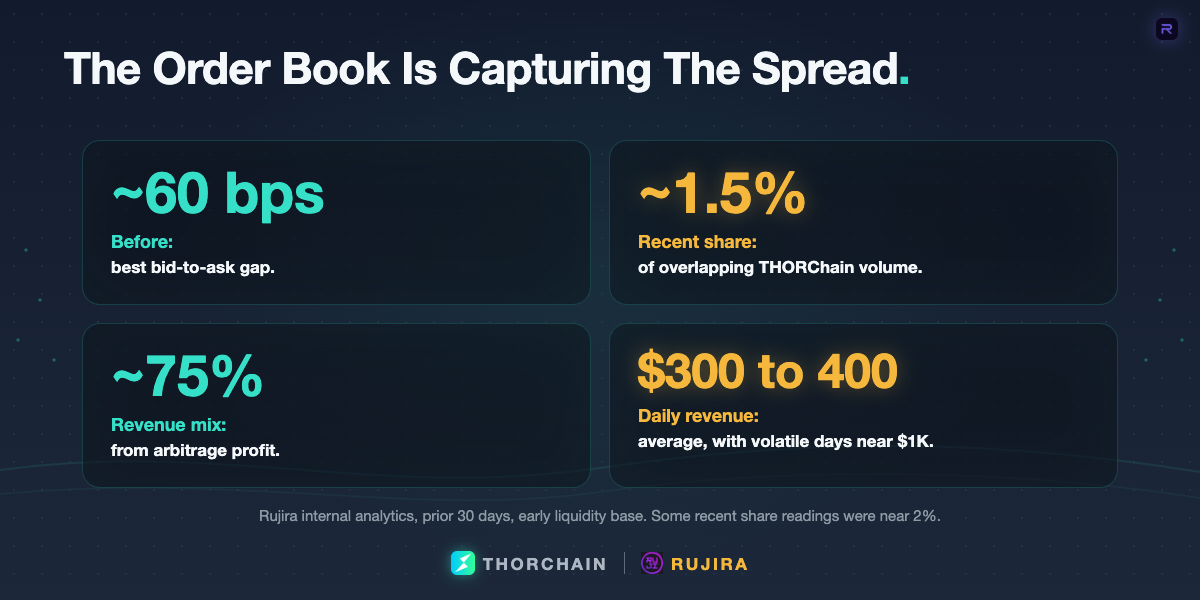
Before the minimum slip change, Pragmatic Monkey said the virtualization strategy's best bid and ask were separated by roughly 60 bps. It has since been tightened, although not to its final setting, so smaller price differences can trigger trades.
Rujira's internal analytics showed the virtualization strategy moving from less than 1% of overlapping THORChain volume on many earlier days to around 1.5% more recently, with a few readings around 2% to 2.2%. Over the prior 30 days, roughly 75% of Rujira Trade revenue came from captured arbitrage profit rather than its explicit trading fee. Pragmatic Monkey put average daily revenue around $300 to $400, with more volatile days approaching $1,000.
These are early internal figures from a small liquidity base. The flywheel is what matters: tighter quotes create more trades, trading improves returns for app-layer liquidity, and more liquidity gives the strategy greater capacity to rebalance THORChain's pools.
"It really shows that the model is working. Then it is just a matter of scaling liquidity." (Pragmatic Monkey)
3. CCL Turns a Range Into an Automated Strategy
Custom Concentrated Liquidity is the product Rujira wants users to try now. A user selects two assets, chooses the highest and lowest price at which the position should operate, sets a spread, and decides whether profits should compound or accumulate as claimable yield.
FIN distributes buys below the current price and sells above it, then replaces filled orders. A narrower range concentrates capital and can earn more per unit of volume, but reaches its boundary sooner. A wider range stays active longer.
For a $BTC/$USDC position, the interface estimates the average price at which it would become fully $BTC at the bottom of the range or fully $USDC at the top. A leaderboard also lets users inspect and copy live parameters.
Copying a past performer does not guarantee the same result. Returns change with competition and market conditions, and a strategy can finish entirely in one asset. The pitch is access to market making without manually maintaining an order-book bot, not a fixed yield.
"CCL is really the key product: pick two assets, make money on volatility, and put native assets to work fully on-chain." (Pragmatic Monkey)
Rujira charges 15 bps for market takers, 7.5 bps for limit or tracking orders, and 2.5 bps for CCL positions, according to the walkthrough. The lower CCL fee reflects that the user supplies persistent liquidity on both sides of the market.
4. DCL Removes the Fixed Range
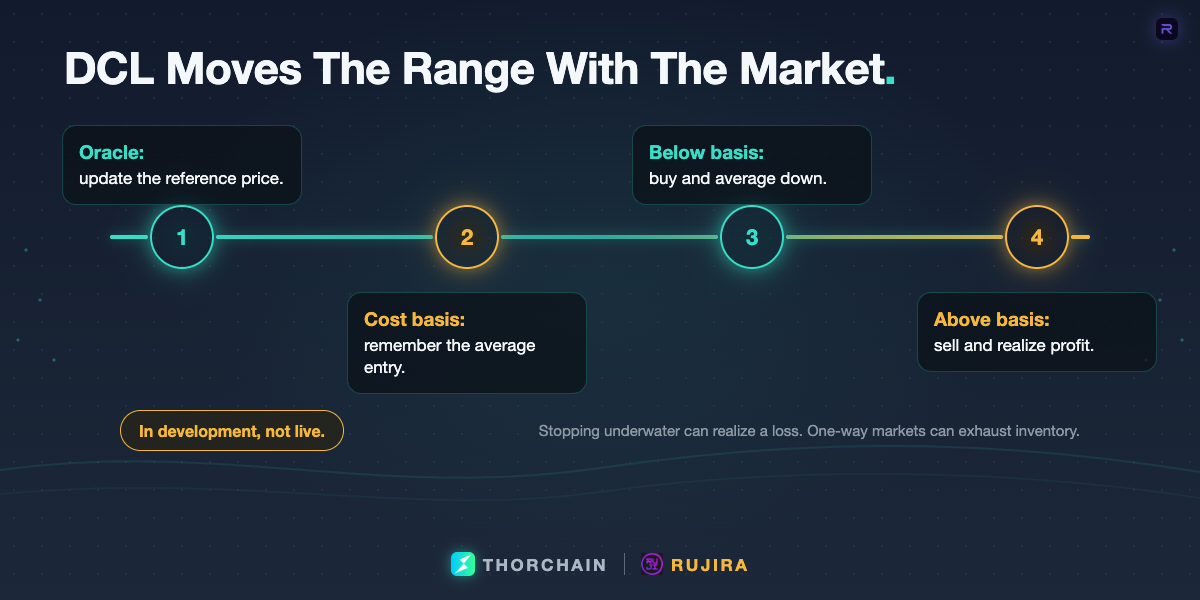
Dynamic Concentrated Liquidity is designed to automate the hardest CCL decision: where the range should sit. Instead of fixing upper and lower boundaries, DCL would follow an oracle price and maintain an average entry price for the position.
Below that cost basis, the strategy buys and averages down. Above it, the strategy sells and realizes profit. It places orders on one side at a time to avoid realizing impermanent loss during normal operation. Stopping underwater could still lock in a loss, and a one-way market could exhaust one side of the inventory.
DCL is not live. Hans said the contract was roughly half complete and waiting for the market-making algorithm to be refined. Deployment, testing and interface work still follow. Pragmatic Monkey also said the design itself was still being revisited as the components came together.
If it works as intended, DCL adds a third liquidity source beside CCL and the virtualization strategy, creating more matching opportunities. It also makes the experience closer to "set and forget" for users who do not want to reposition a fixed range.
The nearer-term extension may be using CCL positions as collateral. That would allow a user to borrow against a mixed-asset liquidity position, hedge part of an exposure, or create leveraged LP positions when the expected yield exceeds the borrowing cost. This is also planned, not live.
5. Spot Liquidity Comes Before Perps and the Stablecoin
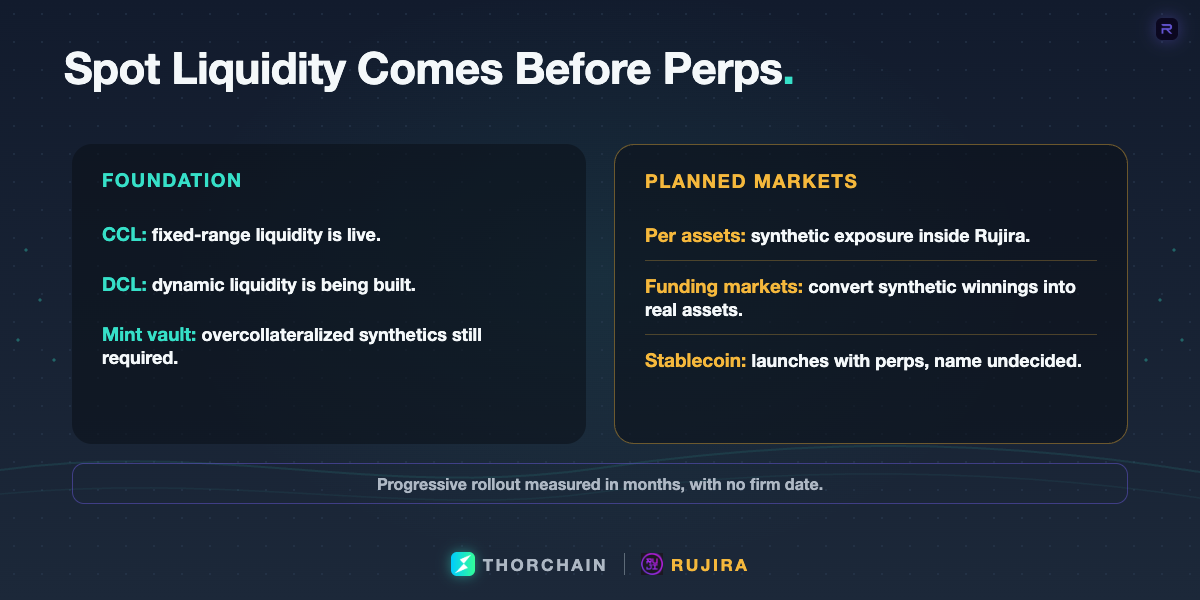
Rujira's perpetual market design starts from its spot markets rather than adding spot liquidity after building an isolated perps venue. DCL is a prerequisite because the synthetic markets will not have a matching THORChain base-layer pool to supply liquidity or keep prices aligned.
The proposed model mints synthetic "per" assets against overcollateralized positions. A trader could hold per-$BTC or per-$USDC, reuse it as collateral, or trade it through a funding market against the corresponding real asset. Cashing out creates the pressure other venues express through a funding rate.
Interfaces could hide those mechanics behind a familiar long, short and cash-out flow, while advanced integrators package more complex products.
"Most people will not sit and get their head around all of this directly, but it gives interfaces the ability to package it however their users might like." (Hans)
The planned stablecoin would launch with perps as the synthetic dollar across those pairs. Its name is undecided. Exporting it is conceptual and would introduce new security risks. Hans sees a censorship-resistant stablecoin as a way to pull outside yield into Rujira; Pragmatic Monkey is more cautious about demand in a market dominated by established issuers.
There is no firm release date. DCL, a mint vault, liquidity, deployment and interface work come first. Pragmatic Monkey's expectation was months, not weeks, and not years, with a progressive market-by-market rollout.
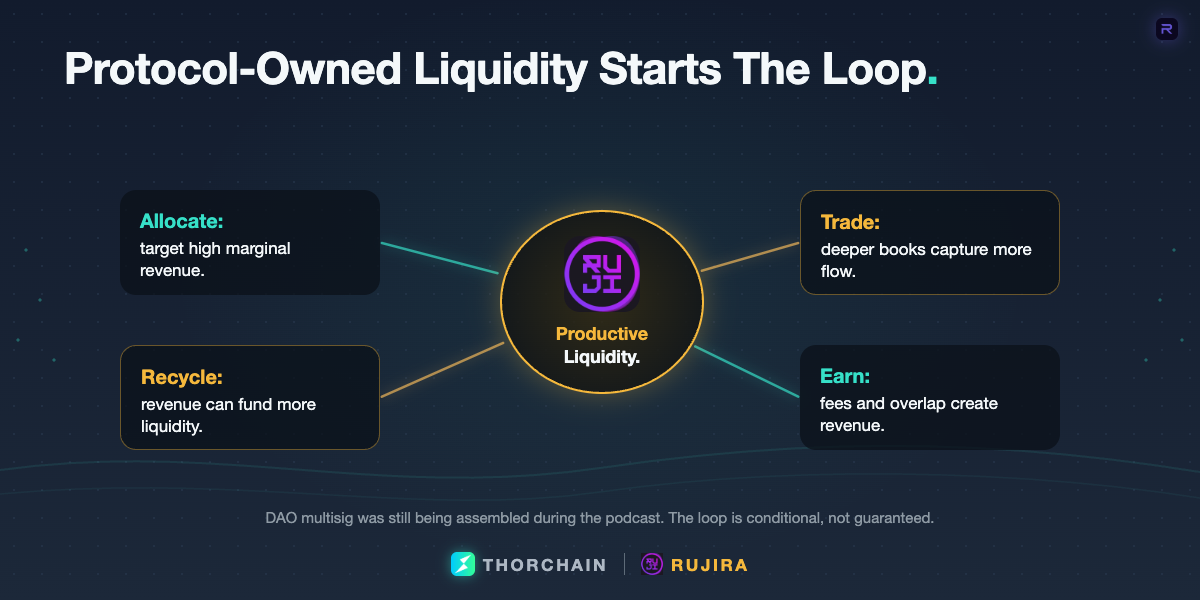
6. Protocol-Owned Liquidity Starts the Scaling Loop
The app layer still needs more liquidity before its internal economics can scale. ADR31's protocol-owned-liquidity provision is meant to start that process, especially for markets that cannot virtualize an existing THORChain pool.
The POL arrangement will use DAO-controlled multisig accounting separate from Rujira's ecosystem fund because some Rujira applications generate revenue outside ADR31's revenue-sharing scope. The multisig was still being assembled, so deployment and the first allocation remain items to watch.
While app-layer liquidity is limited, even a small allocation could matter. Rujira can rank markets by revenue per unit of liquidity, direct capital toward the strongest marginal effect, then use added revenue to fund more liquidity.
Distribution is incomplete. App-layer revenue currently reaches the THORChain reserve because THORNode lacks the interface needed to send it directly to bonders. Work has started on a separate module, with no completion date.
Rujira's contracts, interface and documentation are open source, but there is no referral model for outside integrators. Kenton wants a professional version of THORChain Swap that exposes Rujira products as one integration package. The teams agreed to work together, but committed no implementation.
Rujira's developers have financial runway while those economics mature. Pragmatic Monkey said the Stage of Deca Foundation continues covering salaries and operating costs and that the team has more than a year of funding based on what it has been told.
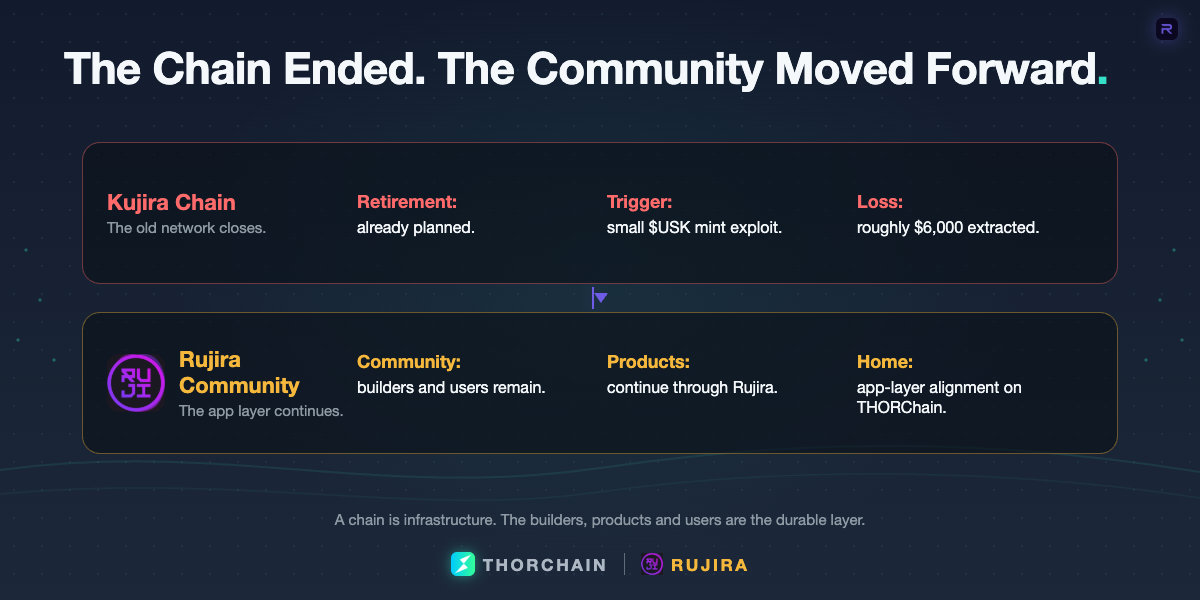
7. The Kujira Chain Ends, the Community Continues
The Kujira chain was already scheduled to wind down after more than two years without active maintenance. A small exploit accelerated the shutdown. Pragmatic Monkey said an attacker found a way to mint $USK and extracted roughly $6,000. With little value left and old code that had never been revisited with modern AI-assisted auditing, the team chose to stop the chain rather than divert effort into repairing it.
Kujira had been the community's rescue boat after Terra collapsed. The team launched a new chain within months and restored users' tokens one for one. That recovery created a group that followed the builders through bad debt, the move to THORChain and Rujira's early problems.
Denny described the community as a battle-hardened, almost nomadic group that had kept fleeing fires. THORChain, he argued, should finally provide a durable home.
"Now you're home. We have two ecosystems that got thrown together, but we are far more similar than we are dissimilar." (Denny)
The token-merger question remains separate. Pragmatic Monkey said Rujira can prosper alongside THORChain without merging $RUJI into $RUNE. He was not categorically opposed, but argued that any future terms would need to avoid dilution for the Rujira community and would become more natural only after the app layer contributes substantially more revenue.
For now, ADR31 is the practical union: shared infrastructure, shared economics and a common mission without forcing the tokens into one asset.
"We are not doing this just for the money. We believe we can make a difference, and that the world needs an alternative financial system." (Pragmatic Monkey)
What to Watch
- Virtualization strategy: whether further tightening increases app-layer volume and improves THORChain execution without weakening revenue.
- CCL adoption: whether more users and liquidity follow the new automated-trading leaderboard, and how returns change as capital enters each pair.
- DCL: completion of the market-making algorithm, contract, deployment and interface. It is under development, not live.
- Leveraged liquidity: whether CCL positions become usable as collateral before perpetual markets arrive.
- Perps and stablecoin: a progressive rollout is measured in months, with no firm date or final stablecoin name.
- Protocol-owned liquidity: deployment of the separate DAO multisig and its first transparent allocations.
- Integrations: any concrete plan to expose Rujira lending, CCL or other products through THORChain Swap or a shared integration package.

More THORChain data, check out raynalytics.net
Follow Raynalytics for more Weekly Analytics and Podcast recaps.

Related articles
![Ecosystem Update Podcast with Radix]()
Sep. 19, 2026
Radix and THORChain: Building Trust for the Agentic Future
- Podcast
![THORChain Podcast protocol update cover]()
Sep. 17, 2026
THORChain Returns to Shipping: Zcash, Monero and Self-Sufficiency
- Podcast
![Ecosystem Update Podcast with Station Wallet]()
Sep. 13, 2026
Terra’s Station Wallet Is Back as Vultisig’s Agentic THORChain Wallet
- Podcast
![Protocol Update Podcast with Chad Barraford, Kenton and Patriot / Denny]()
Sep. 10, 2026
THORChain Prioritizes Stability Before Monero and New Features
- Podcast
![Ecosystem Update Podcast with RAVN]()
Sep. 5, 2026
Inside RAVN’s Native $BTC Aggregator and Its THORChain Integration
- Podcast
![Protocol Update Podcast with Hans, Devel, Chad, Kenton & Denny]()
Sep. 3, 2026
THORChain Churns Again: POL Goes Live, Rujira Resumes and BLO Debate
- Podcast
![Ecosystem Update Podcast with Rujira]()
Aug. 29, 2026
THORChain’s App Layer Rujira Is Paused. Rujira Wants a Clear Restart Path.
- Podcast
![Protocol Update Podcast with Chad Barraford, Kenton and Denny]()
Aug. 27, 2026
THORChain Puts Stability First: Monero & Zcash Delayed, ADR30, AI Agents and Memoless Swaps
- Podcast
![Ecosystem Update Podcast with Unstoppable Wallet]()
Aug. 22, 2026
Unstoppable Wallet Adds $RUNE, $TCY and $RUJI, With a Stablecoin Wallet Next
- Podcast
![Protocol Update Podcast with Chad Barraford, Kenton and Denny]()
Aug. 20, 2026
v3.20 Voting Is Underway. Should THORChain’s TSS Library Remain Open Source?
- Podcast
![Ecosystem Update Podcast with Dash]()
Aug. 15, 2026
Inside Dash’s Zcash Orchard Upgrade and Its THORChain Potential
- Podcast
![Protocol Update Podcast with Chad Barraford, Kenton, Denny and Oleg Petrov]()
Aug. 13, 2026
THORChain is Close to v3.20: FROST, DKLS, SwapKit Rev-Share and Dynamic Fees
- Podcast
![Ecosystem Update Podcast with Morpheus]()
Aug. 8, 2026
Morpheus Maps Decentralized AI, $MOR Inference and a Planned THORChain Pool
- Podcast
![Ecosystem Update Podcast with Depouch]()
Aug. 1, 2026
Inside depouch: Direct THORChain Swaps Built for Simplicity
- Podcast
![Monero Gets a Soft Launch as THORChain's v3.20 Enters Testing and ADR31 Passes]()
Jul. 30, 2026
Monero Gets a Soft Launch as THORChain's v3.20 Enters Testing and ADR31 Passes
- Podcast