Terra’s Station Wallet Is Back as Vultisig’s Agentic THORChain Wallet
2026-09-13 — 6 min read
- Podcast
THORChain x Station Wallet Podcast #234 ft. Omar, KentonC137 & patriotsounds | September 13, 2026 | Watch the full episode on YouTube
By Raynalytics
TL;DR
- Station Wallet is the former Terra wallet, now rebuilt by Vultisig as a conversational, agentic wallet that uses Vultisig's MPC vault infrastructure rather than a seed phrase.
- The agent can read balances and prepare an action, but it cannot complete a normal transaction alone. The user reviews and approves the proposal with a separate vault share.
- Station supports $RUNE and routes cross-chain swaps through multiple providers, with THORChain its preferred route when it remains the best outcome for the user.
- Recurring payments can be authorized within explicit limits. Polymarket support is the next proposed addition, followed by a similar idea for perpetuals.
- Native $XMR custody remains a technical dependency for Vultisig's TSS stack. It is not unlocked merely because THORChain supports an $XMR swap route.
Station Wallet was one of the familiar names from the Terra era. In Podcast #234, Omar joined Kenton and Denny to explain what happened after Terra's collapse, why the new owners kept the Station name, and how it became an agentic wallet built on Vultisig's seedless MPC infrastructure.
The important distinction is control. Station is intended to turn a plain-language request into an on-chain proposal, but it does not turn an AI model into an unattended signer. That boundary runs through the conversation, from legacy wallet migration to THORChain routing, recurring payments, and the proposed Polymarket integration.
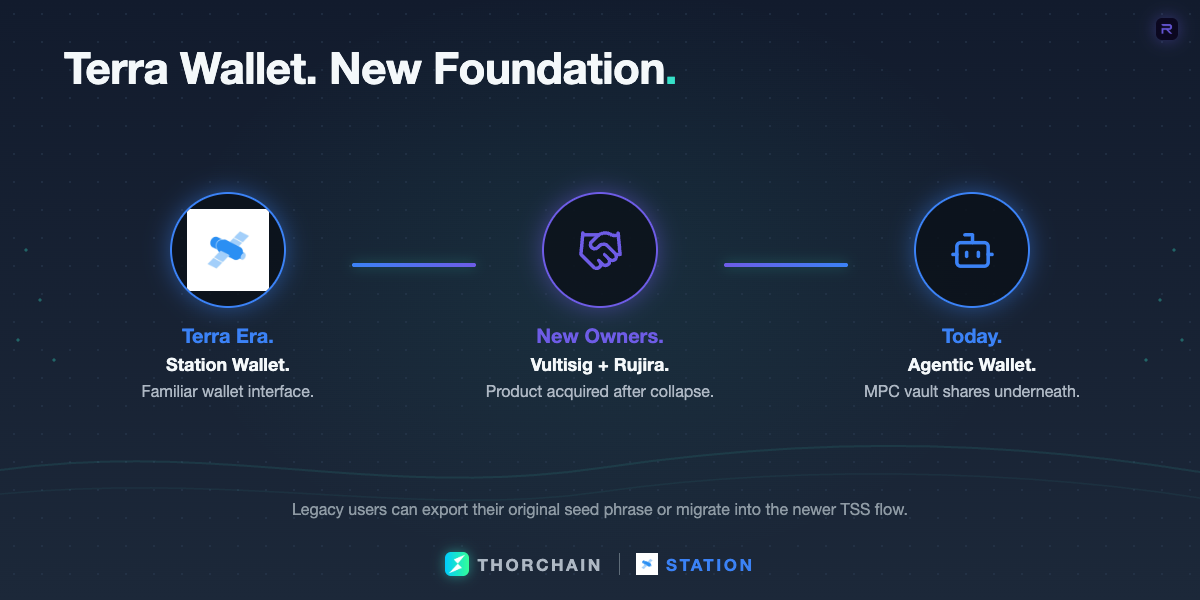
1. A Terra Wallet Gets a Second Life
Station began as Terra Labs' wallet and was widely used in the Terra ecosystem before the Luna collapse. Omar said the project lost funding and development stopped. Vultisig and Rujira later acquired it, but for roughly a year the product sat dormant while the teams decided what to build.
The first idea was to rename it as a Vultisig agent product. The team instead kept Station's familiar name and visual identity after seeing how strongly former users responded to it. The resulting product is not a recreation of the old seed-phrase wallet. It is an AI-facing layer that uses Vultisig's vault system underneath.
The handover was not clean. Omar said the prior code and user data were unavailable, so the new team reverse-engineered where the older app stored the local material needed for a recovery flow. A legacy user who still has the old app installed can export the seed phrase or migrate into the new TSS-based setup.
"Station is practically an AI wrapper that contacts the Vultisig backend." (Omar)
That migration matters because importing an old seed phrase does not make the original secret disappear. Omar called the phrase "radioactive" because it can still control the old wallet. Users who migrate need to retire that original recovery material responsibly.
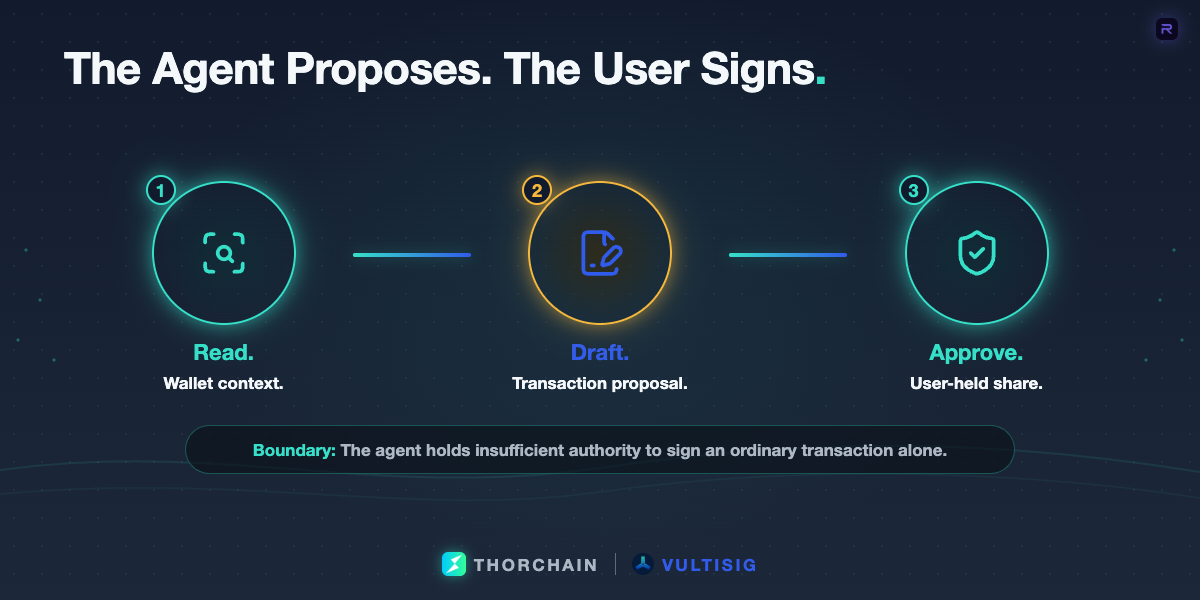
2. The Agent Proposes, the User Signs
Station is a chatbot-style interface. A user can ask it to swap an asset, send funds to a named contact, or prepare another supported action. The agent reads the wallet state, finds the relevant route, and builds a transaction proposal. It does not hold enough signing authority to independently send funds.
For Station's current Fast Vault setup, the agent-side service has one of two vault shares. The user holds the other. One share can inspect the wallet and assemble an action, but it cannot sign the action on its own. The user sees the transaction details and explicitly approves before anything is broadcast.
"The agent never signs a transaction." (Omar)
That is the practical guardrail against a bad prompt, a hallucinated instruction, or a transaction the user did not intend. Station is meant to reduce interface complexity, not remove the final review step. Omar said tool-call errors that were initially around 40% have fallen below 5%, but the user-approval boundary remains the design anchor rather than a temporary workaround.
"It has access to one out of two, meaning it cannot sign transactions." (Omar)
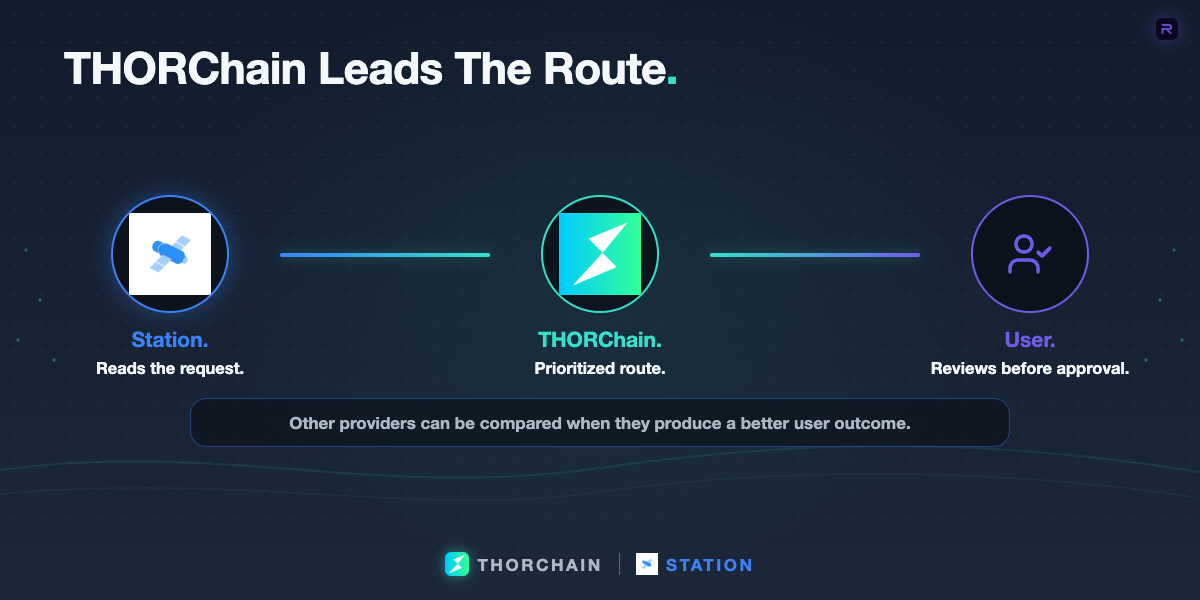
3. THORChain Is the Preferred Cross-Chain Route
Station supports $RUNE and can take a request such as a swap between two assets, then find a cross-chain route. Omar said THORChain is its main and prioritized provider, while the wallet can also compare providers including Maya Protocol, SwapKit, and other supported routes when that produces a better result for the user.
The preference is meaningful without being absolute. Station is built on Vultisig's multi-chain stack, so it can route across different ecosystems while maintaining a THORChain-first posture where possible. The earlier Vultisig recap explains how that same provider mix developed alongside Station's original rollout.
Station users can ask the agent to prepare a cross-chain action in plain language, then review the route, amount, recipient, and transaction details before approval. That flow puts THORChain Swap behind the conversational layer without giving the agent unilateral control.
"Our main one and our always prioritized provider is THORChain." (Omar)
The limitation around native $XMR custody is separate. Omar said Vultisig's TSS implementation does not yet support Monero's required cryptography. THORChain using FROST for its own $XMR work does not mean that code can simply be transferred into Vultisig's wallet stack.
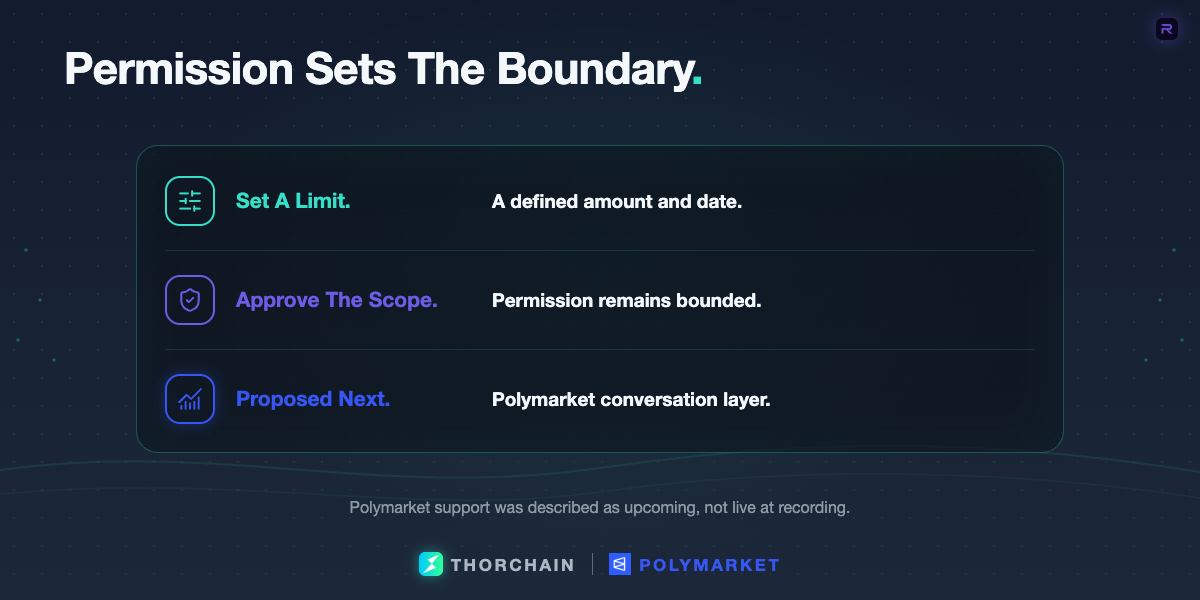
4. Bounded Automation Before Full Autonomy
The immediate use cases are more practical than a fully autonomous trading bot. Station can prepare recurring buys and payroll-style payments. A user can authorize a specific future allowance, such as a set amount on a set date, rather than handing an agent unrestricted access to the entire vault.
That distinction is essential. An advance approval grants the agent permission within the limits the user chose. It is closer to a constrained spending authorization than a blank cheque. The team can add new supported actions through the wallet's harness and improve how the agent understands user intent over time.
The next proposed integration is Polymarket. Omar described a future in which a user could ask Station for the highest-volume markets or prepare a yes-or-no market trade from the same conversation. He also named a similar direction for Hyperliquid perpetuals. Neither integration was presented as live in the episode.
"The next thing on Station that is coming up should be the Polymarket support." (Omar)
Station is therefore an experiment in where to draw the line. It can make an on-chain interface conversational, surface scheduled actions, and connect more services, while the wallet keeps signing power and user-defined permissions separate from the agent.
What to Watch
- Station's legacy migration: whether remaining Terra-era users can safely export or migrate their old wallet material before relying on the new setup.
- Agent reliability: whether tool-call improvements continue without weakening transaction review and explicit approval.
- THORChain routing: how much Station activity reaches THORChain Swap as conversational cross-chain swaps become easier to use.
- Polymarket and perpetuals: whether the proposed integrations ship, and what permissions they require before an action can be executed.
- Native $XMR custody: progress on a compatible TSS implementation for Vultisig, which remains a separate technical project from THORChain's route support.
More THORChain data, check out raynalytics.net
Follow Raynalytics for more Weekly Analytics and Podcast recaps.

Related articles
![Protocol Update Podcast with Chad Barraford, Kenton and Patriot / Denny]()
Sep. 10, 2026
THORChain Prioritizes Stability Before Monero and New Features
- Podcast
![Ecosystem Update Podcast with RAVN]()
Sep. 5, 2026
Inside RAVN’s Native $BTC Aggregator and Its THORChain Integration
- Podcast
![Protocol Update Podcast with Hans, Devel, Chad, Kenton & Denny]()
Sep. 3, 2026
THORChain Churns Again: POL Goes Live, Rujira Resumes and BLO Debate
- Podcast
![Ecosystem Update Podcast with Rujira]()
Aug. 29, 2026
THORChain’s App Layer Rujira Is Paused. Rujira Wants a Clear Restart Path.
- Podcast
![Protocol Update Podcast with Chad Barraford, Kenton and Denny]()
Aug. 27, 2026
THORChain Puts Stability First: Monero & Zcash Delayed, ADR30, AI Agents and Memoless Swaps
- Podcast
![Ecosystem Update Podcast with Unstoppable Wallet]()
Aug. 22, 2026
Unstoppable Wallet Adds $RUNE, $TCY and $RUJI, With a Stablecoin Wallet Next
- Podcast
![Protocol Update Podcast with Chad Barraford, Kenton and Denny]()
Aug. 20, 2026
v3.20 Voting Is Underway. Should THORChain’s TSS Library Remain Open Source?
- Podcast
![Ecosystem Update Podcast with Dash]()
Aug. 15, 2026
Inside Dash’s Zcash Orchard Upgrade and Its THORChain Potential
- Podcast
![Protocol Update Podcast with Chad Barraford, Kenton, Denny and Oleg Petrov]()
Aug. 13, 2026
THORChain is Close to v3.20: FROST, DKLS, SwapKit Rev-Share and Dynamic Fees
- Podcast
![Ecosystem Update Podcast with Morpheus]()
Aug. 8, 2026
Morpheus Maps Decentralized AI, $MOR Inference and a Planned THORChain Pool
- Podcast
![Protocol Update Podcast with Hans and Pragmatic Monkey]()
Aug. 6, 2026
Rujira and THORChain Align on the App Layer: ADR31, CCL, and the Road to Perps
- Podcast
![Ecosystem Update Podcast with Depouch]()
Aug. 1, 2026
Inside depouch: Direct THORChain Swaps Built for Simplicity
- Podcast
![Monero Gets a Soft Launch as THORChain's v3.20 Enters Testing and ADR31 Passes]()
Jul. 30, 2026
Monero Gets a Soft Launch as THORChain's v3.20 Enters Testing and ADR31 Passes
- Podcast
![THORChain and Pirate Chain podcast thumbnail featuring anarchy_dot_gov, KentonC137, and Patriotsounds discussing $ARRR listing on THORChain]()
Jul. 25, 2026
Pirate Chain Wants Off Centralized Exchanges: Next Ask Is an $ARRR Pool on THORChain
- Podcast
![THORChain Podcast #219 thumbnail.]()
Jul. 23, 2026
Dynamic Fees Take THORChain From 6% to 33.5% of ShapeShift Volume, With ADR29 Rev-Share Up Next
- Podcast