Zodl and THORChain: Shielded Zcash, Zodl Vault and the Case for Redundant Swap Routes
2026-10-23 — 12 min read
- Podcast
THORChain x Zodl Podcast #245 ft. cozymaximalist, KentonC137 & Patriotsounds | October 23, 2026 | Watch the full episode on YouTube
By Raynalytics
TL;DR
- Zodl, formerly Zashi, is the Zcash wallet built by the team that originally developed the Zcash protocol. That team left Electric Coin Company, formed the Zcash Open Development Lab and raised more than $25 million in February. There is no token, and the team still does core protocol work.
- Zodl's swaps run through NEAR Intents today, and the swap fee is its main revenue source. Kenton and Denny pitched THORChain as a second, redundant route where Zodl could still keep a fee. Both sides said they want to stay in touch. Nothing has been agreed.
- Zodl's roadmap rests on three pillars, Spend, Save and Run, under a "no banks" vision. Zodl Vault, a desktop app for long-term $ZEC savings, has a waitlist open, and beta access will roll out 100 people at a time.
- Zodl is shielded by default. Cozy argued that most transparent $ZEC today reflects institutional holding and trading, and he pointed to the NU7 upgrade on November 5, which cuts Zcash block times from 75 seconds to 25.
- Cozy sees viewing keys as one possible path to a fully shielded Zcash, while crediting the transparent side with helping Zcash win exchange listings.
Introduction
Zodl is the Zcash wallet built by the people who built Zcash. For now, every swap it offers runs through a single provider, NEAR Intents. Kenton and Denny spent part of this episode making the case for a second route.
Their guest was Cozy, who has led content and communications at Zodl since June. He came into crypto through the 2021 Dogecoin wave, spent the bear market posting and building a following, led growth at Kuru, a DEX on Monad, and became a Zcash convert about a year ago. He explained how Zashi became Zodl, what the team is building next, why he prefers Zcash's privacy model to Monero's, and why most $ZEC still sits outside the shielded pool. The conversation closed on how Zodl and THORChain might work together, framed as a conversation to continue rather than a deal.
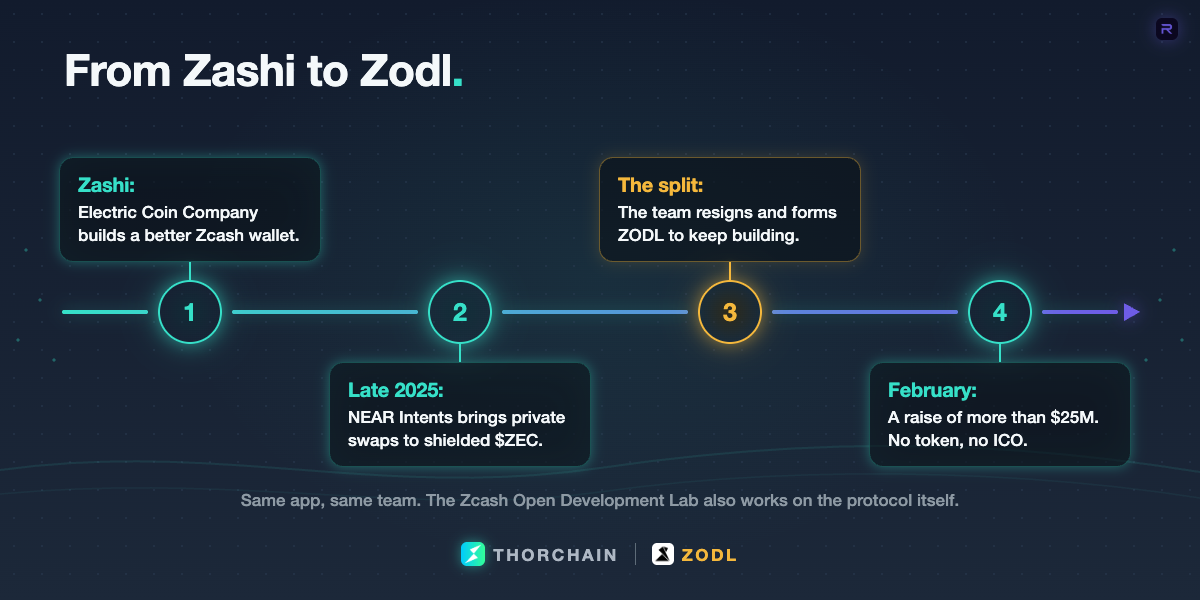
1. From Zashi to Zodl: The Original Zcash Team Goes Independent
Zodl began life as Zashi, a wallet Electric Coin Company built to give Zcash a better user experience. Electric Coin Company was the original developer of the Zcash protocol. Cozy first met the product as a user. In late 2025, Zashi integrated NEAR Intents, which let users swap privately in and out of shielded $ZEC.
The split came later. Cozy described a dispute with the board, without going into the details. The team wanted to scale, move into startup mode and operate as a for-profit, rather than continue relying on community grants. The entire Electric Coin Company team resigned, formed the Zcash Open Development Lab (ZODL), and bought the rights to Zashi and its underlying technology. Existing users kept the same app, which transitioned to the new name.
"Zcash was what my father-in-law always wanted Bitcoin to be." (Cozy)
The raise in February brought in more than $25 million from investors including Paradigm and a16z, with angels including David Friedberg, Naval and Mert. Cozy said the team more than doubled its headcount afterward. Asked about a token, he said there is none and no ICO, and that he would be "quite surprised" if one ever became part of the plan.
ZODL is not only a wallet company. Cozy said part of the team still works on the Zcash protocol itself, maintaining full nodes and working on the underlying code, and that it was instrumental, alongside other ecosystem teams, in the recent Ironwood shielded-pool migration. The company is led by CEO Josh Swihart, whom Cozy credited with leading Zcash's user-experience push.
Zodl is the incumbent Zcash wallet, not the only one. Cozy named multichain options like Cake Wallet and credited Vizor, an independent Zcash-only competitor, with making Zodl better.
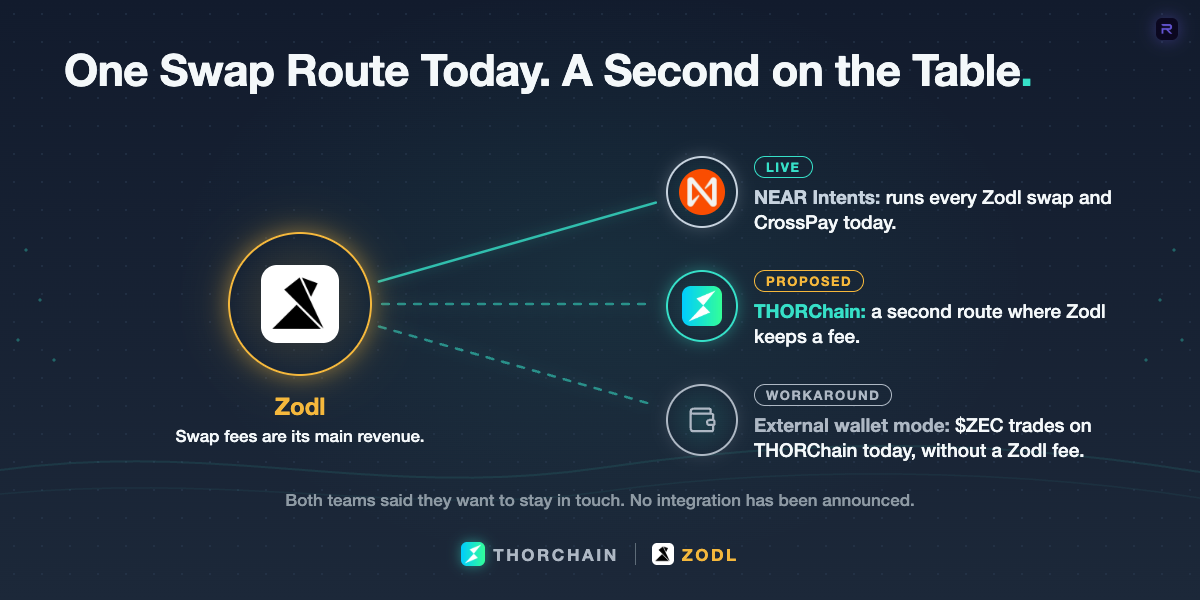
2. One Swap Route Today, and the Case for a Second
Zodl's main revenue today comes from swaps. When a user swaps $ZEC into $BTC, Solana assets or stablecoins, NEAR Intents executes the trade and Zodl takes a small fee. Cozy put the total fee at about 0.67%, by his recollection, and said it is lower than most leading wallets charge. The same rails power CrossPay, which debits shielded $ZEC and sends an exact amount of another asset directly to a payee's address.
Kenton pointed out that users can already reach THORChain with Zcash. Using external wallet mode on THORChain Swap, anyone can enter addresses from any self-custody wallet and trade, including $ZEC, which THORChain supports today. Zodl cannot connect to THORChain Swap directly, though, and routing that way bypasses Zodl's fee entirely. A direct integration would let Zodl keep a fee on those swaps.
Denny framed it as redundancy. Zodl's users could input an address, use THORChain as a payment route and add a second source of liquidity alongside NEAR Intents. Cozy agreed with the principle.
"Redundancy, multiple providers, get the best price, get the best performance, slippage, all of those things." (Cozy)
He said it was Zodl's BD contact who connected the teams, and that both sides should stay in touch. That is the status: an open conversation, not an announced integration.
Denny's wider argument was about access. He said giving people a direct, low-friction way to swap into $ZEC from native assets like $BTC, $LTC, $ETH, $DOGE or $XMR creates direct buy pressure, with the most untapped potential in countries where people need a private store of value and getting Zcash is harder than in the West.
Kenton also gave a quick wallet update for THORChain Swap. Trezor and Brave Wallet are supported, Rabby should go live any day, and WalletConnect is next on his list after a recent update fixed earlier bugs.
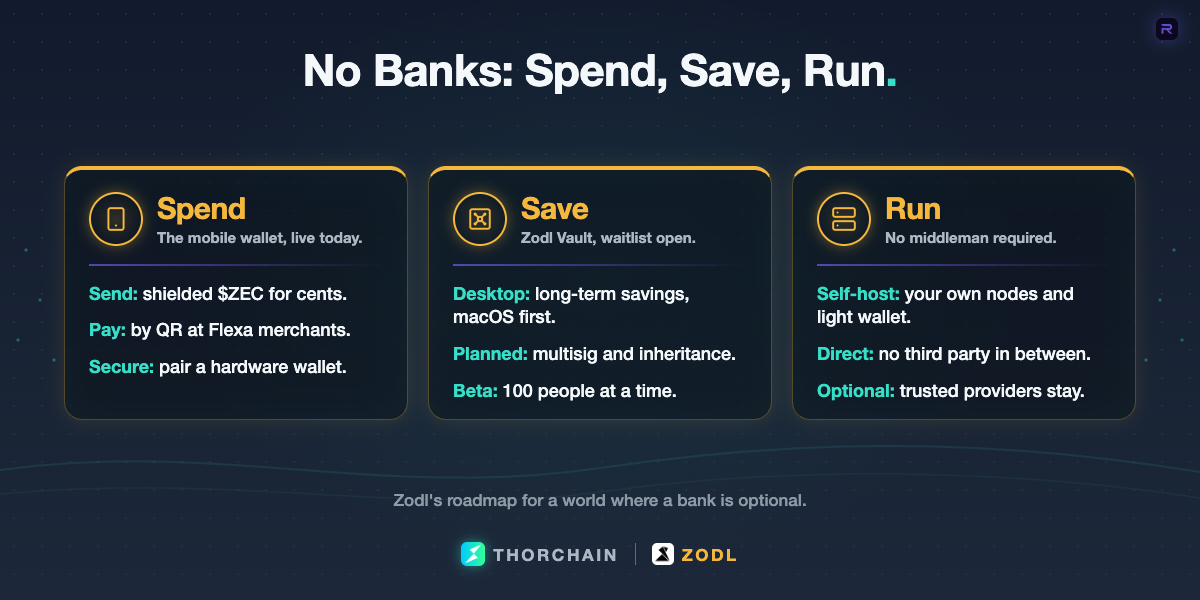
3. Spend, Save, Run: Zodl's Plan for a World Without Banks
Cozy laid out the roadmap the way Zodl's CEO has presented it publicly: one vision and three pillars.
"The overarching vision of Zodl is no banks." (Cozy)
Spend is the mobile wallet, Zodl's flagship product today. Users can send shielded $ZEC wallet to wallet anywhere in the world for a few cents in fees, which Cozy called "a better wire transfer." The app connects to hardware wallets, and an integration with Flexa lets users pay with shielded $ZEC at participating merchants, including Chipotle, by scanning a QR code. Cozy said more spend features are coming but would not share details. Zodl is also exploring stablecoin integrations, although the wallet is Zcash-only today and will probably remain so.
Save is Zodl Vault, a desktop app for long-term $ZEC savings, launching first on macOS. At launch it will be close to feature parity with the mobile app, but its roadmap diverges from there: multisig is coming in the near future, with inheritance planning also on the list. One of the team's key internal goals is solving recovery, meaning a model that is secure and private without relying on a seed phrase stored on paper or steel. The beta includes a built-in way for users to vote on features and report issues directly to the team.
Run is about removing middlemen entirely: running your own light wallet and nodes, so you can interact with the Zcash network without trusting a third party. Cozy said making that easy for lay users will take time, and a trusted-provider option will remain for people who prefer convenience.
Cozy also said Zodl is working with several providers on a light-KYC fiat onramp, requiring a name and email address. He suggested limits somewhere in the $500 to $1,500 range, possibly weekly, but the details are still being worked out.
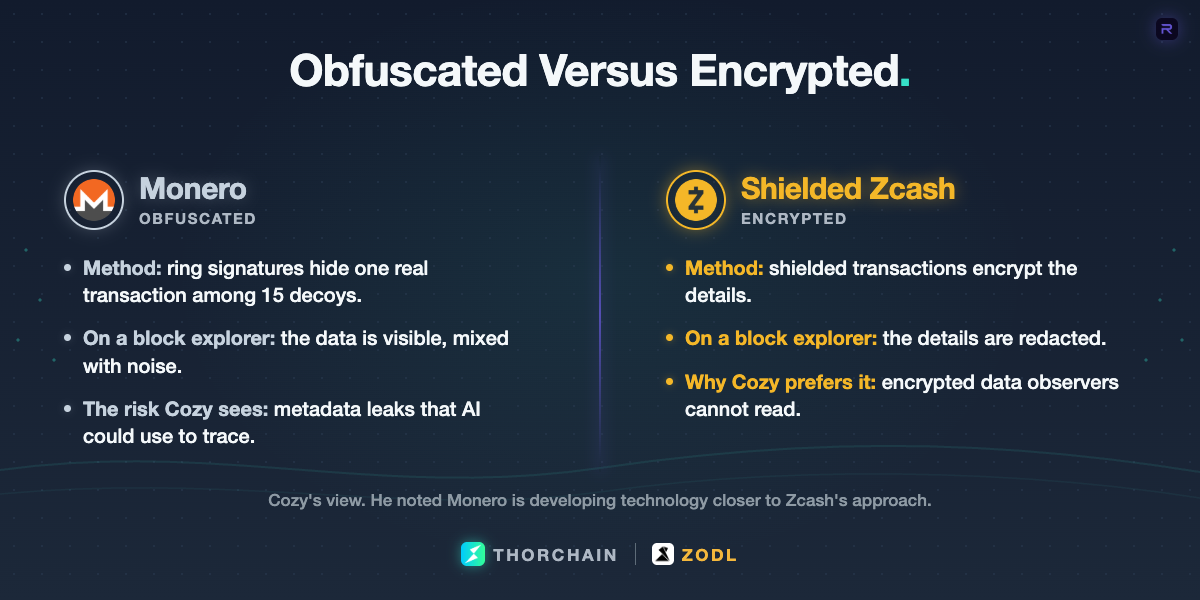
4. Encrypted, Not Obfuscated: Cozy's Case for Zcash Over Monero
The hosts asked the obvious question for a THORChain audience with $XMR support in the works: why Zcash rather than Monero? Cozy kept it brief and was careful to call himself non-technical.
His argument is that the two chains hide transactions in fundamentally different ways. Historically, a Monero transaction has been sent alongside 15 decoys, so the real one is hidden among 16. A shielded Zcash transaction, by contrast, is encrypted. On a block explorer, the details are simply redacted.
"Your transaction is still private. It's just being obfuscated. Whereas on Zcash, it's being encrypted." (Cozy)
He tied the distinction to AI. He said he would not claim Monero can be cracked, but argued that metadata and leakages could increasingly be used by AI to trace transactions. He also added his own caveat: Monero is under active development to adopt technology closer to Zcash's approach, so the comparison may not hold forever.
He also said he respects the Monero community and its views, even if he finds some of its criticisms unfair.
5. Shielded by Default, but Most $ZEC Is Still Transparent
The hosts raised the most common criticism of Zcash: most activity is transparent, not shielded, which means the shielded anonymity set is smaller than it could be. He asked whether that comes down to tooling.
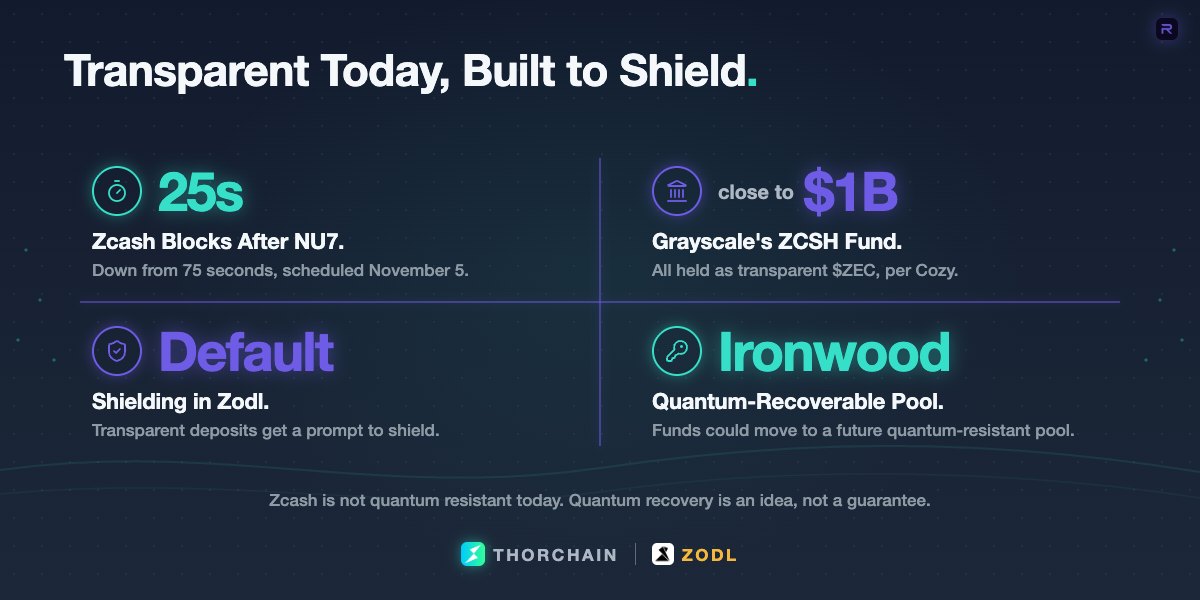
Cozy said Zodl is shielded by default. If a user sends transparent $ZEC into the wallet from an exchange, the app prompts them to shield it before doing anything else. He gave two reasons the transparent share is still high and could come down.
The first is that the technology is still evolving. The NU7 network upgrade, scheduled for November 5, drops Zcash block times from 75 seconds to 25 seconds. On the user-experience side, he said the work now is making shielded $ZEC easy to use through vendor integrations and stablecoins, not just in peer-to-peer transfers.
The second is institutional and trading demand. Grayscale converted its Zcash Trust into an exchange-traded fund under the ticker ZCSH, which anyone can buy through a brokerage account. Cozy put its assets at close to $1 billion, all held as transparent $ZEC. Much of the $ZEC traded on Solana and Hyperliquid is transparent as well.
"Zcash is reflexive. The more Zcash that goes into the shielded pool the more private it becomes." (Cozy)
He also made the case for shielded $ZEC on quantum readiness. Zcash is not quantum resistant today, he said, but the Ironwood pool, now the default shielded pool, is quantum recoverable. Because shielded wallets do not expose public keys, holders could in theory move their funds to a future quantum-resistant pool before a quantum computer could seize them. He called that an idea rather than a guarantee, and advised staying agile as the research develops.
6. Viewing Keys and the Road to a Fully Shielded Zcash
Denny asked whether Zcash should eventually be fully shielded. Cozy stressed that this was his personal opinion, not a stated Zodl position.
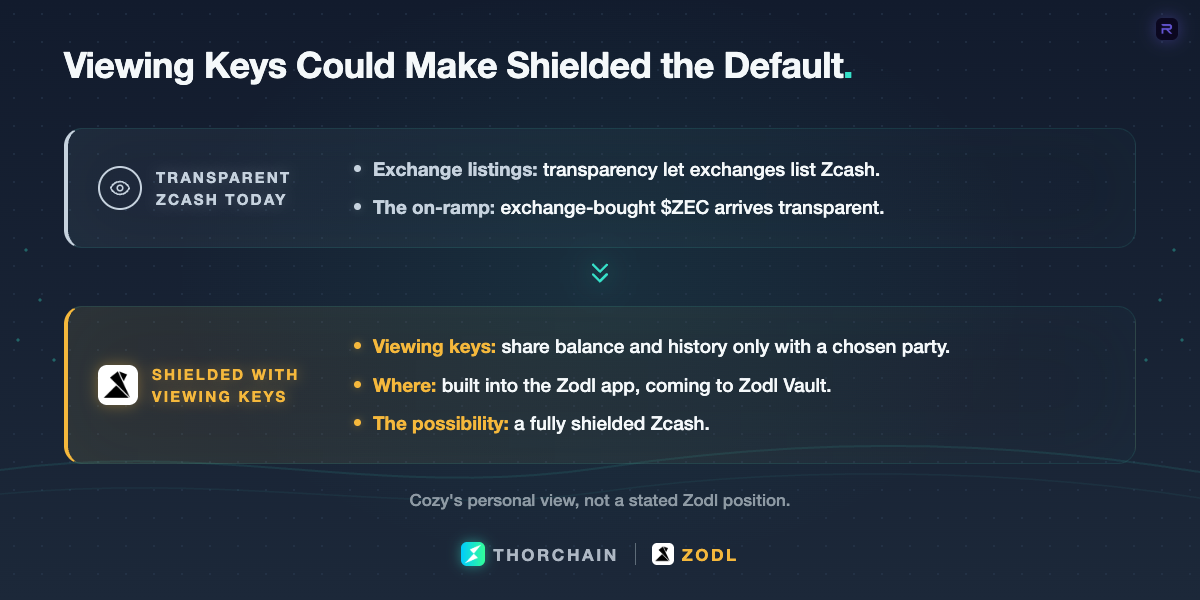
He credited the transparent side with Zcash's reach. In his view, transparency let exchanges list Zcash when they might not have listed a fully private asset, which is a hurdle he said Monero has struggled with. Zcash has framed itself as private money, he argued, not as a tool for criminals.
What could change the equation is viewing keys, a feature Zodl recently built into the mobile app that is coming to Vault. A user can share a viewing key with a specific party, such as an auditor or another outside entity, who can then see that wallet's balance and transaction history. Nobody else can. Cozy said that kind of selective disclosure could make a fully shielded Zcash workable, though how that plays out will depend on how the ecosystem evolves.
Denny compared transparent $ZEC to memecoins as a gateway drug: useful for bringing people in, with less reason to leave once they have shielded. He noted that Maya Protocol already supports swaps to and from shielded Zcash. He said he hopes THORChain adds shielded support too, although Chad said on the previous THORSday that shielded Zcash addresses are not coming soon.
"Once you go shielded, you don't need to go unshielded for any particularly good reason." (Denny)
Cozy's own example was a Pokémon card collection he bought from another Zcash user he met on X. He paid in shielded $ZEC, wallet to wallet on Zodl, and the seller shipped the cards while on FaceTime with him. He also described a business owner Josh met at a conference, possibly from Nigeria, who runs his company's financials through Zodl. Paying salaries on a public chain, Cozy argued, would expose every employee's pay.
The episode closed with a comparison between Cozy's financial-sovereignty argument and the one Paul Puey of Edge Wallet makes: different teams attacking the same goal from different angles.
What to Watch
- Whether Zodl and THORChain move from staying in touch to an actual integration, giving Zodl a second swap route alongside NEAR Intents with its own fee.
- The NU7 upgrade on November 5, and whether 25-second blocks and easier tooling move more $ZEC into the shielded pool.
- The Zodl Vault beta rollout, plus multisig, inheritance planning and the light-KYC fiat onramp.
- Zcon in Mexico next week, hosted by the Zcash Foundation, and the winter Zodl Summit in Punta Cana in January. Applications are open, attendees pay their own way and spots are limited.
- On the THORChain side, Moca returns next Saturday with an update now that its point-of-sale product is live, and Rabby support on THORChain Swap is expected any day.
More THORChain data, check out raynalytics.net
Follow Raynalytics for more Weekly Analytics and Podcast recaps.

Related articles
![Protocol Update Podcast with Chad Barraford, Kenton and Denny]()
Oct. 22, 2026
Monero on THORChain Waits on v3.21.1, SwapKit Rev-Share and 2-Second Blocktime
- Podcast
![Protocol Update Podcast with Chad Barraford, Kenton and Denny]()
Oct. 15, 2026
SwapKit Rev-Share Week One: Early Data Looks Promising, v3.21 and Monero Next
- Podcast
![Ecosystem Update Podcast with Zano]()
Oct. 10, 2026
Zano’s Recovery Plan and the Road to THORChain
- Podcast
![Protocol Update Podcast with Chad Barraford, Kenton and Patriot]()
Oct. 8, 2026
Chad's Unchained Podcast Debrief, Rev-Share and Monero
- Podcast
![Ecosystem Update Podcast with Houdini Swap]()
Oct. 3, 2026
Houdini Swap on THORChain Explained: What It Means for Users and Treasury Revenue
- Podcast
![Protocol Update Podcast with Chad Barraford, Kenton and Denny]()
Oct. 1, 2026
Can or Should THORChain Censor Transactions?
- Podcast
![Protocol Update Podcast with Chad Barraford, Kenton, Devel and Boone]()
Sep. 24, 2026
Inside the Houdini Swap Debate: THORChain’s Treasury, Privacy and Revenue
- Podcast
![Ecosystem Update Podcast with Radix]()
Sep. 19, 2026
Radix and THORChain: Building Trust for the Agentic Future
- Podcast
![THORChain Podcast protocol update cover]()
Sep. 17, 2026
THORChain Returns to Shipping: Zcash, Monero and Self-Sufficiency
- Podcast
![Ecosystem Update Podcast with Station Wallet]()
Sep. 13, 2026
Terra’s Station Wallet Is Back as Vultisig’s Agentic THORChain Wallet
- Podcast
![Protocol Update Podcast with Chad Barraford, Kenton and Patriot / Denny]()
Sep. 10, 2026
THORChain Prioritizes Stability Before Monero and New Features
- Podcast
![Ecosystem Update Podcast with RAVN]()
Sep. 5, 2026
Inside RAVN’s Native $BTC Aggregator and Its THORChain Integration
- Podcast
![Protocol Update Podcast with Hans, Devel, Chad, Kenton & Denny]()
Sep. 3, 2026
THORChain Churns Again: POL Goes Live, Rujira Resumes and BLO Debate
- Podcast
![Ecosystem Update Podcast with Rujira]()
Aug. 29, 2026
THORChain’s App Layer Rujira Is Paused. Rujira Wants a Clear Restart Path.
- Podcast
![Protocol Update Podcast with Chad Barraford, Kenton and Denny]()
Aug. 27, 2026
THORChain Puts Stability First: Monero & Zcash Delayed, ADR30, AI Agents and Memoless Swaps
- Podcast