THORSday Community Podcast #241 ft. CBarraford, KentonC137 & patriotsounds | October 8, 2026 | Watch the full episode on YouTube
By Raynalytics
TL;DR
- Chad Barraford used the show to respond to the recent Unchained interview, arguing that discussions of THORChain governance need to distinguish between a minority that can halt activity and the supermajority required to authorize it.
- Rev-Share is now live with SwapKit. The first credited $25,000 $USDC-to-$BTC trade arrived during the show, beginning a trial intended to win incremental routing without subsidising existing flow.
- v3.21 has been cut and is in stagenet testing. Monero-related churn edge cases could mean some $XMR work moves to v3.21.1, rather than delaying every other part of the release.
- Chad described a narrowly scoped AI workflow for tests and performance work. Two draft pull requests tested the THORNode code at roughly 3x faster, while replaying real blocks to check that state does not change.
- The active set reached 111 nodes during the episode. The team also highlighted RAVN native $BTC delivery, and continued protocol-owned liquidity accumulation.
The episode was a dense status check, but its through-line was the difference between what THORChain is testing, what is live, and what still needs proof. Chad opened with a debrief of the Unchained interview, then the conversation turned to a live Rev-Share pilot, the remaining work before $XMR can join the protocol, and a more experimental use of AI in development.
That distinction matters. A new incentive programme is not yet evidence that it will create durable volume. A stagenet release is not a mainnet launch. And AI-assisted code work is not autonomous protocol control. The hosts were clear about those boundaries even as they made the case for moving faster.
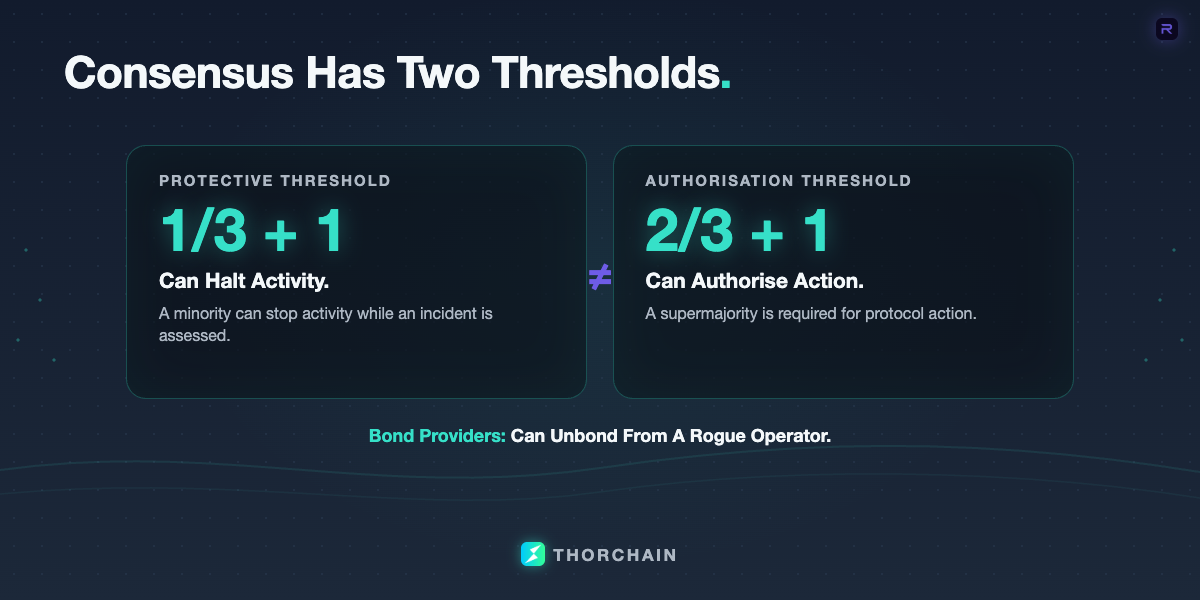
1. Chad's Unchained Debrief Focused on Consensus Thresholds
Chad used the opening of the episode to respond to questions raised in the recent Unchained interview about THORChain's governance, censorship resistance, and the security implications of its node set. His central argument was that the discussion needs to separate two different thresholds: a minority of 1/3 + 1 can stop activity, while a 2/3 + 1 supermajority is required to authorize protocol action.
That distinction is not a claim that a halt is painless. The hosts described it as a protective power that can freeze the system when something is wrong, not a tool for redirecting funds. Chad argued that an operator acting against its bond providers would face economic consequences, because providers can unbond and move to another operator. Kenton added that many operators manage bonds for multiple providers, rather than controlling all bonded $RUNE themselves.
"Every blockchain in the world can change anything they want with consensus." (Chad)
The group compared this tradeoff with proof-of-work and proof-of-stake systems more broadly. Their point was not that every chain has the same implementation, but that no consensus system removes the need to consider who can halt, who can coordinate, and what economic incentives restrain them.
The conversation also returned to the question of selective censorship. Chad argued that freezing a pool based on a percentage of suspicious volume creates no clear rule for when to reopen it, while the hosts said cross-chain infrastructure needs limited safety controls for events such as external-chain failures. These are the team's positions, not settled answers to every governance question, but they explain the reasoning they took into the interview.
2. Rev-Share Is Live, With New Flow as the Test
The concrete product update was Rev-Share. During the show, the hosts said the first eligible $25,000 $USDC-to-$BTC trade had arrived through SwapKit, after the programme was enabled on both sides. The purpose is not simply to rebate an existing integrator. It is to use a share of fees to improve selected quotes and make THORChain more likely to win routing it would otherwise miss.
Chad pointed listeners to Raynalytics's SwapKit Revenue Share dashboard, where the credit ledger, routed volume, wallet mix, and liquidity fees can be monitored as the pilot develops. The episode's framing was deliberately empirical: give the data time, then decide whether the arrangement is creating profitable incremental volume.
"If it doesn't work for both of us, we ain't doing it at all." (Chad)
The hosts also discussed Rev-Share as a possible business-development tool for future wallet and interface integrations. Rather than paying a flat Treasury grant before a partner sends volume, a limited fee share could reward a wallet only as it brings traffic. Kenton used large-wallet integration incentives as an example, while stressing that any allocation remains subject to node governance.
The economics are simple in principle but unproven in practice: a programme can share a large portion of fees from a new route and still improve protocol income if the alternative was no routed volume at all. What matters now is whether the pilot produces that new flow, not whether the mechanism sounds attractive on paper.
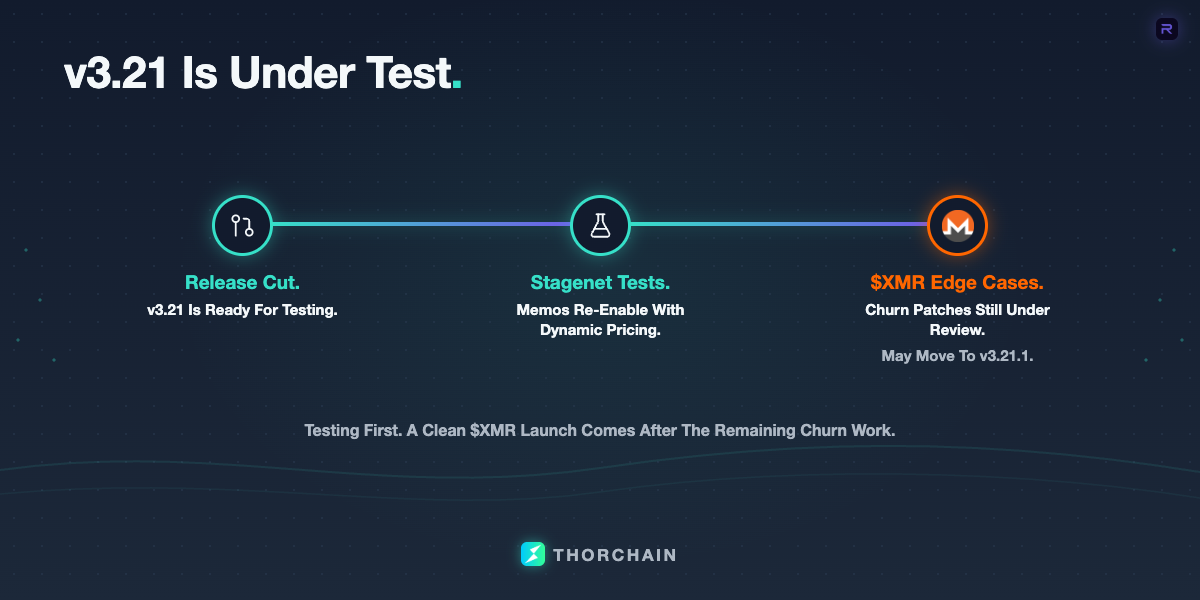
3. v3.21 Is Testing, While $XMR Churn Work Continues
Chad said v3.21 has been cut and is being tested on stagenet. The release includes work to re-enable memoless transactions with a dynamic registration cost: as a coin's available memo space fills, registering another entry becomes progressively more expensive. The intent is to make spam costly without relying on a fixed price that can become ineffective.
The main uncertainty is $XMR. The team has encountered churn edge cases in its Monero integration, and Chad said some patches may need to move to v3.21.1 if they cannot be reviewed, merged, and tested in time for v3.21. That is a release-management decision, not an abandonment of the integration. The discussion repeatedly kept $XMR in a pre-mainnet, work-in-progress state.
"We might not be able to get all the Monero patches in for v3.21." (Chad)
This follows the liquidity-first approach outlined in the previous podcast recap. A technical release alone would not make a useful $XMR market. Chad said CakeWallet is expected to support THORChain at launch, based on an earlier team conversation, while other wallet support remains an active integration question.
For a transparent release view, the hosts highlighted devops.thorchain.org, which tracks work items and release activity. It is the better source for status than treating a podcast target as a fixed delivery date.
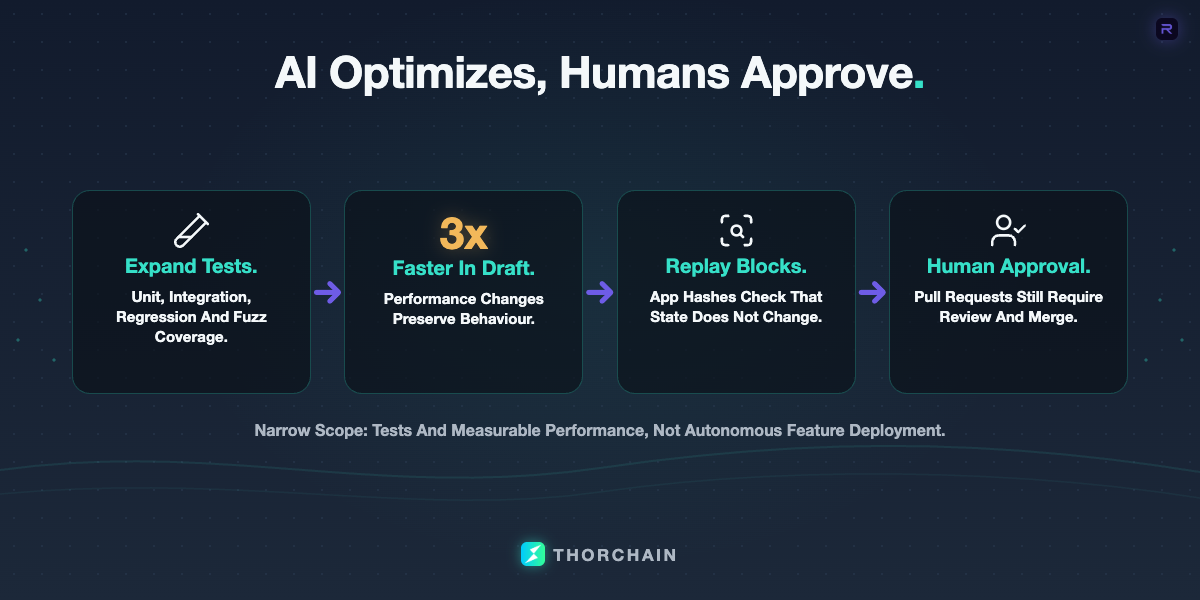
4. AI Is Being Scoped to Tests and Verified Performance Work
Chad's most forward-looking update was not an AI agent writing new protocol features unchecked. He described a narrower effort to use AI for two areas where output can be measured: expanding test coverage and finding performance improvements that preserve existing behaviour.
The testing side would add unit, integration, regression, and fuzz tests. The performance side asks an AI system to make a function run faster without changing what the protocol does. Chad said two draft pull requests, produced over a few days, had tested THORNode at roughly 3x faster when combined.
"We can verify its correctness." (Chad)
The verification method is the important constraint. The process replays thousands of real mainnet blocks locally and compares each resulting app hash, effectively checking that the protocol state is identical even if execution is faster. Chad said the pull requests still require human approval. He also noted that faster execution does not automatically change the roughly six-second block interval, though it could reduce resource requirements and make erratic block times less likely.
He referred to the broader idea as recursive improvement, not literal recursive self-improvement. Whether this work eventually lives inside Huginn or a separate tool is still undecided. For now, the proposal is an assistive development loop with deterministic checks, not a transfer of governance or deployment authority to an AI system.
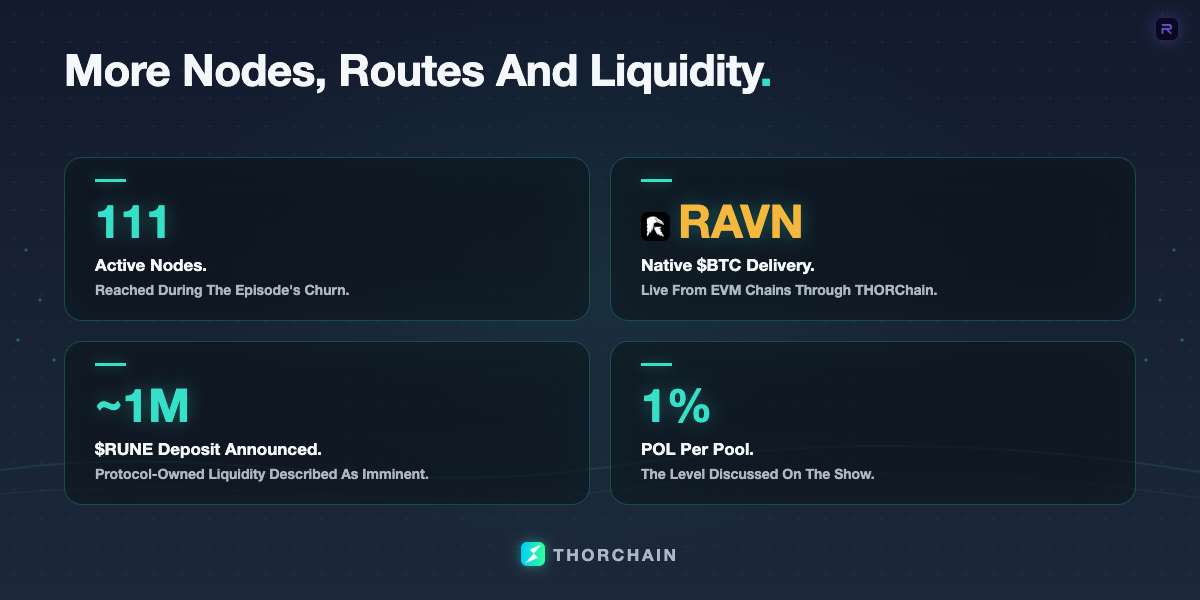
5. The Network Added Nodes, Routing and Protocol-Owned Liquidity
The show also captured several live ecosystem updates. After a churn, the active set had grown to 111 nodes. The hosts said it was at least close to the largest active set they had seen, and noted that some operators had waited in standby through months when the protocol could not churn normally.
On routing, RAVN had gone live with native $BTC delivery from Ethereum, Base, BNB Chain, and Avalanche through THORChain. The point is not wrapped Bitcoin exposure. The announced route delivers native $BTC at the destination, extending the set of interfaces that can access THORChain liquidity.
The group also discussed protocol-owned liquidity. They said a deposit of roughly 1 million $RUNE was imminent, which would put protocol-owned liquidity at about 1% per pool. According to the speakers, those positions had already earned about $100,000 in fees. The next question is how the system behaves as new pools, including a future $XMR pool, gain depth and volume.
"We still only need 5% of the market." (Kenton)
Those updates do not erase the open questions from earlier in the episode. Rev-Share still needs volume data. $XMR still needs completed churn work and liquidity. But the snapshot was of a protocol adding capacity and connections while it tests the economic and technical assumptions behind them.
What to Watch
- Whether the SwapKit Rev-Share dashboard shows sustained incremental routed volume, fee generation, and new-wallet activity after the pilot's initial trades.
- Whether the remaining Monero churn edge cases can be resolved in v3.21, or move cleanly into v3.21.1 without changing the integration's careful launch posture.
- Whether the new memoless pricing model deters registration spam without creating material friction for ordinary users.
- Whether AI-assisted testing and performance work continues to pass app-hash replay checks before human review and merge.
- Whether the active-set growth, RAVN routing, and protocol-owned liquidity provide the deeper distribution and market capacity the team expects.
More THORChain data, check out raynalytics.net
Follow Raynalytics for more Weekly Analytics and Podcast recaps.

Related articles
![Ecosystem Update Podcast with Houdini Swap]()
Oct. 3, 2026
Houdini Swap on THORChain Explained: What It Means for Users and Treasury Revenue
- Podcast
![Protocol Update Podcast with Chad Barraford, Kenton and Denny]()
Oct. 1, 2026
Can or Should THORChain Censor Transactions?
- Podcast
![Protocol Update Podcast with Chad Barraford, Kenton, Devel and Boone]()
Sep. 24, 2026
Inside the Houdini Swap Debate: THORChain’s Treasury, Privacy and Revenue
- Podcast
![Ecosystem Update Podcast with Radix]()
Sep. 19, 2026
Radix and THORChain: Building Trust for the Agentic Future
- Podcast
![THORChain Podcast protocol update cover]()
Sep. 17, 2026
THORChain Returns to Shipping: Zcash, Monero and Self-Sufficiency
- Podcast
![Ecosystem Update Podcast with Station Wallet]()
Sep. 13, 2026
Terra’s Station Wallet Is Back as Vultisig’s Agentic THORChain Wallet
- Podcast
![Protocol Update Podcast with Chad Barraford, Kenton and Patriot / Denny]()
Sep. 10, 2026
THORChain Prioritizes Stability Before Monero and New Features
- Podcast
![Ecosystem Update Podcast with RAVN]()
Sep. 5, 2026
Inside RAVN’s Native $BTC Aggregator and Its THORChain Integration
- Podcast
![Protocol Update Podcast with Hans, Devel, Chad, Kenton & Denny]()
Sep. 3, 2026
THORChain Churns Again: POL Goes Live, Rujira Resumes and BLO Debate
- Podcast
![Ecosystem Update Podcast with Rujira]()
Aug. 29, 2026
THORChain’s App Layer Rujira Is Paused. Rujira Wants a Clear Restart Path.
- Podcast
![Protocol Update Podcast with Chad Barraford, Kenton and Denny]()
Aug. 27, 2026
THORChain Puts Stability First: Monero & Zcash Delayed, ADR30, AI Agents and Memoless Swaps
- Podcast
![Ecosystem Update Podcast with Unstoppable Wallet]()
Aug. 22, 2026
Unstoppable Wallet Adds $RUNE, $TCY and $RUJI, With a Stablecoin Wallet Next
- Podcast
![Protocol Update Podcast with Chad Barraford, Kenton and Denny]()
Aug. 20, 2026
v3.20 Voting Is Underway. Should THORChain’s TSS Library Remain Open Source?
- Podcast
![Ecosystem Update Podcast with Dash]()
Aug. 15, 2026
Inside Dash’s Zcash Orchard Upgrade and Its THORChain Potential
- Podcast
![Protocol Update Podcast with Chad Barraford, Kenton, Denny and Oleg Petrov]()
Aug. 13, 2026
THORChain is Close to v3.20: FROST, DKLS, SwapKit Rev-Share and Dynamic Fees
- Podcast