THORChain Needs a Churn for $XMR and Base Limit Orders Could Cut Slippage by Up to 20 bps

— 13 min read
- Podcast
THORChain Podcast #251: Protocol Update ft. Devel484, KentonC137, Patriotsounds & BooneW | November 14, 2026 | Watch the full episode on YouTube
By Raynalytics
TL;DR
- As far as Devel knows, the $XMR code is already live, but turning it on needs a churn and a node vote, and THORChain has not churned in about three weeks. A stuck Base refund and oversized $BTC memos stand in the way; Solana signing is fixed.
- Devel expects to open the base limit orders merge request next week, for THORChain and Maya at the same time, with Maya likely live first. Resting orders could remove up to 20 bps of slippage from a double swap without cutting protocol revenue.
- An Ethereum reorg paid one user 20 $ETH instead of 10. Devel paused every chain, a fix took about two days, and the user, who contacted Devel almost immediately, returned the funds.
- Node operators voted the stablecoin minimum fee back up to 10 bps from 2 bps, and the exponential fee on memoless registrations appears to have stopped the spam.
- Boone pushed back on any talk of loosening economic security, and argued the exogenous assets held as protocol-owned liquidity should act as a floor for the $RUNE market cap.
1. Why $XMR Is Waiting on a Churn
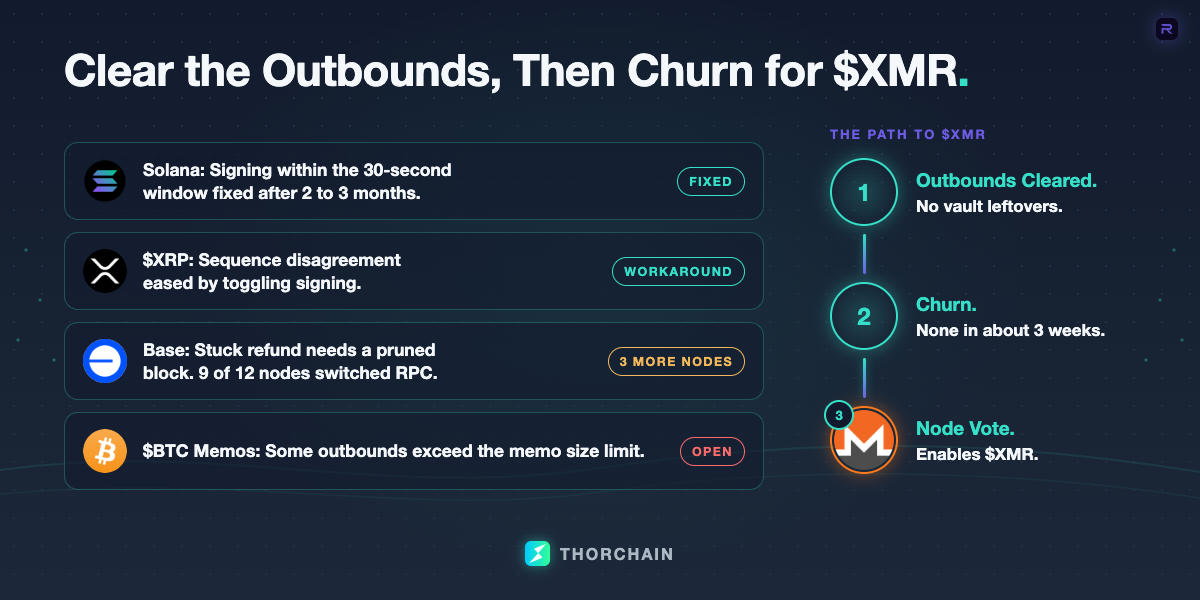
Denny relayed the question he keeps getting from Monero holders: when is $XMR coming? Devel, who said he is not deep in the $XMR code right now, understands all of its pieces are already live. Turning it on needs a churn first, and probably a second one, about three days later, where nodes vote to enable it. The problem is that THORChain has not churned in about three weeks.
Devel prefers not to churn while outbounds are stuck, since they get left behind in retiring vaults and recovering them is tedious manual work. He walked through the outbound problems:
- Base: Base cut its block time from 2 seconds to 200 milliseconds, many nodes fell behind, and Base was paused. One stuck outbound needs a refund that depends on a block most nodes have pruned, so they must point temporarily at an RPC that still has it. The count stood at nine of the 12 nodes needed; otherwise the fix waits for v3.22.
- $BTC memos: some stuck $BTC outbounds carry memos longer than the size limit, which Devel believes is about 80 bytes, so they cannot be sent as they are.
- Solana: nodes get about 30 seconds to complete a Solana signature, with roughly 13 needing to agree. After two to three months of work, Solana outbounds now run without issue.
- $XRP: vault members disagreed on which account sequence to sign with, the queue piled up and jailed nodes left too few signers. Toggling signing off and on worked around it, which explains the repeated enable and disable cycles people saw.
Earlier, repeated Gaia (Cosmos Hub) upgrades also held up churning. A new version is hoped for within the next few days, and Devel has agreed with the release scheduler to ship smaller minor versions more often, so fixes stop piling up.
Kenton said irregular churns hurt everyone. About 11 nodes are trying to leave and will then have to compete to rejoin, and bond providers whose capital is locked for months may not bond again.
"We definitely got to get churning back to more normal. It's just not good for anybody." (Kenton)
Bonding is also temporarily paused, and the reason has not been made public. Kenton flagged a UI bug on bond.thorchain.org and ASGARDEX: rebonds only work with a zero amount, which moves the full bond. Bond yield can still be paid out to a wallet in any asset through a THORName, as covered in the #248 recap. Denny noted that many nodes sit at maximum capacity, which Devel put at a little over 1 million $RUNE, where compounding earns nothing extra. Devel suggested taking the payout and diversifying into smaller, active nodes once bonding reopens.
2. Base Limit Orders Could Cut Slippage by Up to 20 bps
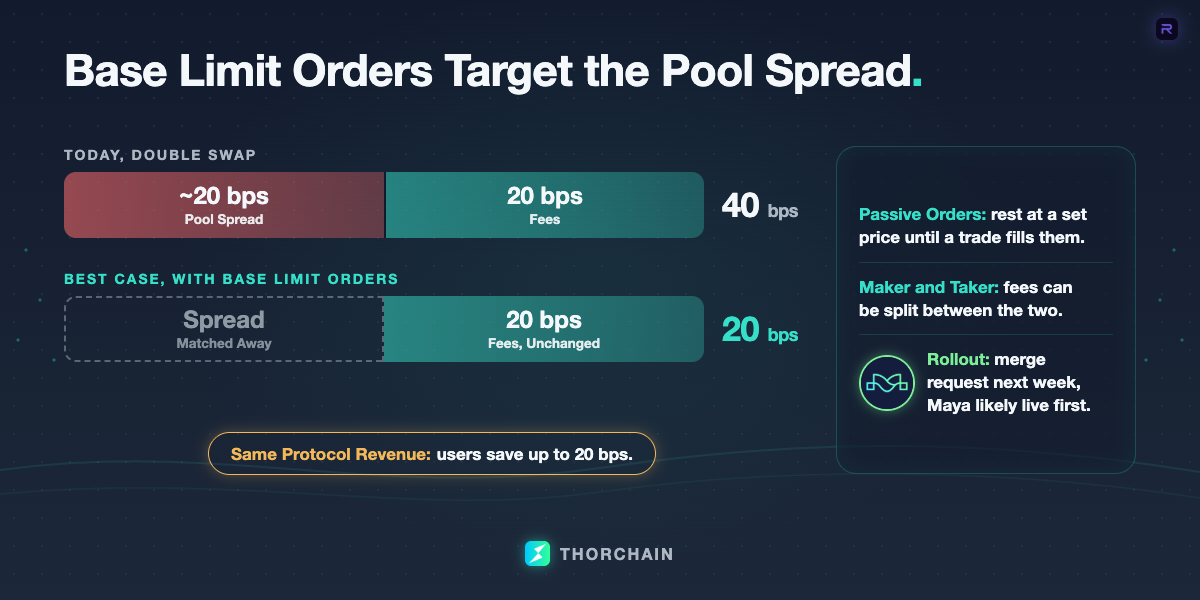
Devel laid out his base limit orders in depth on the show back in July, and he expects to open the first merge request next week. It goes to THORChain and Maya Protocol at the same time, but Maya, which is smaller and eager for the feature, will probably go live first. THORChain will want more review and data, has a backlog of fixes ahead of it, and Devel expects a few weeks of back and forth.
THORChain's existing limit swaps are active. A base limit order is passive: it waits at a set price for a trade to fill against it, which removes slippage for the trade it matches. Using Devel's estimate that the pools carry a spread of about 20 bps on a double swap, Kenton's math adds 20 bps in fees for about 40 bps in total. Removing the pool spread halves the total, while the protocol earns the same fees. Asked how much execution would improve, Devel expects 10 to 20 bps on a one- or two-leg swap. Arbitrage bots save that slippage too, and he expects competition to pass most of the saving through to users' prices.
"In the best case scenario there is no slippage at all happening, which is a great improvement, and at the same time we are still maintaining the same level of revenue." (Devel)
With a maker and a taker on each trade, fees can be split, for example 5 bps for the maker and 15 bps for the taker, with the protocol earning the same total. Devel has spoken with THORChain's two biggest arbitrageurs, who agree the orders improve execution, and he invited others to reach out.
The first version is deliberately narrow:
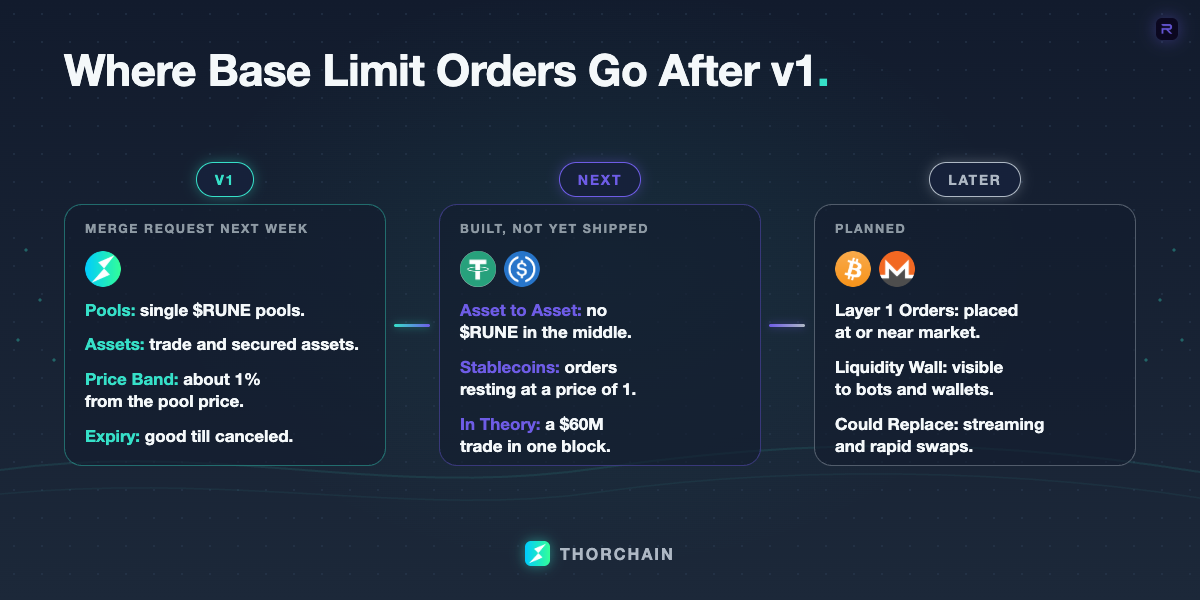
- Pools: single $RUNE pools only. A double swap still matches resting orders on both legs.
- Assets: trade assets and secured assets only. Trade assets are a ledger entry, so placing or canceling an order costs no gas.
- Price band: about 1% above or below the pool price, set by Mimir. Orders outside the band are canceled automatically and returned. It could widen to 5% or 10%, or be lifted, once performance looks fine.
- Expiry: good till canceled, with expiry options planned.
- Controls: Mimirs switch the feature, order creation and cancellation, and nodes can cancel every order at once and return the funds.
Asked whether arbitrageurs would need to screen counterparties, Devel said everything still moves through the same vault, so nothing changes from the outside, and a cautious arbitrageur could disable a pair.
3. Where Base Limit Orders Go Next
The pools stay central. Base limit orders take their price from the pools, and Devel is not trying to replace the AMM, which stays the market maker of last resort if order liquidity ever pulls out.
The next step, already done on the code and math side, is direct asset-to-asset orders without $RUNE in the middle. A $USDT to $USDC order could then rest at a price of 1, which would make stablecoin swaps far more efficient.
"In theory, you can have a 60 million trade done within 6 seconds. One block." (Devel)
After that come orders from layer 1 assets. Instead of a streaming swap, a large seller could place one order at market or a slight premium such as 5 bps, a liquidity wall visible to bots, integrators and wallets. Orders could also step their price up, say 1 bps every 10 blocks, until filled, which Devel thinks could eventually make streaming and rapid swaps unnecessary. Any chain THORChain integrates, including Monero, works with the orders without extra changes. Because layer 1 support comes later, Kenton cannot offer the orders on THORChain Swap yet, though he still wants a pro version with trade assets and an order book view.
Kenton, who likes stink bids 10% to 30% from spot, asked whether the band would ever allow them. Relaying a point from Boone, Denny asked whether long-lived orders far from the price would consume economic security. Devel agreed they could, said he had not considered it before, and noted the band limits it for now. THORChain may simply not be the place for orders meant to sit for weeks. Nodes can also tighten the band by Mimir, which would return those orders.
4. A Reorg Double Payout, and Why Nodes Should Pause
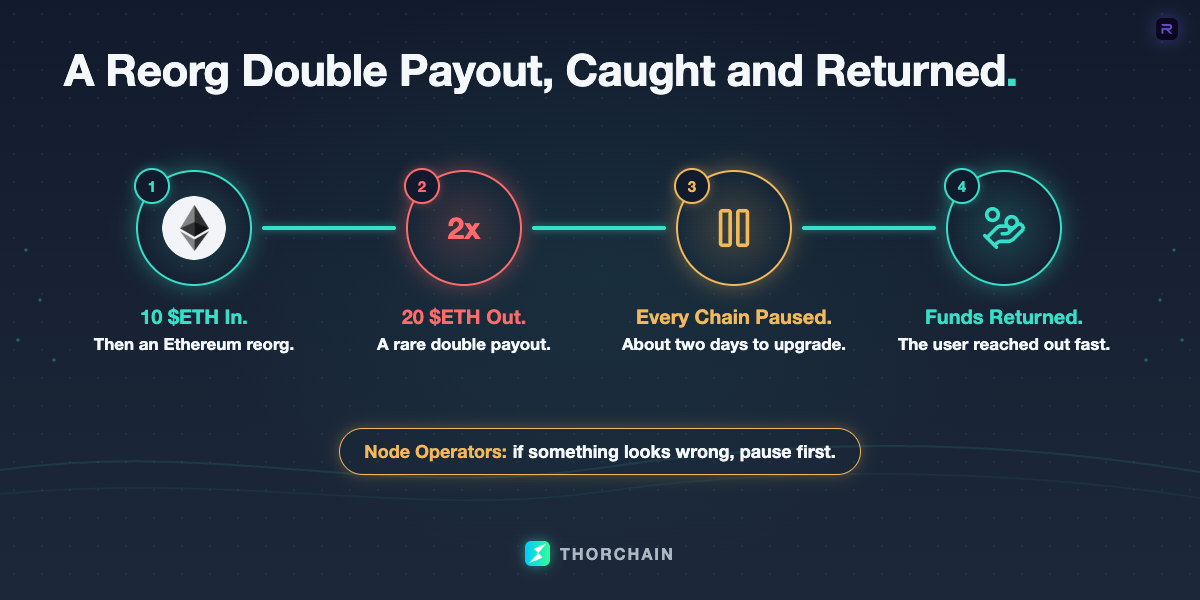
One user swapped 10 $ETH and received 20 back after an Ethereum block reorg. THORChain has handled reorgs for years, but the user hit a rare combination of conditions that led to a double payout. Devel realized it could apply to other chains, paused every chain, and checked the code with the core developers. They agreed it needed a version upgrade, which meant about two days of downtime. Devel said user funds came first.
The user messaged Devel on Discord within seconds of his public request, their history showed ordinary trading, and they returned the funds. The hosts thanked them and the node operators who spotted the problem.
Devel used the moment to encourage every node operator to pause when something feels wrong, even if it turns out to be nothing. Kenton added that different operators pausing helps show how decentralized THORChain is, and suggested operators run their own drills now that Slambammer's monthly fire drills have stopped. Denny compared it to medicine, where the bad thing that never happens goes unnoticed because the team was prepared.
"Just pause. Who cares? Just pause." (Denny)
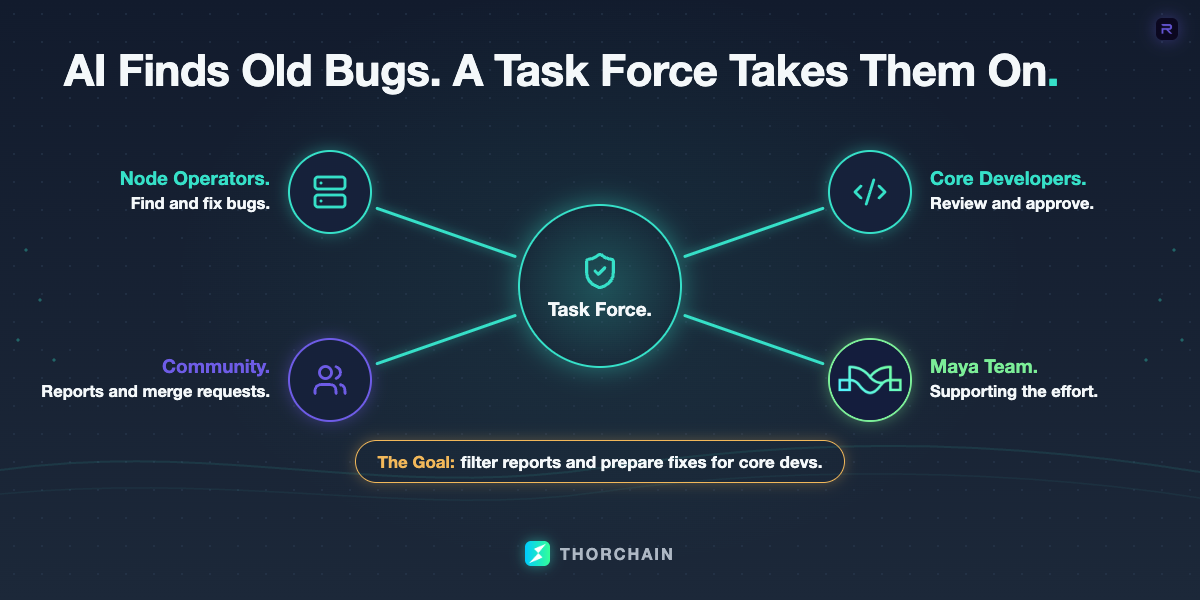
5. AI Is Finding Old Bugs, and a Task Force Is Taking Them On
Kenton is weighing year-long campaigns with Bitcoin Magazine and Bitcoin.com, would like to work with The Defiant too, and finds AI useful for design but not for writing. He put a question to Devel: is AI-written code why THORChain has needed so many patches and pauses? Kenton recalled Liquify's Andy saying on Thursday's show that more new code means more room for errors. Devel said AI-heavy projects can become hard to maintain, but THORChain existed before AI, so it is mostly used to review code and find issues.
"The issues we are currently experiencing I would say are not related to new code. That is mostly related to old code and AI finding a lot of issues." (Devel)
Node operators and community members are finding long-standing problems, many tied to slash points, and preparing fixes. Devel has fixed slow churns, though no churn has run with the fix yet, and got core developers to set aside time for community merge requests, several of which are already in the code.
He has also started a task force of node operators, community members and core developers, supported by the Maya team, to filter issue reports, separate real bugs from normal delays, and prepare fixes for core developers to approve. It starts small and will open to active contributors. Denny said many node operators want to focus on stability once $XMR ships.
6. Stablecoin Fees Back to 10 bps, Memoless Spam Priced Out
Kenton asked whether the stablecoin minimum fee should drop from 2 bps to 1 bps, but it had already gone the other way. He recalled that Chad Barraford set 2 bps to try to win stablecoin volume from Uniswap and NEAR Intents, but node operators later showed it brought no extra revenue and voted it back to 10 bps. Low-fee swaps were also pushed back in a full swap queue, which prioritizes by liquidity fee, likely why Kenton's own small stablecoin swap took 30 to 45 minutes.
The minimum fee for trade assets and secured assets is also 10 bps. Devel noted the same value sets both the fee and the slippage on a swap, so they cannot be changed separately. As an arbitrageur he uses trade assets, which benefit from swapper clout, a reward that shortens outbound delays the more fees an address has paid. Denny credited Chad with coming up with it on the fly during a volume surge. Rujira plans to delay large secured asset outbounds as an exploit safeguard, which would not suit arbitrageurs who move funds hundreds of times a day.
Memoless swaps are back too. They serve wallets without a memo field, such as Monero wallets: the user registers the swap first, and the last digits of the amount, such as 1.000000672, tell THORChain what to do. A spammer had been reserving the 100,000 registration IDs, each held for 24 hours unless used, hoping someone would send funds without a memo. The Mimir fee was initially set at 0.002 $RUNE rather than 0.02 $RUNE, so filling every slot cost only 200 $RUNE a day. Nodes corrected it by vote and added an exponential fee curve per address, and Devel has not seen the abuse return.
7. Economic Security, POL and the Prophecy of Three
Kenton wondered aloud whether THORChain might one day relax its economic security cap to allow more TVL, which Denny joked would give Boone a heart attack. Boone, who joined from the gym, said he is pretty much never going to give up economic security.
"You show me the incentive, I'll show you the behavior." (Boone)
A bigger prize brings more attackers. Devel asked whether POL itself could strain economic security if it grows too large. Boone said THORChain could simply stop adding to POL once returns diminish. He expects most execution to move to base limit orders, which he called twice as efficient. Turning POL off would then raise yield, which would raise bonding and economic security. He has a long-form post in mind arguing that the exogenous assets held as POL should be the floor of the $RUNE market cap, which Kenton invited him to publish on the THORChain blog, open to anyone. Denny called for making THORChain the safe, simple play, and the panel turned Kenton's "make THORChain great again" into a new slogan: "make THORChain boring again."
The panel pulled up live POL figures: the Zcash pool's POL had almost doubled its initial seed, and Boone said about 2.2 million $RUNE has been deposited into system-income POL, with about 1.18 million currently held. Both are slightly inflated by a Treasury position that POL absorbed. System-income POL is now about 2.3% of the pools, and Boone noted it can never reach 100% while other LPs remain. Ray's POL Income dashboard tracks system income collected and POL deposits by pool.
Kenton also made the case for his "Prophecy of Three": THORChain could become the third-largest crypto by market cap, since a centralized exchange token, $BNB, held that spot in the 2021 bull market. He called it a deliberately high anchor and conceded top 10 may be more realistic. A reply that kept misspelling "third" as "threeth" only made it a meme, and Denny wants a party if it ever happens.
What to Watch
- The Base refund nodes, the $BTC memo fix and the new version hoped for within days, followed by a churn and the vote to enable $XMR.
- Whether the $XMR pool is deep enough for real volume by Christmas, a timeline floated on the show, even if it technically goes live sooner with only a few hundred dollars.
- Bonding reopening, and the rebond UI fix.
- Devel's base limit orders merge request on THORChain and Maya, with Maya likely live first.
- Whether more community merge requests land through the new task force.
- Nym joins next Saturday's podcast.

More THORChain data, check out raynalytics.net
Follow Raynalytics for more Weekly Analytics and Podcast recaps.

Related articles
![Protocol Update Podcast with Andy from Liquify, Kenton and Denny]()
Nov. 12, 2026
Liquify Fixes THORChain’s Quote Slowdown & Kenton Reviews a Year of THORChain Marketing
- Podcast
![Ecosystem Update Podcast with Aaluxx]()
Nov. 7, 2026
Aaluxx on How $MAYA Inspired $TCY, $CACAO’s Fair Launch and Maya’s Aztec Intents
- Podcast
![Protocol Update Podcast with Chad Barraford, Kenton and Denny]()
Nov. 5, 2026
Monero Is Ready on THORChain, Bond Yield and SwapKit Rev-Share
- Podcast
![Ecosystem Update Podcast with Moca]()
Oct. 31, 2026
Moca Nears Launch & How It Uses THORChain to Bring Crypto Payments to the Register
- Podcast
![Protocol Update Podcast with CodeHans, Pragmatic Monkey, Boone, Chad Barraford, Kenton and Denny]()
Oct. 29, 2026
Inside Rujira’s Kaiyo Debate: Can a Rujira Chain Stay Aligned With THORChain?
- Podcast
![Ecosystem Update Podcast with Zodl]()
Oct. 23, 2026
Zodl and THORChain: Shielded Zcash, Zodl Vault and the Case for Redundant Swap Routes
- Podcast
![Protocol Update Podcast with Chad Barraford, Kenton and Denny]()
Oct. 22, 2026
Monero on THORChain Waits on v3.21.1, SwapKit Rev-Share and 2-Second Blocktime
- Podcast
![Protocol Update Podcast with Chad Barraford, Kenton and Denny]()
Oct. 15, 2026
SwapKit Rev-Share Week One: Early Data Looks Promising, v3.21 and Monero Next
- Podcast
![Ecosystem Update Podcast with Zano]()
Oct. 10, 2026
Zano’s Recovery Plan and the Road to THORChain
- Podcast
![Protocol Update Podcast with Chad Barraford, Kenton and Patriot]()
Oct. 8, 2026
Chad's Unchained Podcast Debrief, Rev-Share and Monero
- Podcast
![Ecosystem Update Podcast with Houdini Swap]()
Oct. 3, 2026
Houdini Swap on THORChain Explained: What It Means for Users and Treasury Revenue
- Podcast
![Protocol Update Podcast with Chad Barraford, Kenton and Denny]()
Oct. 1, 2026
Can or Should THORChain Censor Transactions?
- Podcast
![Protocol Update Podcast with Chad Barraford, Kenton, Devel and Boone]()
Sep. 24, 2026
Inside the Houdini Swap Debate: THORChain’s Treasury, Privacy and Revenue
- Podcast
![Ecosystem Update Podcast with Radix]()
Sep. 19, 2026
Radix and THORChain: Building Trust for the Agentic Future
- Podcast
![THORChain Podcast protocol update cover]()
Sep. 17, 2026
THORChain Returns to Shipping: Zcash, Monero and Self-Sufficiency
- Podcast