Aaluxx on How $MAYA Inspired $TCY, $CACAO’s Fair Launch and Maya’s Aztec Intents

— 12 min read
- Podcast
THORChain x Maya Protocol Podcast #249 ft. AaluxxMyth, KentonC137 & Patriotsounds | November 7, 2026 | Watch the full episode on YouTube
By Raynalytics
TL;DR
- $TCY was modeled on Maya's $MAYA token. Aaluxx explained how giving $TCY directly to claim holders, plus a pool to trade it, turned THORChain's debt into equity. He said it has averaged over 20 cents on the dollar, against about 8 cents for secured creditors in a traditional bankruptcy.
- Maya is building Aztec, a fork of NEAR's chain and NEAR Intents. Aaluxx said it will be fully open source, with permissionless signers and THORChain and Maya as solvers. He gave no firm launch date.
- $MAYA holders receive 10% of Maya's fees with no staking, and another 1% of fees buys $MAYA back. $CACAO launched fairly, with the team keeping 0%, and $MAYA now has its own pool.
- Maya bond providers bond liquidity rather than $CACAO. Maya is building base layer limit orders (BLOs) and adding Solana, Tron, BNB Smart Chain and Bitcoin Cash.
- Kenton said THORChain's marketing is staying low-profile for now, with a push into video content planned once the news cycle cools.
Introduction
$TCY, the token that let THORChain restructure its debt, was modeled on Maya Protocol's $MAYA.
Aaluxx, co-founder of Maya Protocol, stepped in on short notice when the scheduled guest had to cancel. Back on the show after his July episode on the exploit and protocol redundancy, he walked Kenton and Denny through the night the $TCY proposal came together, why it worked, and how Maya's $MAYA and $CACAO tokens work. He also explained how Maya's nodes differ from THORChain's, and shared new detail on Aztec, Maya's intents layer.
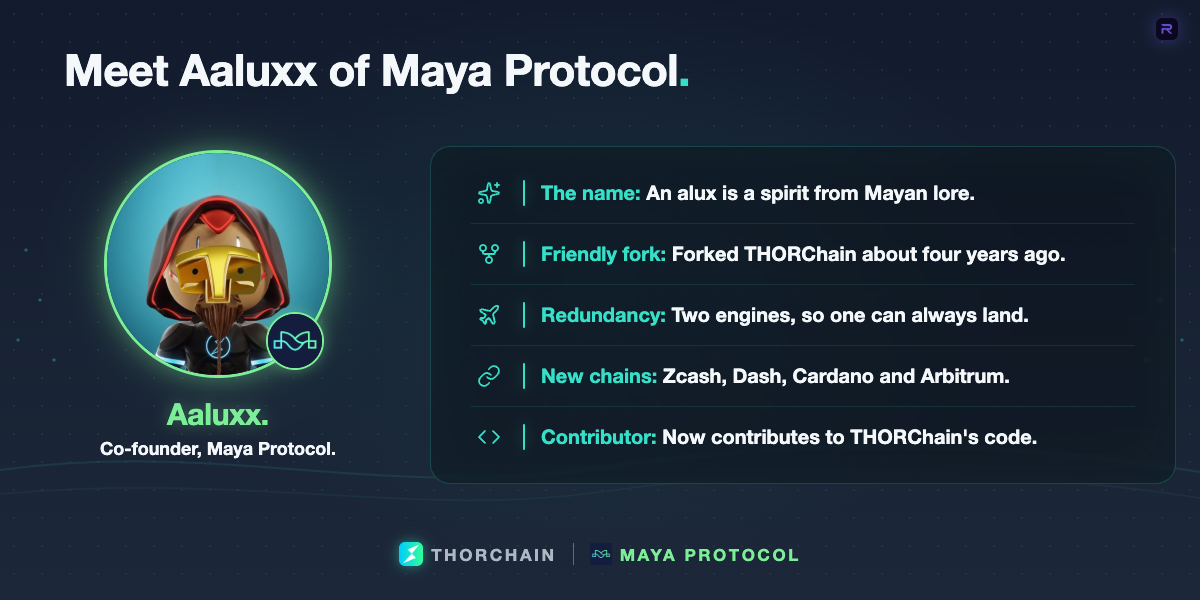
1. Meet Aaluxx: The Friendly Fork With Two Engines
Aaluxx picked his name from Mayan mythology, the way THORChain drew on Norse myth. In southeast Mexico, an alux is a spirit that villagers pay respects to. He accepts every pronunciation, including what the hosts called "the gringo pronunciation," Alex.
Maya forked THORChain's code about four years ago and has been on mainnet for three or four years. Aaluxx said the reasoning has not changed: what THORChain does is important enough to need redundancy, so there are always "two candles lit." Maya branded itself a friendly fork from the start. It never tried to pull liquidity away from THORChain, and its team now contributes directly to THORChain's code base.
Maya also covers chains THORChain did not have. It integrated Zcash more than a year ago, before THORChain did, and runs Dash, Cardano and Arbitrum.
"I think it's important to fly a jet airplane with two engines." (Aaluxx)
2. How $MAYA Inspired $TCY
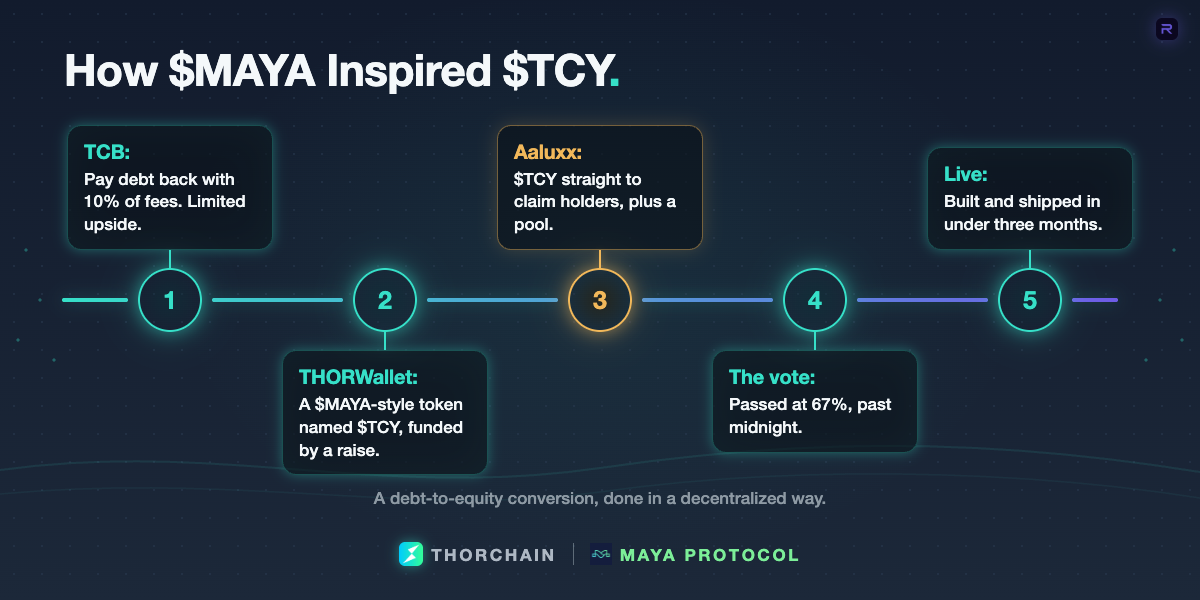
When THORChain's savers and lending programs collapsed, the first fix on the table came from TCB. TCB proposed paying debt holders back with a share of fees, and chose 10%. Aaluxx said the flaw was limited upside: nobody would add liquidity, so repayment could take anywhere from 20 to 100 years.
Next, THORWallet pointed to Maya and proposed a token modeled on $MAYA, and came up with the name $TCY. Investors would fund a raise to pay the debt holders and receive $TCY, with unlimited upside. Aaluxx saw a single point of failure. The raise could fall short, the parties could disagree on whether it was enough, or the person coordinating it could disappear with the money.
His version skipped the raise: give $TCY directly to the claim holders and create a pool so anyone can keep it, sell it or buy it. In traditional finance, Aaluxx said, that is a debt-to-equity conversion. Here it was done in a decentralized way.
The night it came together is one Denny still remembers. At one point five or six hundred people were in the Space. Aaluxx joined, explained the idea, left because his sister was giving birth, and came back to walk through it. Earlier proposals had sat for two or three weeks at 10 to 15% support. Aaluxx had driven five hours that day to meet JP, then to Mexico City for his sister. He did not go to bed until past midnight, when the vote reached 67%. The system was live in less than three months.
"Just a bunch of randos online coming together and figuring out a solution in real time." (Denny)
3. Why $TCY Worked: Over 20 Cents on the Dollar
Aaluxx compared the result with traditional finance. His brother-in-law specializes in large bankruptcies, which Aaluxx said take about five years. Even a secured creditor with a formal contract is lucky to get 10 cents on the dollar, and the average is about 8. $TCY claim holders had no guarantee, yet Aaluxx said $TCY has averaged over 20 cents on the dollar, with peaks of 40 to 50 cents.
The rest was design work: buyback programs to create steady demand, a way to seed the first liquidity, and payouts that start only when $TCY is staked. That last detail came from large investors who wanted the price upside, but whose status as registered US institutions meant automatic yield could look like a taxable dividend.
Aaluxx said the real saving grace was that THORChain's core product stayed mostly intact. Swaps kept running, if less deep, and kept earning fees, independent of the savers and lending programs that failed. He contrasted that with Terra, whose insolvency hit its core product directly.
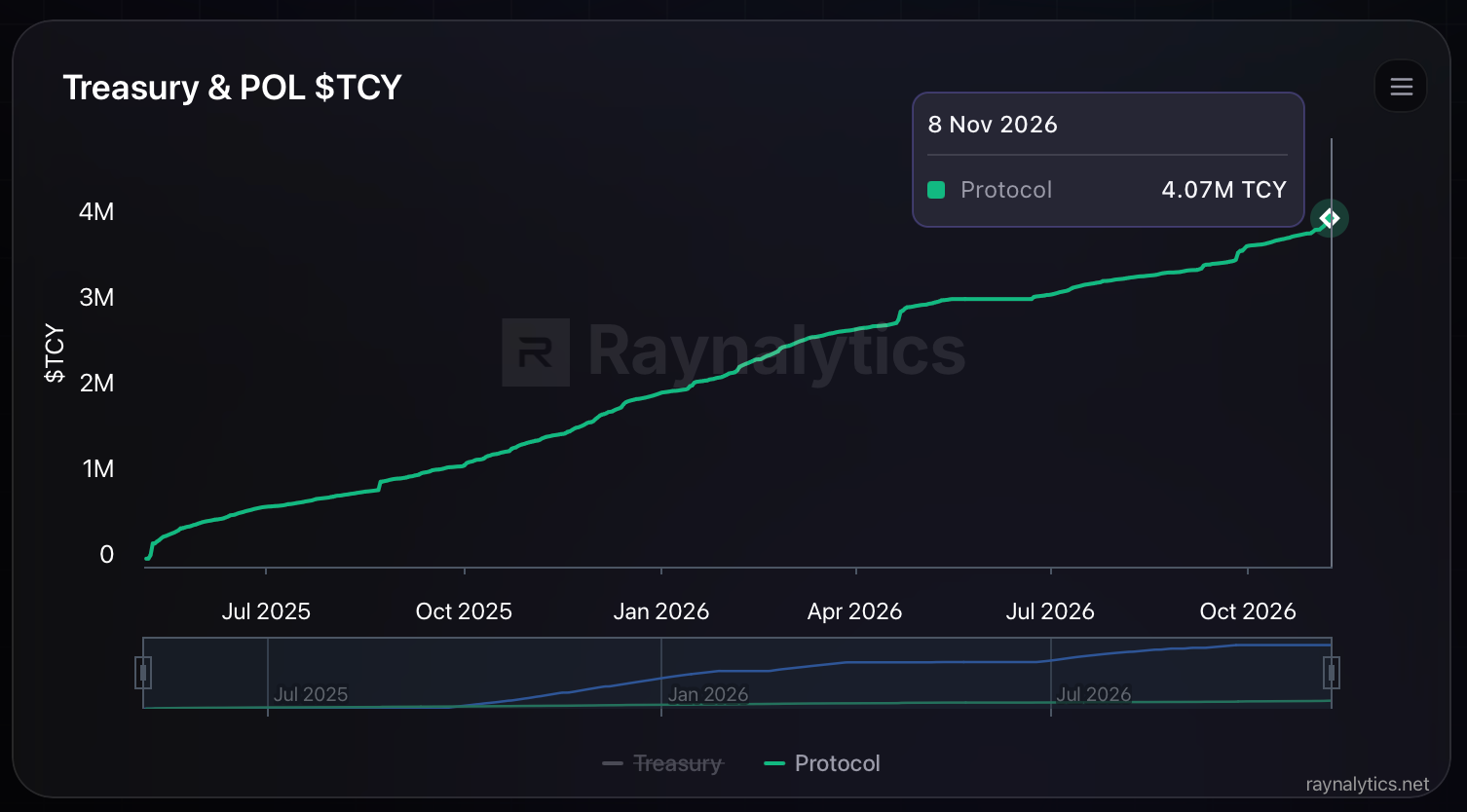
The buybacks keep compounding. Aaluxx said the protocol already owns about 3.9M $TCY. At 4.2M, which he expects within the next couple of weeks, that is 2% of the supply, and he estimated 10% within another five to eight years. He compared the buying to Slender Man, the horror-game figure that is always following you.
"That's sort of this $TCY buying. Like it's always lurking. Just every day, boom, buying, boom, buying." (Aaluxx)
4. Aztec Intents: Maya's Open Take on NEAR Intents
Aaluxx argued that crypto is not zero-sum. He sees tribalism against Chainflip, NEAR and others, while Maya studies Chainflip every month or so to borrow what works. Kenton added that even the combined volume of NEAR, Chainflip, Maya and THORChain is a drop in the bucket next to centralized exchanges, which are the real competition.
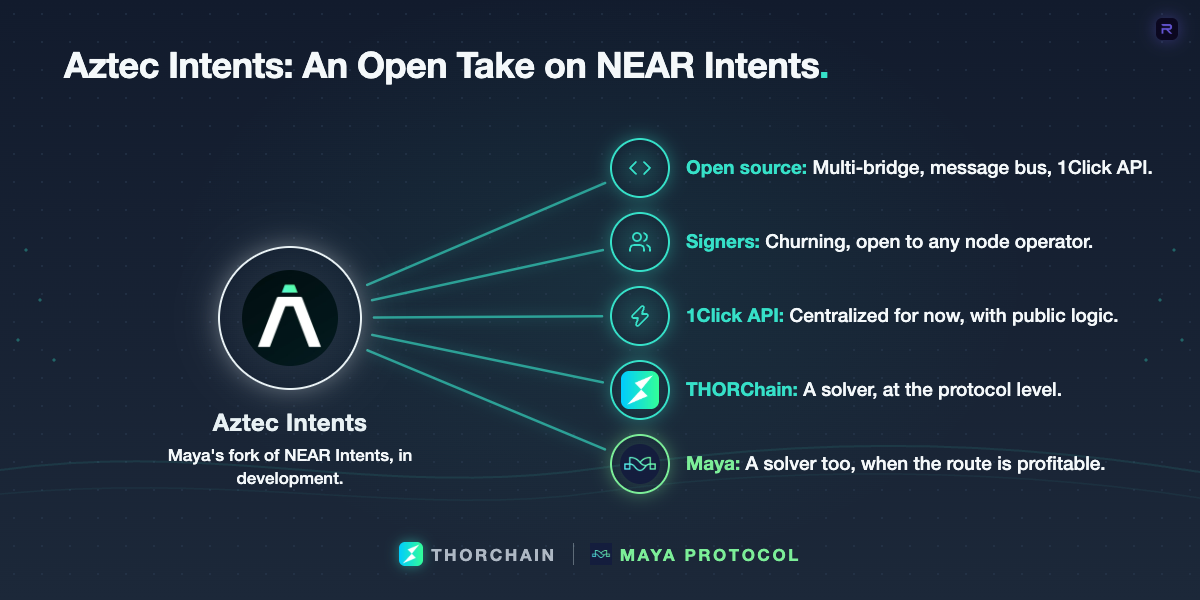
In that spirit, Aaluxx said THORChain and Maya are built for decentralization and trustlessness, but not for speed, fast chain integrations or small swaps. NEAR Intents excels at all three. So Maya forked NEAR's chain into Aztec chain, and NEAR Intents into Aztec intents.
Aaluxx described several changes:
- Open source: NEAR keeps its multi-bridge, message bus and 1Click API closed source. Maya reverse-engineered them, and Aztec will be fully open source.
- Signers: NEAR's signer set is closed. Aztec's will churn, and any node operator can join.
- 1Click API: It works much like an L2 sequencer, ordering requests and matching intents with solvers, and stays centralized for now. Aaluxx said it cannot move or steal funds, and its logic will be public.
He rated NEAR Intents a 6 out of 10 on decentralization, put Aztec at perhaps 8.5 and THORChain at 9.5. Fully decentralizing the matcher will need zero-knowledge proofs, so a solver can prove it has the best quote without revealing it. Aaluxx said he is "pretty sure" Aztec's solvers will be open to anyone, and will confirm.
Kenton noted that Chad has talked to the NEAR Intents team about THORChain as a solver. Aaluxx said Aztec will make both THORChain and Maya solvers, filling an intent at the protocol level whenever that is profitable. He does not expect Aztec to take any share from either protocol that NEAR has not already taken. The aim is to win some back, plus volume from centralized exchanges.
Aztec was meant to launch this summer. Aaluxx said Maya's own issues pushed that back, including recovering from a summer hack, which wrapped up in October. He hopes for about a month, while admitting he is an optimist.
"I want everything open." (Aaluxx)
5. How $MAYA and $CACAO Work
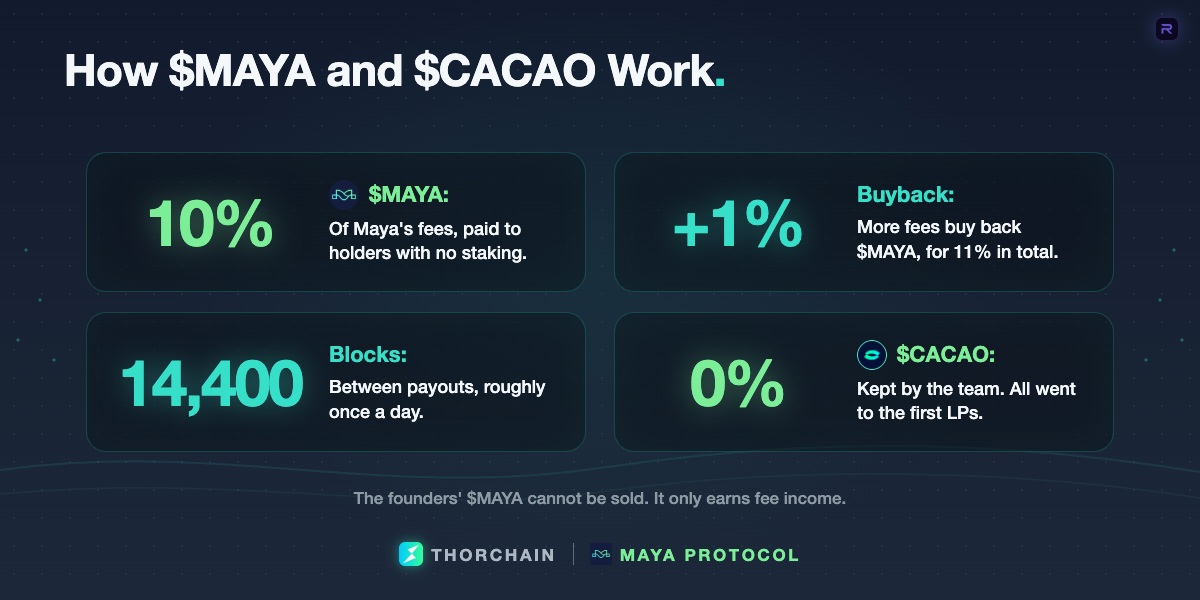
Maya launched $CACAO, its equivalent of $RUNE, as a fair launch. The team kept 0% and gave all of it to the community members who provided the first liquidity, in what Denny called probably the fairest launch up to that time, and probably since.
Instead, the team took $MAYA, which receives 10% of Maya's revenue. Aaluxx said 10% was enough to reward the team and investors without feeling like a heavy burden. There is no staking: payouts go straight to holders' addresses every 14,400 blocks, roughly once a day. The founders' allocation cannot be sold. It only earns fee income, so the team always keeps a long-term stake.
After $TCY, Aaluxx brought one of its ideas back to Maya. An additional 1% of fee revenue now buys back $MAYA, for 11% in total, and the token's own revenue also buys more of it back. He said $MAYA has a supply of about 1M and trades around three or four dollars.
$MAYA also has a real pool now, replacing an informal order book a community member used to run. Kenton had not known and said he needs to add it to THORChain Swap.
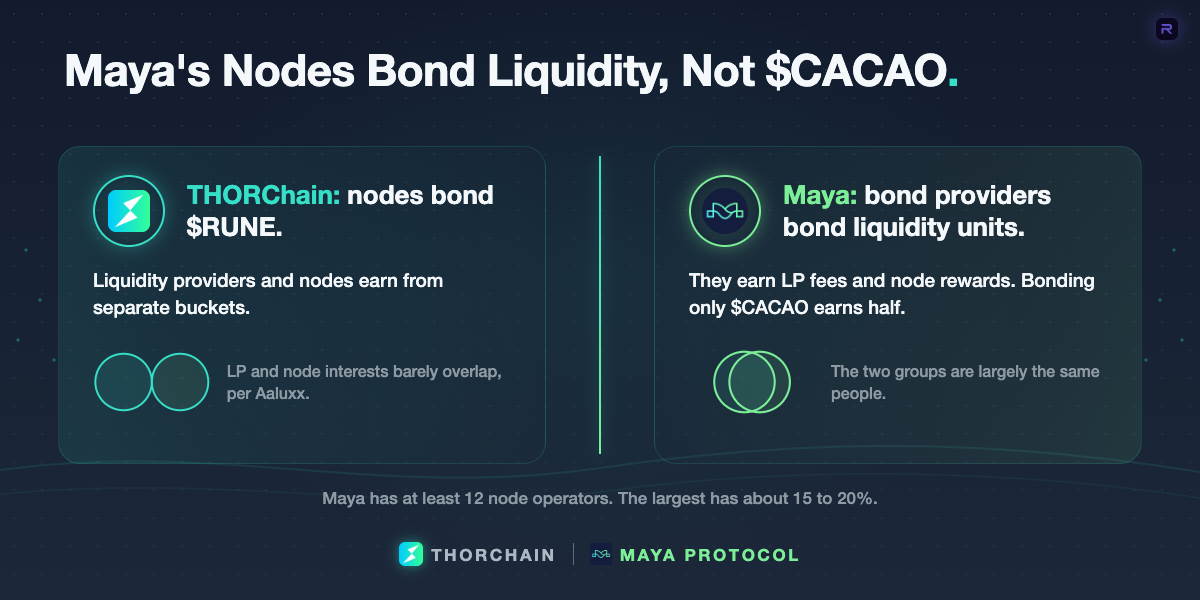
6. Maya's Nodes Bond Liquidity, Not $CACAO
On Maya, bond providers do not bond $CACAO. They bond liquidity units, so the network is owned by active liquidity providers rather than passive token holders. Bonding $CACAO alone is now possible indirectly, but it earns half the rewards and carries an extra lockup.
Aaluxx described it as a Venn diagram. On THORChain, he said, the interests of liquidity providers and nodes barely overlap. On Maya they almost fully overlap, and a bond provider earns from both buckets. He credited this model with keeping Maya's liquidity from drying up.
Protocol-owned liquidity fits the same model on Maya. Aaluxx said it deepens the smallest pools, a design he credited to Boone. That makes more swaps likely to route through Maya without diluting existing bond providers.
Joel Valenzuela of Dash asked about censorship resistance, node distribution and whether regulators had reached out. Aaluxx said no regulator has reached out, as far as he knows. Node distribution "could be better": Maya has at least 12 node operators, and the largest has about 15 to 20%. The bond is measured in $CACAO worth of liquidity units, and with $CACAO around 10 cents, he said it is "really not very expensive." He wants more THORChain operators running Maya nodes, suggested Denny's RUNEBond could help, and said he knows a bond provider willing to fund existing operators.
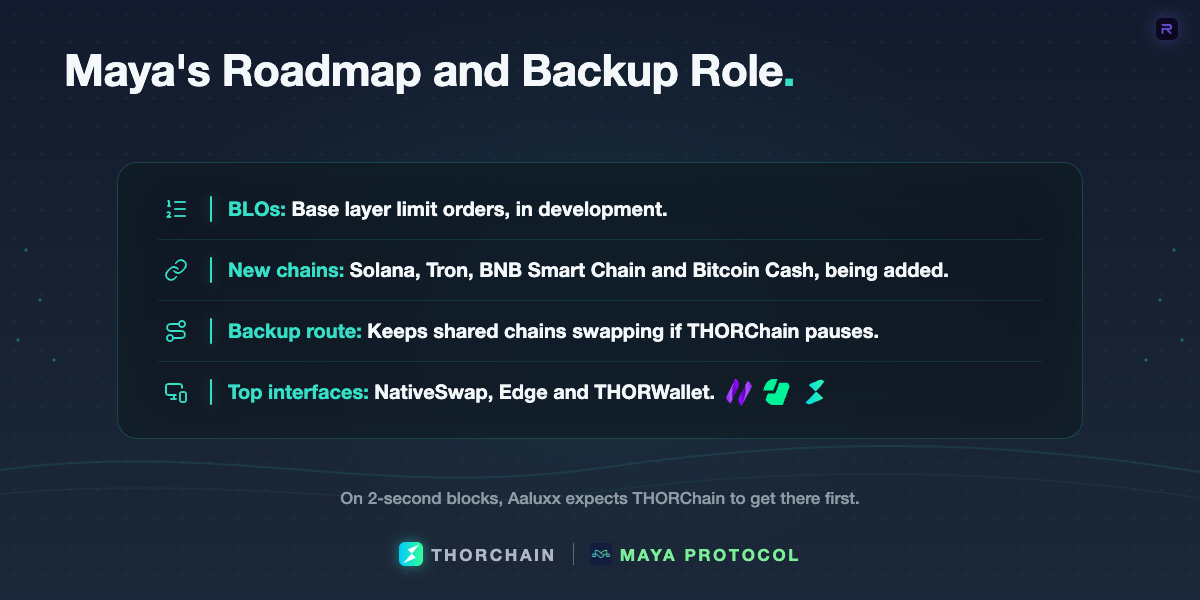
7. BLOs, New Chains and a Backup Route
Asked whether Maya would add base layer limit orders, the idea Devel presented on the show in July, Aaluxx said Maya is building them. One of the hosts said that if BLOs prove successful, Maya could even beat THORChain on quotes. On 2-second blocks, Aaluxx expects THORChain to win the race, given how much Chad is talking about them.
Maya is also adding Solana, Tron, BNB Smart Chain and Bitcoin Cash. Asked why it overlaps with THORChain, Aaluxx said these chains are popular there, and when one pauses on THORChain, users need another route. Maya still trades Zcash well even after THORChain added it.
Kenton said the backup helps when pitching THORChain to wallets. Aaluxx added that the two codebases always differ slightly, so a bug that pauses THORChain, and with it THORChain Swap, rarely stops Maya too. The GG20 signing code is the exception, kept nearly identical the way DNA is conserved.
"That's what a wallet and interface wants. They want uptime." (Kenton)
For anyone who wants to swap on Maya, Aaluxx named his top three interfaces. NativeSwap started as an arbitrageur on Maya before building its own interface. Edge and Paul Puey have supported Maya at every step. THORWallet was the first interface to go live with Maya's launch, and Aaluxx thanked Marcel Harmann for it.
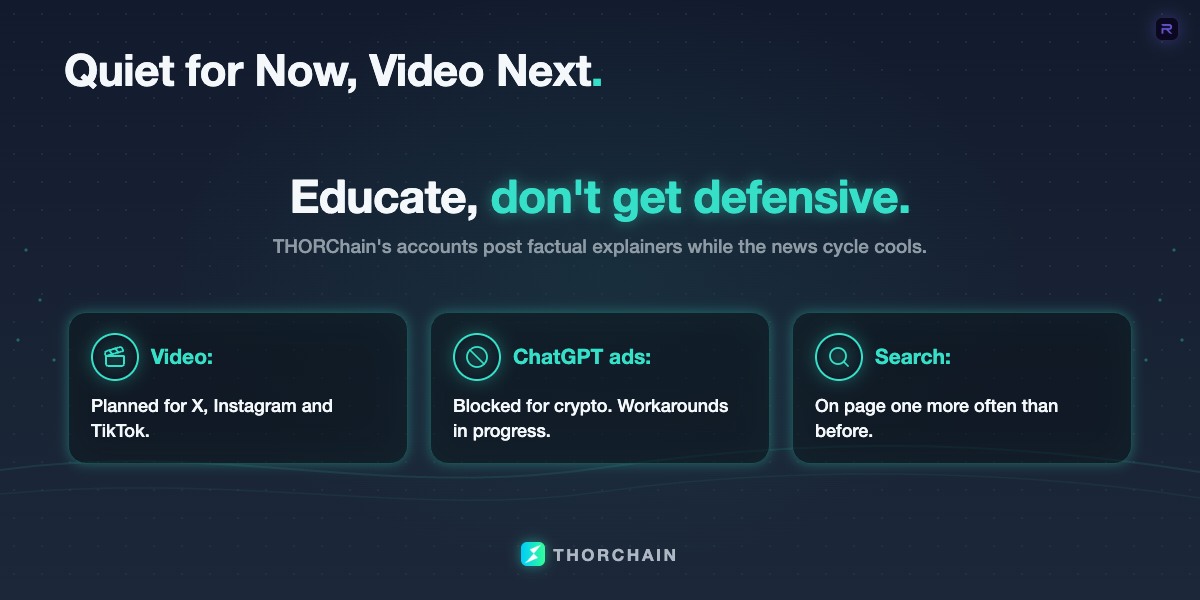
8. THORChain Marketing: Quiet for Now, Video Next
Kenton opened with a marketing update. THORChain's accounts are keeping a low profile through the current news cycle, posting factual, educational content about how the protocol works rather than responding defensively. He said the news appears to be quieting down.
Looking back on the past year, Kenton said he focused heavily on THORChain Swap and on website SEO and AEO, and too little on social channels like TikTok and Instagram, which have not grown. After talking with the people who run those accounts, the plan is more video content across every platform, showing how THORChain and THORChain Swap work and why decentralized exchanges beat centralized ones.
He also tried ChatGPT ads and was banned because the account was crypto-related. An agency that was among the first approved for ChatGPT ads suggested workarounds, such as a landing page, and Kenton is pursuing them. He is adding pages to the main website for SEO too. He said THORChain used to land on page two or three of search results, and now appears on page one more consistently.
What to Watch
- Aztec's launch: Whether Aztec arrives in the month Aaluxx hopes for, whether its solvers open to anyone, and how THORChain and Maya perform as solvers.
- $TCY buybacks: Whether the protocol's holdings pass 4.2M $TCY, about 2% of the supply, in the next couple of weeks.
- BLOs and new chains on Maya: Progress on base layer limit orders and the Solana, Tron, BNB Smart Chain and Bitcoin Cash integrations.
- Maya's node set: Whether more THORChain operators start running Maya nodes and the largest operator's share comes down.
- A $MAYA listing: Whether the new $MAYA pool becomes tradable on THORChain Swap.
- THORChain's video push: Whether the planned video content arrives on X, Instagram and TikTok once the news cycle cools.

More THORChain data, check out raynalytics.net
Follow Raynalytics for more Weekly Analytics and Podcast recaps.

Related articles
![Protocol Update Podcast with Chad Barraford, Kenton and Denny]()
Nov. 5, 2026
Monero Is Ready on THORChain, Bond Yield and SwapKit Rev-Share
- Podcast
![Ecosystem Update Podcast with Moca]()
Oct. 31, 2026
Moca Nears Launch & How It Uses THORChain to Bring Crypto Payments to the Register
- Podcast
![Protocol Update Podcast with CodeHans, Pragmatic Monkey, Boone, Chad Barraford, Kenton and Denny]()
Oct. 29, 2026
Inside Rujira’s Kaiyo Debate: Can a Rujira Chain Stay Aligned With THORChain?
- Podcast
![Ecosystem Update Podcast with Zodl]()
Oct. 23, 2026
Zodl and THORChain: Shielded Zcash, Zodl Vault and the Case for Redundant Swap Routes
- Podcast
![Protocol Update Podcast with Chad Barraford, Kenton and Denny]()
Oct. 22, 2026
Monero on THORChain Waits on v3.21.1, SwapKit Rev-Share and 2-Second Blocktime
- Podcast
![Protocol Update Podcast with Chad Barraford, Kenton and Denny]()
Oct. 15, 2026
SwapKit Rev-Share Week One: Early Data Looks Promising, v3.21 and Monero Next
- Podcast
![Ecosystem Update Podcast with Zano]()
Oct. 10, 2026
Zano’s Recovery Plan and the Road to THORChain
- Podcast
![Protocol Update Podcast with Chad Barraford, Kenton and Patriot]()
Oct. 8, 2026
Chad's Unchained Podcast Debrief, Rev-Share and Monero
- Podcast
![Ecosystem Update Podcast with Houdini Swap]()
Oct. 3, 2026
Houdini Swap on THORChain Explained: What It Means for Users and Treasury Revenue
- Podcast
![Protocol Update Podcast with Chad Barraford, Kenton and Denny]()
Oct. 1, 2026
Can or Should THORChain Censor Transactions?
- Podcast
![Protocol Update Podcast with Chad Barraford, Kenton, Devel and Boone]()
Sep. 24, 2026
Inside the Houdini Swap Debate: THORChain’s Treasury, Privacy and Revenue
- Podcast
![Ecosystem Update Podcast with Radix]()
Sep. 19, 2026
Radix and THORChain: Building Trust for the Agentic Future
- Podcast
![THORChain Podcast protocol update cover]()
Sep. 17, 2026
THORChain Returns to Shipping: Zcash, Monero and Self-Sufficiency
- Podcast
![Ecosystem Update Podcast with Station Wallet]()
Sep. 13, 2026
Terra’s Station Wallet Is Back as Vultisig’s Agentic THORChain Wallet
- Podcast
![Protocol Update Podcast with Chad Barraford, Kenton and Patriot / Denny]()
Sep. 10, 2026
THORChain Prioritizes Stability Before Monero and New Features
- Podcast