Inside Rujira’s Kaiyo Debate: Can a Rujira Chain Stay Aligned With THORChain?

— 12 min read
- Podcast
THORSday Community Podcast #246 ft. codehans1, PragmaticMonkey, BooneW, CBarraford, KentonC137 & Patriotsounds | October 29, 2026 | Watch the full episode on YouTube
By Raynalytics
TL;DR
- Rujira says Kaiyo, a possible separate chain for high-leverage perps, is a plan B it hopes never to need. Denny and Boone pressed on how alignment with THORChain could be guaranteed, and Rujira said Kaiyo cannot launch without THORChain node operators.
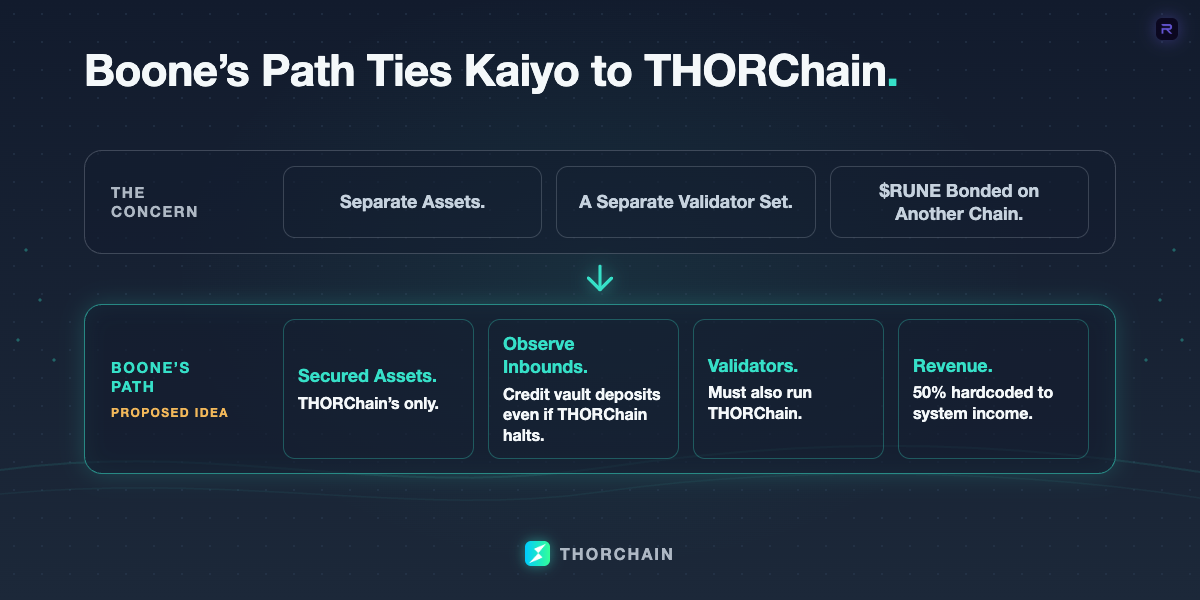
- Boone floated a tighter design: Kaiyo would use only THORChain secured assets, observe THORChain vault deposits directly, and require every Kaiyo validator to be a THORChain validator.
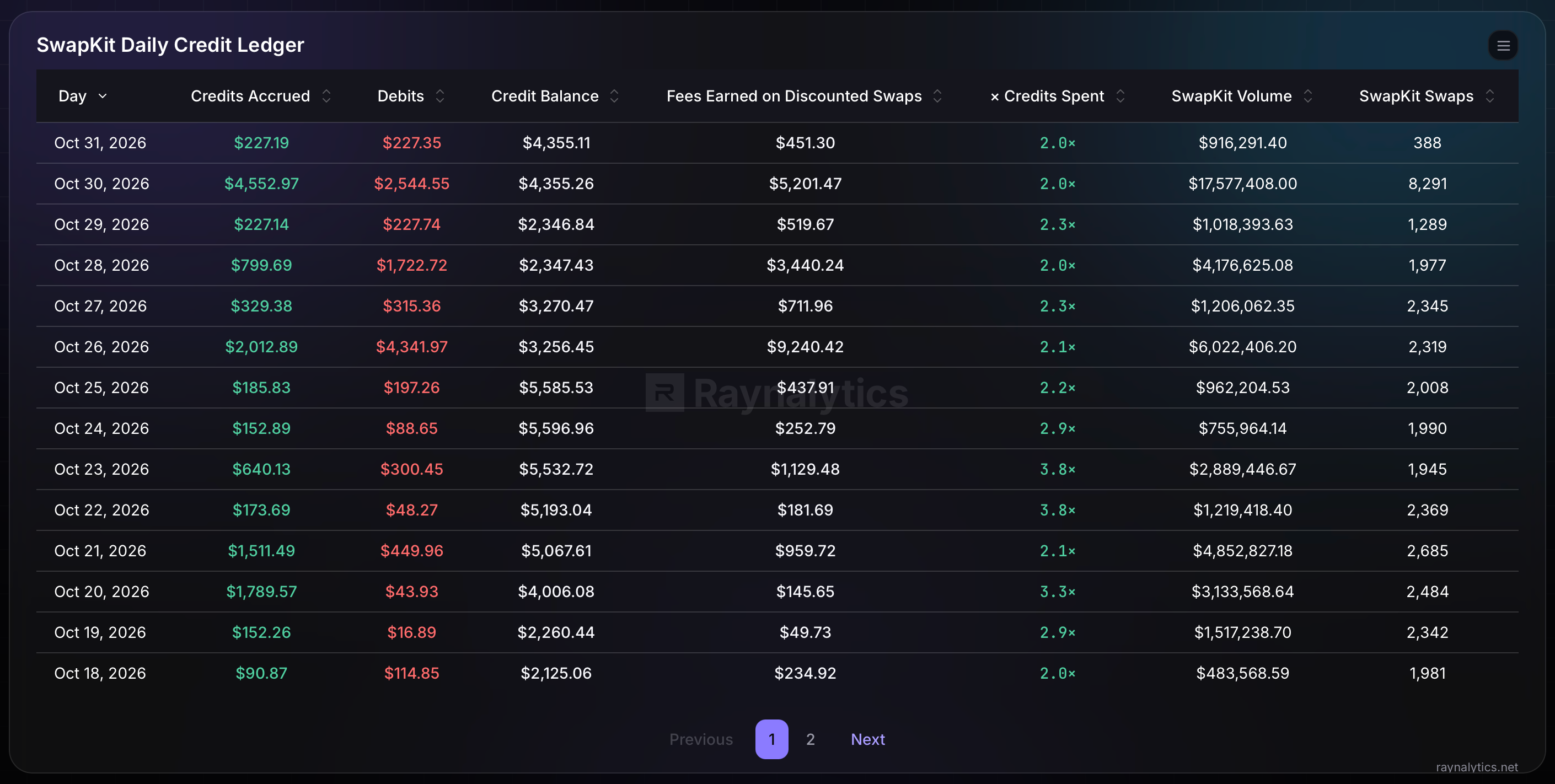
- SwapKit Rev-Share is at about 2.2x after an accounting bug was fixed. By recording day, $8.91K of credits had been spent on swaps that earned THORChain $19.44K in fees.
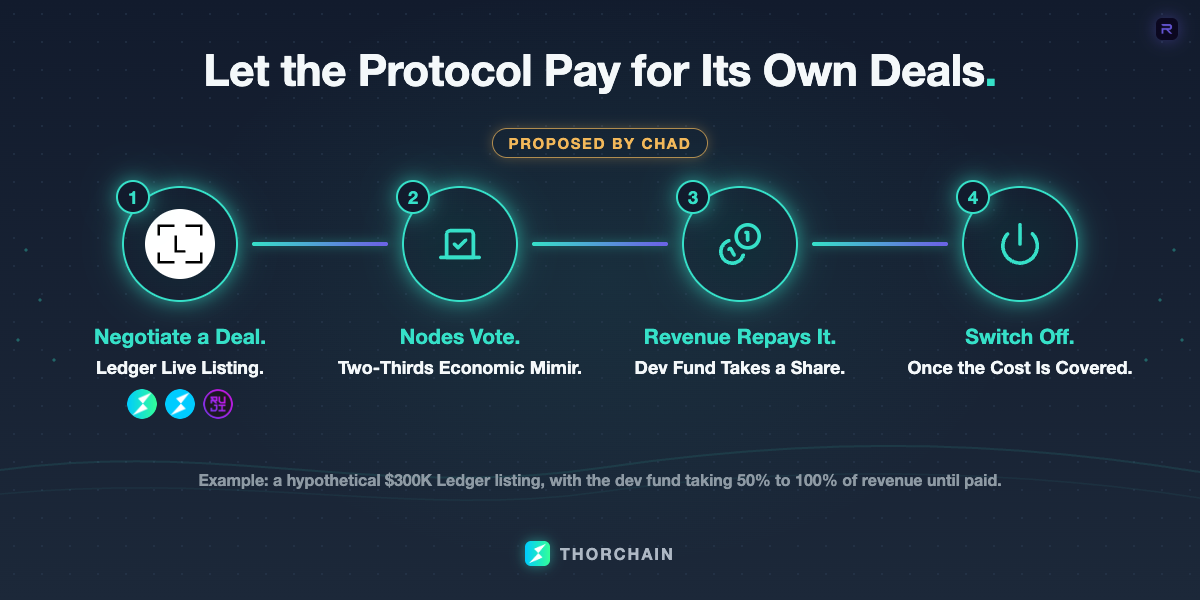
- Chad proposed an economic mimir that would let nodes approve one-off deals, such as a Ledger listing for $RUNE, $TCY and $RUJI, with protocol revenue paying off the cost.
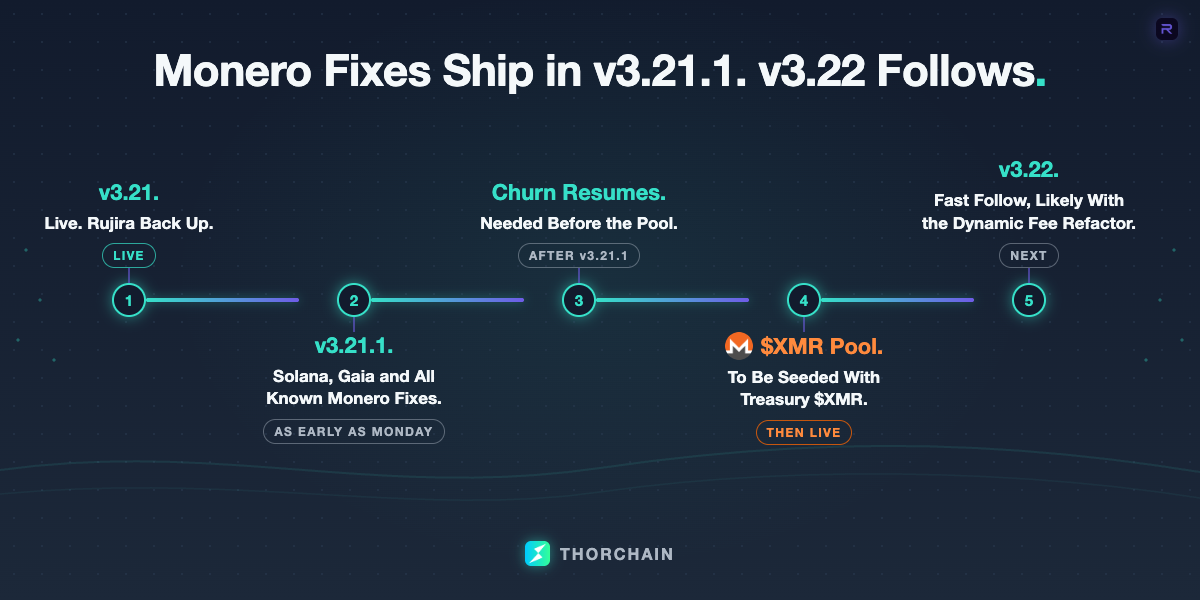
- v3.21.1 should be cut as early as Monday with every known Monero fix, and Chad believes the Treasury has already sourced $XMR to seed the pool.
1. Kaiyo Is Rujira’s Plan B, and Alignment Is the Open Question
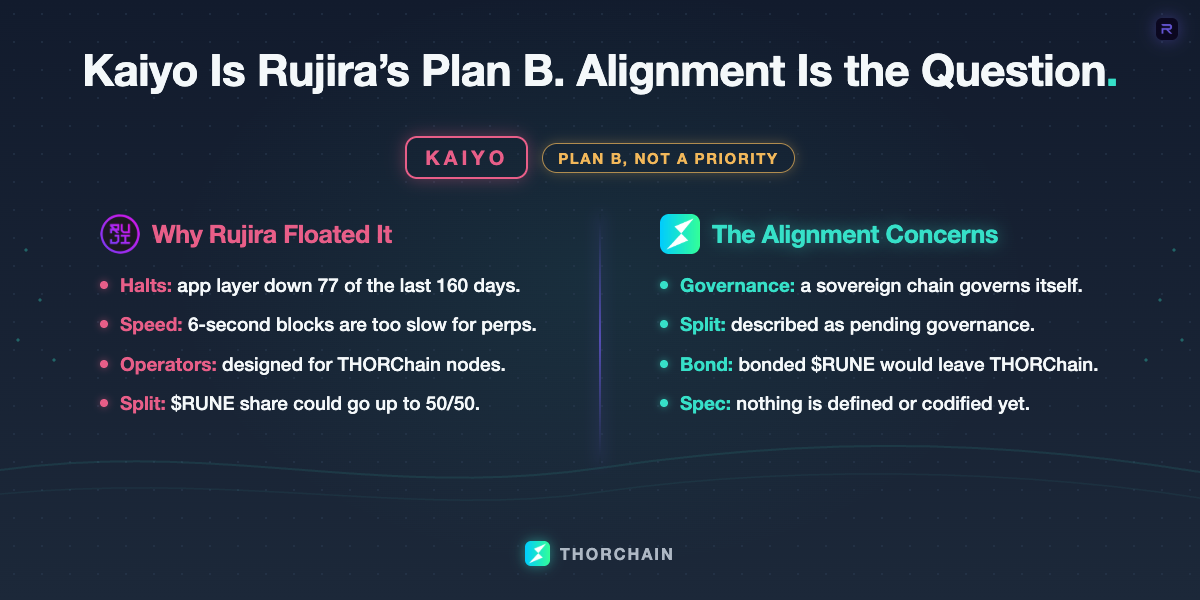
Most of the episode went to a pinned Rujira post about Kaiyo, a possible separate chain for the app layer. CodeHans explained the reasoning. High-leverage perps and high-frequency trading need far faster blocks than THORChain’s 6 seconds, especially next to venues like Hyperliquid. He pointed to Commonware’s Simplex consensus, which offers block ordering in about 50 milliseconds, and described Kaiyo as a playground where Rujira could iterate faster, with the same aligned economics and without putting THORChain itself at risk.
Pragmatic Monkey tied it to the halts. Before the recent restart, the app layer had been halted for 77 of the previous 160 days, almost half the time. Spot markets can survive that, he said, but a perps venue running 20x to 50x leverage could not: liquidations stop, prices move, and bad debt can bankrupt the protocol. He also said Kaiyo would not compete on L1-to-L1 swaps. Rujira plans a withdrawal meter, where withdrawals above a governance-set threshold are delayed and queued so nodes could step in after a hack, and that would make Kaiyo uncompetitive for swaps.
On revenue, nothing is codified. Hans described two models: send fees directly into THORChain’s revenue collector as today, or let $RUNE be bonded on Kaiyo. Pragmatic Monkey likened the second to the Terra Alliance model and stressed that nothing is set in stone, with the split as the key question. He said Kaiyo would be built for THORChain node operators, who could run a light client that reuses their existing chain observation for a second income stream, and that he would personally accept a 50/50 split if that is what it takes. Asked about a gas token, he expected none, matching THORChain’s zero gas price.
Denny relayed the concerns he has been fielding. A post from a Rujira team member had said there would be no revenue split, and its follow-up described a much lower split pending governance. A sovereign chain, he argued, means external governance, with no mechanical guarantee of alignment. He also noted that THORChain covered Rujira users’ secured assets after the exploit, and that after two tokens and two order books, two chains would make his job of keeping both sides together impossible.
"I do not want trust assumptions and I don't want outcome assumptions." (Denny)
Hans and Pragmatic Monkey answered that Kaiyo cannot exist without THORChain node operators. A THORChain node costs roughly $800 to $1,000 a month to run, so no one else could bootstrap a validator set, and those operators would only sign the first block if the voting weights and revenue split honored the spirit of ADR31, which was covered in the Podcast #223 recap. Kenton suggested the deeper issue is having two tokens, not two chains.
"It only starts with any genesis if everybody in this whole community is happy with it." (Hans)
The Rujira side was clear that Kaiyo is not a priority. Pragmatic Monkey hopes it stays in the drawer for months or years, or never happens at all, because THORChain stabilizes and moves toward 2-second blocks.
2. Boone’s Path: One Set of Assets, One Validator Set
Boone joined mid-show and agreed the desire for Kaiyo makes sense after a month-long pause, but argued a sovereign chain is a meaningful change. Today, THORChain has full governance over the app layer and could turn it off; on a separate chain, any promise made now could change later. He also argued that a separate spot order book is inherently in competition with THORChain’s base-layer pools, while Pragmatic Monkey countered that Rujira’s order book only trades secured assets and does not do L1-to-L1 swaps.
Pragmatic Monkey’s objection to simply using THORChain secured assets on Kaiyo was the isolated island problem: if THORChain halts, deposits and withdrawals stop, prices disconnect and liquidations fail. Boone suggested a fix. Even when THORChain is not producing blocks, Bitcoin and Ethereum are, so Kaiyo could observe deposits into THORChain’s vaults on those chains directly and credit users anyway. Pragmatic Monkey called it a very nice way to avoid two kinds of secured assets and asked to review a PR once one exists. Boone said his design work so far looks promising.
Boone would go further: hardcode that only a THORChain validator can be a Kaiyo validator, which would effectively make it an L2 and keep governance with THORChain. He dislikes bonding $RUNE on another chain because that bond is needed to secure THORChain’s exogenous assets, and suggested that, if Kaiyo secures no assets, 50% of its profits could simply be hardcoded to THORChain system income.
Boone also said the post had read as a set of specific design decisions, not ideas being batted around, and that what Rujira described on the show was materially different. Pragmatic Monkey said the post was high level and reactive, written while the app layer was still halted and users were angry, to show there was still a path forward if things did not improve. Both said they want to align the base layer and the app layer as closely as possible.
The discussion ended on base-layer limit orders (BLOs), first proposed by Devel and covered in the Podcast #217 recap. Boone has worked out his own version from Devel’s ADR and believes it is feasible. Pragmatic Monkey called a unified book the purest form of alignment but remains unsure the compute works on-chain.
"If we could unify the books, then that removes almost all the problems." (Boone)
3. SwapKit Rev-Share Settles Near 2.2x After an Accounting Fix
Chad opened with good news and bad news. A bug in SwapKit’s implementation had been miscounting flows and inflating the figures, including a brief reading above 50x and the higher return reported in the Podcast #244 recap. With the accounting corrected, the share is still 20% and the return is about 2.2x: for every $1 THORChain gives SwapKit, it gets back about $2.20 in fees, where 1.1x would already be profitable.
Ray’s SwapKit Revenue Share dashboard shows that by recording day, $11.25K in credits had accrued, $8.91K had been spent, and the discounted swaps had earned THORChain $19.44K in fees. Through October 31, spending reached $11.47K against $24.64K in fees (2.1x), across $12.53M of discounted volume and 2.1K swaps, with a $4.47K balance left.
Spending jumped after the v3.21 fixes SwapKit had been waiting on went live the previous Friday, taking it from about 20% of the bucket to about 80%. Ledger was switched on and tends to do larger swaps, so a single big trade can drive a spending spike. Chad expects most remaining SwapKit interfaces to be enabled within a week or two, and said the share of new wallets coming through SwapKit suggests the program is bringing in volume it would not otherwise get.
There is room to optimize. SwapKit currently gives either the full 10 bps discount or none, when a partial discount might win the same trade for less. Raising the share from 20% to 50% is an option, but Chad is hesitant because it could tilt the split too far toward SwapKit. He wants about a month at full scale before drawing firm conclusions.
"We give them a dollar, we get $2.20 back, which is still very profitable for THORChain." (Chad)
4. Chad Proposes Letting the Protocol Pay for Its Own Deals
Chad floated a way to make THORChain less reliant on the Treasury. He and Randy have been talking with Ledger about listing $RUNE, $TCY and even $RUJI in Ledger Live, and with Tangem about listing as well, but these deals come with large one-off fees. His proposal is an economic mimir, requiring a two-thirds vote but not operational, that lets nodes approve a specific deal. Using a hypothetical $300,000 Ledger contract, the dev fund would receive 50%, or perhaps 100%, of protocol revenue until the cost is covered, then switch back off.
Kenton asked why THORChain should not simply spend the Treasury down. Chad said the Treasury already supplements the dev fund for monthly bills. By his rough estimate, it holds around $3 million in liquid capital plus $6 million to $10 million in LP positions and a few nodes, and he does not want to reach the point of pulling liquidity or selling $RUNE to pay developers. He compared that with Zcash, whose development budget he described as orders of magnitude larger. Another option would be raising the dev fund from 5% to about 20%, if nodes want it.
"It makes logical sense that the entity that actually profits from the deal is the thing that pays for the thing." (Chad)
Kenton noted the Treasury benefits too, and argued that if funding is the concern, THORChain should build its own aggregator; Chad said it was worth doing but a multi-month, sometimes multi-year, effort. The hosts agreed paid listings are a cost of doing business, and that bear-market prices will rise in a bull market. Kenton said Token Terminal once quoted Nine Realms about $300,000 and now quotes him about $80,000, though the older quote may have included more. The hosts asked node operators and bond providers to weigh in on Discord.
5. v3.21.1 Carries the Monero Fixes, With v3.22 Close Behind
v3.21.1 is being tested and validated, and Chad hopes to cut it on Monday. It should include fixes for Solana and Gaia to get them trading and churning again, plus every known fix for Monero. Once the churn is running again, the pool can be created, and Chad believes the Treasury has already sourced $XMR to seed it.
v3.22 should follow quickly. It is mostly bug fixes, and Chad will walk through the full list next week. It should also carry the dynamic fee refactor: dynamic fees have been turned off for all affiliates while the model is rebuilt to pick up more signal and less noise, and will likely be switched back on once those changes are merged and adopted.
6. Rujira Restarts With Zcash Pairs and a Rebuilt Virtualization Strategy
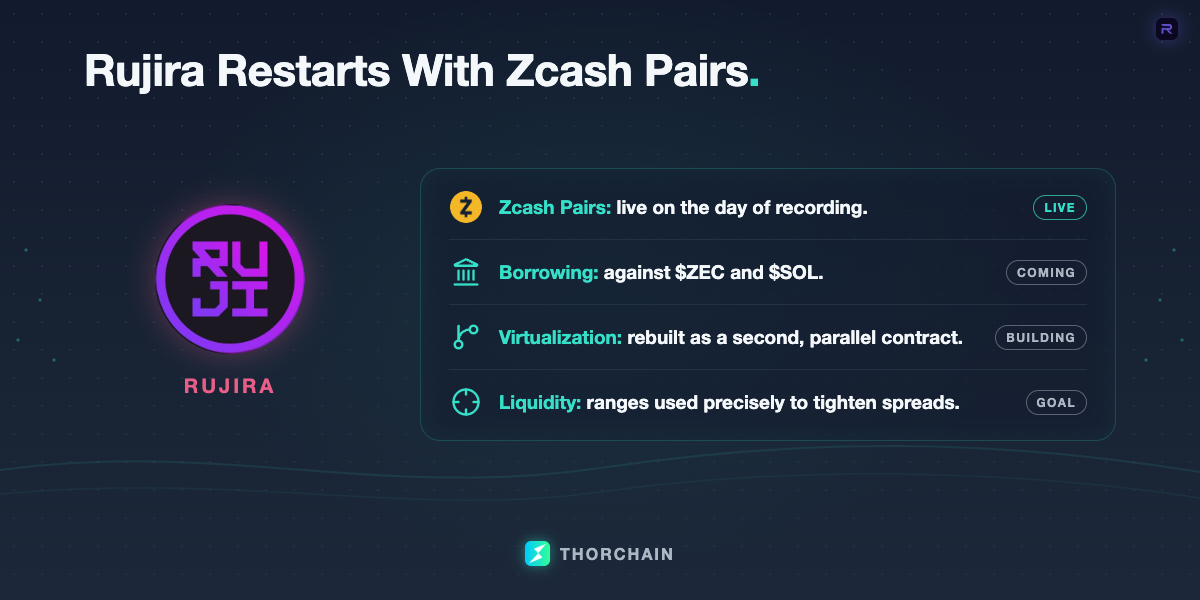
With v3.21 live, Rujira is coming back after a pause covered in the Podcast #230 recap. Hans said Zcash pairs went live on the day of recording, and users will be able to borrow against $ZEC and $SOL.
The next step is restarting the virtualization strategy, which links THORChain pool liquidity to Rujira’s order books. It was originally built to back liquidations and market swaps, but was being pushed in directions it was never designed for. Rujira is now building a second, parallel contract that should use concentrated liquidity ranges more precisely, tighten spreads and reduce volatility in THORChain’s base pools, helping them price more aggressively to win swaps through aggregators. Pragmatic Monkey said he is looking forward to restarting it with the new arbitrage contract.
7. THORChain’s Own Frontend Nears $1B as Marketing Shifts to Video
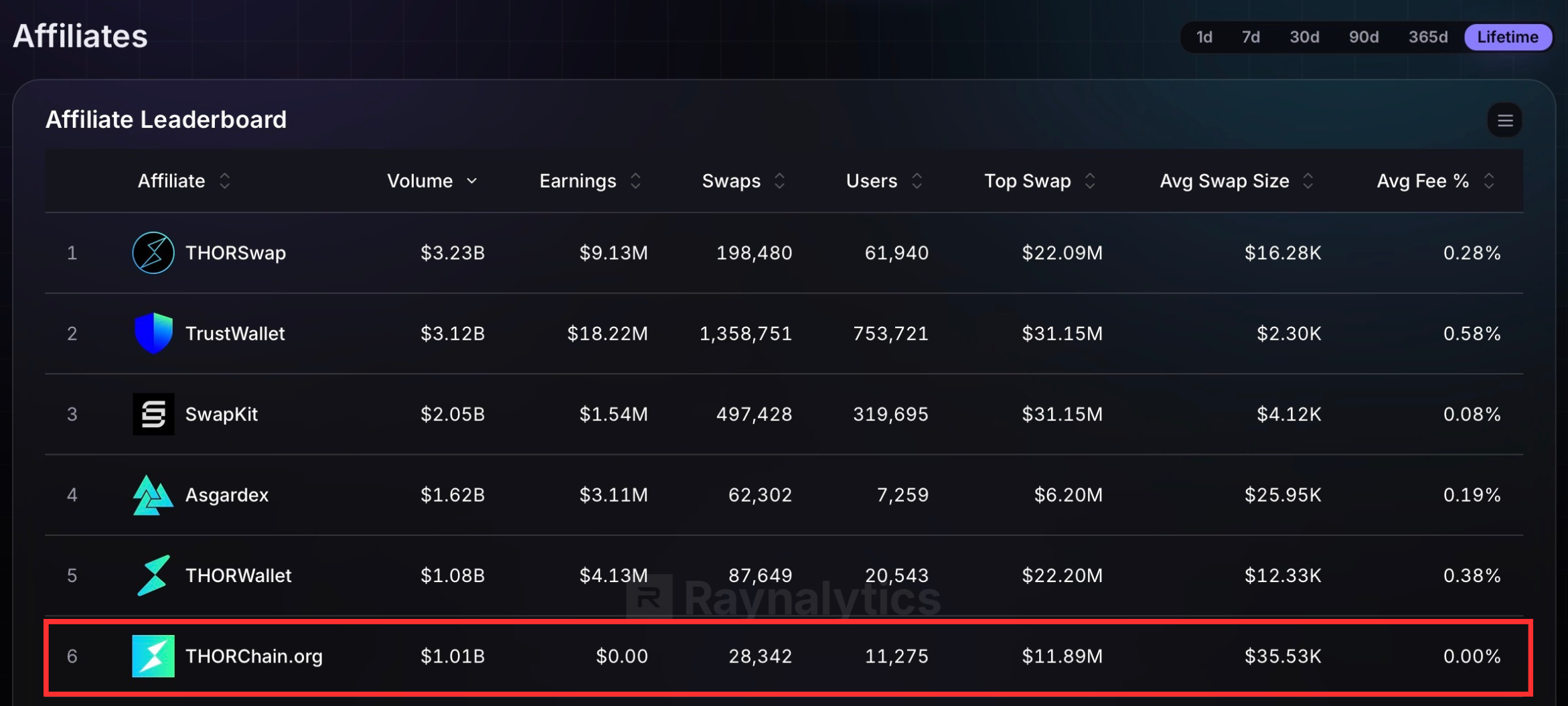
Kenton’s marketing report should land on the blog shortly. THORChain Swap is now the sixth-largest affiliate with just under $1B in volume after about a year, and has the largest average swap size, almost double THORSwap’s. That figure comes from Ray’s Affiliates Leaderboard, which counts user volume once per swap; counting both legs of each double swap, as the chain does, puts it closer to $2B.
THORChain has issued more than 120 API keys after filtering out spam, but most have produced little volume yet. Kenton suspects the dashboard has become confusing and is redesigning it, while Chad said a conversion rate around 1% is normal for builders who start a project and get distracted. At least half are finding THORChain through Google and AI search. Kenton also wants to offer KOLs a rev-share link worth around 10% of THORChain’s fees on the volume they bring, and would like to get buy-in from nodes.
"We're getting 100% of nothing, and if we offer them 10%, we'll get 90% of something." (Kenton)
Video is the next focus. Kenton praised the new video from French Chad, plans AI-made swap videos for every trading pair on social, and wants human-voiced YouTube walkthroughs linked to blog posts for search. He asked the community for memes and short videos.
Meanwhile, Chad and Randy were at Zcon7 in Cancún, meeting wallets and builders. Chad said THORChain is talking with Zcash Foundation about grants to add liquidity to the Zcash pool, and possibly about shielded address support.
What to Watch
- Whether a concrete Kaiyo design is published, and whether Rujira returns for a dedicated episode to discuss it.
- Boone’s design for observing THORChain vault deposits directly, and whether a PR follows.
- The v3.21.1 cut, the churn resuming and the $XMR pool launch.
- v3.22 and dynamic fees returning after the refactor.
- Whether SwapKit Rev-Share holds near 2.2x at full scale, and whether the share moves above 20%.
- Node feedback on Chad’s one-off funding mimir and the Ledger and Tangem talks.
- Rujira’s new virtualization contract going live.
- The Moca episode, and the Saturday show’s new slot an hour later, at 11 a.m. Eastern.

More THORChain data, check out raynalytics.net
Follow Raynalytics for more Weekly Analytics and Podcast recaps.

Related articles
![Ecosystem Update Podcast with Zodl]()
Oct. 23, 2026
Zodl and THORChain: Shielded Zcash, Zodl Vault and the Case for Redundant Swap Routes
- Podcast
![Protocol Update Podcast with Chad Barraford, Kenton and Denny]()
Oct. 22, 2026
Monero on THORChain Waits on v3.21.1, SwapKit Rev-Share and 2-Second Blocktime
- Podcast
![Protocol Update Podcast with Chad Barraford, Kenton and Denny]()
Oct. 15, 2026
SwapKit Rev-Share Week One: Early Data Looks Promising, v3.21 and Monero Next
- Podcast
![Ecosystem Update Podcast with Zano]()
Oct. 10, 2026
Zano’s Recovery Plan and the Road to THORChain
- Podcast
![Protocol Update Podcast with Chad Barraford, Kenton and Patriot]()
Oct. 8, 2026
Chad's Unchained Podcast Debrief, Rev-Share and Monero
- Podcast
![Ecosystem Update Podcast with Houdini Swap]()
Oct. 3, 2026
Houdini Swap on THORChain Explained: What It Means for Users and Treasury Revenue
- Podcast
![Protocol Update Podcast with Chad Barraford, Kenton and Denny]()
Oct. 1, 2026
Can or Should THORChain Censor Transactions?
- Podcast
![Protocol Update Podcast with Chad Barraford, Kenton, Devel and Boone]()
Sep. 24, 2026
Inside the Houdini Swap Debate: THORChain’s Treasury, Privacy and Revenue
- Podcast
![Ecosystem Update Podcast with Radix]()
Sep. 19, 2026
Radix and THORChain: Building Trust for the Agentic Future
- Podcast
![THORChain Podcast protocol update cover]()
Sep. 17, 2026
THORChain Returns to Shipping: Zcash, Monero and Self-Sufficiency
- Podcast
![Ecosystem Update Podcast with Station Wallet]()
Sep. 13, 2026
Terra’s Station Wallet Is Back as Vultisig’s Agentic THORChain Wallet
- Podcast
![Protocol Update Podcast with Chad Barraford, Kenton and Patriot / Denny]()
Sep. 10, 2026
THORChain Prioritizes Stability Before Monero and New Features
- Podcast
![Ecosystem Update Podcast with RAVN]()
Sep. 5, 2026
Inside RAVN’s Native $BTC Aggregator and Its THORChain Integration
- Podcast
![Protocol Update Podcast with Hans, Devel, Chad, Kenton & Denny]()
Sep. 3, 2026
THORChain Churns Again: POL Goes Live, Rujira Resumes and BLO Debate
- Podcast
![Ecosystem Update Podcast with Rujira]()
Aug. 29, 2026
THORChain’s App Layer Rujira Is Paused. Rujira Wants a Clear Restart Path.
- Podcast