THORSday Community Podcast #235 ft. CBarraford, KentonC137 & patriotsounds | September 17, 2026 | Watch the full episode on YouTube
By Raynalytics
TL;DR
- THORChain's stability sprint has ended. The team has resumed normal operations, with an oversolvency sweep, affiliate-fee experiments, and new chain launches back on the near-term agenda.
- Zcash is next in line for mainnet, with Monero planned as a fast follow. The team stressed that timing remains conditional, and that $XMR will begin with a deliberately cautious soft launch.
- Dynamic fees for Symbiosis, a proposed SwapKit rev-share test, and a privacy-routing integration from Houdini Swap are all intended to test whether more protocol revenue can fund operations without a larger Dev Fund.
- Chad's priority is not adding headcount. It is reaching a point where protocol revenue reliably pays for maintenance, security, and development without depending on treasury support or token inflation.
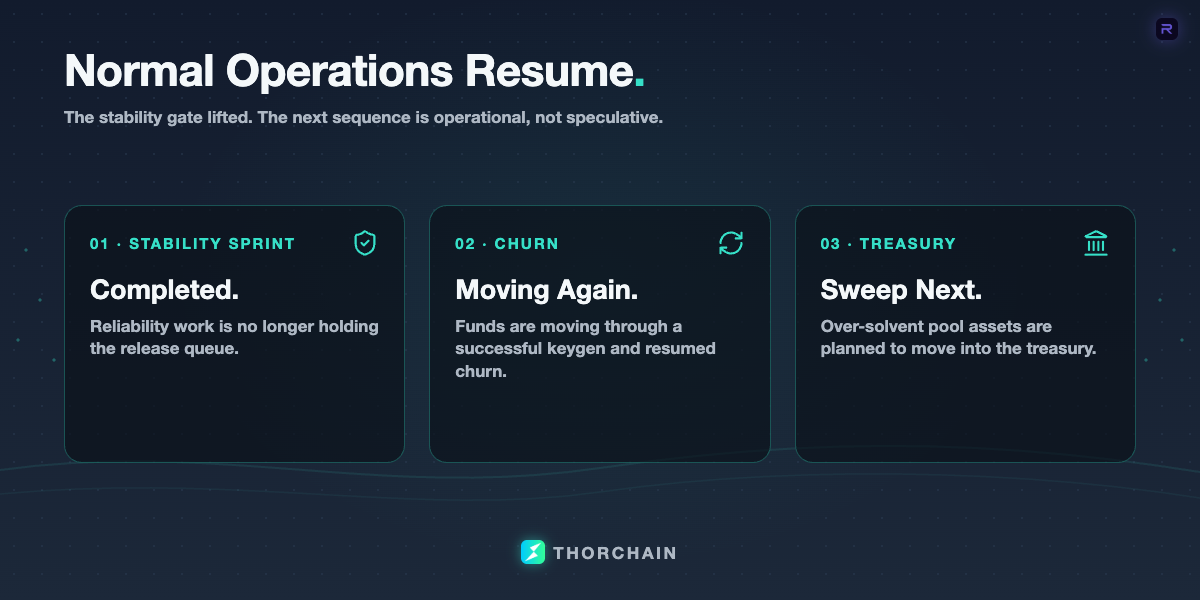
1. The Stability Sprint Is Over
The episode opened with the clearest operational update in weeks: the developer teams agreed to end the stability sprint and return to normal operations. That does not mean the recent work has been forgotten. The point of the sprint was to make the protocol more consistent after the exploit-related disruption, and Chad said the current churn was moving funds after a keygen that succeeded quickly.
Chad Barraford described the next immediate action as enabling the oversolvency sweeper, which will move assets from over-solvent pools into the treasury. He also separated protocol work from external-chain issues, noting that a new Solana transaction type and Gaia nodes falling behind their chain tip had created recent interruptions outside THORChain's core code.
"The sprint is over. We're back to normal operation." (Chad)
The practical meaning is a return to shipping, but with the stability work informing the pace. The team still wants predictable churns, reliable external-chain observation, and a safer base before treating the next rollout as business as usual.
2. Zcash First, Then a Careful $XMR Launch
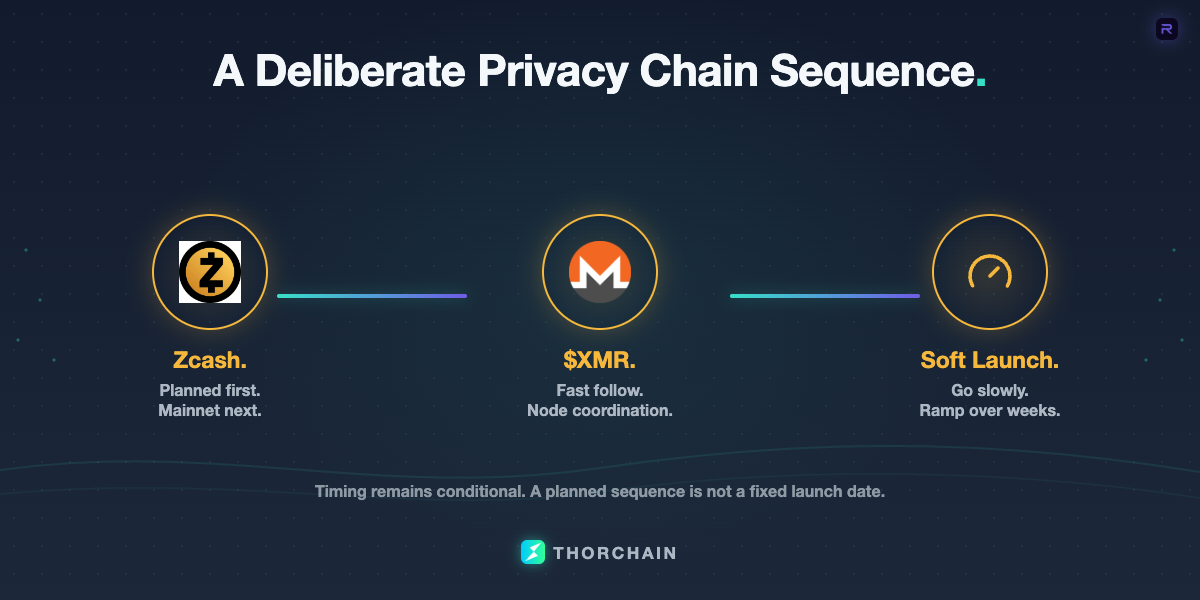
The immediate chain-client sequence is Zcash first, then Monero. Chad said the ordering reflects the existing queue rather than a technical rule. Either chain could technically go first, or both could launch together, but the working plan was to finish Zcash and then focus on $XMR.
That is a meaningful change from the earlier stability-first posture, not a promised date. Chad said the $XMR code is already in place, but enabling it requires coordination from node operators. Kenton added that the team expects to give roughly three days' notice before asking nodes to apply the change that enables $XMR by default, ideally just after a churn so operators have the maximum window before the next one.
"We want to do a soft launch. It's technically live, but ... don't trade in size." (Kenton)
The proposed soft launch is important context. The goal is to create awareness and invite early use without presenting a new chain client as fully seasoned on day one. The team expects a ramp period of several weeks, even if the integration reaches mainnet on schedule.
For background on why the rollout was delayed, see THORChain Prioritizes Stability Before Monero and New Features.
3. More Revenue Tests Are Back on the Table
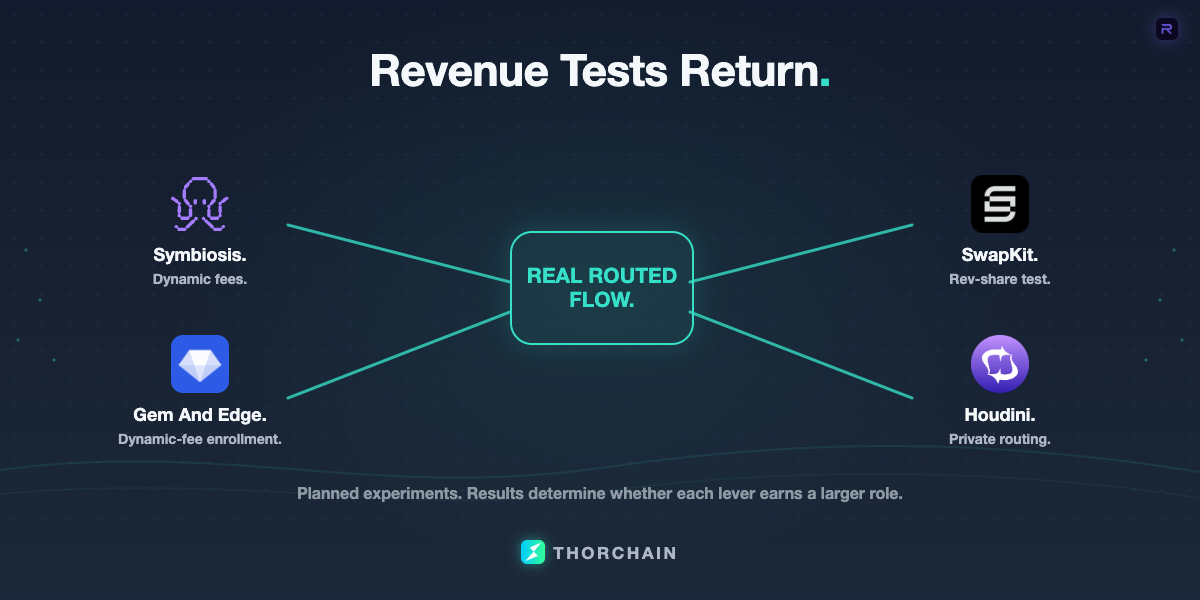
Several experiments paused by the sprint are now moving again. Chad said the dynamic-fee model was due to be re-enabled for Symbiosis after the aggregator resolved a routing issue. He also named Gem Wallet and Edge Wallet as potential next participants, while a rev-share experiment for SwapKit was targeted for the following week, subject to operational readiness.
These are distinct levers. Dynamic fees aim to find a partner- and pair-specific fee floor that protects price-sensitive flow without giving away revenue from users who would route through THORChain anyway. Rev-share would let an approved affiliate share in some protocol liquidity fees. The test matters more than the announced date because it will show whether the mechanism works with real routed volume.
Kenton also outlined the intended integration of Houdini Swap into THORChain Swap: a private-swap option first, followed by a private-send option once it is ready. He described it as a new revenue opportunity, but the discussion kept the status clear. It was planned, not live at the time of the episode.
"We'll flip it on, give it a few weeks, and see what happens." (Chad)
The team has reasons to be interested without treating them as results. Chad cited Symbiosis's reported $300 million to $500 million in trailing-30-day trade volume as flow THORChain would like to win a greater share of. Kenton said Houdini's own partner data suggested a potentially meaningful contribution to treasury income. Both are hypotheses to test, not guaranteed revenue.
4. Self-Sufficiency Comes Before a Bigger Dev Fund
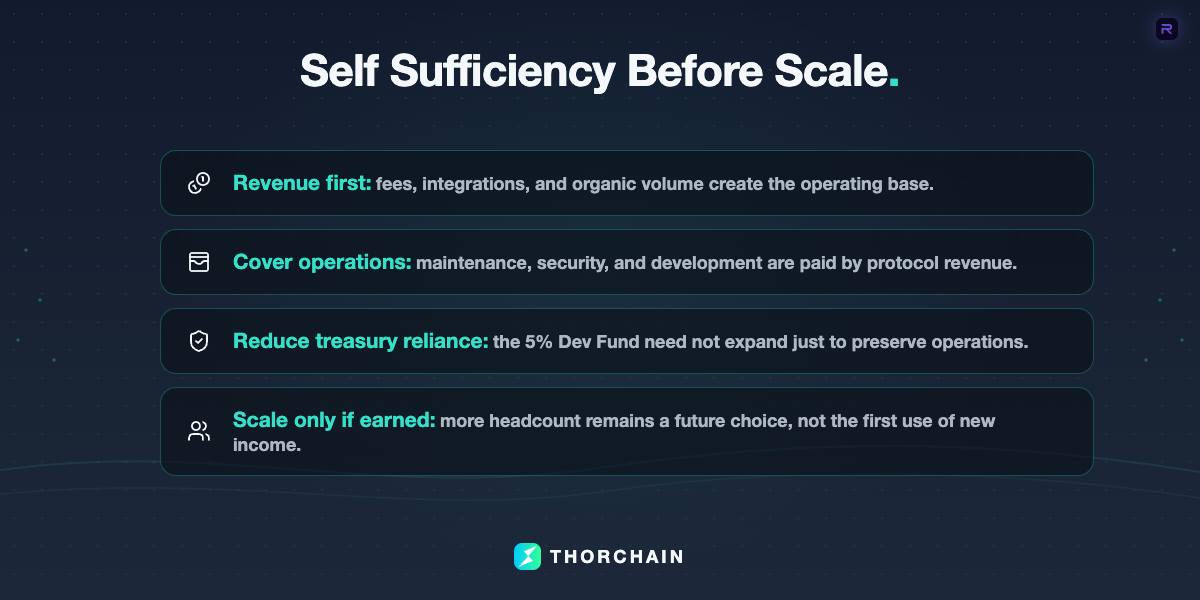
The longest strategic discussion was not about a new feature. It was about what success should look like after those features begin producing revenue. Chad said THORChain was operating at a monthly shortfall of roughly $100,000 to $200,000, covered by the treasury. Increasing the Dev Fund from 5% to 10% would reduce that reliance, but he did not see it as a reason to immediately hire more developers.
Instead, the stated objective is for protocol revenue to cover the people and services that keep THORChain operating. In that model, an oversolvency sweep, new integration revenue, and higher organic swap activity would first reduce the treasury's operating burden. Only then would the community face a stronger question about whether to spend the surplus on a larger team, reserves, or other priorities.
"I'd rather have the money become less reliant on the treasury than go ahead and hire one or two or three more devs." (Chad)
That framing also explains the team's caution on hiring. Chad said developers are already finding ways to become more productive with AI tools, while the treasury is being managed for longevity rather than the spending profile of a venture-backed startup. A larger team remains possible, but only if the economics support it without recreating the dependency the protocol is trying to leave behind.
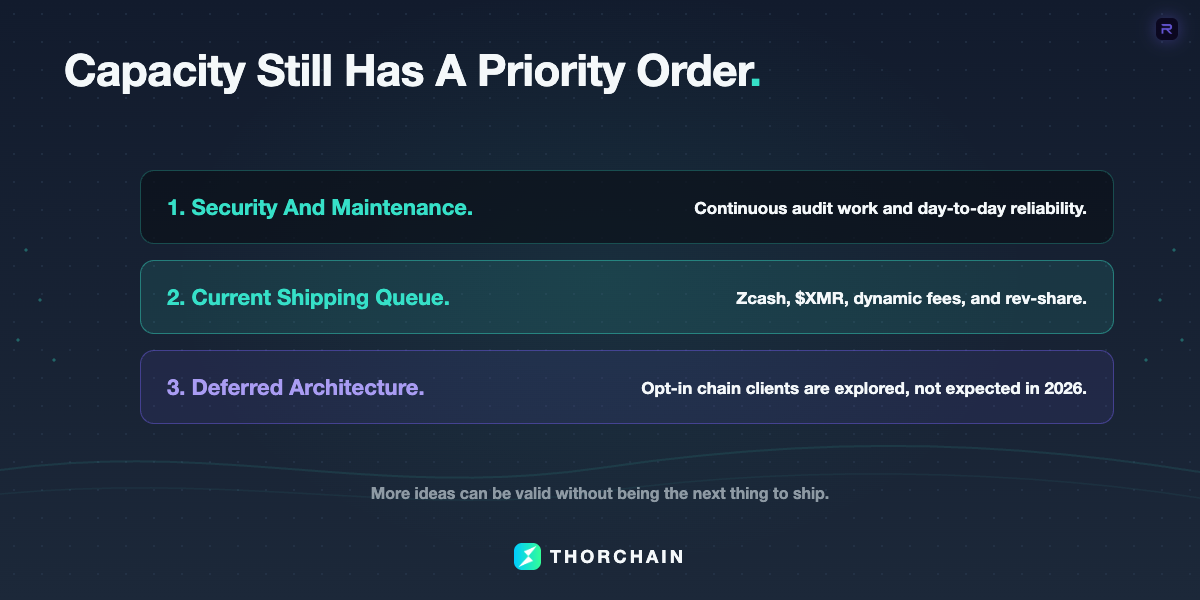
5. More Capacity Does Not Mean Every Idea Ships Now
Returning to normal operations does not mean every queued idea has the same priority. Chad described separate groups working on maintenance, new chains and features, and continuous security work. That lets the security team continue an audit and work on initiatives such as DKLS and FROST while other developers focus on integrations and day-to-day protocol reliability.
Some ideas remain intentionally deferred. An opt-in chain-client model could eventually let smaller chains be validated by a subset of nodes, making it easier to support assets that cannot justify the full validator set. Chad said the concept was actively explored, but paused in favor of higher-value work such as Zcash, $XMR, $TAO, dynamic fees, and rev-share. He did not expect it to return this year.
The same discipline applies to chain removal. When the group asked whether Gaia should be removed, Chad's answer was economic rather than ideological: a chain that brings useful volume and revenue has a reason to remain. In the future, opt-in validation could allow participation to decline naturally rather than forcing every chain question into an all-or-nothing governance decision.
"We shouldn't Ragnarok any chain when that chain is profitable." (Chad)
What to Watch
- Whether Zcash reaches mainnet cleanly, and whether the team announces the $XMR node-change window that precedes its cautious soft launch.
- The live results from Symbiosis dynamic fees, the proposed SwapKit rev-share test, and the planned Houdini integration.
- Whether new revenue sources and the oversolvency sweep reduce the treasury's operating burden before any Dev Fund change is considered.
- Whether the resumed churn continues to bring standby node operators into the active set without recreating the instability that prompted the sprint.
More THORChain data, check out raynalytics.net
Follow Raynalytics for more Weekly Analytics and Podcast recaps.

Related articles
![Ecosystem Update Podcast with Station Wallet]()
Sep. 13, 2026
Terra’s Station Wallet Is Back as Vultisig’s Agentic THORChain Wallet
- Podcast
![Protocol Update Podcast with Chad Barraford, Kenton and Patriot / Denny]()
Sep. 10, 2026
THORChain Prioritizes Stability Before Monero and New Features
- Podcast
![Ecosystem Update Podcast with RAVN]()
Sep. 5, 2026
Inside RAVN’s Native $BTC Aggregator and Its THORChain Integration
- Podcast
![Protocol Update Podcast with Hans, Devel, Chad, Kenton & Denny]()
Sep. 3, 2026
THORChain Churns Again: POL Goes Live, Rujira Resumes and BLO Debate
- Podcast
![Ecosystem Update Podcast with Rujira]()
Aug. 29, 2026
THORChain’s App Layer Rujira Is Paused. Rujira Wants a Clear Restart Path.
- Podcast
![Protocol Update Podcast with Chad Barraford, Kenton and Denny]()
Aug. 27, 2026
THORChain Puts Stability First: Monero & Zcash Delayed, ADR30, AI Agents and Memoless Swaps
- Podcast
![Ecosystem Update Podcast with Unstoppable Wallet]()
Aug. 22, 2026
Unstoppable Wallet Adds $RUNE, $TCY and $RUJI, With a Stablecoin Wallet Next
- Podcast
![Protocol Update Podcast with Chad Barraford, Kenton and Denny]()
Aug. 20, 2026
v3.20 Voting Is Underway. Should THORChain’s TSS Library Remain Open Source?
- Podcast
![Ecosystem Update Podcast with Dash]()
Aug. 15, 2026
Inside Dash’s Zcash Orchard Upgrade and Its THORChain Potential
- Podcast
![Protocol Update Podcast with Chad Barraford, Kenton, Denny and Oleg Petrov]()
Aug. 13, 2026
THORChain is Close to v3.20: FROST, DKLS, SwapKit Rev-Share and Dynamic Fees
- Podcast
![Ecosystem Update Podcast with Morpheus]()
Aug. 8, 2026
Morpheus Maps Decentralized AI, $MOR Inference and a Planned THORChain Pool
- Podcast
![Protocol Update Podcast with Hans and Pragmatic Monkey]()
Aug. 6, 2026
Rujira and THORChain Align on the App Layer: ADR31, CCL, and the Road to Perps
- Podcast
![Ecosystem Update Podcast with Depouch]()
Aug. 1, 2026
Inside depouch: Direct THORChain Swaps Built for Simplicity
- Podcast
![Monero Gets a Soft Launch as THORChain's v3.20 Enters Testing and ADR31 Passes]()
Jul. 30, 2026
Monero Gets a Soft Launch as THORChain's v3.20 Enters Testing and ADR31 Passes
- Podcast
![THORChain and Pirate Chain podcast thumbnail featuring anarchy_dot_gov, KentonC137, and Patriotsounds discussing $ARRR listing on THORChain]()
Jul. 25, 2026
Pirate Chain Wants Off Centralized Exchanges: Next Ask Is an $ARRR Pool on THORChain
- Podcast