Pirate Chain Wants Off Centralized Exchanges: Next Ask Is an $ARRR Pool on THORChain

2026-07-25 — 15 min read
- Podcast
THORChain x Pirate Chain Podcast #220 ft. anarchy_dot_gov, KentonC137 & Patriotsounds | July 25, 2026 | Watch the full episode on YouTube
By Raynalytics
TL;DR
- Pirate Chain wants $ARRR on THORChain, and the liquidity looks like the easy half. Kenton put the starting pool at $20,000 to $25,000, split evenly with $RUNE, and Daniel said his community could raise it "no problem."
- The hard half is engineering. Pirate Chain is shielded only, so its chain client cannot just reuse the Zcash work. Maya Protocol's shielded Zcash implementation is the likeliest starting point.
- The concrete outcome was a group chat between the two dev teams. Nothing is scheduled, approved, or built.
- Pirate Chain is deliberately walking away from centralized exchanges after the TradeOgre seizure, and says it will not compromise its privacy to win a listing.
- Pirate Chain never launched Zcash's Orchard pool, so it was never exposed to the Orchard inflation bug. It goes straight from Sapling to Ironwood.
Introduction
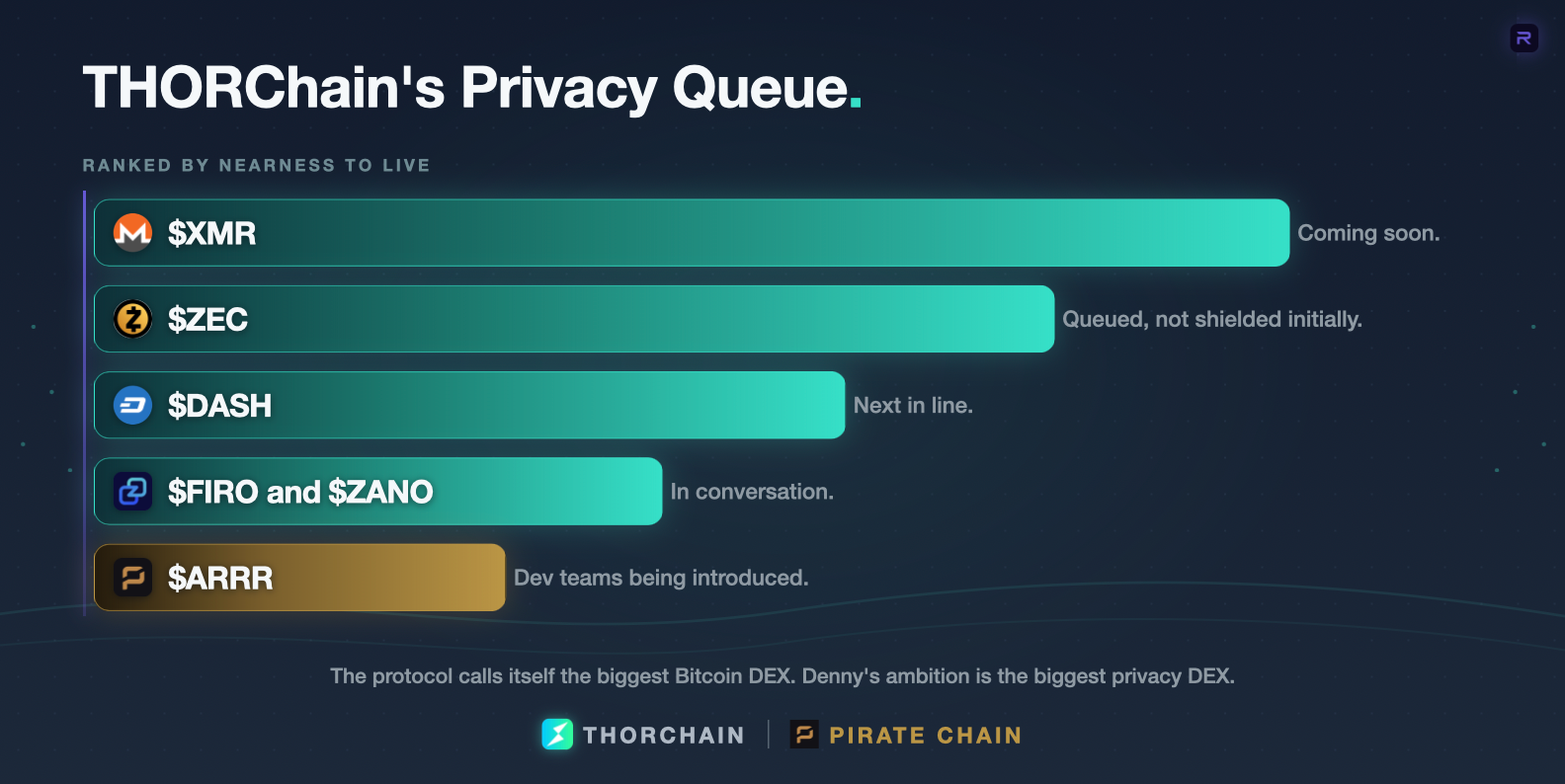
THORChain has spent the past year building toward privacy assets. $XMR live soon, $ZEC is queued, $DASH follows, and conversations with Firo and Zano are underway. On Saturday the queue picked up another name, and this one arrived ready to pay.
Daniel, a First Mate at Pirate Chain, joined Kenton and Denny to make the case for $ARRR. What followed was less a pitch than an opening negotiation: Kenton laid out what a listing costs under THORChain's new liquidity model, Daniel said his community could cover it, and both sides agreed to put their developers in one room.
1. Why Pirate Chain Wants Off Centralized Exchanges
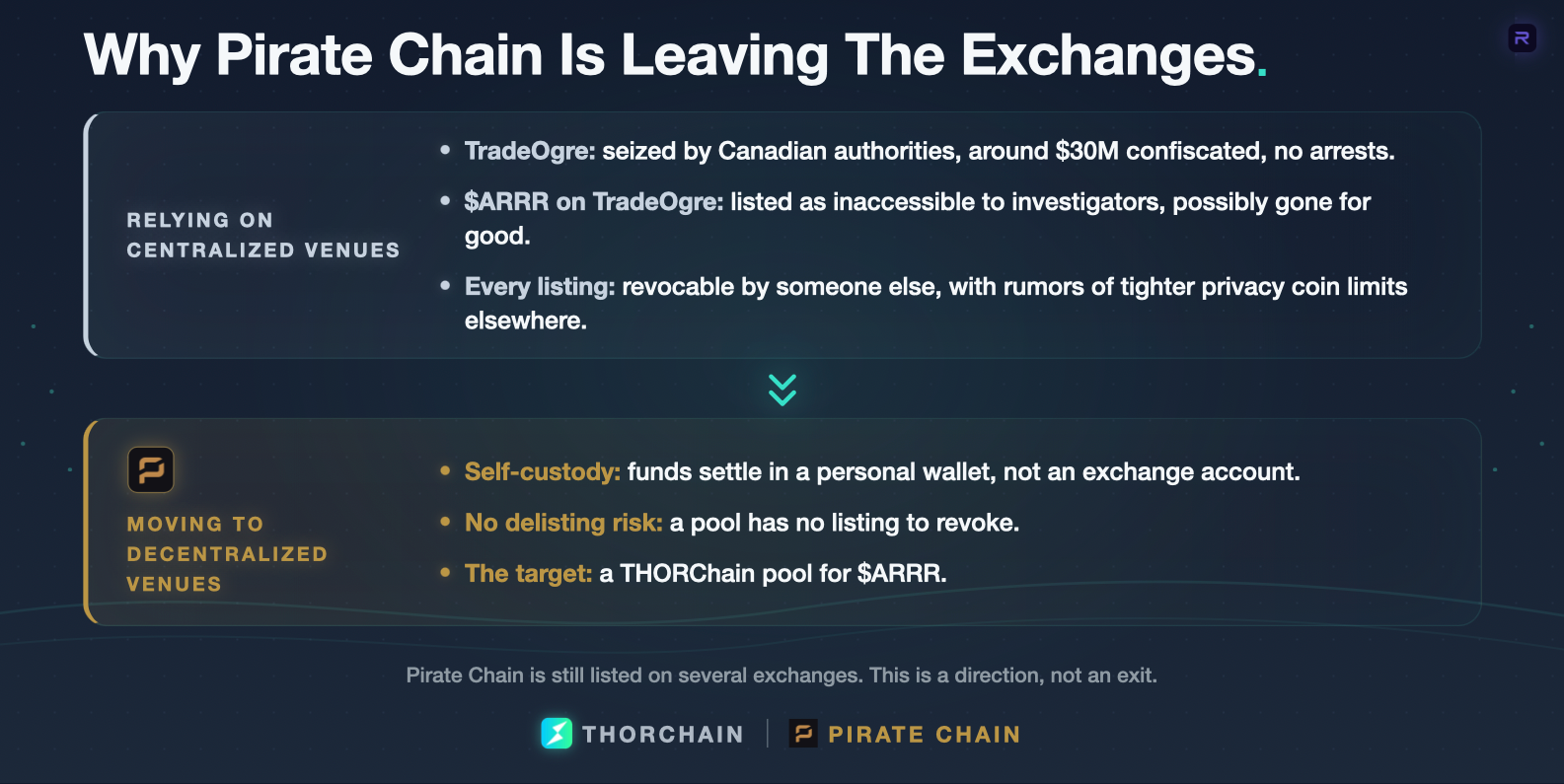
$ARRR is not short of listings. Daniel counted MEXC, CoinEx, Gate and SafeTrade, plus Komodo's atomic swap wallets and a long tail of custodial swap services. Anyone who wants the asset can find it. That is not the problem.
The problem is what happened to the venue Pirate Chain liked best. TradeOgre, at the time $ARRR's deepest market, was seized by Canadian authorities, with Denny recalling around $30M confiscated. No arrests have been made, and by Daniel's reading officials said only that they believe the operator was an American citizen who has since died. At one hearing a handful of assets were listed as inaccessible to investigators, and $ARRR was among them, so a meaningful chunk of the supply that sat there may simply be gone. There is no way to confirm it either way.
Add rumors Daniel has heard that Kraken is tightening $XMR deposit and withdrawal limits, and the strategic read writes itself. Getting a shielded chain listed is hard work, since ZK-SNARK integrations are more demanding than most, and every listing is revocable by someone else.
"We'd love to be on any of your centralized exchanges, but we're not going to beg for it. We're not going to compromise our privacy to do it." (Daniel)
So the effort is being redirected to decentralized venues. Daniel named Luke Parker's Serai and BasicSwap as projects that have mentioned adding $ARRR, without official confirmation from either, then named the one he actually wants. He also volunteered that THORChain Swap has the best interface he has used, which Denny met with "I didn't pay Daniel to say that."
2. What It Takes to Put $ARRR on THORChain
Kenton walked through the two requirements every chain faces.
The first is a chain client, and here $ARRR is harder than its cousins. THORChain's incoming $ZEC support will not be shielded initially, so that client cannot be copied across to a chain where everything is shielded by default. Denny said plainly it would take significant engineering, and floated Maya Protocol, THORChain's friendly fork, as a source, since Maya already runs shielded $ZEC and parts of that work may be forkable. He also relayed Chad Barraford's verdict on real layer 1 to layer 1 swaps generally: had Chad known how hard it would be, he probably would not have taken the task on. Daniel offered his developers, and both hosts committed to opening a group chat between the teams. Denny's framing: "We're matchmakers. We have a dating service for devs basically."
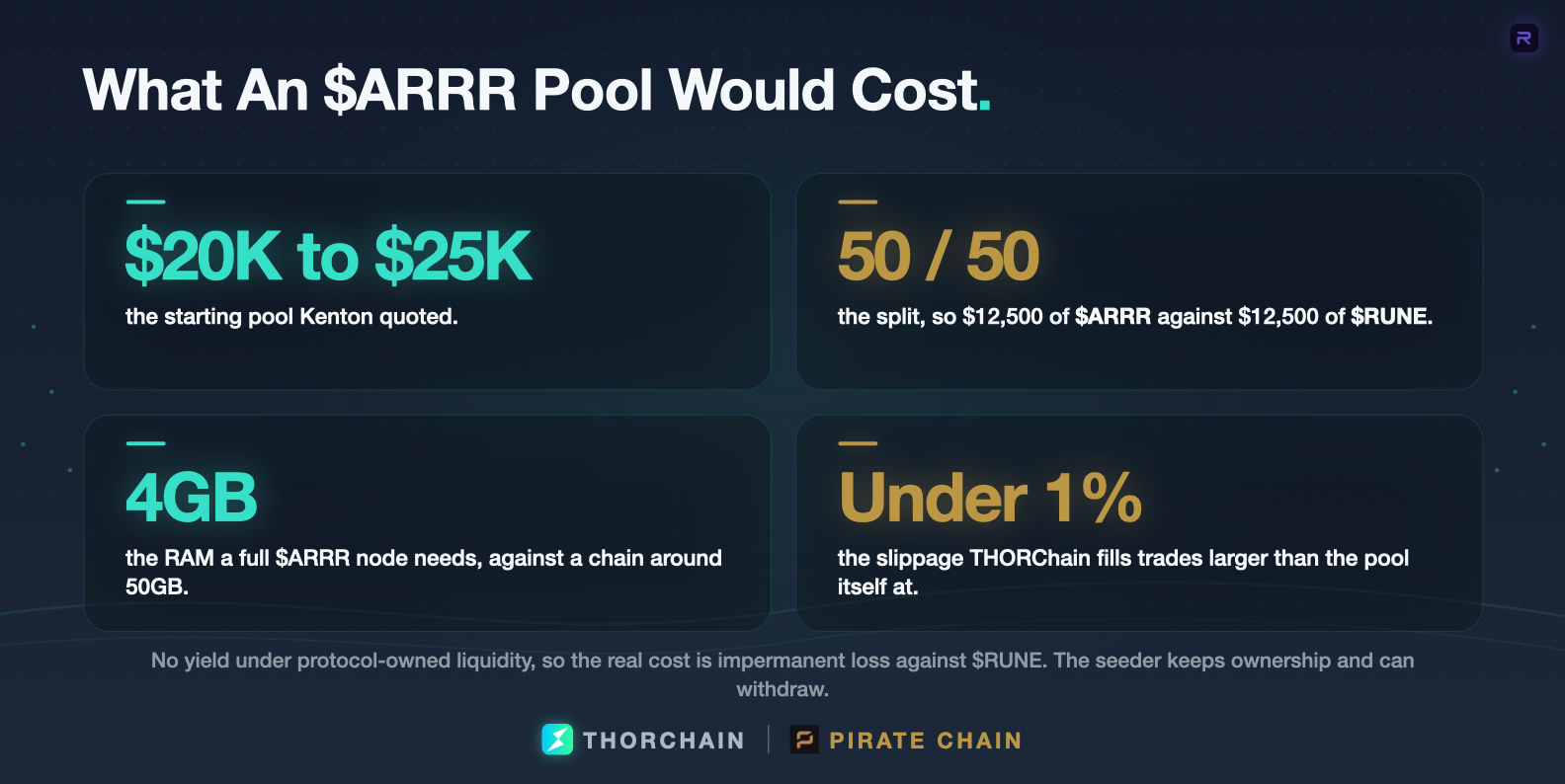
The second is liquidity. A new pool needs roughly $20,000 to $25,000 to start, split evenly, so $12,500 of $ARRR against $12,500 of $RUNE. The seeder keeps ownership and can withdraw later. There is no yield, since THORChain is moving to a protocol-owned liquidity model and pools have not paid meaningfully for months anyway, so the real cost is impermanent loss against $RUNE. Kenton added that a warning to that effect belongs on the interface, and that he needs to check it is there.
"Whatever asset we add, it's buy pressure for that asset. It's liquidity that gets bought and sold. It's never sold." (Denny)
That is the POL trade. The protocol accumulates the pool, liquidity stops being something a nervous provider can pull during a FUD event, and the seed becomes recoverable once protocol-owned depth grows past it.
Two details made the ask land. A $25,000 pool sounds thin until you hear THORChain routinely fills trades larger than the pool itself at under 1% slippage, using streaming swaps that break a trade into many small ones, with the intra-block sub-swap cap for arbitrageurs recently raised from two to three. And the infrastructure is cheap: a full $ARRR node needs about 4GB of RAM against a chain around 50GB, which matters because THORChain nodes run a full node for every chain they support. Daniel said the funding side "wouldn't be an issue at all" between the team, its whales and a community raise.
3. Meet Daniel: The Community Member Who Became the Face
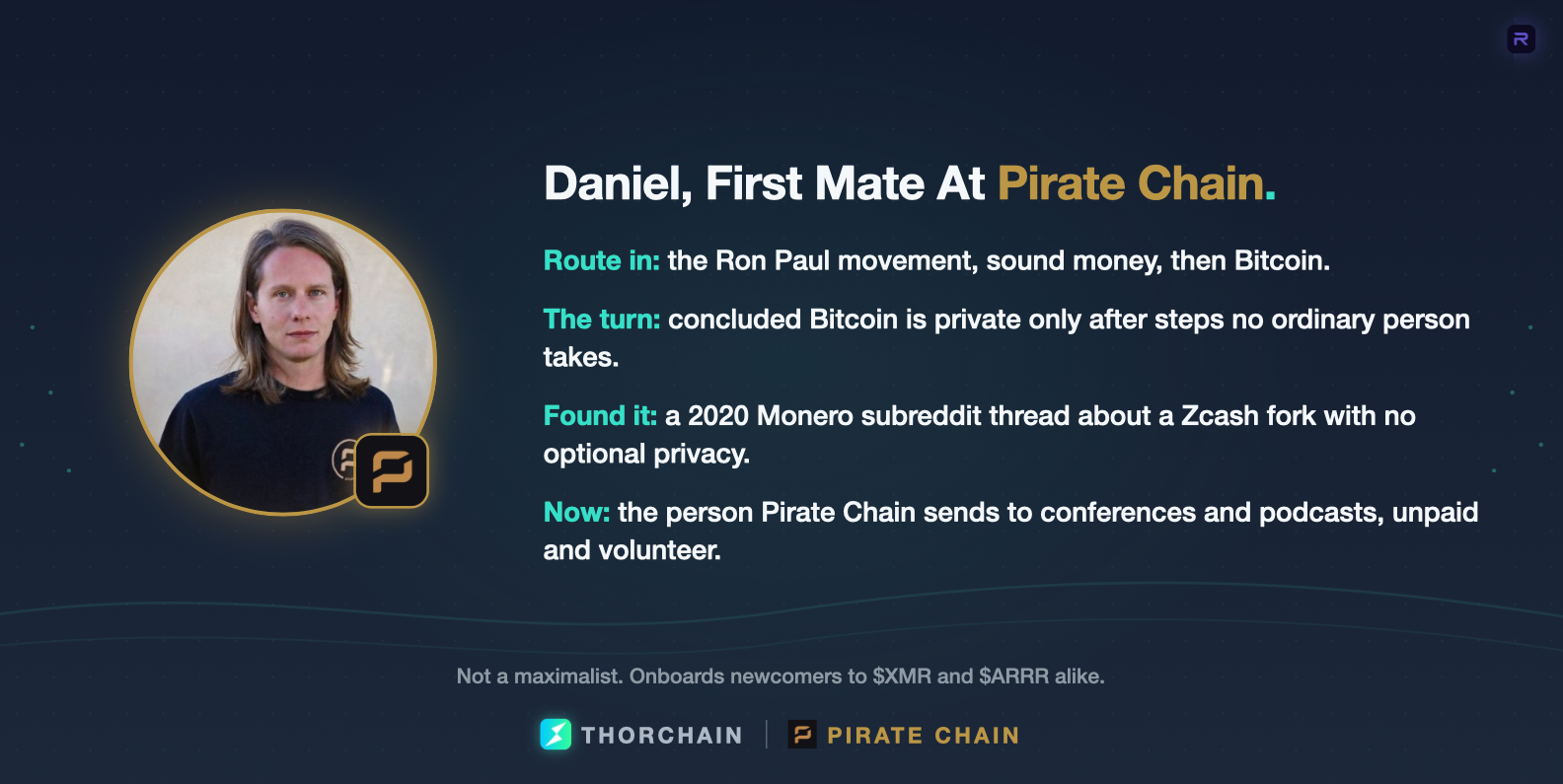
Daniel came in through the Ron Paul movement and sound money, which took him to Bitcoin early. His disillusionment was specific: he had come for private peer-to-peer cash and concluded Bitcoin is close to the opposite, private only after enough steps that no ordinary person will take them. That took him to Monero.
Pirate Chain arrived by accident. In 2020 someone in the Monero subreddit described it as Monero but more fun, so Daniel assumed it was a privacy memecoin. Months later, in a thread about Zcash, he said he wished Zcash had shielded the whole chain instead of making privacy optional. Someone replied that this is exactly what Pirate Chain is. He joined the Discord, spent two years writing blog posts, then co-presented at a Phoenix conference with a team member named Amy. The team brought him on, and he became the person they send to conferences and podcasts.
Two things sold him: shielded-by-default privacy, and the launch. No ICO, no premine, no centralized foundation. He was careful not to criticize projects that took the other path, noting how much easier his own fundraising would be with a war chest.
"There's no ICO for gold. There's nobody that votes on the characteristics of the gold in my safe." (Daniel)
He is emphatic that he is not a maximalist. He attends Monerotopia every year, onboards people onto $XMR constantly, and hands newcomers a few dollars of both assets inside Edge Wallet. Denny reached for Paul Puey's line about the ecosystem: everyone has the same goal, they are just meeting in the middle. Amy is why this episode happened at all, having met Kenton in Las Vegas and introduced the two sides.
4. The Empty Box: Why Pirate Chain Shields Everything
Daniel gave the clearest explanation of the two privacy approaches the show has aired.
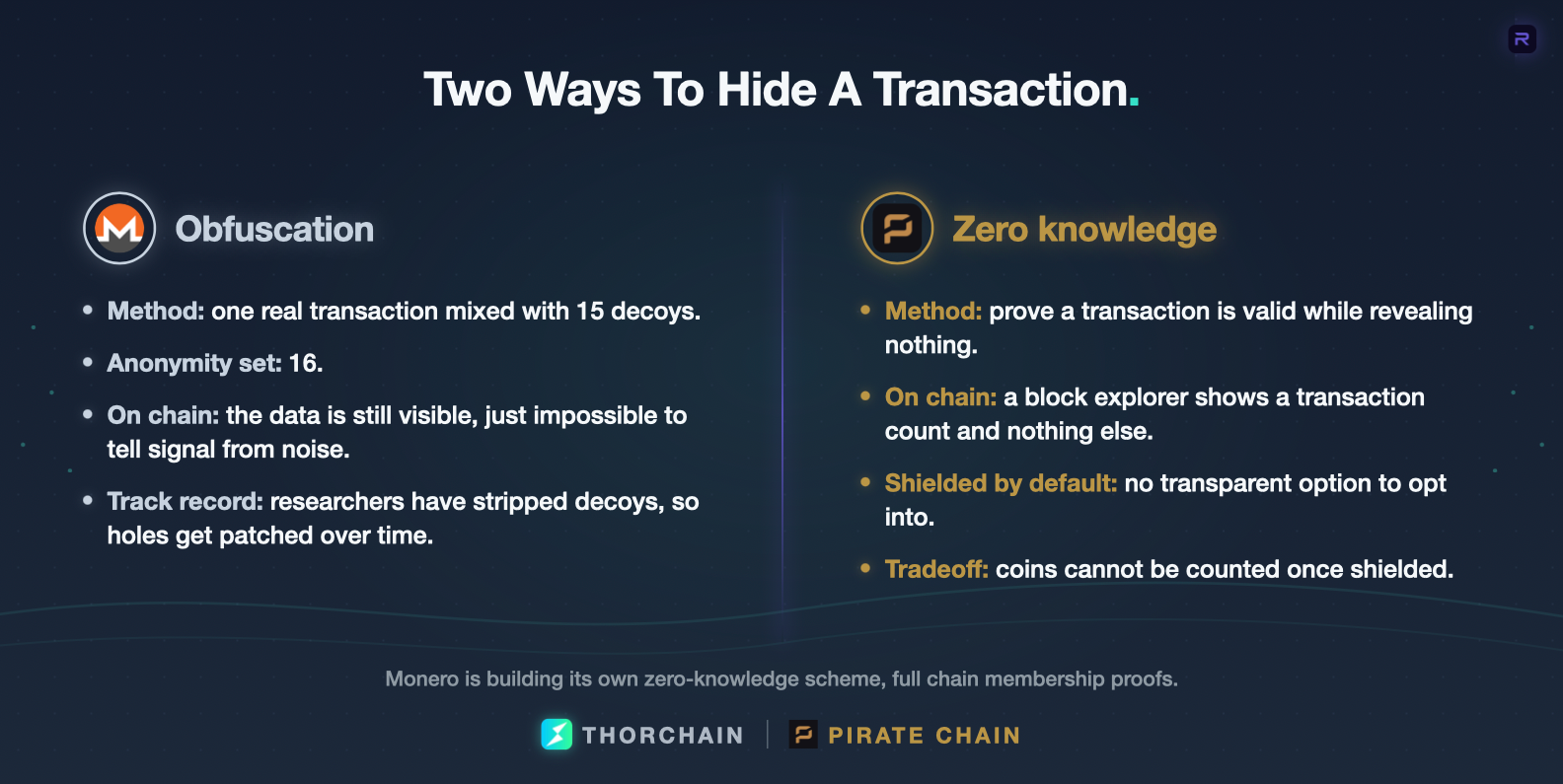
Monero obfuscates: your real transaction is mixed with 15 decoys for an anonymity set of 16, backed by network-level protections. It works well, but the data is still on chain, and over the years researchers and analytics firms have found ways to strip decoys and occasionally isolate the real transaction, which has meant a running cycle of patching. Daniel noted Monero is now building its own zero-knowledge scheme, full chain membership proofs, and he welcomes it.
Pirate Chain inherited Zcash's zero-knowledge proofs and removed the option to transact transparently. Optional privacy is the flaw, in his view: it enables timing attacks, and more practically it lets exchanges refuse shielded deposits and withdrawals, which is why so few venues let you buy or sell shielded $ZEC at all. His analogy for a proof is a Where's Waldo page covered by paper with a hole cut over Waldo's face. You can verify he knows where Waldo is without learning anything else.
"It's like showing you an empty box and saying, how do I make this box more empty? The box is already empty." (Daniel)
Pull up a Pirate Chain block explorer and you see how many transactions were in a block, and nothing else.
The honest tradeoff is supply auditability, and he did not dodge it. Coinbase transactions are transparent, so newly minted coins can be audited as they reach miners, but once coins are shielded there is no way to count them. An inflation bug would be invisible after the fact. That is the drawback of every fully private chain, and it is what the next upgrade is meant to close.
5. Ironwood, and the Bug Pirate Chain Sidestepped
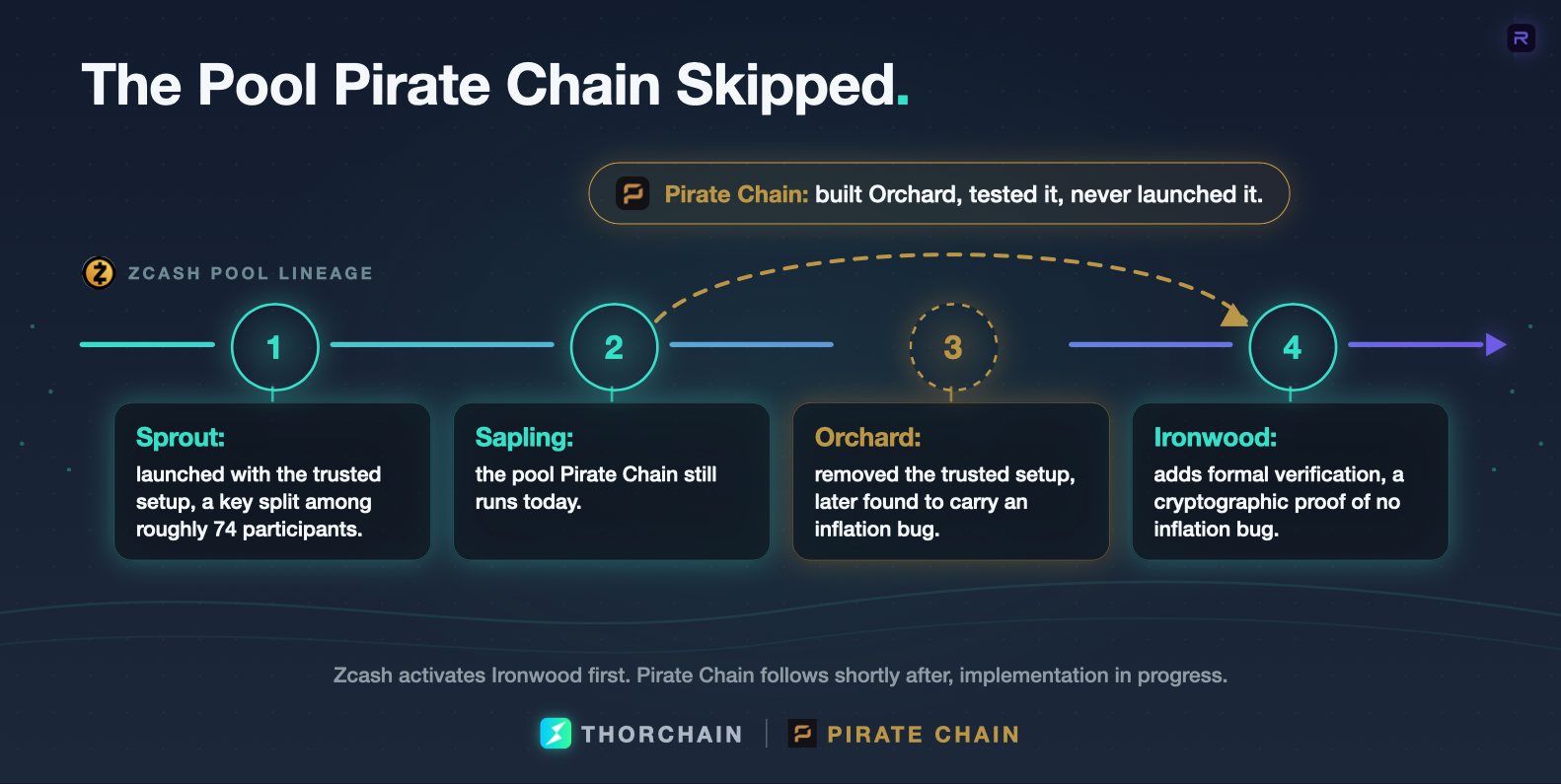
Zcash's shielded pools have gone Sprout, Sapling, Orchard, and now Ironwood, each solving a real problem.
Sprout required the trusted setup, where a private key was split among roughly 74 participants, Edward Snowden among them, who livestreamed the ceremony and destroyed their hardware afterward. Only total collusion could have compromised it. Daniel never thought that a real risk but acknowledges it was persistent FUD, and Orchard removed the requirement. Ironwood adds formal verification: a cryptographic proof that the code contains no inflation bug. It still cannot count coins, but it can prove none were counterfeited.
That matters because of Orchard. An inflation bug sat there undiscovered through multiple audits, including by the Zcash team. By Daniel's account it surfaced only when a new Claude release was run over the code, on the day that version came out, and it was patched within days. Evidence points to it never being exploited, and the turnstile migration into Ironwood, where coins pass through a transparent address on the way in, will let everyone count what is actually there.
Pirate Chain's position is close to lucky. It had finished its Orchard implementation and had it on public testnet, ready to launch, when the news broke. With Ironwood close behind, the team dropped Orchard entirely. The chain was never exposed, and it arrives at Ironwood with all the launch preparation already done. Users migrate by updating their wallet and sending funds from a Sapling address to a new Ironwood one, with no deadline and the option to move back.
6. What Ships Next: A Unified Wallet, and Life Beyond Komodo
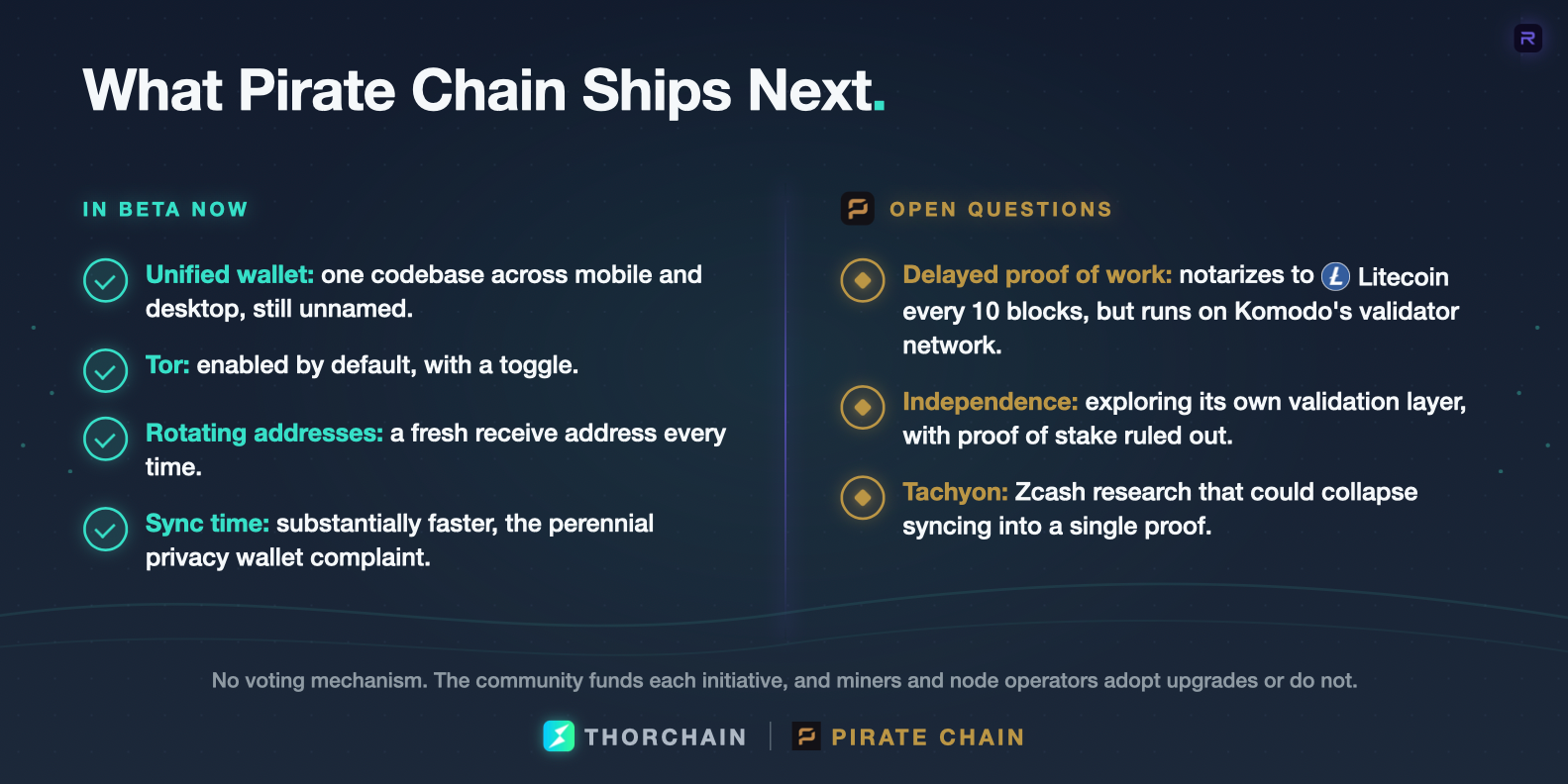
After Ironwood comes a new unified wallet, in beta at github.com/PirateNetwork and still waiting on a better name. One codebase across mobile and desktop, a rebuilt interface, Tor on by default with a toggle, and automatic rotating receive addresses.
The headline improvement is sync time, the perennial complaint about privacy wallets. A transparent chain lets a wallet look up its balance instantly; a shielded chain forces it to scan block by block and decrypt anything relevant. Daniel argued the pain is overstated for real users, since a wallet opened weekly syncs only from where it left off and a birthday height skips everything before you started. But he expects the problem to disappear rather than shrink: Zcash researchers are building Tachyon, which he described as a proof of all the proofs, collapsing the scan into a single decryption. If it works without costing privacy or decentralization, Pirate Chain will adopt it.
Security is the other open question. Pirate Chain adds a second layer on top of proof of work by notarizing to Litecoin every 10 blocks, so overpowering it would also require 51% of Litecoin's hashrate. Litecoin was chosen over Bitcoin because notarizing nodes pay a fee every 10 minutes and Bitcoin fees became uneconomic around 2022. The catch is that this runs on Komodo's validator network, and Pirate Chain would rather not tie its security to another project's fortunes. No decision has been made, and proof of stake is not on the table. Watching Qubic come close to overpowering Monero last summer sharpened the question, and Daniel sees dwindling block rewards against thin transaction fees as a problem facing every proof-of-work chain, Bitcoin included.
What gets built is not the team's call. Pirate Chain has no voting mechanism and governs like Bitcoin: propose an upgrade, publish it, and miners and node operators adopt it or do not. Funding works the same way, through community fundraisers per initiative, with viewing keys published for the $XMR and $ARRR donation addresses so anyone can audit what was raised and whether it moved. Two drives are running now at piratechain.com/crowdfunding, one of them to get listed on a privacy-coin marketplace.
"None of us are paid. I am a volunteer here. I spend my own money to contribute to this project." (Daniel)
7. Privacy, Prosecution, and Onboarding as the Real Defense
Kenton used the episode to tell THORChain's own privacy story, and it is not a straight line. Around 2022, when $XMR support was first explored, Tornado Cash developer Roman Storm was arrested and THORChain's developers were not willing to risk the same. The work was shelved, and it was not technically solved yet either. Denny added the part that changed things: most of those developers are no longer with the project.
The turning point was the Bybit hack, when roughly $1.5B in $ETH moved through THORChain four times. Some nodes wanted to censor it. The majority refused, and nothing happened to anyone. Since then Kenton reads the community, the nodes and the developers as settled, which is how a community member came to solve $XMR several months ago and why the queue now runs $ZEC, then Dash, with Firo and Zano in conversation.
Kenton still asked the honest question: does supporting every privacy coin invite the eye of Sauron? His read is that THORChain has plausible deniability because it does not obfuscate anything. An $ARRR transaction on THORChain records the same data a $BTC one does, and any shielding happens on Pirate Chain's own chain.
Daniel, careful to say he is not an attorney, thinks both projects sit safer than Samourai Wallet or Tornado Cash, where as he understands it the same people published the code and collected fees for the mixing service. Here the people writing code are not the ones collecting fees, and US courts have already held that code is speech. He would not bet on courts staying consistent, which is why his long-term answer is not legal at all.
"We need to stop this infighting and we need to onboard people to protect ourselves in the future." (Daniel)
His model is file sharing: get enough people using the technology, in enough countries, that enforcement stops being feasible. That is why merchant adoption is his personal priority, and where he would like privacy chains to pool effort on genuinely usable point-of-sale software. Denny pointed him at Moca, whose point-of-sale application entered testing recently and settles through THORChain and Maya pools, so a shopper could spend $ARRR while the merchant receives stablecoins.
His closing worry was that stablecoins are being mistaken for crypto. They are usable precisely because they are centralized, and in his view they can be frozen, burned and traced, and are backed by government debt, which makes them a Trojan horse rather than an alternative to fiat. His counter is that self-custody is easier than people believe, and easier than opening a brokerage account: download a wallet, write down the seed phrase, put it somewhere safe.
Denny closed on the THORChain half of that mission. The protocol calls itself the biggest Bitcoin DEX in the world, he said, and it should be the biggest privacy DEX too.
What to Watch
- The dev-to-dev conversation. Kenton and Denny committed to opening a group chat between THORChain and Pirate Chain developers. That is the only firm outcome; treat everything downstream as unscheduled.
- Whether the chain client can be forked. Shielded-only support is the real blocker. First question to settle: how much of Maya Protocol's shielded $ZEC work transfers across.
- The liquidity raise. $20,000 to $25,000 to start, half in $RUNE. Daniel expects the team, its whales and the community can cover it, but no campaign has been announced.
- Ironwood. Zcash activates first, Pirate Chain follows shortly after, implementation in progress now. Watch the turnstile coin count settle the Orchard question.
- THORChain's index path. Kenton is chasing inclusion in the S&P Pantera Digital Asset Index. Three criteria: coverage on Lukka (done), THORChain data on Artemis (next on his list after Token Terminal, gated on marketing budget), and a $RUNE market cap above $500M. A long-term play, since index funds eventually buy what the index holds.

More THORChain data, check out raynalytics.net
Follow Raynalytics for more Weekly Analytics and Podcast recaps.

Related articles
![Protocol Update Podcast with Chad Barraford, Kenton and Denny]()
Oct. 22, 2026
Monero on THORChain Waits on v3.21.1, SwapKit Rev-Share and 2-Second Blocktime
- Podcast
![Protocol Update Podcast with Chad Barraford, Kenton and Denny]()
Oct. 15, 2026
SwapKit Rev-Share Week One: Early Data Looks Promising, v3.21 and Monero Next
- Podcast
![Ecosystem Update Podcast with Zano]()
Oct. 10, 2026
Zano’s Recovery Plan and the Road to THORChain
- Podcast
![Protocol Update Podcast with Chad Barraford, Kenton and Patriot]()
Oct. 8, 2026
Chad's Unchained Podcast Debrief, Rev-Share and Monero
- Podcast
![Ecosystem Update Podcast with Houdini Swap]()
Oct. 3, 2026
Houdini Swap on THORChain Explained: What It Means for Users and Treasury Revenue
- Podcast
![Protocol Update Podcast with Chad Barraford, Kenton and Denny]()
Oct. 1, 2026
Can or Should THORChain Censor Transactions?
- Podcast
![Protocol Update Podcast with Chad Barraford, Kenton, Devel and Boone]()
Sep. 24, 2026
Inside the Houdini Swap Debate: THORChain’s Treasury, Privacy and Revenue
- Podcast
![Ecosystem Update Podcast with Radix]()
Sep. 19, 2026
Radix and THORChain: Building Trust for the Agentic Future
- Podcast
![THORChain Podcast protocol update cover]()
Sep. 17, 2026
THORChain Returns to Shipping: Zcash, Monero and Self-Sufficiency
- Podcast
![Ecosystem Update Podcast with Station Wallet]()
Sep. 13, 2026
Terra’s Station Wallet Is Back as Vultisig’s Agentic THORChain Wallet
- Podcast
![Protocol Update Podcast with Chad Barraford, Kenton and Patriot / Denny]()
Sep. 10, 2026
THORChain Prioritizes Stability Before Monero and New Features
- Podcast
![Ecosystem Update Podcast with RAVN]()
Sep. 5, 2026
Inside RAVN’s Native $BTC Aggregator and Its THORChain Integration
- Podcast
![Protocol Update Podcast with Hans, Devel, Chad, Kenton & Denny]()
Sep. 3, 2026
THORChain Churns Again: POL Goes Live, Rujira Resumes and BLO Debate
- Podcast
![Ecosystem Update Podcast with Rujira]()
Aug. 29, 2026
THORChain’s App Layer Rujira Is Paused. Rujira Wants a Clear Restart Path.
- Podcast
![Protocol Update Podcast with Chad Barraford, Kenton and Denny]()
Aug. 27, 2026
THORChain Puts Stability First: Monero & Zcash Delayed, ADR30, AI Agents and Memoless Swaps
- Podcast