Inside Liquidy’s $700K Treasury: Market Making, Governance and Smarter Rujira Swaps

2026-07-18 — 9 min read
- Podcast
THORChain x Liquidy Podcast #218 ft. jandevman, KentonC137 & Patriotsounds | July 18, 2026 | Watch the full episode on YouTube
By Raynalytics
TL;DR
- Liquidy turns a DAO-managed treasury into one $LQDY token, giving holders exposure to market making, staking, lending, and a Rujira swap router without managing every position themselves.
- During the episode, the treasury held roughly $700,000 outside its own token, with about 84% in large-cap assets and close to $500,000 deployed in market making. $LQDY traded near 0.7x that net asset value.
- Staked $LQDY controls the treasury through discussion, on-chain proposals, and simple-majority votes. A multisig can veto a malicious transfer but cannot move treasury funds itself.
- Liquidy’s router can split one order across several Rujira paths. In the example shown, routing part of a $USDC-to-$RUNE trade through $BTC reduced slippage enough to improve the user’s result after Liquidy’s 0.1% fee.
- The longer-term opportunity is B2B and agentic routing. Liquidy expects bots and applications to use its API, while direct access from native Layer 1 assets still has deposit and interface hurdles to solve.
Introduction
Market making usually asks users to choose ranges, watch prices, rebalance positions, and understand a stack of DeFi tools. Liquidy packages that work into a community-governed treasury. Holding and staking $LQDY gives users a share in the DAO’s assets, revenue streams, and decisions while the community manages the underlying strategies.
Builder Jandevman joined Kenton and Denny to explain how Liquidy evolved from MantaDAO, what sits inside its treasury, and why its swap router could become useful infrastructure for the Rujira app layer. The episode moved between investment-fund mechanics and routing code, but the same idea connected both: make difficult on-chain activity easier to access without hiding how it works.
1. From MantaDAO to Liquidy
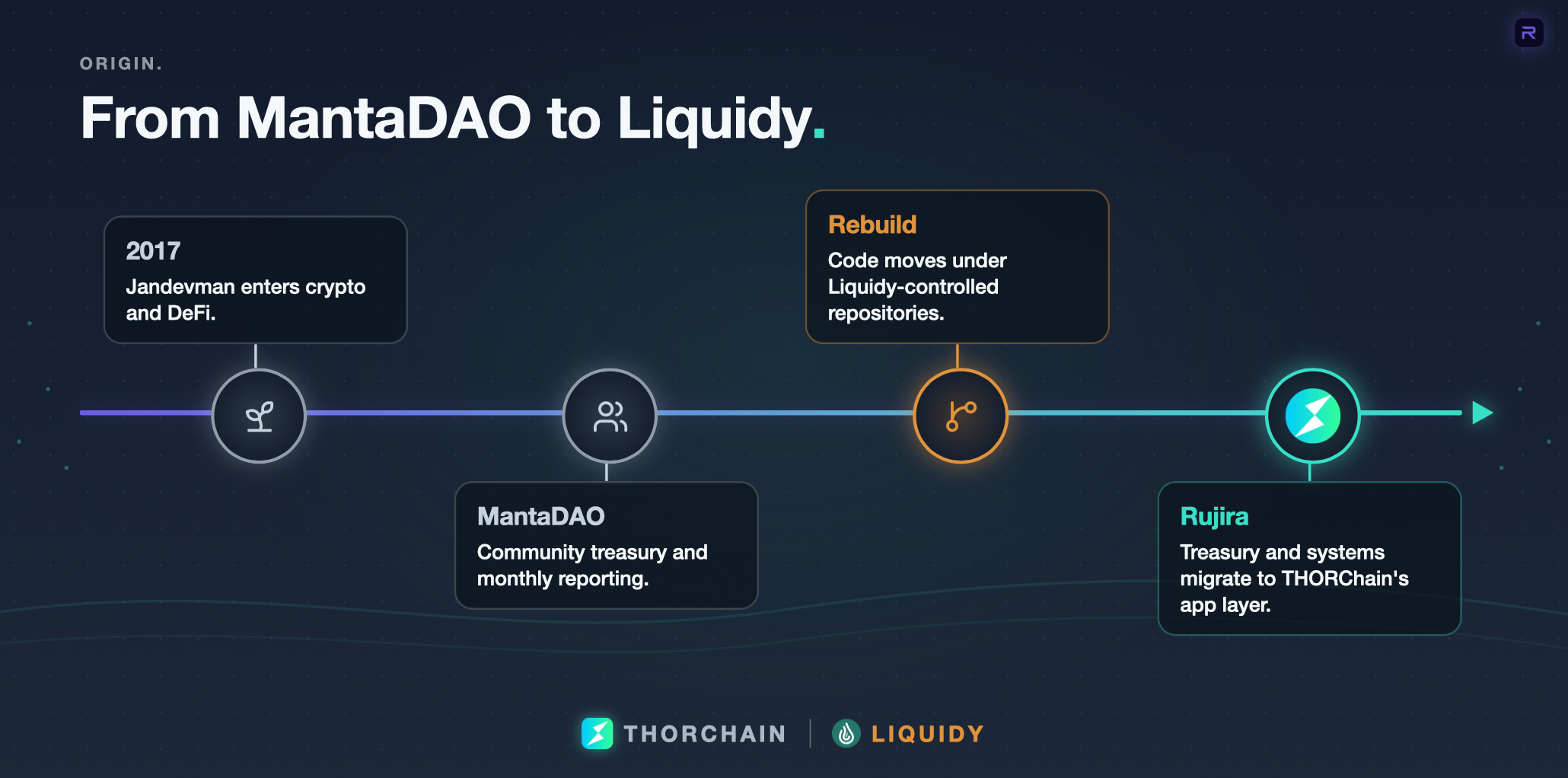
Jandevman entered crypto in 2017 and began building portfolio tools for himself after discovering that dozens of DeFi positions could not be tracked reliably in a spreadsheet. He was drawn to Kujira’s low transaction costs, readable on-chain data, and community culture.
MantaDAO was already operating as a community investment vehicle when he became involved. Monthly reports from Pragmatic Monkey helped convince him that the group wanted professional financial reporting rather than an informal token treasury. A dispute with an earlier developer then exposed a structural weakness: important code remained in private repositories controlled by one person and could not be handed over cleanly.
Jandevman rebuilt the stack under Liquidy-controlled repositories and separated writing the code from deploying it. When Kujira’s ecosystem moved toward Rujira on THORChain, MantaDAO migrated its community and treasury, rebuilt its router and market-making systems, and rebranded as Liquidy.
"The hard part is making the difficult stuff simple." (Jandevman)
Liquidy describes itself as a community rather than a conventional company. There is no permanent staff or core team managing an opaque fund. The goal is to let a passive holder gain exposure to strategies while more active members propose and evaluate what the treasury should do next.
2. One Token Controls an On-Chain Treasury
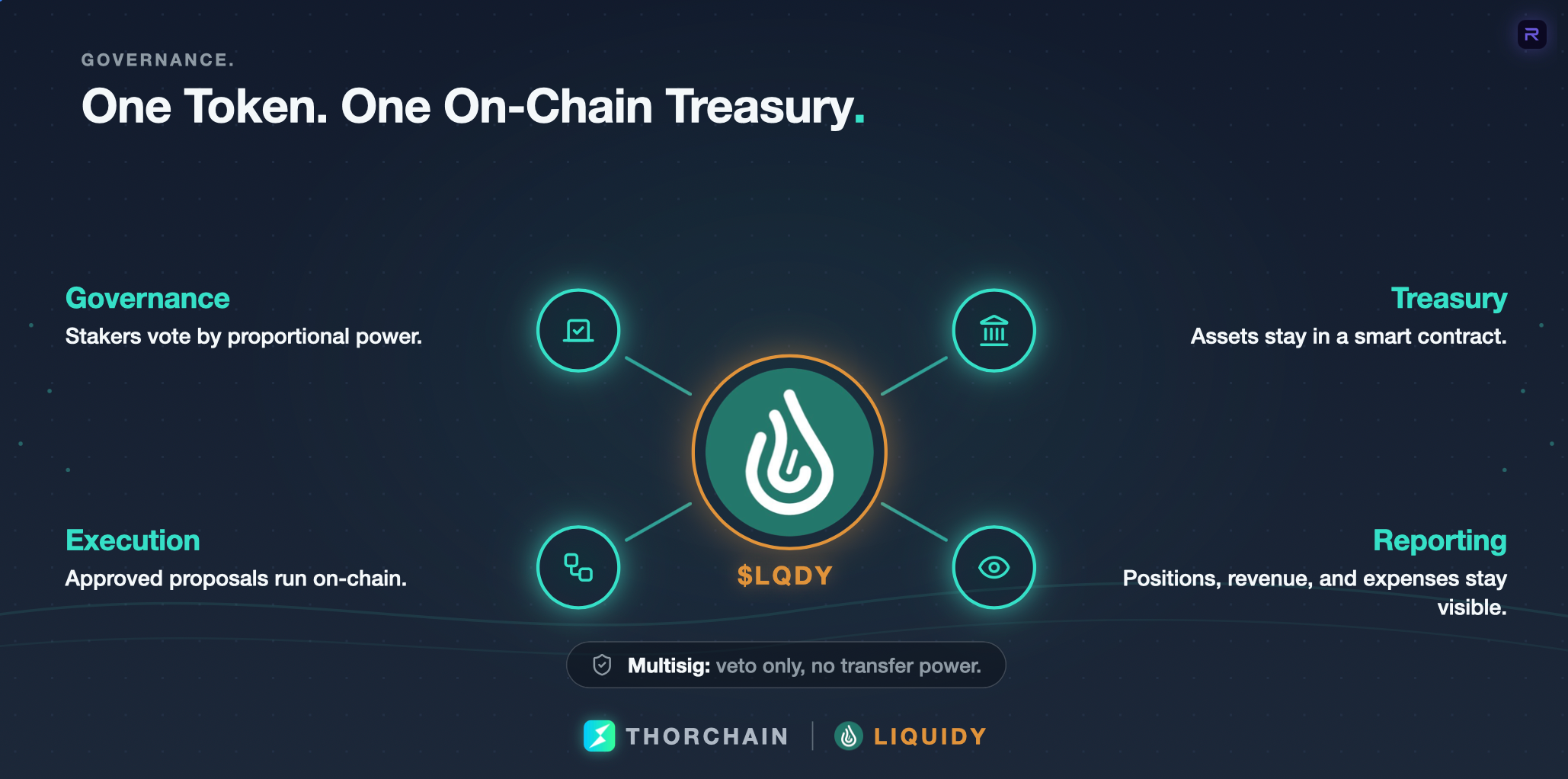
$LQDY is both the governance token and the ownership layer around the treasury. Stakers receive voting power proportional to their stake. The DAO can market make, lend, stake, acquire assets, or fund development, but each action begins with a proposal.
The usual process starts with three to seven days of community discussion, followed by an on-chain vote. Approved proposals can carry the contract actions needed to execute the decision. Liquidy’s public analytics show the wallet balances, positions, ranges, yields, revenue, expenses, and monthly financial statements so holders can evaluate those choices against the results.
"We want to do this transparently, professionally, so anyone can make a solid decision." (Jandevman)
That governance still needs defenses. A simple majority can approve ordinary proposals and could decide to wind down the DAO, liquidate the treasury, and distribute the proceeds to stakers. A separate multisig has veto power to stop a malicious proposal that tries to send the treasury to one address. The multisig cannot transfer the assets itself, which keeps it as a brake rather than a second treasury manager.
The distinction matters because $LQDY is not directly redeemable for a basket of treasury assets. Holders govern a continuing operation. They do not have an automatic conversion mechanism that forces the token price to match the value held on-chain.
3. The $700K Treasury and Its Valuation Gap
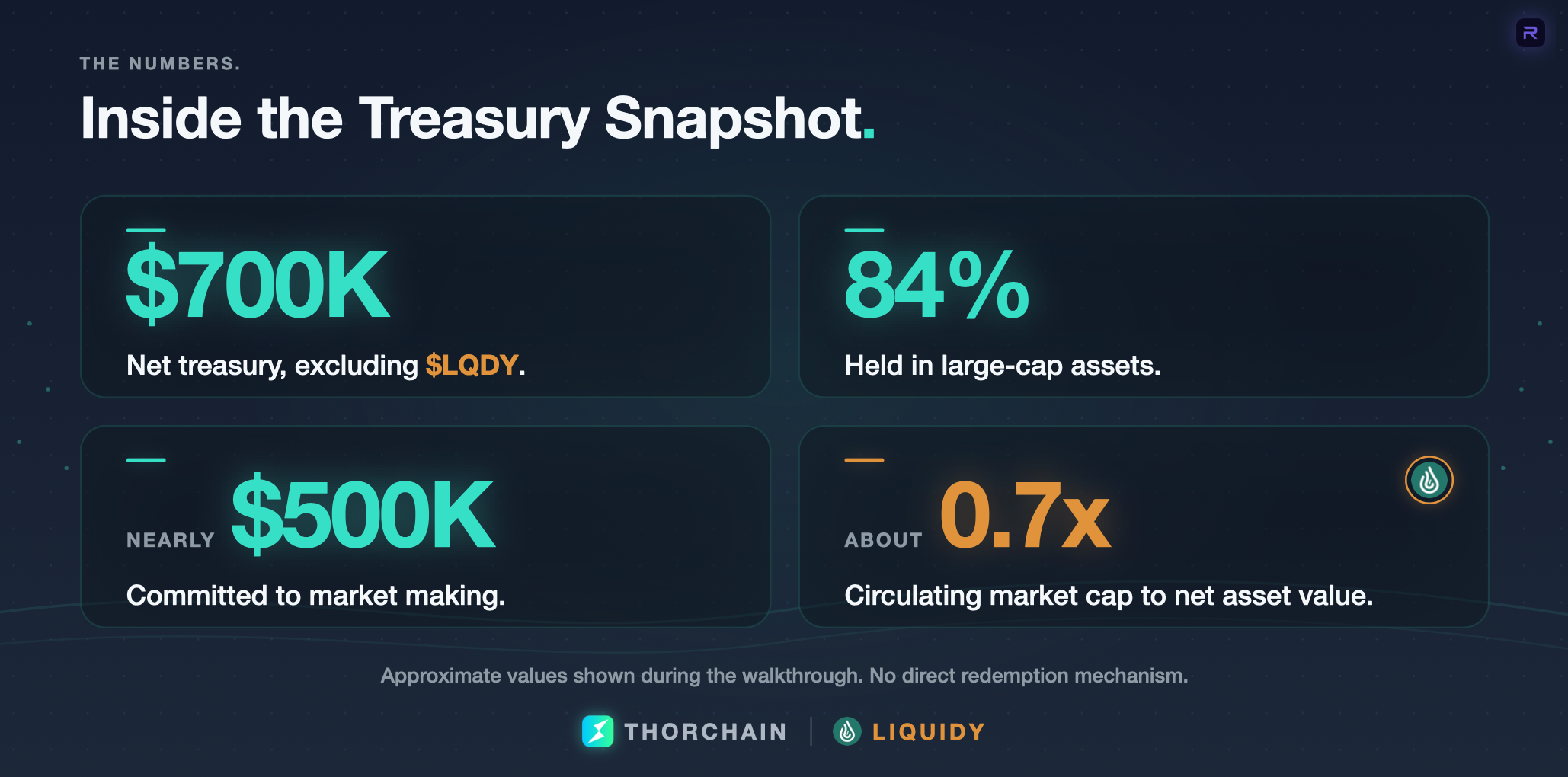
During the walkthrough, Liquidy showed roughly $700,000 of net treasury value excluding its own $LQDY holdings. About 84% sat in large-cap assets, mainly $BTC, $ETH, and $USDC. Close to $500,000 was deployed into market-making positions, with other capital in the wallet, staking, or lending.
The circulating $LQDY market capitalization was roughly $500,000. Against the $700,000 net treasury, that put the token near 0.7x mNAV. In closed-end-fund language, the market was valuing one dollar of treasury assets at about 70 cents. That does not guarantee the gap will close, especially without direct redemption.
Liquidy has several possible levers, all subject to governance. Revenue could fund buybacks while mNAV is below 1.0x. If $LQDY eventually trades above treasury value, the DAO could sell some of its non-circulating tokens through an approved deal and add the proceeds to the treasury. Neither path is automatic.
The community must also decide what to do with revenue. Current staking incentives are inflationary and recorded as a cost. Jandevman said he personally prefers reinvestment or buybacks while Liquidy is still building, but that is one voter’s view rather than settled policy.
"The more liquidity we can get on-chain, the better." (Jandevman)
More treasury capital could deepen Rujira’s books, improve execution through Liquidy’s router, and create more market-making opportunities. Existing holders still have to judge any new token sale against dilution and the price offered.
4. How the Swap Router Finds a Better Path
Rujira Trade exposes individual order books. A user moving between two assets may need several swaps, and the deepest direct pair is not always the cheapest path for the full order. Liquidy combines an off-chain routing engine with a smart contract that can execute multiple swaps in one transaction.
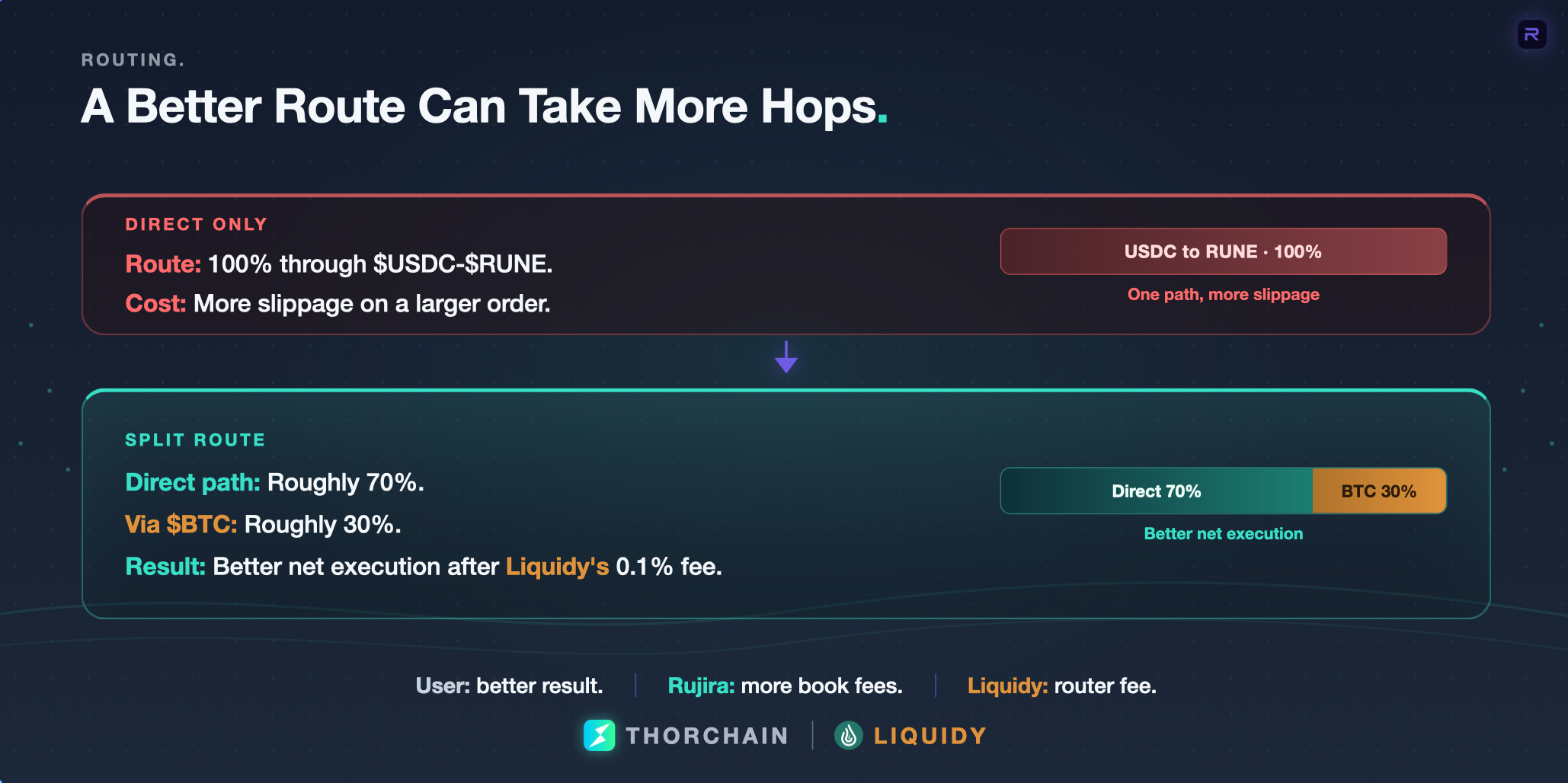
In the demonstration, a larger $USDC-to-$RUNE order was split across two paths. Roughly 70% went through the direct $USDC-$RUNE book, while 30% moved through $USDC, $BTC, and then $RUNE. Sending everything through the direct pair would have created more slippage. Splitting the order produced a better net result even after Liquidy added its 0.1% router fee.
The extra path also generated fees on more Rujira books. The user received better execution, Rujira collected multiple trading fees, and Liquidy earned its routing fee.
"We get the end user a better deal, we get more fees for Rujira, and we take a small fee for ourselves as well." (Jandevman)
The same engine can search for circular arbitrage. Earlier, while the books were less balanced, Liquidy showed paths that could turn 50 $USDC into 52 $USDC over several hops. Those specific opportunities were temporary, but the mechanism remains useful: every additional book creates another possible route, and bots can query an optimized API for imbalances.
Liquidy does not need to run every arbitrage bot itself. By supplying quotes and transaction messages through the API, it can let outside applications and bots balance the books while the router and Rujira earn fees from the activity.
5. Market Making as App-Layer Infrastructure
The router becomes more useful when the underlying order books are deeper. Liquidy therefore acts on both sides of the problem: it supplies market-making capital and builds the routing layer that searches across that liquidity.
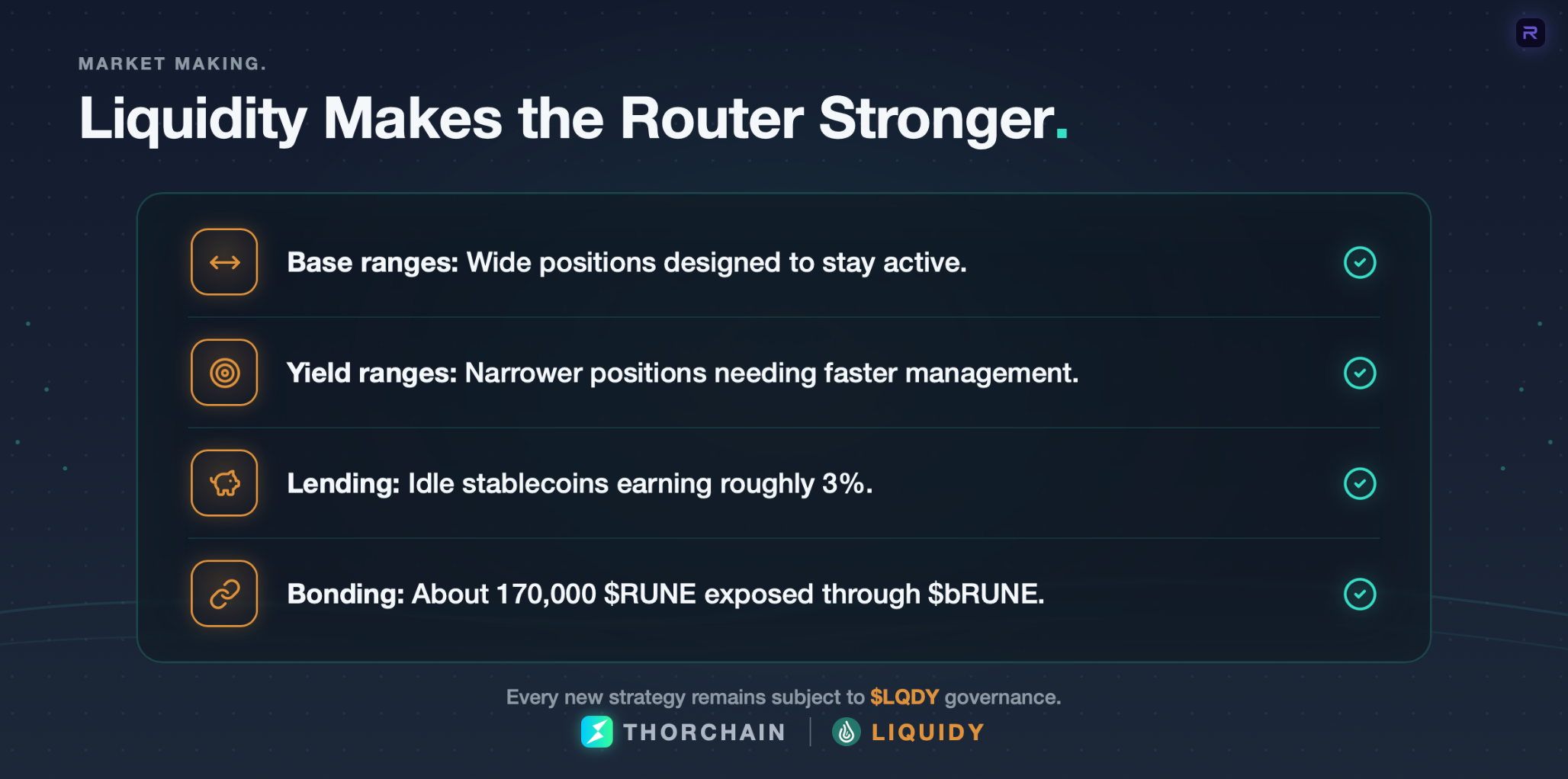
Its concentrated-liquidity positions were deliberately divided by purpose. Wide base ranges were meant to stay active through larger price moves. Narrower, yield-optimized ranges could earn more when prices remain contained, but they also require faster management because volatility can push them out of range.
That creates a governance tradeoff. A DAO is transparent but slow. Every adjustment cannot wait through several days of discussion and voting. Jandevman floated a future structure where the DAO allocates a limited amount to a multisig group that can manage narrow positions more actively. It was an operating idea, not an approved program.
Liquidy was already using other Rujira primitives. Idle stablecoins were earning roughly 3% through lending, while about 170,000 $RUNE was bonded through $bRUNE. Future assets and applications could add more strategies, but each one would require the community to evaluate risk rather than chase yield automatically.
This is the broader app-layer role Liquidy wants to fill: early user, liquidity provider, reporting layer, and feedback loop for new Rujira products. Its treasury benefits if those products work, while its activity helps make them more usable for everyone else.
6. From User Interface to B2B and Agentic Routing
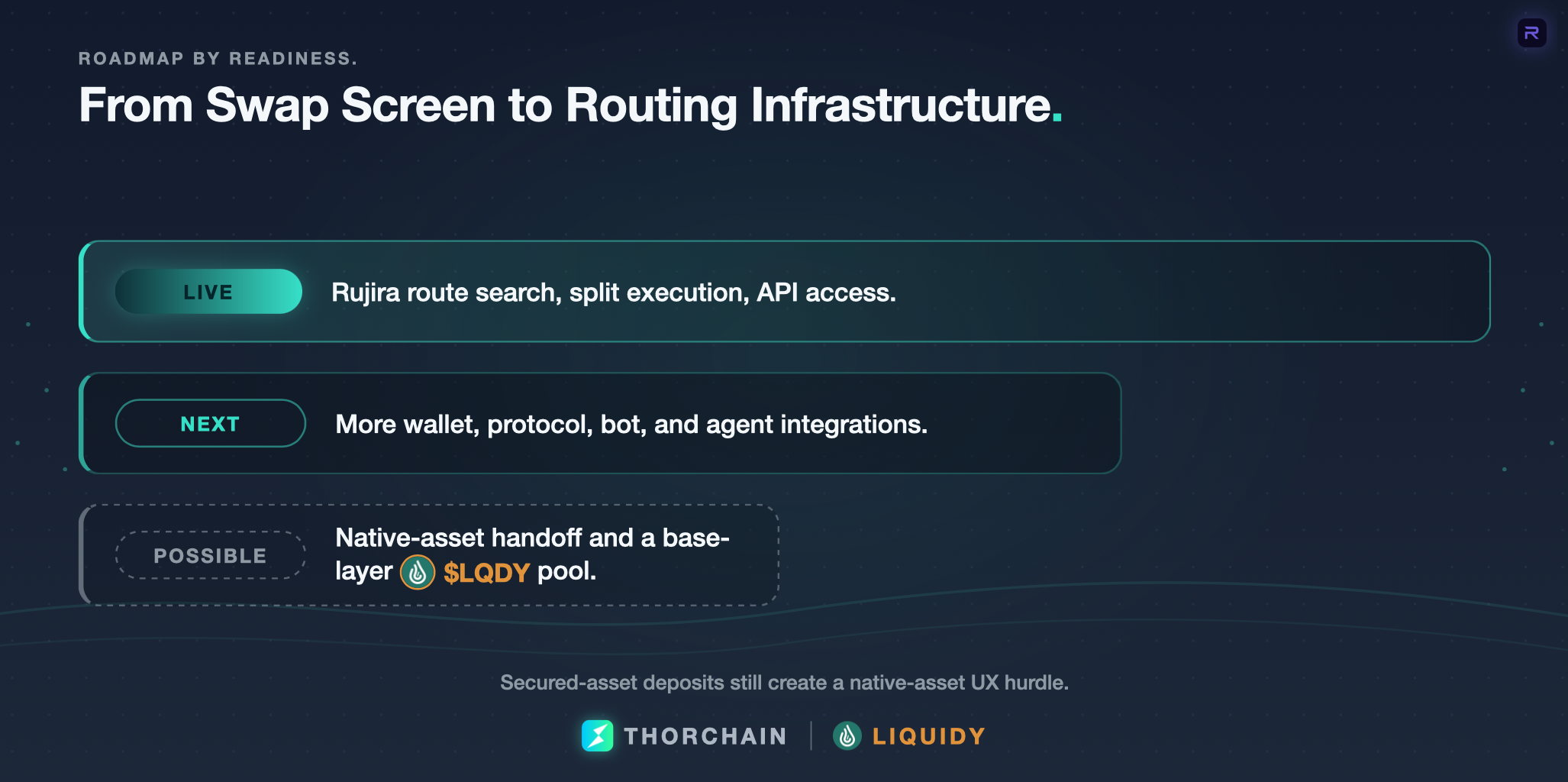
Liquidy has a swap screen, but Jandevman does not see another consumer frontend as the main destination. The larger opportunity is an API that wallets, protocols, automations, and agents can call when they need the best route between two Rujira assets.
"What is going to be trading the most is not end users. It’s going to be AI bots." (Jandevman)
That positioning avoids competing for the same users as every other swap interface. Liquidy can specialize in pathfinding and execution while partners own the customer experience. More integrations would bring more router volume, more Rujira book activity, and more fee revenue back to the DAO.
The path from native Layer 1 assets is not seamless yet. Liquidy’s router operates on secured assets inside Rujira. A user starting with native $BTC must first complete the deposit into its secured representation before the router can execute the next sequence. Jandevman said a future connection with THORChain Swap was worth investigating, but the timing and interface design remain unresolved.
A base-layer $LQDY pool could also reduce the first step for buyers, although that remains only a possibility. For now, users need a supported wallet and a secured asset on Rujira before buying or staking $LQDY.
Liquidy is early, but its two revenue engines reinforce each other. Market making creates more usable books. The router finds better paths through those books. Governance decides how the resulting fees and treasury capital return to the system.
What to Watch
- Router adoption: Whether wallets, protocols, bots, or agents integrate Liquidy’s API and turn early routing activity into sustained volume.
- Treasury performance: How market-making, staking, lending, and router revenue develop in the monthly reports.
- The valuation gap: Whether $LQDY moves closer to net asset value and whether governance approves buybacks, reinvestment, or a future token sale.
- Active management: Whether holders delegate a limited pool of capital for faster concentrated-liquidity adjustments.
- Access: Progress toward easier native-asset entry, a possible base-layer pool, or a connection with THORChain Swap.

More THORChain data, check out raynalytics.net
Follow Raynalytics for more Weekly Analytics and Podcast recaps.

Related articles
![Protocol Update Podcast with Chad Barraford, Kenton and Denny]()
Oct. 15, 2026
SwapKit Rev-Share Week One: Early Data Looks Promising, v3.21 and Monero Next
- Podcast
![Ecosystem Update Podcast with Zano]()
Oct. 10, 2026
Zano’s Recovery Plan and the Road to THORChain
- Podcast
![Protocol Update Podcast with Chad Barraford, Kenton and Patriot]()
Oct. 8, 2026
Chad's Unchained Podcast Debrief, Rev-Share and Monero
- Podcast
![Ecosystem Update Podcast with Houdini Swap]()
Oct. 3, 2026
Houdini Swap on THORChain Explained: What It Means for Users and Treasury Revenue
- Podcast
![Protocol Update Podcast with Chad Barraford, Kenton and Denny]()
Oct. 1, 2026
Can or Should THORChain Censor Transactions?
- Podcast
![Protocol Update Podcast with Chad Barraford, Kenton, Devel and Boone]()
Sep. 24, 2026
Inside the Houdini Swap Debate: THORChain’s Treasury, Privacy and Revenue
- Podcast
![Ecosystem Update Podcast with Radix]()
Sep. 19, 2026
Radix and THORChain: Building Trust for the Agentic Future
- Podcast
![THORChain Podcast protocol update cover]()
Sep. 17, 2026
THORChain Returns to Shipping: Zcash, Monero and Self-Sufficiency
- Podcast
![Ecosystem Update Podcast with Station Wallet]()
Sep. 13, 2026
Terra’s Station Wallet Is Back as Vultisig’s Agentic THORChain Wallet
- Podcast
![Protocol Update Podcast with Chad Barraford, Kenton and Patriot / Denny]()
Sep. 10, 2026
THORChain Prioritizes Stability Before Monero and New Features
- Podcast
![Ecosystem Update Podcast with RAVN]()
Sep. 5, 2026
Inside RAVN’s Native $BTC Aggregator and Its THORChain Integration
- Podcast
![Protocol Update Podcast with Hans, Devel, Chad, Kenton & Denny]()
Sep. 3, 2026
THORChain Churns Again: POL Goes Live, Rujira Resumes and BLO Debate
- Podcast
![Ecosystem Update Podcast with Rujira]()
Aug. 29, 2026
THORChain’s App Layer Rujira Is Paused. Rujira Wants a Clear Restart Path.
- Podcast
![Protocol Update Podcast with Chad Barraford, Kenton and Denny]()
Aug. 27, 2026
THORChain Puts Stability First: Monero & Zcash Delayed, ADR30, AI Agents and Memoless Swaps
- Podcast
![Ecosystem Update Podcast with Unstoppable Wallet]()
Aug. 22, 2026
Unstoppable Wallet Adds $RUNE, $TCY and $RUJI, With a Stablecoin Wallet Next
- Podcast