Houdini Swap on THORChain Explained: What It Means for Users and Treasury Revenue

2026-10-03 — 8 min read
- Podcast
THORChain x Houdini Swap Podcast #240 ft. Aaron from Houdini Swap, KentonC137 & patriotsounds | October 3, 2026 | Watch the full episode on YouTube
By Raynalytics
TL;DR
- Houdini Swap is now an optional private swap and private-send route on THORChain Swap. Aaron described it as a two-exchange route that breaks the visible on-chain link between sender and recipient, while retaining transaction screening and support.
- The integration reignited a community debate over user clarity, compliance, and whether a partner service could pull volume from native swaps. Kenton argued that the option should remain explicit and voluntary.
- Kenton’s Treasury case is that private-route revenue could help cover frontend costs and wallet integrations without adding a new fee to ordinary THORChain Swap trades.
- $XMR was still in stagenet testing. The hosts discussed a quiet, liquidity-first launch rather than promoting a pool before it can handle meaningful swaps.
- The marketing update focused on search and answer-engine optimisation, more API discovery, standardised protocol data, and reaching Bitcoin-native audiences.
For a protocol built around public, native-asset swaps, adding a privacy-focused partner route was always going to invite scrutiny. Aaron joined the show to explain how Houdini Swap works, while Kenton and Denny used the second half to address the harder question: whether an optional service can help fund distribution without confusing users about THORChain’s own guarantees.
The answer on the show was not a demand that every user choose privacy. It was a case for clear choice, honest boundaries, and measuring the Treasury thesis against real outcomes rather than projections.
1. Houdini Swap Is an Optional Private Route
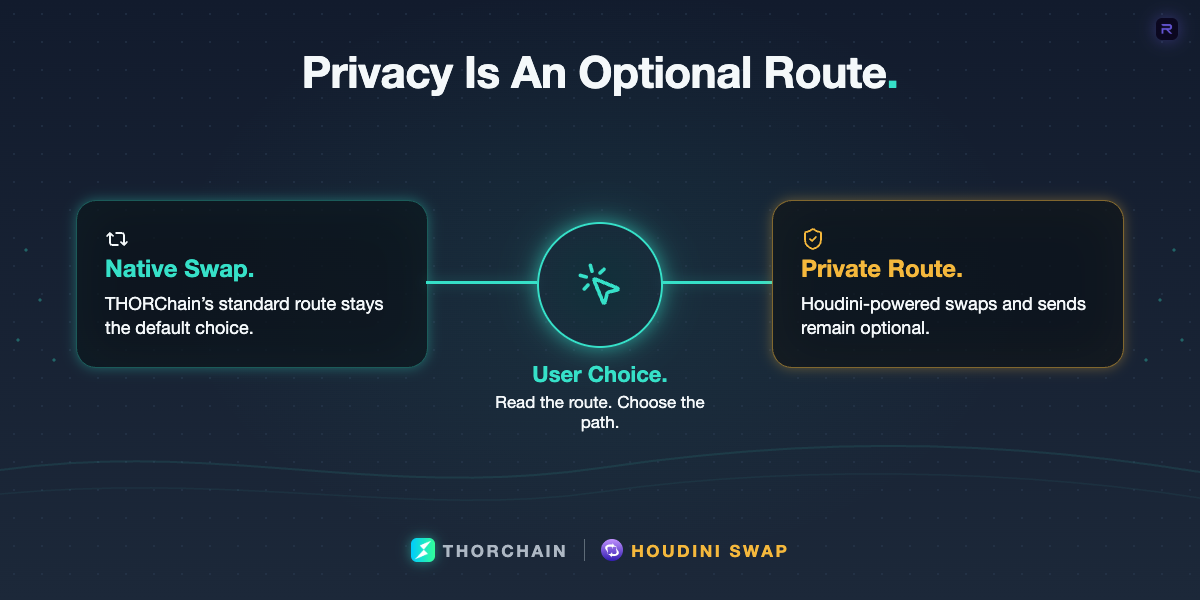
The episode returned to the topic covered in the earlier Houdini Swap debate. Aaron joined to explain what the current THORChain Swap integration is intended to do: give a user an optional private route for a swap or a send, rather than change THORChain’s native swap engine.
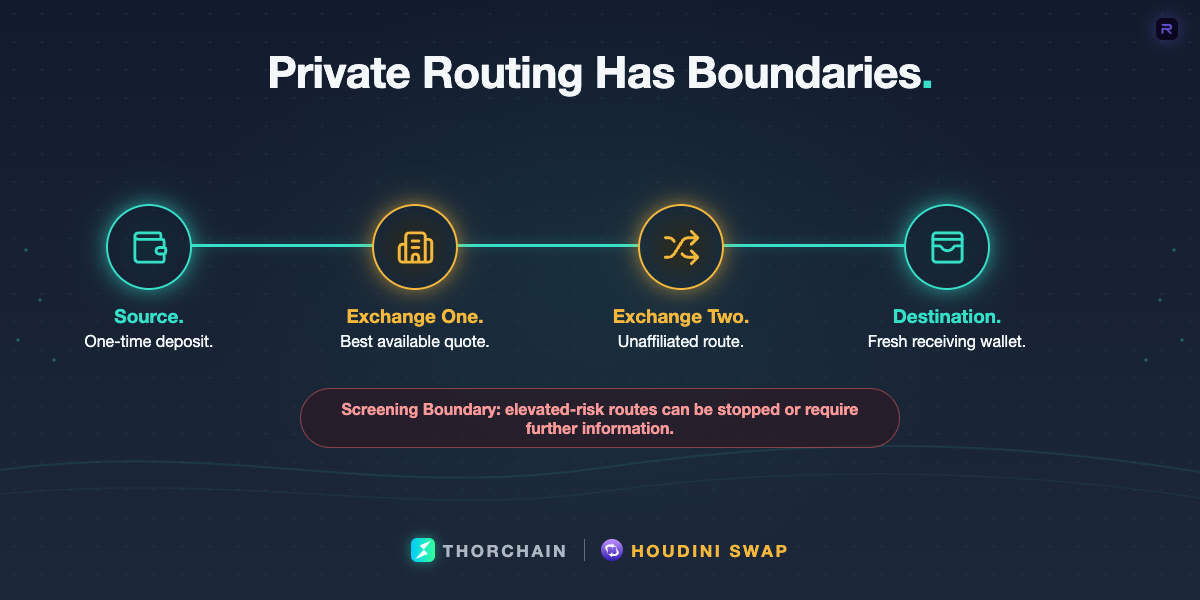
Aaron said a private route sends the deposit to a unique, one-time address from the first liquidity provider, converts through an intermediate asset, then moves to a second unaffiliated exchange partner before the final payout. In the example he gave, the route breaks the visible relationship between the source and destination wallets. He said average end-to-end execution is now roughly four to six minutes.
The distinction matters because the service is not presented as fully permissionless on-chain privacy. Houdini uses screening and geo-blocking, and Aaron said its exchange partners can require more information or hold funds only in high-risk cases. The product’s pitch is privacy optionality with operational support, not an attempt to hide those tradeoffs.
"We're not trying to claim that we are 100% permissionless." (Aaron)
Aaron also highlighted private payments and batch transactions as live Houdini features, while describing a possible multi-chain on-chain privacy product as future work rather than a shipped integration.
2. Privacy Has Boundaries, and the Team Put Them on the Table
The longest part of the guest discussion was not a sales pitch. It was a direct examination of what Houdini’s privacy model can and cannot promise. Aaron said the design routes through two non-custodial exchange partners, not a Houdini-controlled deposit account. The user temporarily gives up custody while a route executes, but Houdini itself does not hold the assets or operate a pooled mixer.
That architecture is designed to make ordinary blockchain tracing difficult, not to make the service exempt from law or its providers’ risk controls. Aaron said a transaction associated with a high-risk exploit or illicit activity can be stopped by an exchange partner and may require KYC and source-of-funds information. A lower-risk flag, such as a restricted IP address, can instead be reverted so the user receives funds back without a KYC process.
He cited 40,000 private transactions through Houdini’s Solflare integration, with six flags that he said were restricted-IP cases rather than KYC cases. The figure is Houdini’s own example, not a THORChain-wide measure, but it explained why the team frames the product as a compliance-aware privacy option.
"Houdini is not a site for criminals." (Aaron)
For a THORChain audience, the practical takeaway is simple: private routing can reduce the public link between wallets, but it is neither a guarantee against all scrutiny nor a substitute for understanding the route being selected.
3. The Controversy Is About Choice, Fees, and Who Benefits
After Aaron left, Kenton addressed the pushback directly. Some community members worried that the Private tab could be unclear, that Houdini might poach volume, or that the integration could blur the line between THORChain’s permissionless protocol and a partner’s screened service. The interface currently identifies the route as powered by Houdini Swap and requires users to accept terms before proceeding.
Kenton’s position was that calling the tab “Private” tells a new user more than “Houdini,” but he was open to an additional acknowledgement that a trade is routed through Houdini. His broader point was that crypto users still need to read what they approve. The feature is intended as an optional service, not the default path every trader must take.
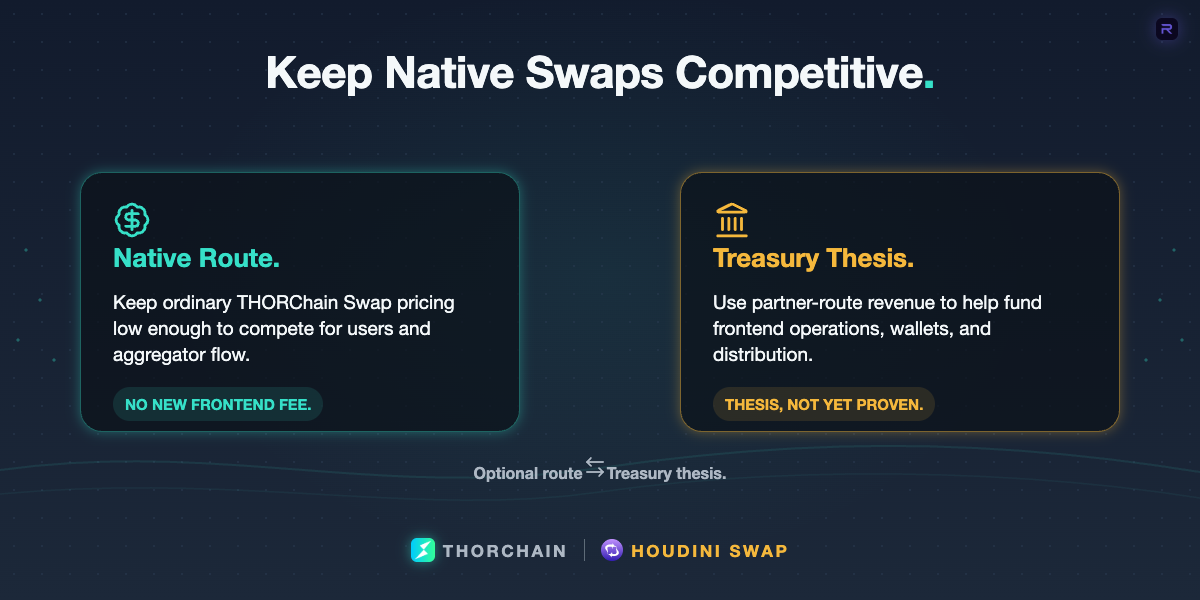
The Treasury argument is economic. Kenton said he does not want new frontend fees added to ordinary THORChain Swap trades, because price is critical when competing with centralised exchanges and aggregators. He sees potential Houdini revenue as a way to help the Treasury fund frontend operations, wallet listings, and marketing while keeping native swap pricing competitive.
"The worst thing we can do is add fees to THORChain Swap." (Kenton)
That is still a thesis, not a proven outcome. The episode did not present realised Treasury revenue from Houdini or evidence that the route has increased overall THORChain volume. It made the intended tradeoff explicit: offer a separate service to create optional revenue, while protecting the low-cost native route.
4. $XMR Needs Liquidity Before a Big Announcement
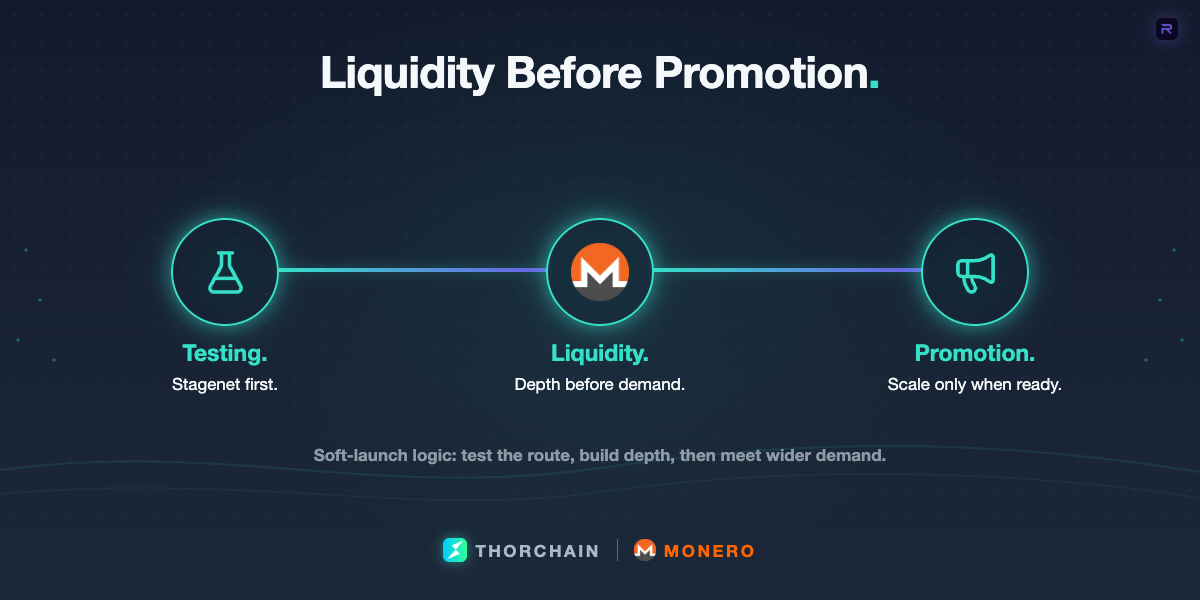
The hosts also discussed the next privacy-asset launch. $XMR was described as being tested in stagenet, with a future mainnet release expected to begin as a soft launch. That status is important: the group did not say $XMR was live on THORChain, and they repeatedly warned against treating a technical activation as a ready-for-scale product.
Their concern comes from the recent $ZEC experience. A live but shallow pool can be technically available while still being unsuitable for meaningful swaps. Kenton suggested that a $XMR pool in the region of $50,000 could be sufficient to begin promoting more widely, though he presented that as a rough judgement rather than a formal launch threshold.
"We kind of do only get one shot." (Kenton)
The proposed playbook is to let arbitrage and experienced community users expose problems first, build liquidity, then give journalists and the wider market a product that can meet initial demand. The tension is obvious: THORChain’s public development makes a completely secret launch unrealistic, but premature promotion can create the wrong first impression.
Wallet support remains part of that adoption puzzle. Kenton said Rabi and Brave Wallet were among the next THORChain Swap connection priorities, while mobile and desktop $XMR wallet behaviour makes a conventional browser-wallet flow less straightforward.
5. Marketing Is Moving From Search Rankings to AI Discovery
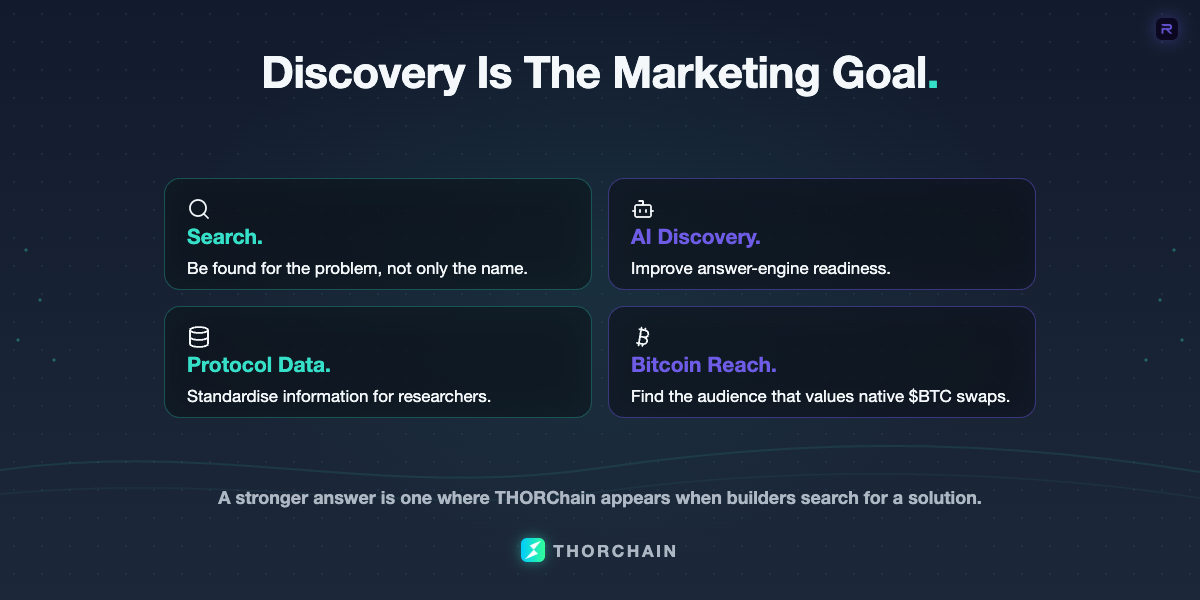
Kenton’s marketing update connected product distribution to how people increasingly find crypto infrastructure. He said THORChain’s answer-engine readiness had risen from roughly 0% to 20% at the starting point to a more consistent 70% to 90% range, while the team works on the harder final improvements.
He also said the API-key flow now receives about one or two requests a day on average, with Google and ChatGPT among the sources people report. The goal is not only to rank when someone searches THORChain by name. It is to appear when a builder searches for a solution to a cross-chain problem.
Kenton is also working with Blockworks and Forge on more standardised protocol reporting, considering paid distribution, and looking for a way into Bitcoin-native media. He named Bitcoin Magazine as a target audience because a small share of that market could matter more than a broad but unfocused campaign.
"The golden ticket [is] that we show up in results when someone's searching for a solution to their problem." (Kenton)
One immediate cleanup task is terminology. Kenton asked the community to flag stale descriptions of THORChain as a “liquidity protocol,” because those descriptions feed search and AI systems. The team has begun updating its own documentation to call THORChain what it is: a decentralised exchange.
What to Watch
- Whether users find the Private route on THORChain Swap sufficiently clear, or whether the interface adds a more explicit Houdini acknowledgement.
- Whether private-route revenue becomes material enough to support the Treasury case for frontend and wallet-expansion costs.
- Whether $XMR moves from stagenet testing to a cautious mainnet soft launch, and whether liquidity is deep enough before broad promotion.
- Whether new wallet connections reduce friction for privacy-asset users without relying on an unreliable WalletConnect flow.
- Whether THORChain’s search, AI-discovery, data-standardisation, and Bitcoin-media work produces durable builder and user demand.

More THORChain data, check out raynalytics.net
Follow Raynalytics for more Weekly Analytics and Podcast recaps.

Related articles
![Protocol Update Podcast with Chad Barraford, Kenton and Denny]()
Oct. 1, 2026
Can or Should THORChain Censor Transactions?
- Podcast
![Protocol Update Podcast with Chad Barraford, Kenton, Devel and Boone]()
Sep. 24, 2026
Inside the Houdini Swap Debate: THORChain’s Treasury, Privacy and Revenue
- Podcast
![Ecosystem Update Podcast with Radix]()
Sep. 19, 2026
Radix and THORChain: Building Trust for the Agentic Future
- Podcast
![THORChain Podcast protocol update cover]()
Sep. 17, 2026
THORChain Returns to Shipping: Zcash, Monero and Self-Sufficiency
- Podcast
![Ecosystem Update Podcast with Station Wallet]()
Sep. 13, 2026
Terra’s Station Wallet Is Back as Vultisig’s Agentic THORChain Wallet
- Podcast
![Protocol Update Podcast with Chad Barraford, Kenton and Patriot / Denny]()
Sep. 10, 2026
THORChain Prioritizes Stability Before Monero and New Features
- Podcast
![Ecosystem Update Podcast with RAVN]()
Sep. 5, 2026
Inside RAVN’s Native $BTC Aggregator and Its THORChain Integration
- Podcast
![Protocol Update Podcast with Hans, Devel, Chad, Kenton & Denny]()
Sep. 3, 2026
THORChain Churns Again: POL Goes Live, Rujira Resumes and BLO Debate
- Podcast
![Ecosystem Update Podcast with Rujira]()
Aug. 29, 2026
THORChain’s App Layer Rujira Is Paused. Rujira Wants a Clear Restart Path.
- Podcast
![Protocol Update Podcast with Chad Barraford, Kenton and Denny]()
Aug. 27, 2026
THORChain Puts Stability First: Monero & Zcash Delayed, ADR30, AI Agents and Memoless Swaps
- Podcast
![Ecosystem Update Podcast with Unstoppable Wallet]()
Aug. 22, 2026
Unstoppable Wallet Adds $RUNE, $TCY and $RUJI, With a Stablecoin Wallet Next
- Podcast
![Protocol Update Podcast with Chad Barraford, Kenton and Denny]()
Aug. 20, 2026
v3.20 Voting Is Underway. Should THORChain’s TSS Library Remain Open Source?
- Podcast
![Ecosystem Update Podcast with Dash]()
Aug. 15, 2026
Inside Dash’s Zcash Orchard Upgrade and Its THORChain Potential
- Podcast
![Protocol Update Podcast with Chad Barraford, Kenton, Denny and Oleg Petrov]()
Aug. 13, 2026
THORChain is Close to v3.20: FROST, DKLS, SwapKit Rev-Share and Dynamic Fees
- Podcast
![Ecosystem Update Podcast with Morpheus]()
Aug. 8, 2026
Morpheus Maps Decentralized AI, $MOR Inference and a Planned THORChain Pool
- Podcast