THORChain’s App Layer Rujira Is Paused. Rujira Wants a Clear Restart Path.

2026-08-29 — 7 min read
- Podcast
THORChain x Rujira Podcast #230 ft. PragmaticMonkey, KentonC137 & patriotsounds | August 29, 2026 | Watch the full episode on YouTube
By Raynalytics
TL;DR
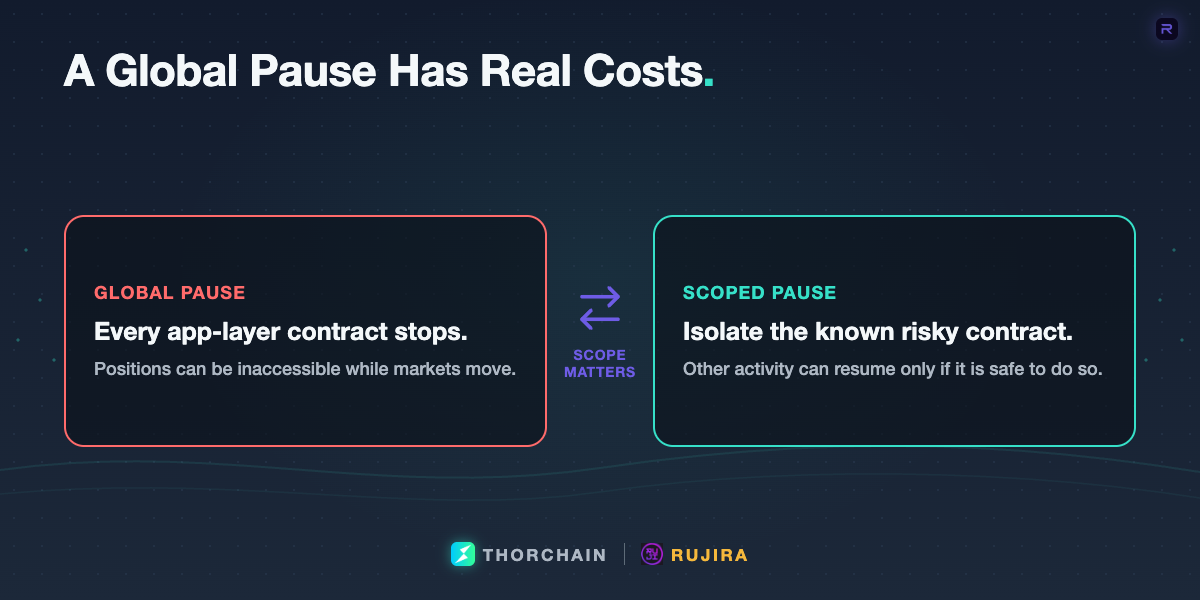
- Rujira's app layer was globally paused while THORChain's base-layer team investigates non-determinism concerns. Pragmatic Monkey argued that the known risky contract could have remained paused while other app-layer activity resumed, but Kenton stressed that the full technical picture was still emerging.
- The dispute was not only about uptime. A global pause leaves users unable to manage positions and removes the app layer from price dislocations that can generate revenue for Rujira and THORChain.
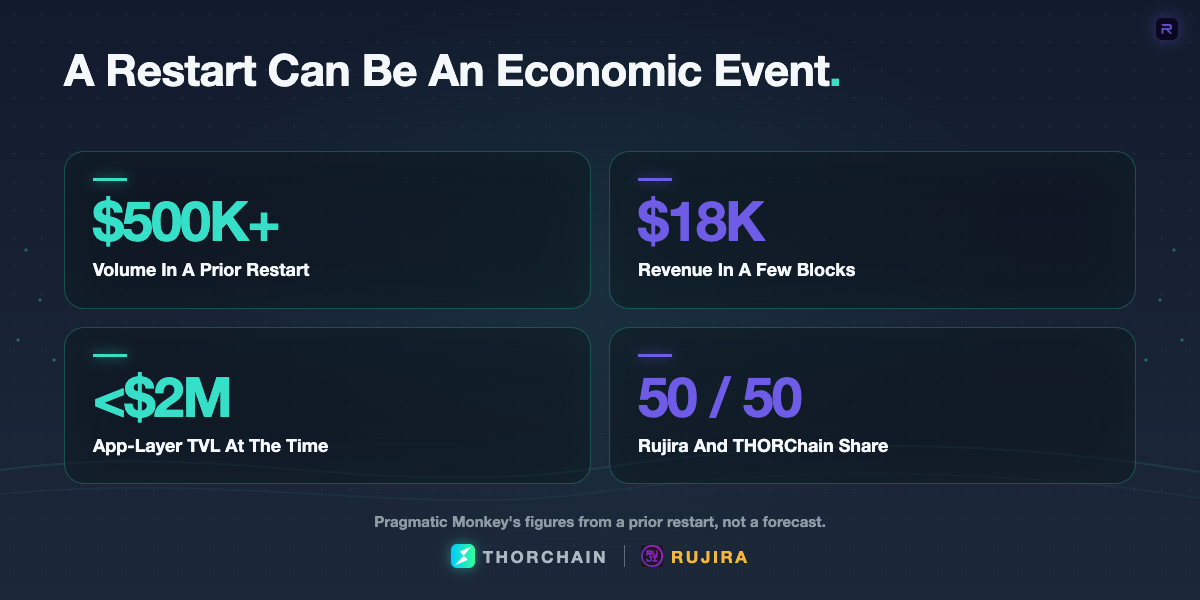
- Pragmatic Monkey said a prior restart produced more than $500,000 in volume and about $18,000 of revenue in a few blocks. Those are his internal figures from a prior event, not a forecast for the next restart.
- The episode's shared conclusion was straightforward: stability takes priority, but emergency decisions need a clearer communication and coordination process.
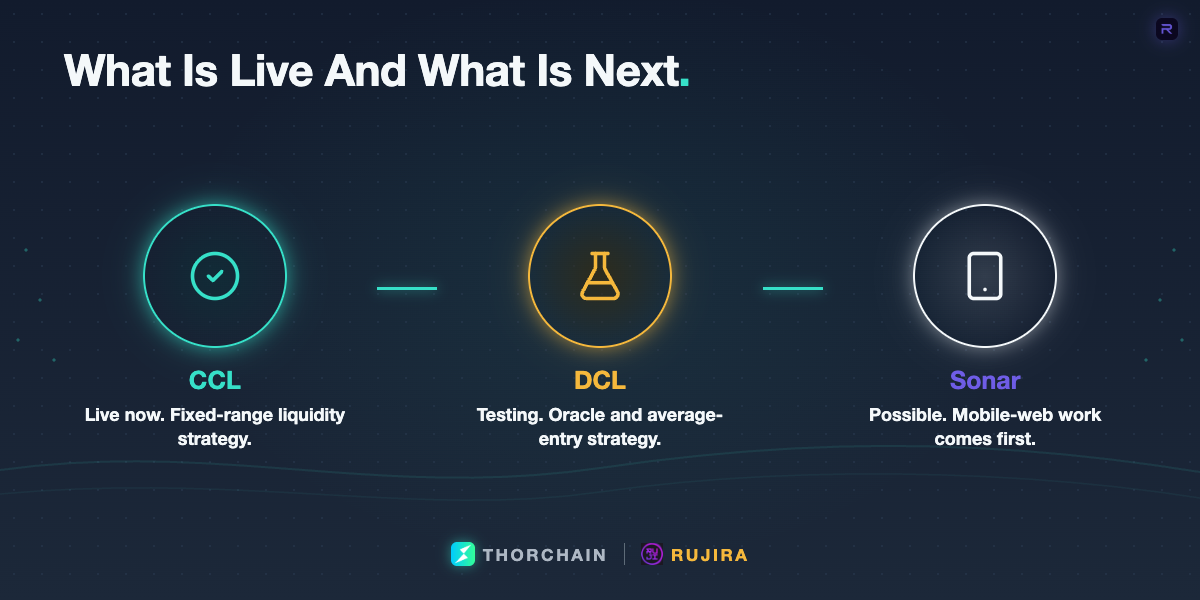
- Custom Concentrated Liquidity is live. Dynamic Concentrated Liquidity is being tested, while Sonar remains a possible future mobile product rather than a committed launch.
Introduction
Two days after THORChain's stability-first update, a separate problem came into view: Rujira's app layer was not merely slowing new work, it was globally paused.
Pragmatic Monkey joined Kenton and Denny to explain why Rujira contributors were frustrated. The immediate question was technical, but the bigger question was operational: when a decentralized network needs an emergency control, who communicates the scope, the rationale and the path back online?
1. The App Layer Is Paused While the Base Layer Stabilizes
Pragmatic Monkey said the chain had encountered several non-determinism issues, the kind that can cause nodes to disagree about the state of the network. One app-layer yield contract was the observed trigger when it was enabled. The base layer had returned after the contract was paused, he said, but the wider app layer remained halted.
His position was not that stability should be sacrificed for activity. Rujira's team supports the broader decision to slow releases and focus on making the base layer robust. The disagreement was over scope. Pragmatic Monkey said the affected contract had already been isolated successfully, so a contract-level pause could let other app-layer positions and strategies operate while the investigation continued.
"We own this system together." (Pragmatic Monkey)
Kenton did not present the case as settled. He said he did not have all the technical information and pointed to the possibility of further concerns that justified testing before a restart. That distinction matters. The episode records Rujira's argument for a narrower pause, not a confirmed finding that a global pause was unnecessary.
For users, however, the difference is tangible. A global halt can leave collateralized positions inaccessible while markets move. Current positions were described as standard CDPs rather than perps, which lowers but does not remove liquidation risk. The same control model would be much harder to defend once high-leverage products exist.
2. Decentralization Needs an Emergency Process
The episode became a live governance discussion. Pragmatic Monkey said Rujira had no warning that the full app layer would remain paused when the base layer restarted. Kenton agreed that communication needed to improve, while also resisting a judgment before the contributing developers had explained their reasoning.
"Real decentralization should not mean no coordination." (Pragmatic Monkey)
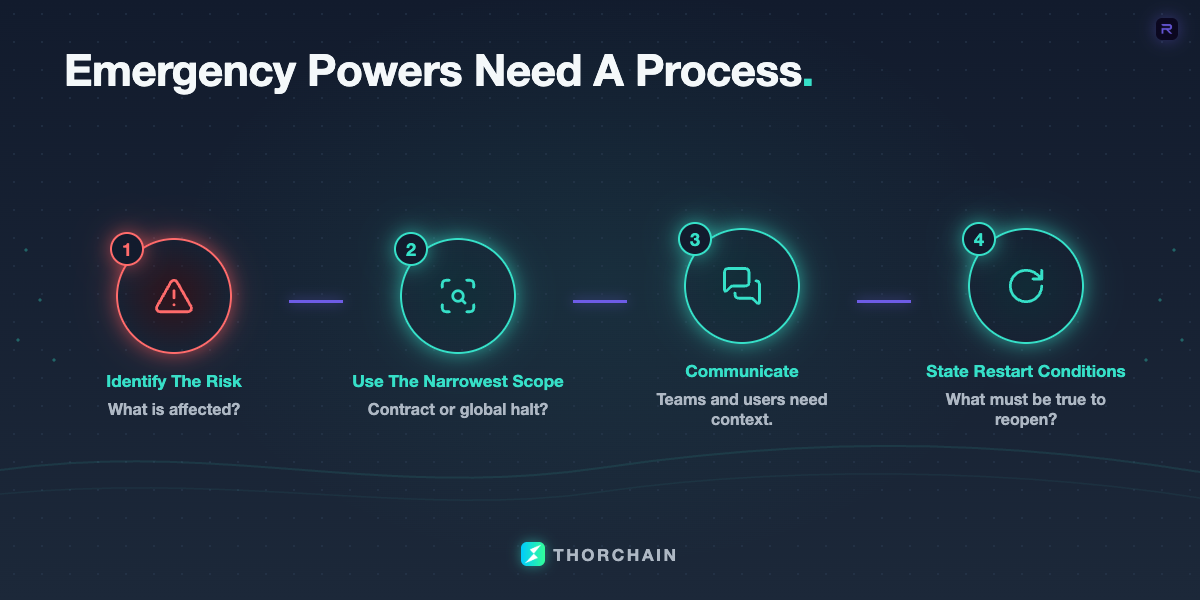
The network's ability to halt a contract or the app layer is a strength in a genuine emergency. The problem is making that power predictable for users, builders and node operators. Rujira's proposed minimum is not centralized control. It is an agreed process: identify the risk, use the narrowest safe scope, tell affected teams and users what happened, and state the conditions for reopening.
Kenton framed the tension with an emergency-brake analogy. A brake belongs on the train, but it should be pulled for an emergency, not as an ordinary operating decision. The practical follow-up is to determine whether the available evidence required a global halt and to make the next decision easier to understand in real time.
"We have to find some chain of command or some procedure or something like that that we can all agree to." (Kenton)
This is also a reminder of how THORChain governance works. Node operators can coordinate a different outcome when the necessary threshold is reached. That is decentralized control, but it does not eliminate the need for shared norms around safety-critical actions.
3. A Restart Can Be an Economic Event
The cost of the pause is not limited to unavailable positions. Rujira's architecture can capture price differences between its app-layer markets and THORChain's base-layer pools. When those markets restart out of sync, the resulting dislocations can create arbitrage opportunities that flow through the protocol instead of entirely to external traders.
Pragmatic Monkey showed a prior restart in which, he said, Rujira processed more than $500,000 of volume and generated roughly $18,000 in revenue in a few blocks. He said nearly all of that revenue came from arbitrage, despite total app-layer TVL remaining below $2 million at the time. Under Rujira's 50/50 revenue split, he estimated about $9,000 went to THORChain from that event.
"We made $18,000 of revenue in just a few blocks." (Pragmatic Monkey)
Those figures describe a prior event with its own market conditions, not an estimate for a future restart. But they explain Rujira's urgency. A wide price gap can be an opportunity to internalize value for liquidity providers and the protocol. Keeping the app layer closed means that opportunity is instead left to whatever external arbitrage can access the base-layer markets.
The same argument has limits. A restart must not be rushed merely to capture revenue. The point is that an app-layer pause changes market access and economic outcomes, so its scope and duration deserve the same transparent treatment as its security rationale.
4. CCL Is Live. DCL and Sonar Remain Work in Progress
The original plan for the show was a demonstration of Custom Concentrated Liquidity, or CCL. That product is live and lets users provide liquidity within a chosen range. A broader walkthrough is being rescheduled.
The next product, Dynamic Concentrated Liquidity, or DCL, is earlier. As covered in the Podcast #223 recap, DCL is designed to move beyond a fixed range. Pragmatic Monkey said the new strategy would use an oracle price and a user's average entry price, buying only when it lowers that average and selling above it at a target spread.
That does not make DCL live. The first contract version was only days into testing, and Pragmatic Monkey was still examining how it behaves in a sustained one-way market. A strategy that protects an average entry price can also go long periods without trading, which is good for capital preservation but less useful for steady market making and protocol volume.
"More stability, more robustness, and then we can move on to actually try to continue building the cool apps." (Pragmatic Monkey)
The group also discussed Sonar, a future Rujira mobile product. It is not an active release. Rujira's immediate priority is improving its web and mobile-web experience, while a rebuilt mobile app remains a possibility when capacity permits.
What to Watch
- The app-layer restart: what the base-layer and Maya teams conclude about broader non-determinism risk, and whether the app layer can return with the affected contract still paused.
- Emergency coordination: whether contributors establish a clearer process for scoped halts, communication and restart conditions.
- User-position safeguards: how the pause model evolves before higher-risk products such as perps are introduced.
- Restart economics: whether a future synchronized restart again creates internalized arbitrage revenue, and how that value is distributed.
- DCL testing: whether the strategy can balance average-entry protection with enough activity to be useful for market making.
- Sonar: whether mobile-web improvements lead to a formal plan for a Rujira mobile app.

More THORChain data, check out raynalytics.net
Follow Raynalytics for more Weekly Analytics and Podcast recaps.

Related articles
![Ecosystem Update Podcast with Zano]()
Oct. 10, 2026
Zano’s Recovery Plan and the Road to THORChain
- Podcast
![Protocol Update Podcast with Chad Barraford, Kenton and Patriot]()
Oct. 8, 2026
Chad's Unchained Podcast Debrief, Rev-Share and Monero
- Podcast
![Ecosystem Update Podcast with Houdini Swap]()
Oct. 3, 2026
Houdini Swap on THORChain Explained: What It Means for Users and Treasury Revenue
- Podcast
![Protocol Update Podcast with Chad Barraford, Kenton and Denny]()
Oct. 1, 2026
Can or Should THORChain Censor Transactions?
- Podcast
![Protocol Update Podcast with Chad Barraford, Kenton, Devel and Boone]()
Sep. 24, 2026
Inside the Houdini Swap Debate: THORChain’s Treasury, Privacy and Revenue
- Podcast
![Ecosystem Update Podcast with Radix]()
Sep. 19, 2026
Radix and THORChain: Building Trust for the Agentic Future
- Podcast
![THORChain Podcast protocol update cover]()
Sep. 17, 2026
THORChain Returns to Shipping: Zcash, Monero and Self-Sufficiency
- Podcast
![Ecosystem Update Podcast with Station Wallet]()
Sep. 13, 2026
Terra’s Station Wallet Is Back as Vultisig’s Agentic THORChain Wallet
- Podcast
![Protocol Update Podcast with Chad Barraford, Kenton and Patriot / Denny]()
Sep. 10, 2026
THORChain Prioritizes Stability Before Monero and New Features
- Podcast
![Ecosystem Update Podcast with RAVN]()
Sep. 5, 2026
Inside RAVN’s Native $BTC Aggregator and Its THORChain Integration
- Podcast
![Protocol Update Podcast with Hans, Devel, Chad, Kenton & Denny]()
Sep. 3, 2026
THORChain Churns Again: POL Goes Live, Rujira Resumes and BLO Debate
- Podcast
![Protocol Update Podcast with Chad Barraford, Kenton and Denny]()
Aug. 27, 2026
THORChain Puts Stability First: Monero & Zcash Delayed, ADR30, AI Agents and Memoless Swaps
- Podcast
![Ecosystem Update Podcast with Unstoppable Wallet]()
Aug. 22, 2026
Unstoppable Wallet Adds $RUNE, $TCY and $RUJI, With a Stablecoin Wallet Next
- Podcast
![Protocol Update Podcast with Chad Barraford, Kenton and Denny]()
Aug. 20, 2026
v3.20 Voting Is Underway. Should THORChain’s TSS Library Remain Open Source?
- Podcast
![Ecosystem Update Podcast with Dash]()
Aug. 15, 2026
Inside Dash’s Zcash Orchard Upgrade and Its THORChain Potential
- Podcast