THORChain Is Back: Monero Nears Mainnet, and POL Takes Center Stage
2026-06-25 — 10 min read
- Podcast
THORSday Community Podcast #211 ft. CBarraford, KentonC137 & Patriotsounds | June 25, 2026 | Watch the full episode on YouTube
By Raynalytics
TL;DR
- THORChain trading is back after roughly a month offline. The team framed the recovery as one of the harder classes of incidents to debug, but the network is live again and the roadmap can move.
- $XMR moved closer. v3.19.2 includes the Solana churn fix and embeds Monero code, with Chad saying $XMR could land closer to two weeks after trading resumed than the month previously discussed.
- The security path is becoming clearer: publish the TSS library around v3.20, keep reviewing the GG20 patch surface with Huginn and Soda Labs, then move chain by chain toward DKLS and FROST.
- Growth work did not stop during the pause. Morpheus, Keplr Wallet, affiliate onboarding, KOL campaigns, x402 payments and MCP tooling all came up as ways to make THORChain more reachable.
- POL became the biggest governance topic. The debate is now about how aggressively THORChain should route income into protocol-owned liquidity, especially if Monero needs deep pools quickly.
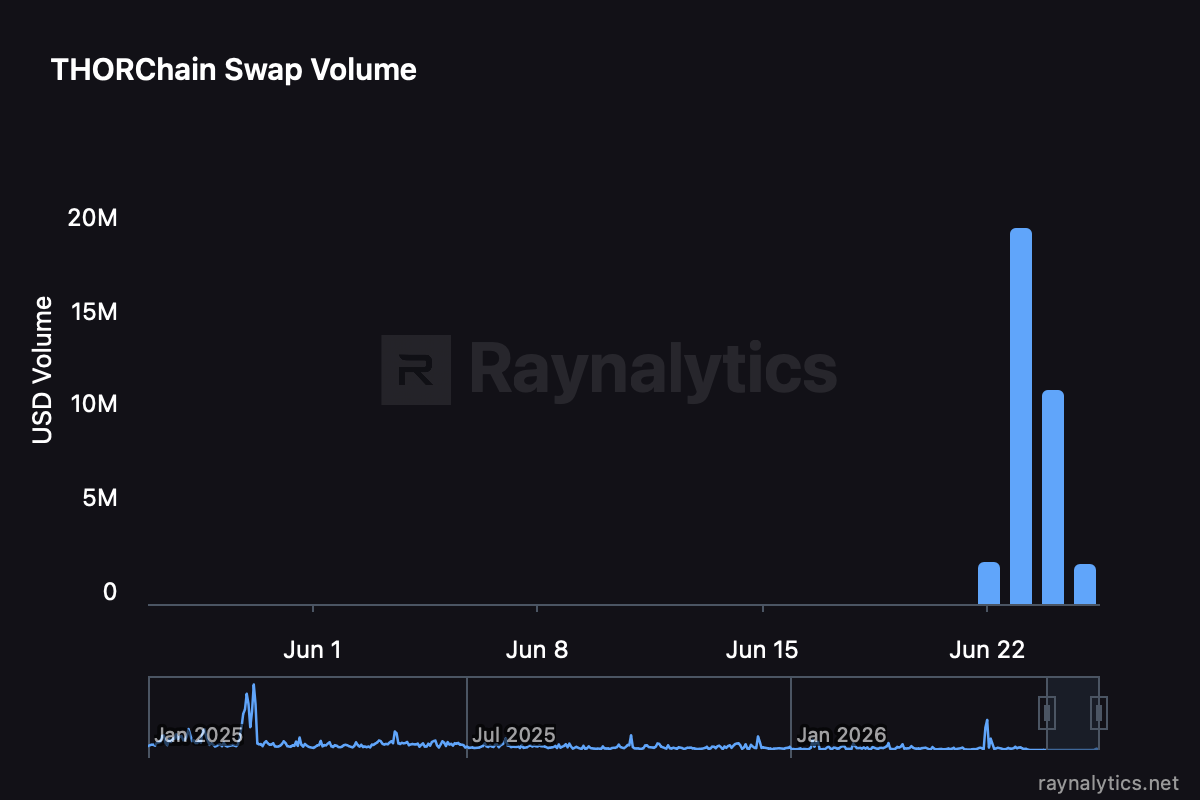
1. Trading Is Back, and the Roadmap Can Breathe Again
Denny opened the first post-restart THORSday like a man who had been waiting a month to press the party button. Confetti fired, the desk-pop jokes landed, and the simple message was the one everyone wanted to hear: THORChain is back online and swapping again.
Under the celebration, Chad Barraford kept the explanation grounded. This was not a normal bug hunt where a developer can read logs, isolate a bad branch and patch the issue within hours. The exploit lived in peer-to-peer validator communication and key-share behavior, which meant the team had to infer the attack path from limited evidence and then make sure the thing they found was the thing that mattered.
"This kind of attack is one of the hardest to recover from." (Chad)
That is why the restart took as long as it did. The network had to recover from a sophisticated cryptography attack, deal with verification and node issues along the way, and then get back into a state where the team could safely resume trading. Now that it has, Chad's posture was simple: the team can get back to the roadmap.
For users, the practical message is equally simple. Swaps are back through THORChain Swap, and the ecosystem has breathing room again. For the dev side, the next release is already queued.
2. Monero Moves From "Later" to "Soon"
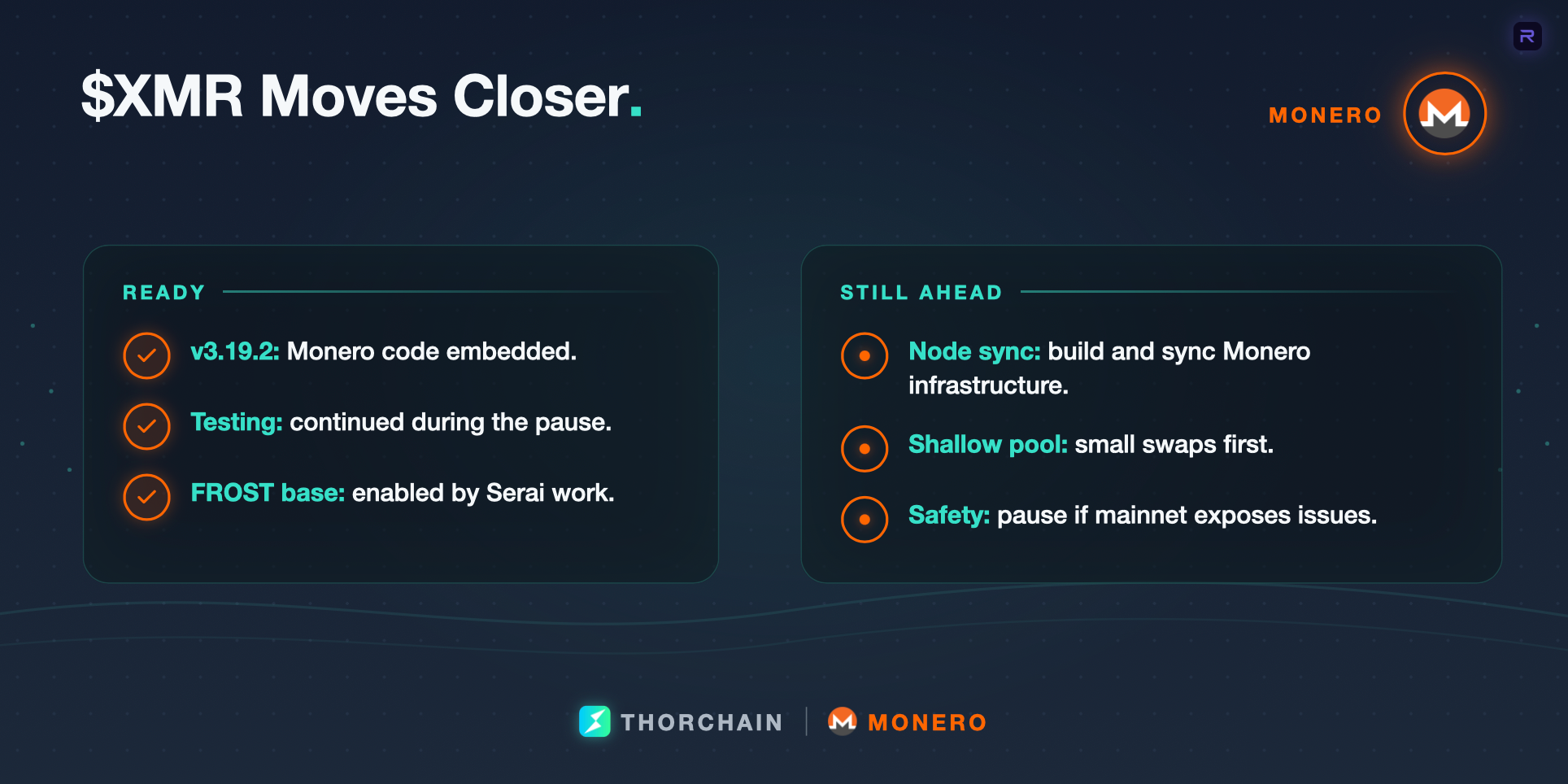
The biggest roadmap update was Monero. Chad said v3.19.2 is being cut with two important pieces: a fix for a Solana churn issue, and the Monero integration embedded in the release. The $XMR code still needs more internal testing and node readiness, but the tone changed from "roughly a month after restart" to "closer to two weeks."
The caveat matters. Nodes still need to build and sync Monero infrastructure, which Chad estimated around two to three days depending on resources. He also said there is a chance Zcash and Monero could launch together, but he did not frame that as a promise.
Denny tied the moment back to the privacy thesis. For the first time, Monero holders would get permissionless layer 1 to layer 1 access without bridges, wrapped assets, accounts or KYC. He also made sure nobody mistook that excitement for a guarantee of a perfect launch.
"The pools will be shallow. Do not attempt big swaps at first." (Denny)
That warning should be repeated. Mainnet is different from testnet. New chain clients have always had their own quirks, and Monero is the most complex chain THORChain has added. The likely launch path is small swaps first, close monitoring and a willingness to pause if something behaves badly.
The shout-outs were important too. Boone started the Monero chain-client process, and Luke Parker's work through Serai gave THORChain an open-source FROST TSS base that helped make the integration possible. Testing never fully stopped during the trading pause. The work just moved in the background until the network could breathe again.
3. Security: Open Source, Huginn, DKLS and FROST
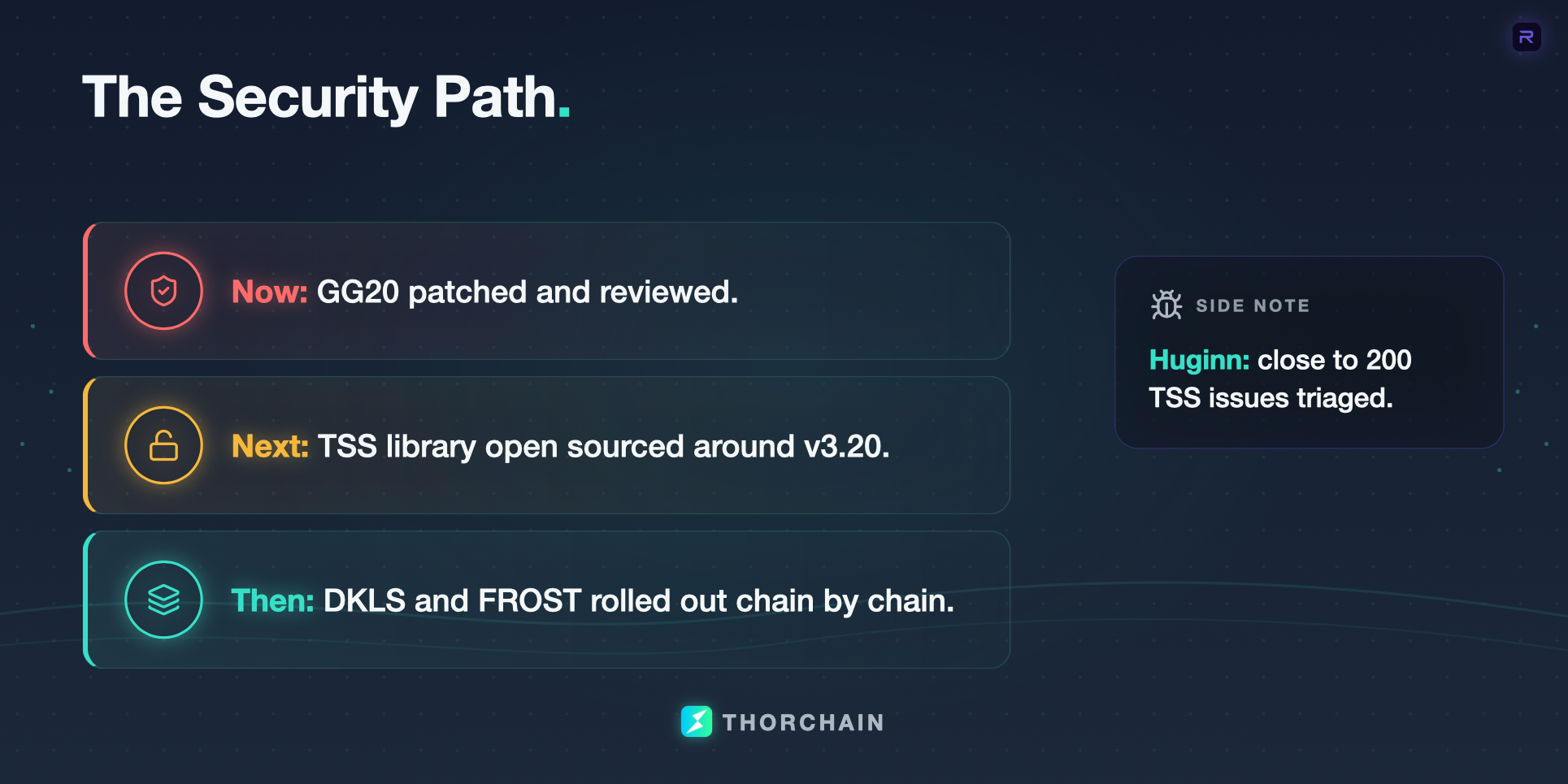
Security dominated the technical section. The current TSS library is not public yet, but Chad expects it to be open sourced around v3.20, likely after a deeper Soda Labs review. Soda Labs is still spending time with the codebase before the team opens it again, and Chad framed that delay as a tradeoff in favor of better review.
The review surface is not small. Chad said Huginn, his AI audit and triage agent, has opened close to 200 issues against the private TSS library alone, with varying severity. The team is reviewing and prioritizing them, but not every issue necessarily deserves a patch if the long-term plan is to leave GG20.
"Everybody wants to get off of GG20 and move to DKLS." (Chad)
That does not mean pressing a panic button. Chad emphasized that changing cryptography is inherently dangerous, especially when live funds have to migrate between schemes. The likely path is slower and more controlled: move chain by chain, start with smaller-value chains if possible, observe keygen and signing behavior, then expand.
The direction is now a dual track. Use FROST where THORChain can, especially EVM chains and Bitcoin through Taproot. Use DKLS where FROST is not available, such as Litecoin and Dogecoin. Monero already uses FROST, but Chad clarified that it is a different variant and cannot simply be reused for EVMs or Bitcoin.
Chainflip came up as one possible FROST implementation to study because it has been in production, but Chad made no commitment. THORChain still needs to evaluate whether any candidate library supports the accountability features the protocol needs, including identifying and slashing participants who hold up keygen or signing.
The team is also exploring bigger vault architecture ideas: hot and cold vaults, less frequent signing for most funds, and possibly two-of-two schemes later. The security team has a deeper meeting next Wednesday. Chad suggested next THORSday may have a clearer readout.
4. The Growth Stack: Wallets, KOLs and AI Agents
The pause did not freeze business development. Kenton ran through a stack of smaller but important growth items now that trading is live again.
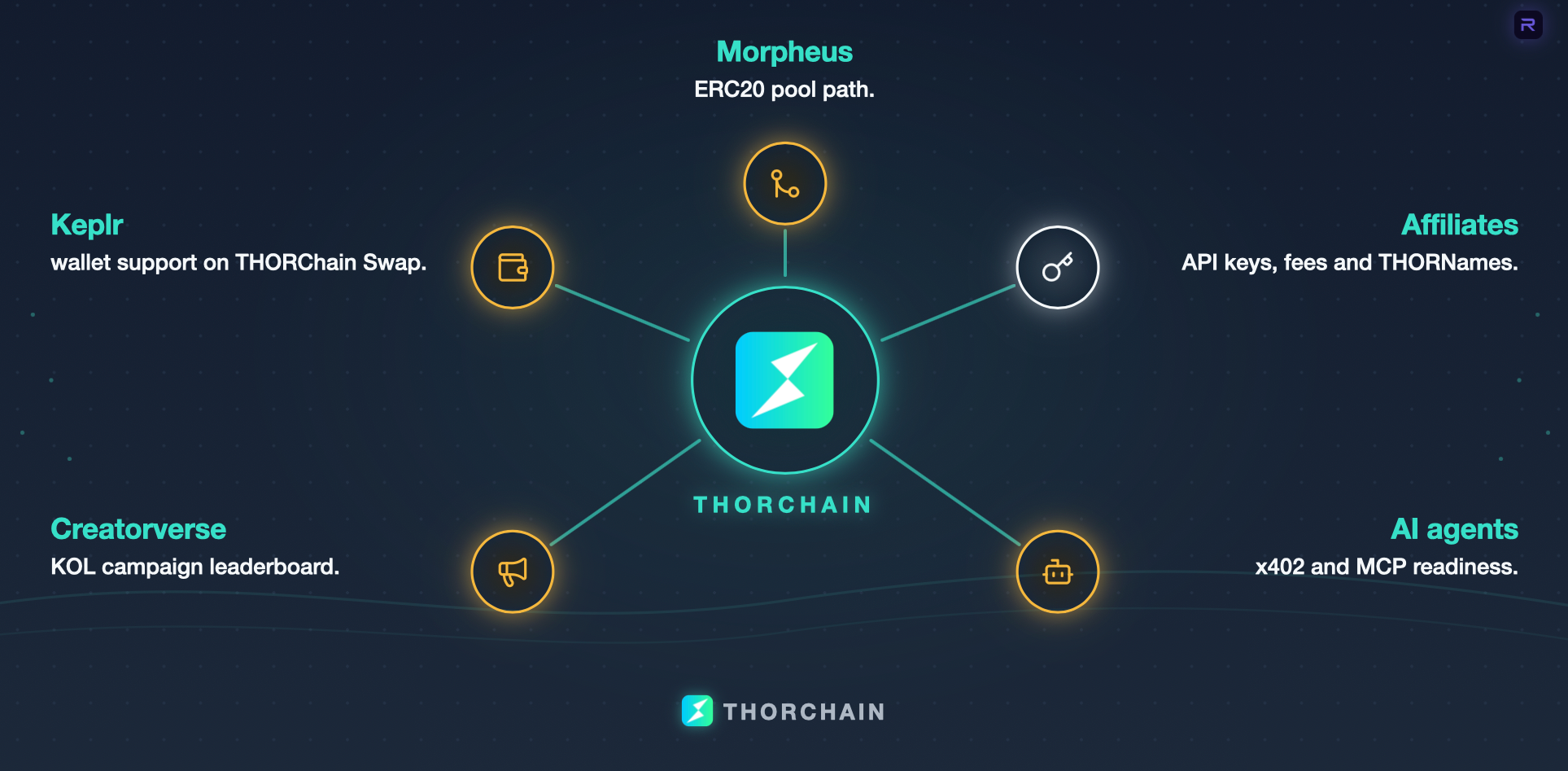
First, Morpheus. THORChain had a call with Morpheus, the decentralized AI project, and the immediate next step is simple: whitelist the ERC20 contract so a liquidity pool can be created. David from Morpheus is expected on the podcast in August. Kenton also floated the broader idea of reaching out to more ERC20 communities that want access to Bitcoin liquidity without asking nodes to support a whole new chain.
Second, wallets and affiliates. Keplr Wallet support on THORChain Swap is expected to start with EVM chains, then UTXO chains. The affiliate page is also being cleaned up so partners can get API keys, set fees, choose payout assets and likely create a THORName up front as part of the onboarding flow.
Third, marketing. Eric from Moca introduced Kenton to Creatorverse, the campaign platform from SCAL3. The pitch is a contest model for KOLs: creators compete on a leaderboard, with payouts tied to performance instead of a flat fee per post. Kenton liked the game theory, while Chad immediately asked the right question: how do they keep bots from gaming likes and retweets?
The AI-agent section was the most forward-looking. After the Morpheus call, Chad listed action items around x402 payments, Ethereum agent standards and an MCP for THORChain. He has built an MCP before and said he may open source it. Andy from Liquify has also been working on MCP tooling.
Kenton had already started checking THORChain's web properties with Agents First, trying to make thorchain.org and THORChain Swap easier for AI systems to read and interact with.
"THORChain has to be easily accessible by AI." (Kenton)
The thesis is straightforward: if agents become a major share of blockchain transactions, THORChain cannot be invisible to them.
5. POL Takes Center Stage
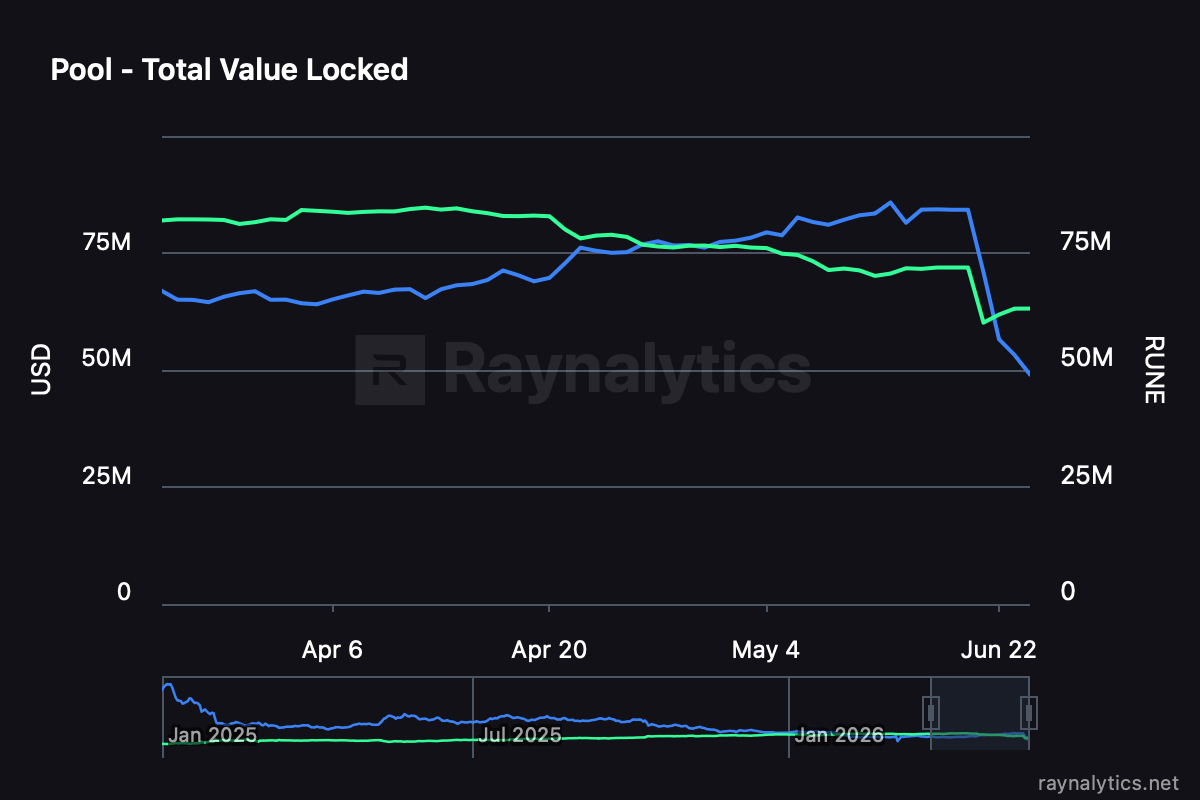
The biggest governance conversation was protocol-owned liquidity. With trading back and Monero close, Kenton wanted to know when the community should start debating what percentage of system income should go to POL.
The first issue is mechanics. Chad believed the POL percentage had been moved to an operational Mimir, where nodes can vote different percentages and the leading value wins. Boone joined to say his dashboard still shows it as an economic Mimir, with 12 votes trying to set it to 1%. Chad linked the commit he remembered making and said he would need to check whether something had been reverted.
The second issue is economics. Kenton corrected his own math from a previous discussion: if the system moved from 75% of fees going to nodes to 50% going to nodes and 25% going to POL, node operators would need to raise operator fees by 50% to get back to even. His view was that bond providers and operators need to have that conversation honestly, especially in a lower-fee, lower-$RUNE environment.
Boone's argument was urgency. After the exploit, asking third-party LPs to trust the pools immediately is a hard sell. Monero could become one of THORChain's most important pools, but without POL, the liquidity has to come from somewhere else.
"Getting liquidity back into the pools is a really really huge priority." (Boone)
That is why the POL debate feels bigger than a simple fee split. Under normal LP incentives, THORChain rents liquidity from third parties and keeps paying for it. Under POL, the protocol slowly owns more of the pools, earns fees on its own liquidity and can target liquidity into strategic pools like $XMR.
"It's renting versus owning." (Boone)
Kenton floated 25% POL while keeping the 5% $RUNE burn, or 29% POL with the burn reduced to 1%. Denny preferred going as aggressive as possible, while keeping at least a 1% burn for the deflationary narrative. The hosts also noted that the attack aftermath already left several million $RUNE to burn, far more than the fee-burn mechanism had destroyed so far, though they were careful with the exact number.
The sales pitch for new chains may be even stronger. Instead of paying a centralized exchange listing fee and handing supply to a market maker that sells, a project can seed a THORChain pool, keep custody of its LP position, accept impermanent loss as the real cost, and let POL keep buying and holding its token if the pool earns its way there. That turns THORChain from a listing venue into a long-term liquidity partner.
What to Watch
- v3.19.2 adoption. Watch for the Solana churn fix, Monero code adoption and node readiness after the release reaches operators.
- $XMR mainnet. The target moved closer, but shallow liquidity and possible early pauses should be expected. Small swaps first.
- The security meeting. Next Wednesday's discussion may clarify hot/cold vaults, two-of-two ideas and the first DKLS or FROST migration path.
- v3.20. Chad expects the public TSS library around v3.20, with $TAO and free stable swaps also discussed for that release path, gated by Mimir where needed.
- POL governance. The Mimir type needs clarity, then the community has to converge on a percentage. The practical question is how fast THORChain should own liquidity again.
- AI accessibility. x402, MCP tooling and agent-readable THORChain sites are now explicit action items, not abstract future talk.
- Upcoming guest. Saturday's episode is expected to feature Amir Taaki for the Monero and cypherpunk crowd.
More THORChain data, check out raynalytics.net
Follow Raynalytics for more Weekly Analytics and Podcast recaps.

Related articles
![Ecosystem Update Podcast with Radix]()
Sep. 19, 2026
Radix and THORChain: Building Trust for the Agentic Future
- Podcast
![THORChain Podcast protocol update cover]()
Sep. 17, 2026
THORChain Returns to Shipping: Zcash, Monero and Self-Sufficiency
- Podcast
![Ecosystem Update Podcast with Station Wallet]()
Sep. 13, 2026
Terra’s Station Wallet Is Back as Vultisig’s Agentic THORChain Wallet
- Podcast
![Protocol Update Podcast with Chad Barraford, Kenton and Patriot / Denny]()
Sep. 10, 2026
THORChain Prioritizes Stability Before Monero and New Features
- Podcast
![Ecosystem Update Podcast with RAVN]()
Sep. 5, 2026
Inside RAVN’s Native $BTC Aggregator and Its THORChain Integration
- Podcast
![Protocol Update Podcast with Hans, Devel, Chad, Kenton & Denny]()
Sep. 3, 2026
THORChain Churns Again: POL Goes Live, Rujira Resumes and BLO Debate
- Podcast
![Ecosystem Update Podcast with Rujira]()
Aug. 29, 2026
THORChain’s App Layer Rujira Is Paused. Rujira Wants a Clear Restart Path.
- Podcast
![Protocol Update Podcast with Chad Barraford, Kenton and Denny]()
Aug. 27, 2026
THORChain Puts Stability First: Monero & Zcash Delayed, ADR30, AI Agents and Memoless Swaps
- Podcast
![Ecosystem Update Podcast with Unstoppable Wallet]()
Aug. 22, 2026
Unstoppable Wallet Adds $RUNE, $TCY and $RUJI, With a Stablecoin Wallet Next
- Podcast
![Protocol Update Podcast with Chad Barraford, Kenton and Denny]()
Aug. 20, 2026
v3.20 Voting Is Underway. Should THORChain’s TSS Library Remain Open Source?
- Podcast
![Ecosystem Update Podcast with Dash]()
Aug. 15, 2026
Inside Dash’s Zcash Orchard Upgrade and Its THORChain Potential
- Podcast
![Protocol Update Podcast with Chad Barraford, Kenton, Denny and Oleg Petrov]()
Aug. 13, 2026
THORChain is Close to v3.20: FROST, DKLS, SwapKit Rev-Share and Dynamic Fees
- Podcast
![Ecosystem Update Podcast with Morpheus]()
Aug. 8, 2026
Morpheus Maps Decentralized AI, $MOR Inference and a Planned THORChain Pool
- Podcast
![Protocol Update Podcast with Hans and Pragmatic Monkey]()
Aug. 6, 2026
Rujira and THORChain Align on the App Layer: ADR31, CCL, and the Road to Perps
- Podcast
![Ecosystem Update Podcast with Depouch]()
Aug. 1, 2026
Inside depouch: Direct THORChain Swaps Built for Simplicity
- Podcast