THORChain x depouch Podcast #222 ft. BubbiByte, KentonC137 & Patriotsounds | August 1, 2026 | Watch the full episode on YouTube
By Raynalytics
TL;DR
- depouch is a father-son side project that has routed almost $200,000 in swaps while giving users access to the liquidity behind THORChain, Maya Protocol and NEAR Intents.
- Its interface intentionally limits choice: a curated asset list, one connected source wallet, a pasted destination address, hidden routing details until confirmation, and the ability to start another swap immediately.
- depouch integrates directly with THORChain. Thorbjørn said the documentation and quote flow made the build straightforward, and the team plans to keep that direct connection rather than switch to the newer API.
- Growth is aimed at people still using centralized exchanges, not at taking users from another THORChain frontend. Search-specific guides and support content are the main acquisition strategy.
- Memoless "Convert" swaps are coming, Monero support is a priority, and Rujira perpetuals are the first app-layer product depouch would consider. None of those additions is live yet.
Introduction
A 24-year-old developer and his father built a cross-chain exchange as a hobby, connected it directly to THORChain, and gained access to more than $100 million in liquidity without asking anyone for permission. That contrast with traditional finance is the best introduction to depouch and its co-founder, Thorbjørn Breum.
Thorbjørn, known online as BubbiByte, joined Kenton and Denny to explain why depouch removes options other interfaces expose, why it chose direct integrations over a middleware dependency, and why its real competition is the centralized exchange market rather than another frontend.
1. From a Bank-Age Limit to a Permissionless Exchange
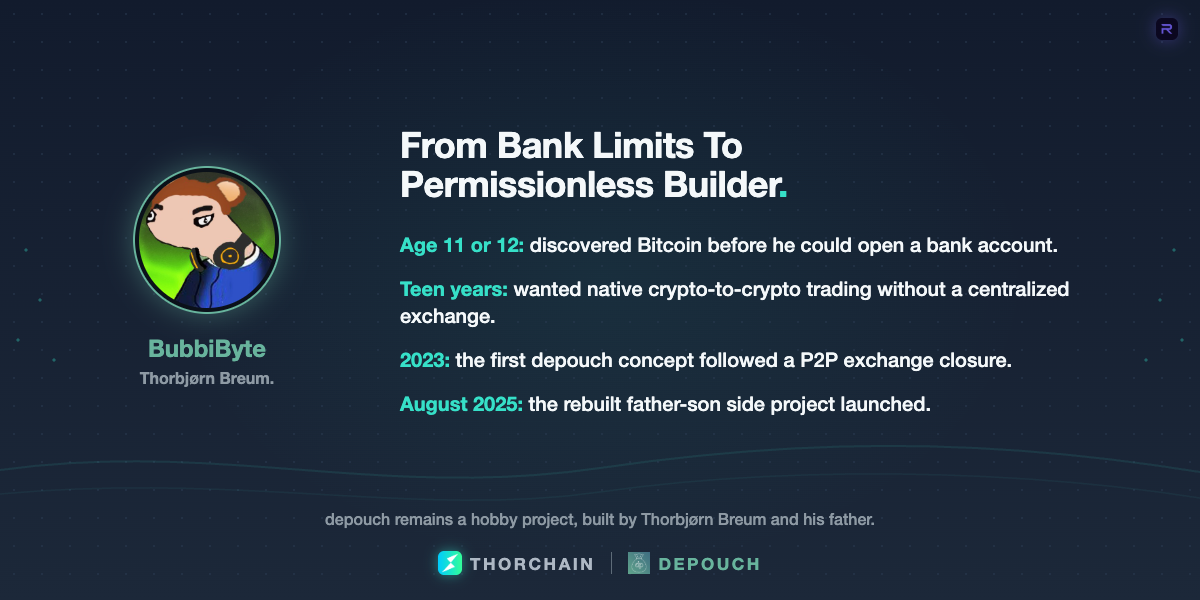
Thorbjørn first encountered Bitcoin around 2012 or 2013, when he was 11 or 12. His father showed him a form of digital money he could hold even though Danish age rules kept him from opening a bank account. When he finally became eligible at 15, his bank experience still involved visiting a branch and printing paper receipts while his crypto wallets already worked online.
That gap stayed with him. As a teenager, he wanted to move between Bitcoin and Litecoin without a centralized exchange, but atomic swaps never reached the user experience he had imagined. When he found THORChain around 2021 or 2022, during the Chaosnet era and before the move from BEP2 $RUNE to native $RUNE, the idea finally looked real.
"This is what I've been dreaming of since 2016 or 2017. This is it." (Thorbjørn)
He and his father first built a peer-to-peer cash-to-crypto exchange. They closed it after being told the viable paths were full KYC or operating outside the law, neither of which matched the product they wanted. The original depouch idea followed in 2023, paused when Thorbjørn joined another crypto company, then returned as their shared hobby project. The current interface launched in August 2025.
The work remains part-time, but the motivation is not casual. Thorbjørn described THORChain as the ecosystem that most closely recreates the experimental, permissionless culture that drew him into crypto.
"THORChain feels the most like the early days of crypto." (Thorbjørn)
2. Less Choice, Fewer Ways to Get It Wrong
Thorbjørn did not claim depouch invented a new kind of swap. His pitch was narrower: cross-chain interfaces share most of the same underlying experience, so depouch tries to remove the places where a user can make a mistake.
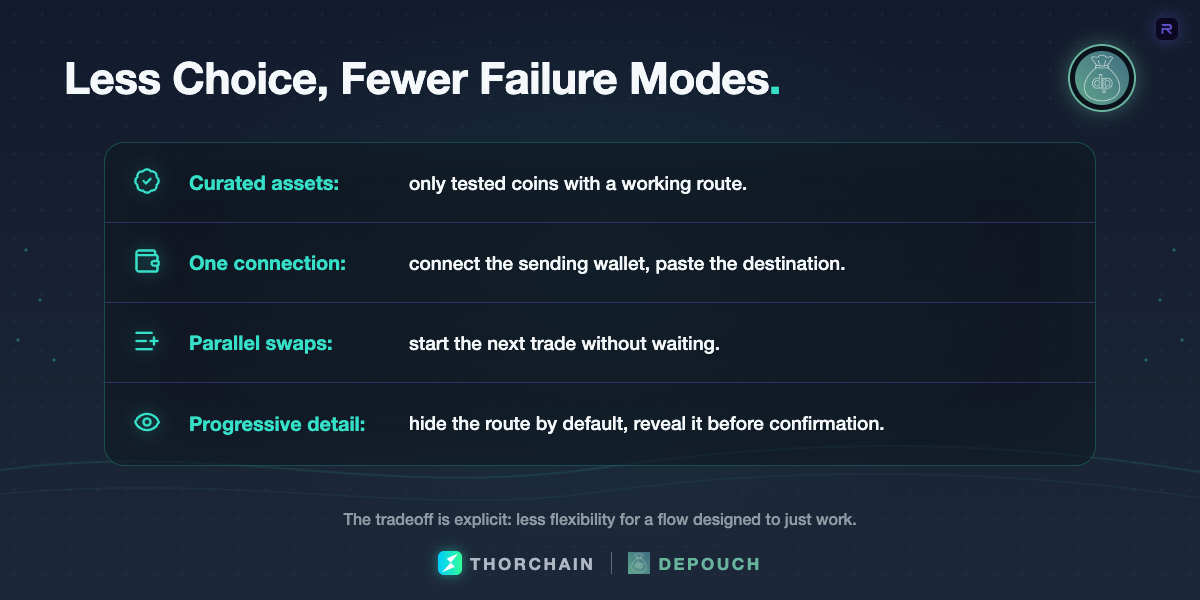
The asset list is curated in public on GitHub. Instead of presenting thousands of tokens, duplicate names and broken icons, depouch lists assets its developers have tested and know have a working route. That means less flexibility, but it also means a user is not left guessing which version of an asset is real or reachable.
Wallet handling follows the same rule. The user connects only the wallet sending the trade, then pastes the destination address. The receiving wallet never needs to connect, which avoids extension conflicts and makes sending directly to a cold wallet or another person natural. The interface also allows several swaps to run at once, so a pending Bitcoin trade does not block the next Ethereum trade.
"The user has a little less flexibility, but it just works." (Thorbjørn)
Even routing information is staged. depouch calculates the best route in the background, keeps it out of the default view, then reveals the selected protocol before confirmation. Settings expose the alternatives for anyone who wants to inspect them. Animations are similarly restrained: one action produces one visual response, with no extra movement competing for attention.
The episode produced one concrete design follow-up. Kenton explained how THORChain Swap combines the quoted price impact and execution tolerance into a user-facing price-protection limit. Thorbjørn agreed that users arriving from centralized exchanges may assume "1% slippage" protects the whole difference between input and output, and said the idea was worth incorporating.

3. Why depouch Integrated THORChain Directly
depouch talks to THORChain and Maya Protocol directly. That decision predates THORChain's newer API, and Thorbjørn sees no reason to replace a working integration.
The implementation starts with a quote request carrying the input asset, output asset, amount and destination address. The response supplies the memo and transaction details needed by the connected wallet. Affiliate fees are another parameter, expressed in bps, with a THORName used to keep the memo compact. When the trade clears, the frontend receives its fee in $RUNE.
"Integrating THORChain directly was really easy. The documentation is quite clear." (Thorbjørn)
That endorsement mattered to Kenton because the API creates a useful but centralized distribution layer. His argument is pragmatic: make THORChain easier to add, get it into more wallets and frontends, then let those products move direct if the service ever disappears or faces pressure. The protocol continues without the API either way.
depouch is already on the destination side of that path. It maintains its own route selection, queries the underlying protocols, and does not depend on a single hosted gateway to keep its THORChain flow alive.
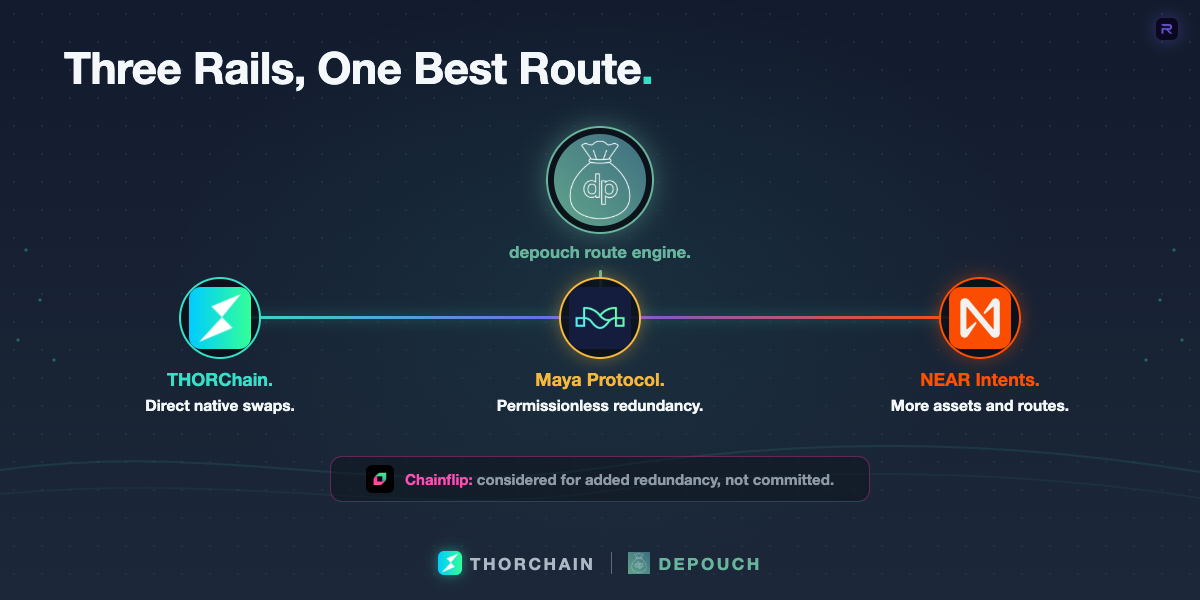
4. Three Routing Rails, One Cross-Chain Focus
The route engine currently compares THORChain, Maya Protocol and NEAR Intents. THORChain came first, Maya added another permissionless native-asset rail, and NEAR Intents expanded coin coverage and redundancy. The default selection considers several parameters and returns the best route, while the user can inspect or override it in settings.
Thorbjørn has looked at Chainflip, and the team discussed it again the day before the show. The obstacle is not philosophical opposition. Its documentation and affiliate-fee flow appeared harder to implement, and its supported assets already overlap with routes depouch can reach. Adding it would therefore be mostly a redundancy decision, weighed against limited development time.
EVM-only routing sits even farther down the list. A user moving from native $BTC to an Ethereum token may still need a second trade on Uniswap, but Thorbjørn does not think another interface can easily dislodge a product people already know and trust for that job. depouch has focused on the less familiar problem: teaching someone that native Bitcoin can move into another chain without a centralized exchange.
The protocol mix also reflects an explicit value judgment. Thorbjørn sees THORChain and Maya as the strongest permissionless cross-chain rails. He described NEAR Intents as useful redundancy while questioning reports of solver-level censorship. For depouch, more routes are valuable, but permissionlessness remains the standard they are measured against.
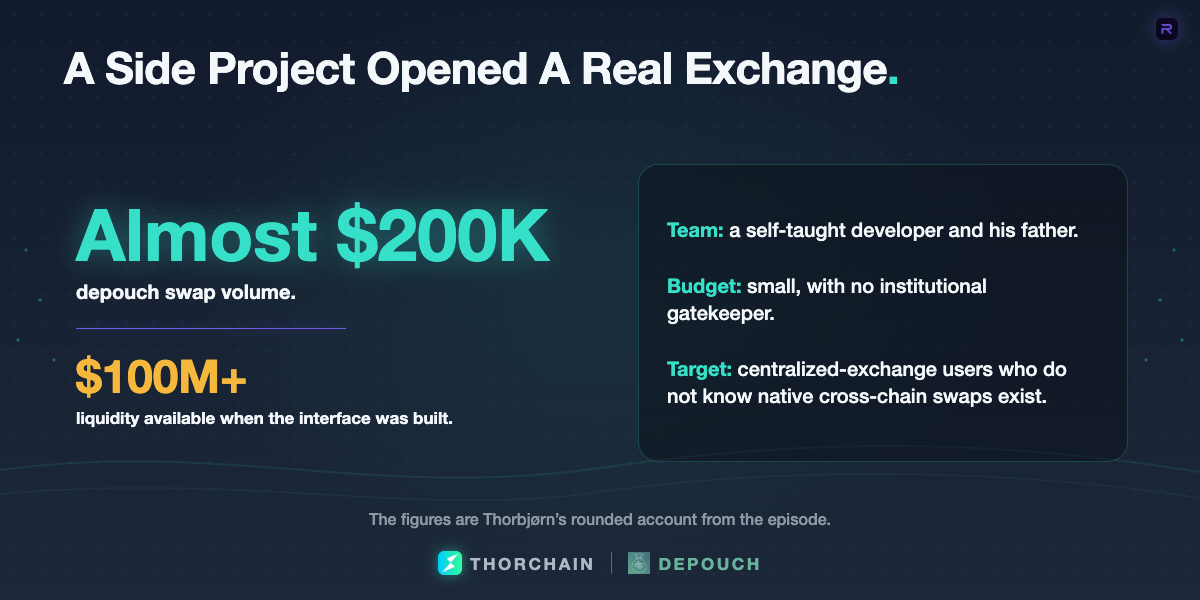
5. The Growth Market Is Still on Centralized Exchanges
depouch has processed almost $200,000 in volume, not enough to fund the project but enough to prove a father-son side build can open a real trading venue. Thorbjørn's larger point was the liquidity behind it: with a small budget and no gatekeeper, they gave users access to more than $100 million that was already sitting in decentralized pools.
"That's only possible in decentralized finance." (Thorbjørn)
The go-to-market strategy follows the same non-zero-sum logic. Thorbjørn does not expect a loyal THORChain Swap or THORSwap user to change interfaces because depouch has a different animation or a slightly different fee. He wants the person searching for "how to swap Ethereum to Bitcoin using MetaMask" who still believes a centralized exchange is mandatory.
With no large KOL budget, depouch builds narrowly targeted articles, full videos and short guides for searches such as swapping Ethereum to Bitcoin with MetaMask. The material shows the entire transaction before a newcomer reaches the app, then support continues through email, Discord and tickets. The aim is to make self-custodial cross-chain trading feel like a supported product rather than an expert-only terminal exercise.
The frontend charges a 0.3% affiliate fee. Thorbjørn framed it openly: users can keep most activity on a protocol-funded interface, then route an occasional trade through an independent frontend if they want to support another team watching the network, maintaining integrations and helping users. More builders around the same liquidity are a net gain for the ecosystem, even when they share the same backend.
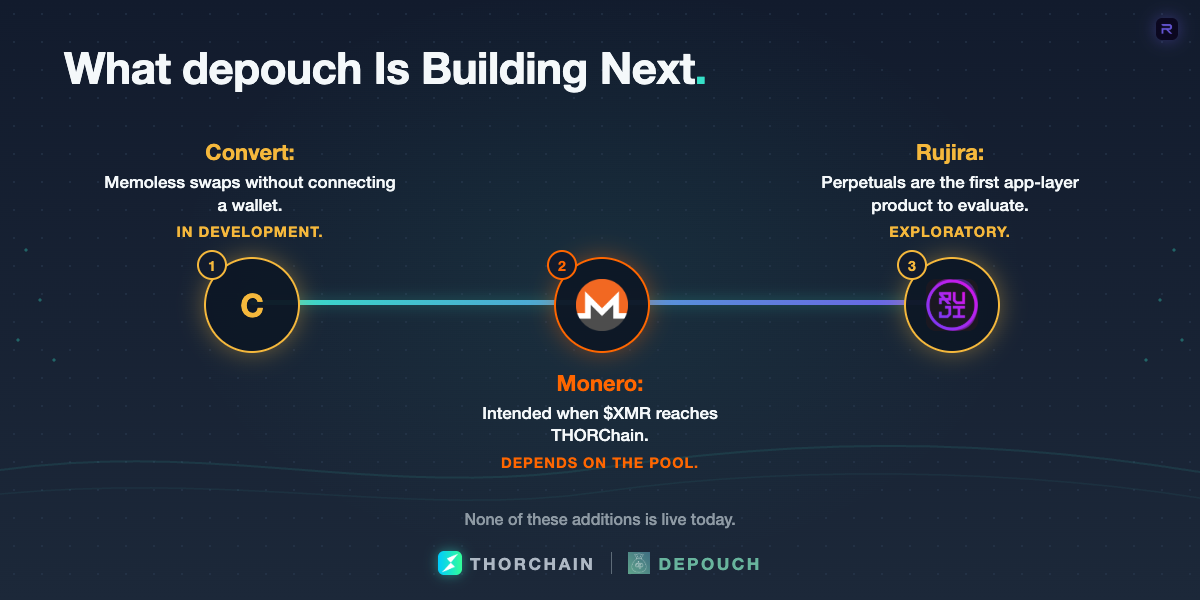
6. Convert, Monero and the App-Layer Roadmap
The closest product addition is a memoless mode depouch will call Convert. Instead of connecting a wallet, a user will receive an inbound address, send funds from any external wallet, and let the swap settle to the chosen destination. Thorbjørn said it is coming, but it is not live yet.
The Monero integration is the reason it moved up the queue. Thorbjørn expects the Monero pool to become THORChain's highest-volume pool because users need both a decentralized way to buy and sell $XMR and a route for moving other assets into a private currency. That is his forecast, not a protocol projection. He credited Boone for the chain-client work and for standing his ground in community debates.
Beyond swaps, depouch is watching the Rujira app layer. The first primitive it would evaluate is perpetual trading, a market unavailable on THORChain's base swap layer. Dollar-cost averaging and other products may fit later, but no app-layer integration has been announced.
The roadmap therefore has three different statuses: Convert is being worked on, Monero support depends on $XMR reaching THORChain, and Rujira products are possibilities to evaluate. None should be read as live.
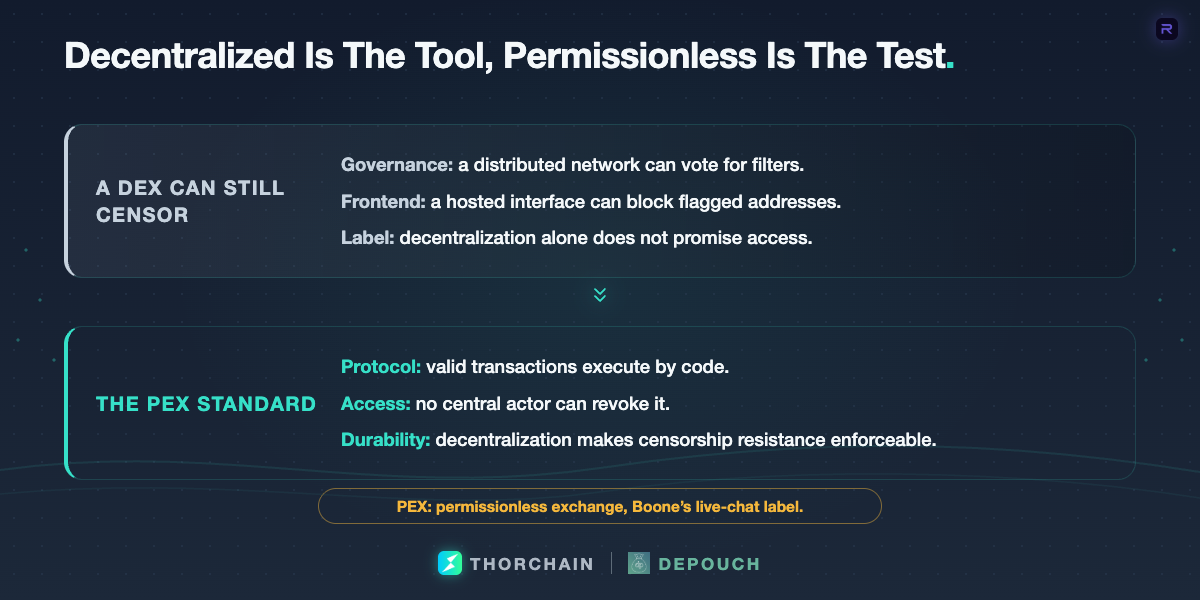
7. Is “Decentralized” Enough?
The closing discussion moved from product design to definitions. Denny argued that a cross-chain DEX able to censor transactions is not meaningfully decentralized in the way users expect. Boone supplied a cleaner label in the live chat: PEX, permissionless exchange.
The distinction matters because different layers can make different choices. depouch owns a domain and server, so its interface checks flagged addresses to reduce its legal exposure and protect itself from sanctioned flow. A blocked user could still construct a memo or reach the underlying protocols another way. The frontend can filter; THORChain continues executing valid transactions according to code.
Thorbjørn's test is that decentralization is the tool that makes the stronger properties durable. A distributed network could still vote for censorship, but a centralized service cannot credibly guarantee that nobody will force it to censor later.
"You cannot be permissionless without being decentralized, and you cannot be censorship resistant without being decentralized." (Thorbjørn)
That is also why Maya's friendly-fork relationship matters to him. The two protocols can disagree on implementation while preserving the same ground rules and giving users redundant permissionless rails. In his view, they are not competing for a fixed pool of existing DEX users. They are building the alternative for everyone still relying on an account, approval and custodian.
What to Watch
- Price protection: whether depouch adopts the broader protection model Kenton demonstrated from THORChain Swap.
- Convert: the memoless swap flow is coming, but no release date was given.
- Monero: depouch intends to support $XMR when the THORChain pool is available. Thorbjørn's high-volume expectation remains a personal forecast.
- Routing: Chainflip is under consideration mainly for redundancy, with no implementation commitment.
- Rujira: perpetuals would be the first app-layer product depouch evaluates. This remains exploratory.
- Distribution: Kenton offered THORChain blog and social support, and invited depouch back when it has meaningful features to show.

More THORChain data, check out raynalytics.net
Follow Raynalytics for more Weekly Analytics and Podcast recaps.

Related articles
![Monero Gets a Soft Launch as THORChain's v3.20 Enters Testing and ADR31 Passes]()
Jul. 30, 2026
Monero Gets a Soft Launch as THORChain's v3.20 Enters Testing and ADR31 Passes
- Podcast
![THORChain and Pirate Chain podcast thumbnail featuring anarchy_dot_gov, KentonC137, and Patriotsounds discussing $ARRR listing on THORChain]()
Jul. 25, 2026
Pirate Chain Wants Off Centralized Exchanges: Next Ask Is an $ARRR Pool on THORChain
- Podcast
![THORChain Podcast #219 thumbnail.]()
Jul. 23, 2026
Dynamic Fees Take THORChain From 6% to 33.5% of ShapeShift Volume, With ADR29 Rev-Share Up Next
- Podcast
![THORChain x Liquidy Ecosystem Podcast #218 thumbnail.]()
Jul. 18, 2026
Inside Liquidy’s $700K Treasury: Market Making, Governance and Smarter Rujira Swaps
- Podcast
![THORChain Community Podcast #217 thumbnail featuring Devel, Boone, Kenton and Patriotsounds discussing base-layer limit orders, Monero's final review stage and post-exploit volume recovery.]()
Jul. 16, 2026
Devel's Limit Orders Could Make THORChain Swaps Up to 4x Cheaper, at No Cost to the Protocol
- Podcast
![THORChain x Vultisig Ecosystem Podcast #216 thumbnail featuring paaao from Vultisig and Patriotsounds discussing seedless MPC vaults, THORChain routing, Station Wallet and agentic signing.]()
Jul. 11, 2026
Vultisig’s Agentic Future: Secure AI Wallets, Rujira, and THORChain
- Podcast
![THORChain Community Podcast #215 thumbnail featuring Aaluxx from Maya Protocol, Eric from Moca, Randy Bechtold and Patriotsounds discussing the exploit, v3.20 and the Monero launch timeline.]()
Jul. 9, 2026
Aaluxx on the Exploit, the Churn, and Why Two DEXes Beat One
- Podcast
![THORChain x BazaarSwap Ecosystem Podcast #214 thumbnail featuring Flynn Jameson and Nikita Anikeev of BazaarSwap, Kenton and Patriotsounds discussing native cross-chain routing and the THORChain integration.]()
Jul. 4, 2026
Why BazaarSwap Chose THORChain for Native Asset Routing
- Podcast
![THORChain Community Podcast #213 thumbnail featuring Chad Barraford, Randy Bechtold and Patriotsounds discussing dynamic fees, Monero's launch timeline and revenue share.]()
Jul. 2, 2026
THORChain Turns On Dynamic Fees for Symbiosis, With More Affiliates Next
- Podcast
![THORChain Community Podcast #212 thumbnail featuring Boone, Kenton and Patriotsounds debating ADR29 minimum swap fees for Monero and THORChain's fee strategy.]()
Jun. 28, 2026
Boone’s ADR29 Gives THORChain a New Fee Lever for Monero
- Podcast
![THORChain Community Podcast #211 thumbnail featuring Chad Barraford, Kenton and Patriotsounds discussing the network restart, Monero timeline and Protocol Owned Liquidity debate.]()
Jun. 25, 2026
THORChain Is Back: Monero Nears Mainnet, and POL Takes Center Stage
- Podcast
![THORChain x xolosArmy Ecosystem Podcast #210 thumbnail featuring Fernando of xolosArmy, Kenton and Patriotsounds discussing eCash's chain client integration with THORChain.]()
Jun. 20, 2026
xolosArmy Wants eCash ($XEC) on THORChain: Chain Client Ready, Liquidity Next
- Podcast
![THORChain Community Podcast #209 thumbnail featuring Chad Barraford, Kenton and Patriotsounds discussing the network restart timeline, Monero launch and Protocol Owned Liquidity.]()
Jun. 18, 2026
THORChain's Restart Is Days Away: Dynamic Fees, Rev-Share, and Protocol-Owned Liquidity
- Podcast
![THORChain x NanoGPT Ecosystem Podcast #208 thumbnail featuring Milan Dereede discussing NanoGPT's integration with Kenton and Patriotsounds.]()
Jun. 13, 2026
NanoGPT Coming to THORChain: Every AI Model, No KYC, Paid in Crypto
- Podcast
![THORChain Community Podcast #207 thumbnail featuring Chad Barraford, Kenton and Patriotsounds discussing the network restart timeline, chain integrations and POL fee split.]()
Jun. 11, 2026
THORChain Eyes Trading by Midweek: Chad Maps the Final Restart Steps, With Zcash and Monero Queued
- Podcast