Devel's Limit Orders Could Make THORChain Swaps Up to 4x Cheaper, at No Cost to the Protocol

2026-07-16 — 11 min read
- Podcast
THORSday Community Podcast #217 ft. Devel484, BooneW, KentonC137 & Patriotsounds | July 16, 2026 | Watch the full episode on YouTube
By Raynalytics
TL;DR
- Devel, a node operator and arbitrageur, pitched base-layer limit orders: a new order type that would let arbitrage bots act as market makers. In the best case it removes slippage on the filled portion, and with an optional maker/taker fee split it could make swaps up to 4x cheaper for users while THORChain keeps the same revenue per unit of volume. It is a proposal, not a shipped feature.
- The Monero integration is in its final review stage, with human reviewers and Chad's Huginn agent surfacing and patching issues. No firm date was given, but v3.20 or later this month are both in play.
- THORChain posted its highest daily volume since the exploit, over $50M, even with Solana and Binance Smart Chain paused. Tron flow has been especially strong.
- The wallet push on THORChain Swap continues: Keplr is updated, Trezor is next (chosen partly to support Monero), and Ctrl Wallet is shutting down on August 1. Export your seed phrase before then.
- Churn is still paused pending v3.20, and the community is racing to onboard node operators before Monero goes live. Denny is dangling a spicy-chocolate stunt to rally bonding.
1. Meet Devel, and Why Arbitrage Keeps THORChain in Sync
The episode's first guest was Devel, a developer who runs two THORChain nodes, arbitrages the protocol, and helps the Maya Protocol dev team in the background. He joined the community only around December 2025, and in roughly seven months has gone from studying the swap code to filing issues and drafting proposals. He is also stepping into a role supporting node operators across THORChain and Maya.
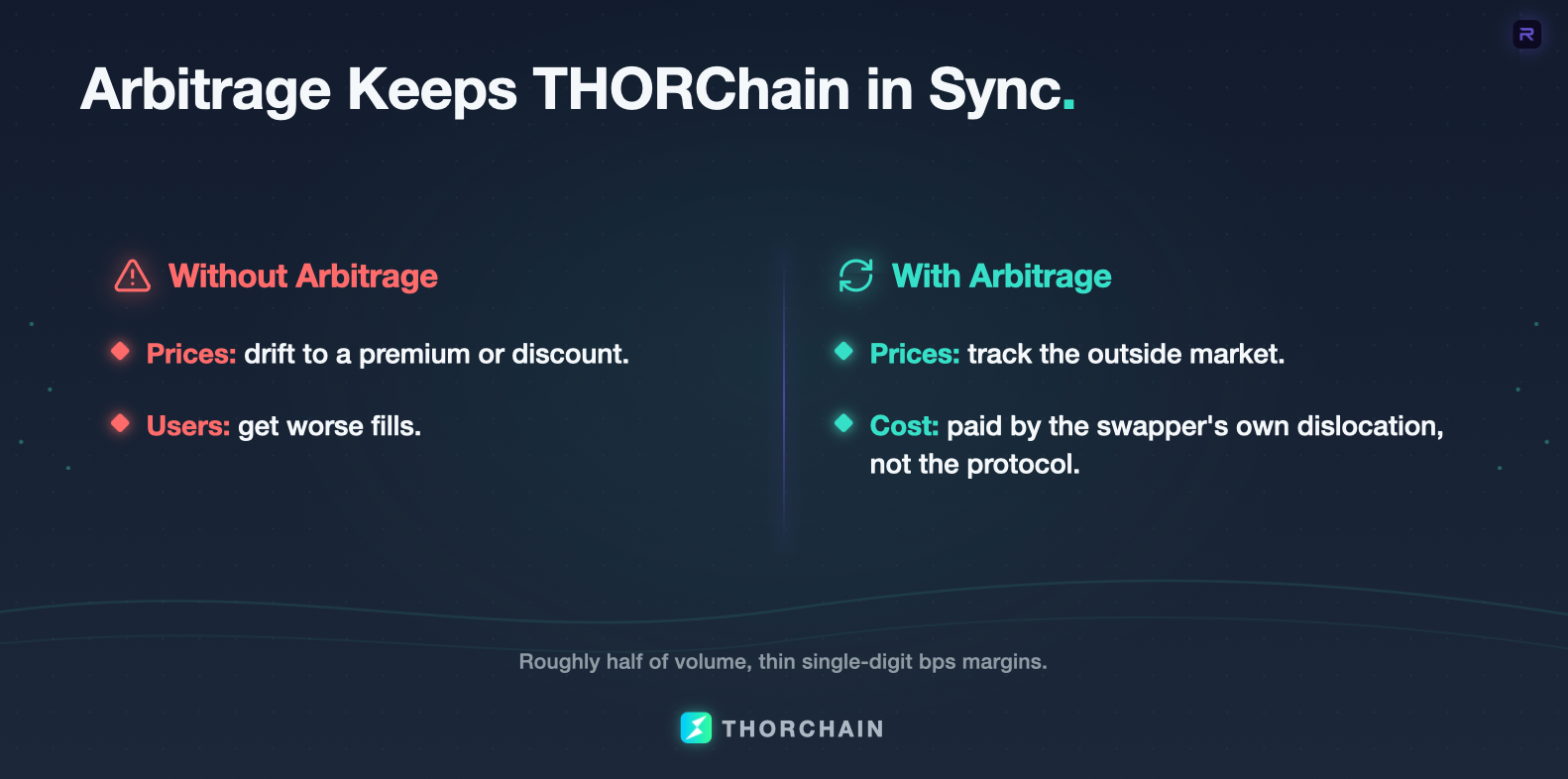
He came on partly to defend a group that rarely speaks up. Arbitrageurs are often called parasitic, but Devel argues they are essential plumbing. Without them, pool prices drift to a premium or discount and every swapper gets a worse fill. Arbitrage bots continuously rebalance the pool back toward the outside market, and the cost of that rebalancing is paid by the swapper's own price dislocation, not by the protocol or the pools. Everyone transacts voluntarily and gets what they came for.
He also pushed back on the idea that more arbitrage is unhealthy. On the chain he came from, bots did 99% of the volume and real users just 1%, a sign almost nobody was actually trading. On THORChain, he estimates arbitrage makes up at least half of volume, with genuine user swaps making up much of the rest. That balance is a feature, not a bug, and margins are thin: he described single-digit basis points of profit, a few cents per $1,000 of volume, with income coming from doing many trades rather than winning big on any one.
"Everyone profits: the user, the arbitrageur, as well as the ecosystem, from the additional volume." (Devel)
2. A New Order Type: Turning Arb Bots Into Market Makers
Devel's proposal is to add true limit orders on THORChain's base layer. He was careful to separate them from what THORChain calls limit swaps today. A limit swap is really just a swap tried over a period of time, defined by an input amount and a minimum amount out, which together produce an average price. Because it targets an average, the pool has to overshoot the set price before the order fills, which is why traders sometimes watch the candlestick blow past their target and wonder why nothing triggered.
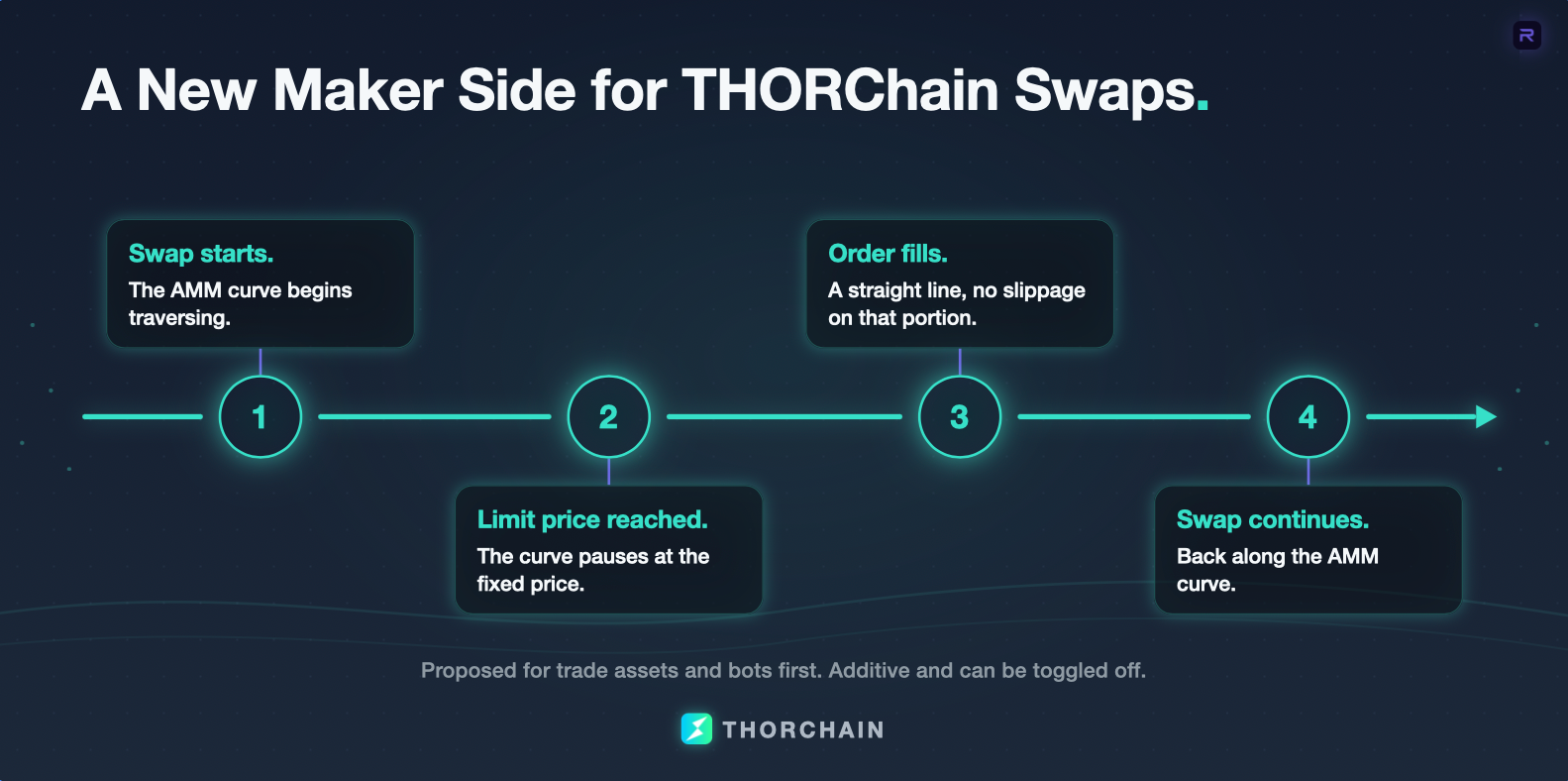
Right now, everything on THORChain is a taker. Every swapper, every arbitrage bot, and even Rujira sits on the taking side of the automated market maker. There is no maker other than the AMM curve itself. Devel's limit orders introduce a maker side: a bot posts liquidity at a fixed price, and when the curve traverses to that price it pauses, fills the order in a straight line with no slippage on that portion, then continues along the curve.
To keep it safe and simple, the first version is scoped to trade assets and to bots only, not wallet interfaces, because a limit order can only exist for a pool that already exists, and everything on THORChain is paired against $RUNE. The change is additive and can be toggled on or off like an operational setting, with a very small code footprint. It is not an order book: there is no matching engine on-chain, the arbitrage bots off-chain are the engine, and settlement stays inside THORChain through trade assets, with the end user receiving Layer 1 assets from the same vault as always. Devel said he ran the same logic for about three years on another chain, and that THORChain's module design makes it far simpler to implement here.
"This could turn arbitrage bots into market makers, improving the liquidity, reducing slippage, reducing the fees for the user." (Devel)
3. Cheaper Swaps at No Cost to the Protocol
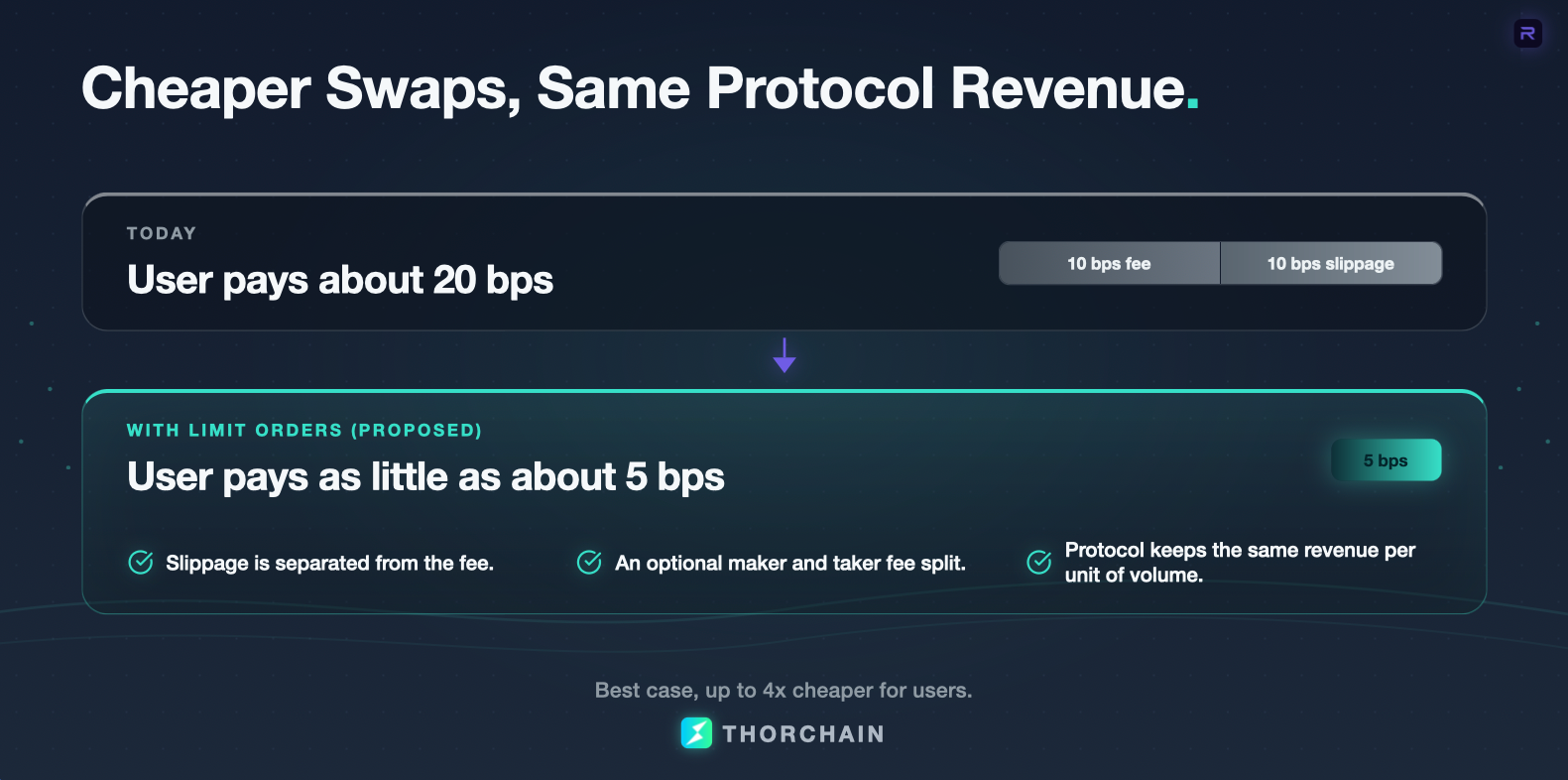
Here is why the community got excited. On THORChain the dislocation equals the fee, so a swap that pays 10 bps of fee also eats roughly 10 bps of slippage, and the user effectively pays around 20 bps. Because a limit order fills in a straight line, it separates slippage from fee, so the swapper pays only the fee side. That alone is roughly a 50% saving on the filled portion.
Devel then floated an optional split of the fee into a maker fee and a taker fee, for example 5 and 5. THORChain would still collect the same 10 bps per unit of volume, but the user would pay a fraction of what they pay today, up to about 4x cheaper in the best case. The lever also works in reverse: keep the user's cost where it is and the protocol could earn up to 4x more on that flow. Either way, revenue per unit of volume is unchanged, which is what makes it different from simply lowering fees.
"This is a 4x cheaper swap for the user at no cost to THORChain." (Boone)
It does not appear to threaten Rujira. Pragmatic Monkey had worried that base-layer limit orders would undo two years of app-layer work, but Boone reported that a call with Rujira's developers that morning put that to rest: Rujira can ignore the base-layer limit orders, read only the AMM curve, and simply get a slightly better fill than its code expects. The app layer is a taker and cannot become a maker without changing base-layer code, which is exactly the capability Devel wants to add. Boone added two cautions: keep the AMM pool liquidity as a permanent liquidity of last resort even though limit orders are more capital efficient, and remember that flow filled by the app layer returns only about half its fees to the base layer, so base-layer-filled volume is roughly twice as profitable for THORChain. Devel even floated using protocol-owned liquidity as a simple market-making bot once POL pools grow large enough. For now it is a proposal: he tagged Chad, who has not yet responded.
4. Monero Enters the Home Stretch
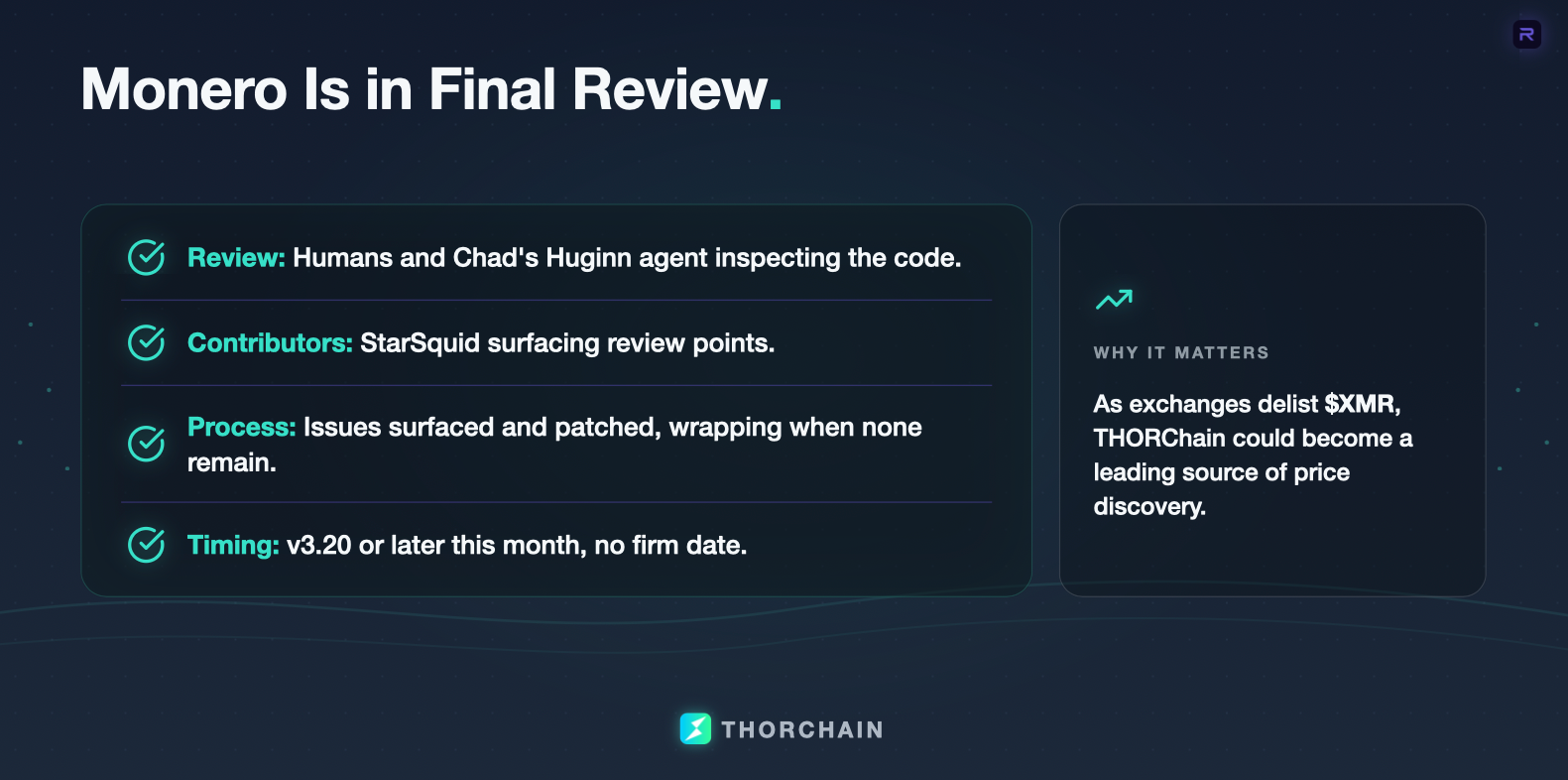
The Monero integration is close. Boone and Denny described it as deep in the review stage, with both human reviewers and AI in the loop: Chad's Huginn agent and StarSquid have been surfacing strong review points, the team keeps patching what they find, and they plan to wrap once no more issues surface. No firm date was promised. v3.20 could open the door, and if not, Denny expects $XMR this month or shortly after. It follows the arc covered when Monero neared mainnet.
The more interesting question is what happens to price. As exchanges keep delisting $XMR across various jurisdictions, liquidity concentrates in fewer venues, and Devel thinks THORChain could become a, or even the, leading source of Monero price discovery, with other markets arbing against its curve. That would bring bigger price gaps for arbitrageurs to close, which they can hedge with futures where spot venues are scarce, and more Monero volume onto THORChain. It is the clearest example yet of THORChain's product-market fit meeting privacy chains.
"Permissionless doesn't matter until it does. And I think it's really starting to matter." (Denny)
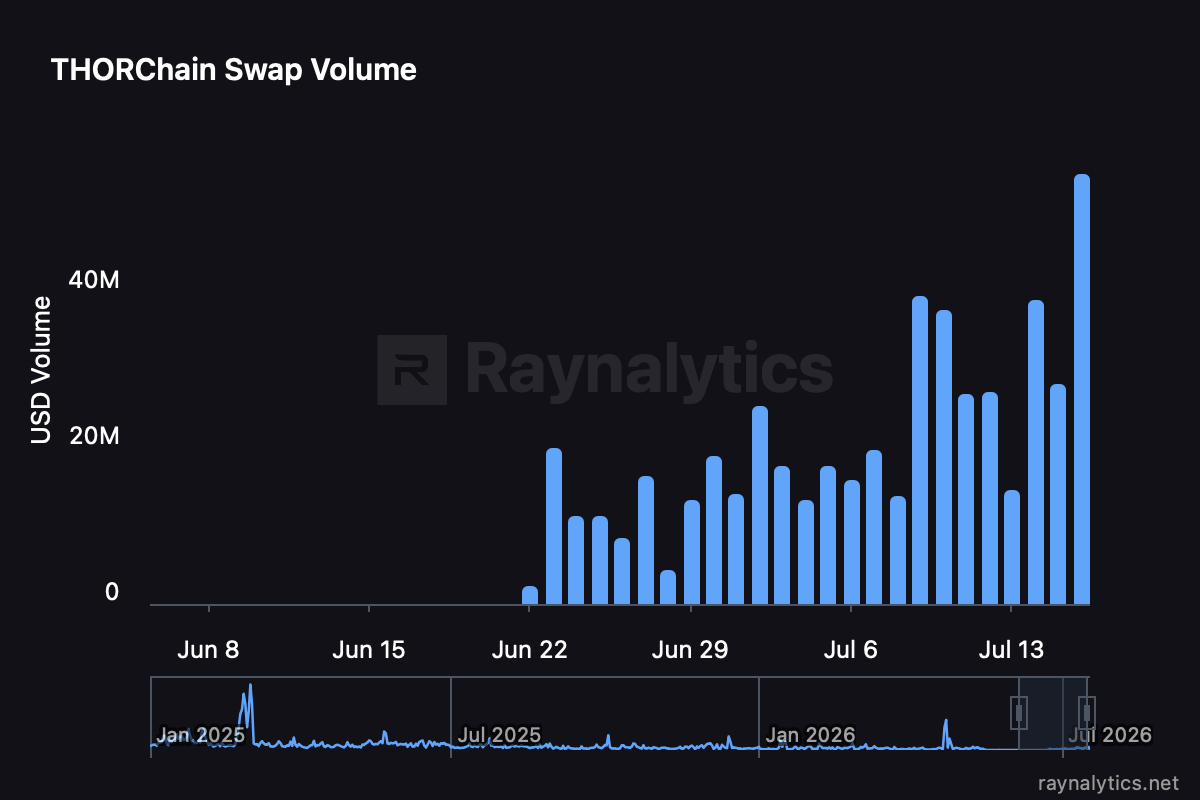
5. The Highest-Volume Day Since the Exploit
Denny shared the number of the week: over $50M in daily volume, the highest since the exploit, and that is with Solana and Binance Smart Chain still paused. Tron in particular has been carrying its weight, with more traders routing Tron flow through THORChain. As far as the hosts could tell, this was honest Layer 1 user activity rather than a hack moving funds.
Was it the dynamic fee model kicking in? Not really, at least not yet. Chad's dynamic fee model first went live for Symbiosis, and more recently ShapeShift was added as a second whitelisted affiliate, with Randy helping line up more partners. So far the impact is small: Symbiosis pushes little volume, ShapeShift is more active but concentrated, and more patches are expected in v3.20. You can track the enrolled affiliates and pairs epoch by epoch on the dynamic fees dashboard.
The bigger drag remains churn. THORChain has not churned since Kenton left for vacation. The fix slipped from v3.19.3 to v3.19.4 and now to v3.20, which ran into technical issues but could land imminently, restore churning, and clear the backlog of operators waiting to rotate in. Some users are still waiting on refunds tied to the paused chains, and the team asked for continued patience.
6. Growing THORChain's Reach: A Spotlight and a Wallet Push
On the marketing side, Denny recapped a guest spot on Sal the Agorist's show that gave THORChain a strong spotlight.
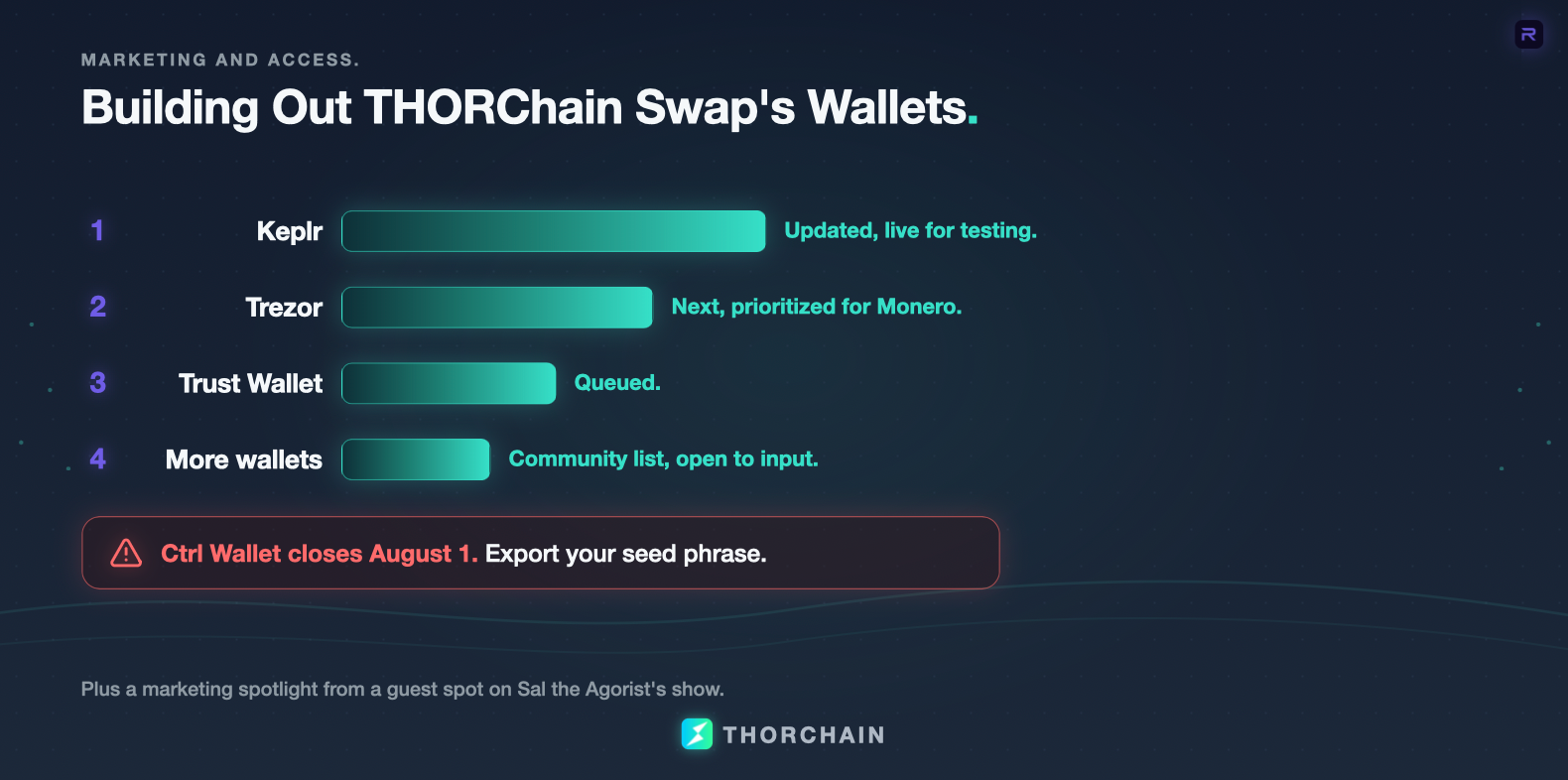
On the product side, the bigger effort is wallet coverage. The goal is simple: for each blockchain, get the most popular wallet supported on THORChain Swap. Keplr has been updated to support all the tokens, and the team asked users to stress-test it. Trezor is next in line, prioritized in part because it is one of the main wallets people use for Monero. Trust Wallet and a longer list of candidates follow, with the roster open to community input. The affiliate page and a swap widget are also further along, with a beta widget ready for real-world testing.
One item is a genuine action for readers. Ctrl Wallet, the former XDEFI, is shutting down on August 1. If you still hold funds there, export your seed phrase now so you can import into another wallet. It is a shame to see one of the original multi-chain wallets and early THORChain supporters go, but exporting the seed is all it takes to stay safe.
7. Node Operators Wanted Before Monero, With a Spicy Incentive
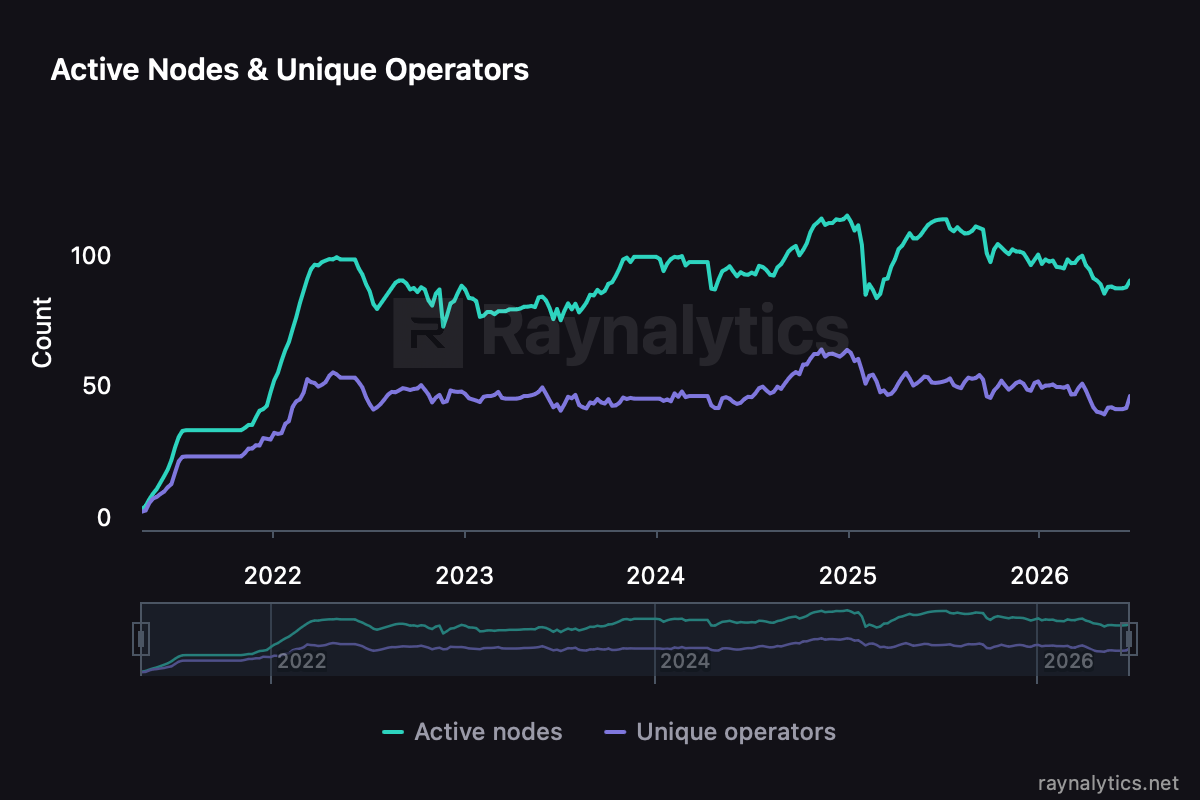
With Monero coming, the hosts want as many independent node operators online as possible, and the community has been rallying to get first-timers to the 300,000 $RUNE bond threshold. Denny's RuneBond has been helping new operators pool the bond they need, and several have crossed the line recently.
To keep the momentum going, Denny made an offer live on stream: if the community bonds a new operator past 300,000 $RUNE within two weeks, he will eat a square of a 9-million-Scoville-unit chocolate on camera, and two squares if it happens within one week. For scale, a jalapeño is a few thousand Scoville units. He promised gloves and a genuine on-camera reaction, no fakes.
There was also a quiet but useful governance change: a passed update removed lowest bond from the churn-out criteria, so once the network hits its 120-node cap, only the oldest node and the node with the highest slash points rotate out. That protects small and new operators who are still building their bond, exactly the people the community is trying to bring in. Devel, himself a recent operator, said the hardest part of starting is the wall of technical setup, and offered to help anyone weighing it. He credited an unusually welcoming ecosystem for how quickly he got up to speed.
"Here there was a warm welcome. I got assisted as much as possible, and other node operators reached out to provide their knowledge." (Devel)
What to Watch
- Devel's limit order proposal: whether Chad and the core devs engage, and whether the idea moves toward a testable, toggleable base-layer feature.
- Monero: the end of the review stage, and whether $XMR ships with v3.20 or later this month.
- v3.20: the churn fix, dynamic fee patches, and the resumption of node rotation.
- Volume durability: whether the post-exploit strength, especially Tron flow, holds once paused chains come back.
- Wallets on THORChain Swap: Trezor going live for Monero users, and progress migrating people off Ctrl Wallet before August 1.
- Upcoming episodes: a liquidity-focused guest this Saturday, followed by the Pirate Chain team the next weekend.

More THORChain data, check out raynalytics.net
Follow Raynalytics for more Weekly Analytics and Podcast recaps.

Related articles
![THORChain x Vultisig Ecosystem Podcast #216 thumbnail featuring paaao from Vultisig and Patriotsounds discussing seedless MPC vaults, THORChain routing, Station Wallet and agentic signing.]()
Jul. 11, 2026
Vultisig’s Agentic Future: Secure AI Wallets, Rujira, and THORChain
- Podcast
![THORChain Community Podcast #215 thumbnail featuring Aaluxx from Maya Protocol, Eric from Moca, Randy Bechtold and Patriotsounds discussing the exploit, v3.20 and the Monero launch timeline.]()
Jul. 9, 2026
Aaluxx on the Exploit, the Churn, and Why Two DEXes Beat One
- Podcast
![THORChain x BazaarSwap Ecosystem Podcast #214 thumbnail featuring Flynn Jameson and Nikita Anikeev of BazaarSwap, Kenton and Patriotsounds discussing native cross-chain routing and the THORChain integration.]()
Jul. 4, 2026
Why BazaarSwap Chose THORChain for Native Asset Routing
- Podcast
![THORChain Community Podcast #213 thumbnail featuring Chad Barraford, Randy Bechtold and Patriotsounds discussing dynamic fees, Monero's launch timeline and revenue share.]()
Jul. 2, 2026
THORChain Turns On Dynamic Fees for Symbiosis, With More Affiliates Next
- Podcast
![THORChain Community Podcast #212 thumbnail featuring Boone, Kenton and Patriotsounds debating ADR29 minimum swap fees for Monero and THORChain's fee strategy.]()
Jun. 28, 2026
Boone’s ADR29 Gives THORChain a New Fee Lever for Monero
- Podcast
![THORChain Community Podcast #211 thumbnail featuring Chad Barraford, Kenton and Patriotsounds discussing the network restart, Monero timeline and Protocol Owned Liquidity debate.]()
Jun. 25, 2026
THORChain Is Back: Monero Nears Mainnet, and POL Takes Center Stage
- Podcast
![THORChain x xolosArmy Ecosystem Podcast #210 thumbnail featuring Fernando of xolosArmy, Kenton and Patriotsounds discussing eCash's chain client integration with THORChain.]()
Jun. 20, 2026
xolosArmy Wants eCash ($XEC) on THORChain: Chain Client Ready, Liquidity Next
- Podcast
![THORChain Community Podcast #209 thumbnail featuring Chad Barraford, Kenton and Patriotsounds discussing the network restart timeline, Monero launch and Protocol Owned Liquidity.]()
Jun. 18, 2026
THORChain's Restart Is Days Away: Dynamic Fees, Rev-Share, and Protocol-Owned Liquidity
- Podcast
![THORChain x NanoGPT Ecosystem Podcast #208 thumbnail featuring Milan Dereede discussing NanoGPT's integration with Kenton and Patriotsounds.]()
Jun. 13, 2026
NanoGPT Coming to THORChain: Every AI Model, No KYC, Paid in Crypto
- Podcast
![THORChain Community Podcast #207 thumbnail featuring Chad Barraford, Kenton and Patriotsounds discussing the network restart timeline, chain integrations and POL fee split.]()
Jun. 11, 2026
THORChain Eyes Trading by Midweek: Chad Maps the Final Restart Steps, With Zcash and Monero Queued
- Podcast
![THORChain Podcast #206 thumbnail.]()
Jun. 6, 2026
The Stablecoin That Survived a 95% Crash: Zephyr Comes to THORChain
- Podcast
![THORChain Podcast #205 thumbnail featuring co-founder Chad Barraford.]()
Jun. 4, 2026
THORChain Still Paused, Monero Targeted for Month-End, and the Limit Order Debate
- Podcast
![THORChain Podcast #204 thumbnail, presented by Raynalytics]()
May. 30, 2026
More Than a Block Explorer: Deving.zone Turns THORChain Into a Living Map
- Podcast
![THORChain Podcast #203 thumbnail featuring co-founder Chad Barraford discussing the v3.19 protocol update, Soda Labs, and vault hardening, presented by Raynalytics]()
May. 29, 2026
THORChain Path to Restart: v3.19, Soda Labs, and Hardening the Vaults
- Podcast
![THORChain Community Podcast #198 thumbnail featuring JP and Kenton demonstrating the first live decentralised RUNE to Monero swap on THORChain's chainnet.]()
May. 14, 2026
JP Demos Live Monero on THORChain: 7 Nodes, Real Funds, First Swap Works
- Podcast
- Guide