Moca Nears Launch & How It Uses THORChain to Bring Crypto Payments to the Register

— 14 min read
- Podcast
THORChain x Moca Podcast #247 ft. EricOnchain, KentonC137 & Patriotsounds | October 31, 2026 | Watch the full episode on YouTube
By Raynalytics
TL;DR
- Moca plans to go live for crypto-savvy businesses on Friday, November 6, and for ordinary merchants on November 20, after a beta with fewer than 50 businesses. Two off-ramp partners arrive with the November 20 launch, and inventory and order features are expected in Q1 2027 if things go well.
- A customer pays in the coin they hold, and the business settles in the coin it wants. When the two differ, THORChain and Moca's other partners perform the swap in the background. Only the merchant needs Moca: any wallet can pay through a QR code, and any phone becomes the terminal.
- Moca charges 50 bps, and only when a payment involves a swap. 40 bps of that goes to the partners who onboard businesses and customers, and Moca keeps 10 bps.
- The first markets are Argentina, through its Bitcoin Cash merchant community, and Mexico, through food-court "Moca hubs."
- Separately, THORChain was paused globally at the time of recording after a 10 $ETH double spend, and Kenton shared a new bond yield payout option awaiting node approval.
Introduction
Swapping one asset for another is what THORChain does. Moca wants to point that engine at the checkout counter, so a customer can pay with whatever coin they hold and the business still receives the coin it wants.
Eric from Moca joined Kenton and Denny to show how far the product has come since he previewed a quiet point-of-sale beta in July. He walked through how payments settle, demoed the point of sale live, explained the fee and partner model, and laid out the launch dates and the first two markets. The hosts opened with two THORChain updates, covered at the end.
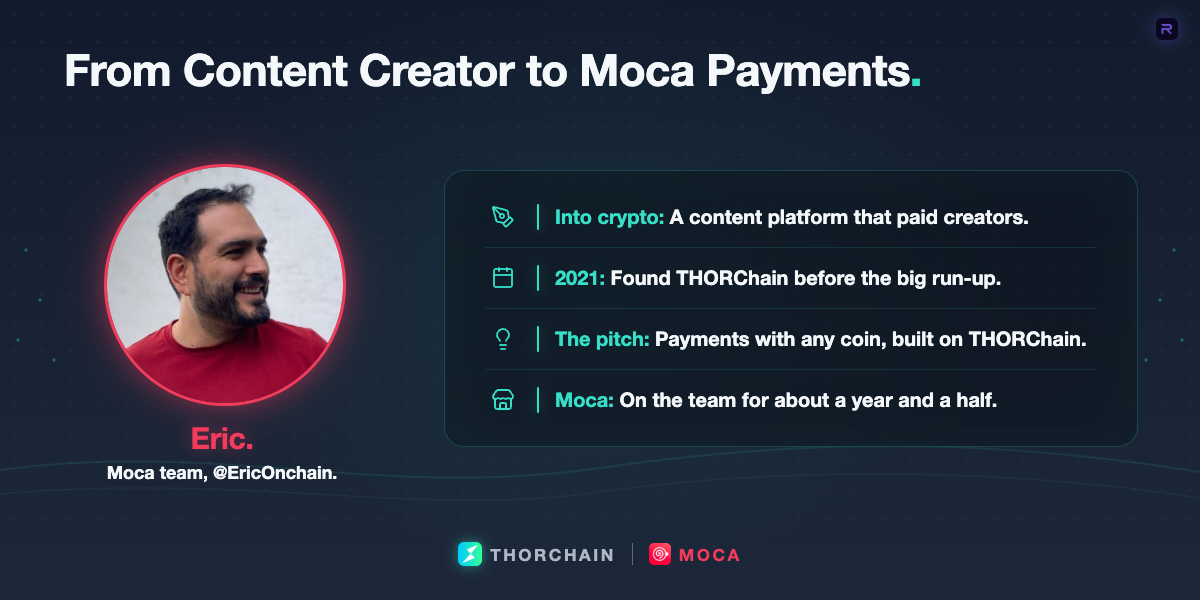
1. From Content Creator to Moca: Eric's Road to THORChain Payments
Eric took what he called a non-traditional route into crypto. Rather than Bitcoin, then Ethereum, then ICOs, he found it through a platform that paid people to create content. He spent the next four years learning about permissionlessness and decentralization, and he heard about THORChain in 2021, before the big run-up.
About two years ago, Moca's founder Zey pitched him an idea: payments were the next big thing. Eric noted that institutions are now moving the same way with their own centralized stablecoins and systems, which he sees as a sign Moca is on the right track.
"He told me we could make payments with any coin if we leverage THORChain technology. Are you in?" (Eric)
Eric joined Moca about a year and a half ago. He described Moca as building permissionless, decentralized payments, with THORChain as its first partner. The idea had been around for a while. Eric said Zey knew Aaluxx of Maya Protocol early on, and Aaluxx later reminded Zey of the idea, told him the technology was finally there, and offered to help and make introductions. Eric believes that path led the team to Rare Evo, where Denny met them and immediately saw THORChain moving from swaps into a settlement layer for goods and services. Zey had planned to join the episode but was out sick.
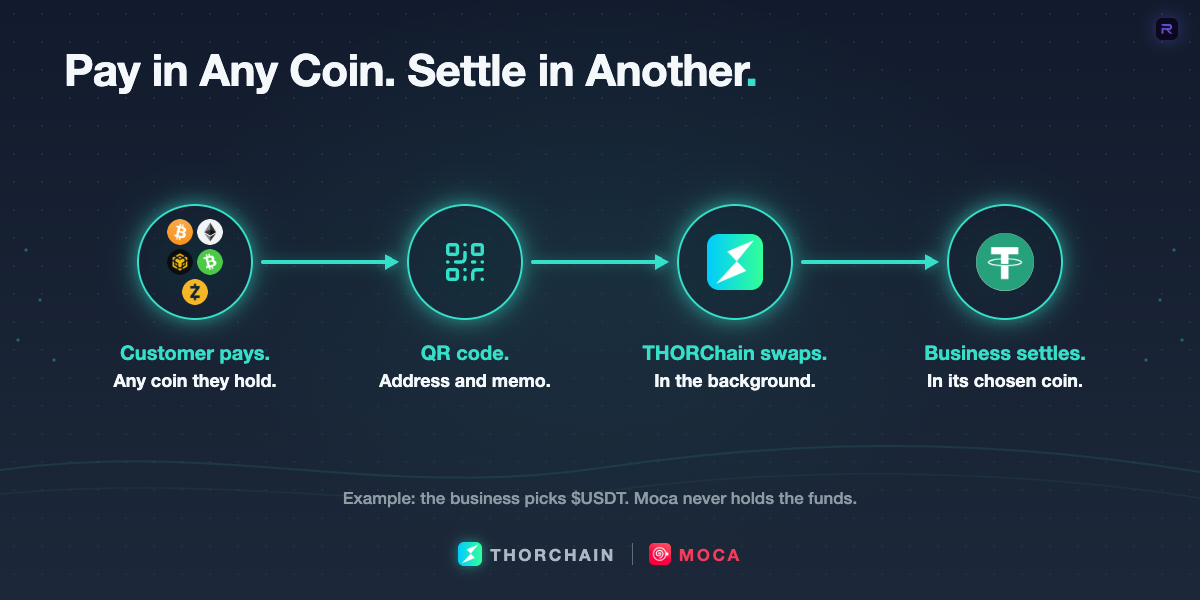
2. Pay in Any Coin, Settle in Another
The problem Moca solves is mismatched coins. Eric gave the example of a customer holding Ethereum and a business that wants stablecoins on Tron. Without a way to connect the two, someone has to teach the staff to swap, visit a website or onboard to another chain, and every step adds friction that loses customers.
In Moca, the business sets its settlement token in the dashboard. A business that wants crypto's instant settlement without price volatility might choose $USDT. A customer holding $BNB, $BTC or $ETH scans the QR code. The code gives their wallet an address and a memo, and THORChain and Moca's other partners handle the swap. The business receives its chosen token, and neither side needs to know how the swap works.
Eric listed $BNB, $ZEC, $ETH, $BCH and $BTC among the assets this already covers, and stressed that Moca never handles the money itself.
Asked about stablecoins, Eric said Visa, Mastercard and others keep backing new blockchains and stablecoin projects that still depend on the centralization crypto was meant to replace. He sees Moca as an alternative that stays compliant without asking anyone's permission. That is why it chose THORChain as its first and main partner.
"THORChain is never going to bend the knee, so to speak." (Eric)
One of the hosts framed stablecoins as a possible Trojan horse. Businesses that set up for stablecoins could add Moca alongside them, giving them a permissionless fallback if stablecoins ever start behaving like CBDCs. Eric agreed and said the two systems can run side by side.
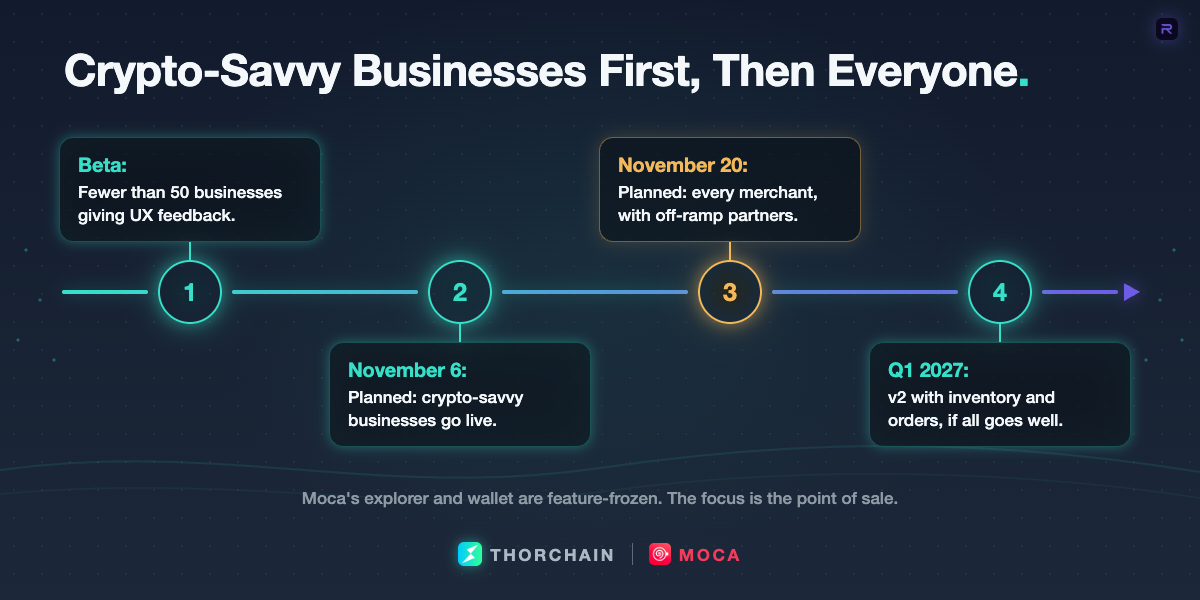
3. The Launch Plan: Crypto-Savvy Businesses First, Then Everyone
Eric said the launch is long overdue. Moca wanted to go to market months ago and held back for two reasons: every wallet on the market had to be able to pay, and sign-up had to be smooth for anyone while staying secure against AI-assisted attacks. Eric said the team attacked the login system several times with different techniques and is confident it is not an attack vector today.
Moca already has fewer than 50 businesses in the beta. Eric called that enough for useful feedback, such as staff getting lost or the payment screen not being clear enough for customers. After speaking with the CTO, he gave this schedule:
- Next Friday (November 6): Moca goes live for crypto-savvy businesses that already accept crypto.
- Two Fridays later (November 20): Moca goes live for ordinary merchants with no crypto background. Eric said setting up should be as easy as creating a Facebook account.
- At the November 20 launch: Two off-ramp partners, with more being added for redundancy and better quotes.
- Also planned, no date given: A crypto card, which Eric called not ideal but a halfway measure, so businesses can spend what they receive without off-ramping.
- Q1 2027, if things go well: A v2 point of sale with inventory and the ability to tie payments to tables and orders.
Eric said Moca's explorer and wallet have reached the point the team wanted, and development on them has stopped so the team can focus entirely on the point of sale and the merchant dashboard. When users asked to bond $RUNE from the wallet, the answer was no, because that is not Moca's business. The landing page is also being rebuilt for merchants rather than crypto users. Eric also hinted that crypto will not be the only way customers can pay.
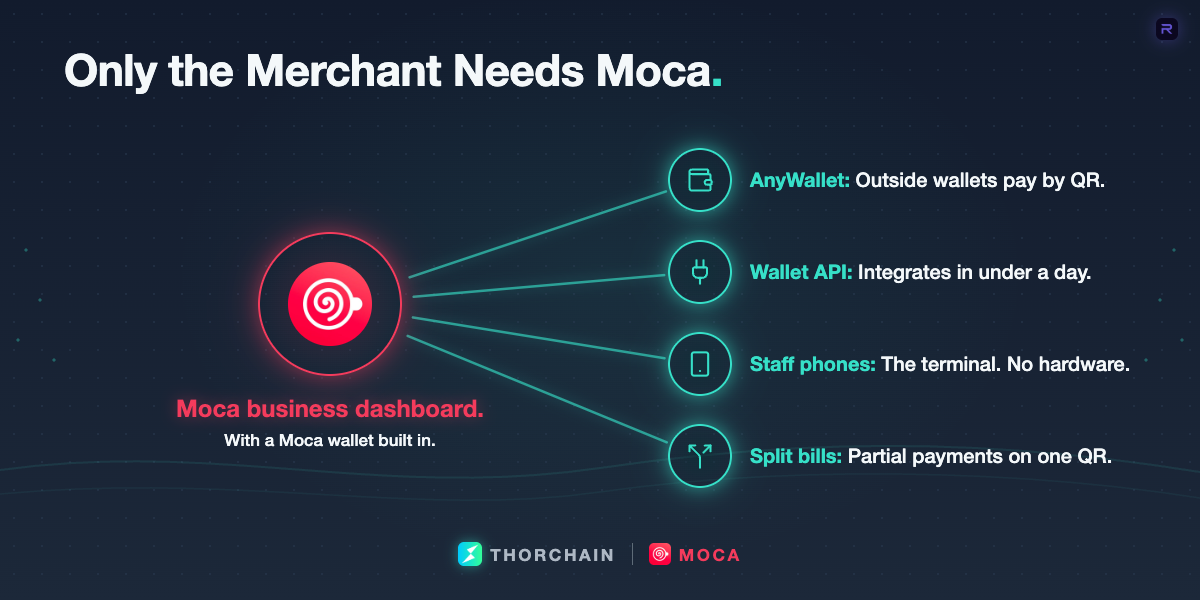
4. Only the Merchant Needs Moca
Asked whether both sides need the Moca app, Eric said no. Asking people to drop the wallet they have used since 2019 would be too much friction, so only the business needs to adopt Moca, he said. Its dashboard comes with a Moca wallet built in.
Customers with any other wallet use AnyWallet, a feature rather than a protocol. They scan the business's QR code, open anywallet.org and paste in the payment details. Eric said this adds a step, so Moca offers APIs that a wallet can integrate in under a day, or a couple of hours with AI, plus the usual security checks. After that, the customer scans and taps confirm. A wallet from the Bitcoin Cash community and one from the THORChain community are already working on integrations.
"The goal is not to make everyone integrate into Moca, because that would be impossible." (Eric)
Eric then demoed the business side live. A business can sign up with Gmail, Discord, Apple, a phone number or a fresh wallet, depending on how much privacy it wants. Every account gets a wallet that supports all of THORChain's chains. Account access is split into three shards, similar to Vultisig: one on the device, one unlocked by the user's PIN or password, and one encrypted by Moca. Any transaction needs two of the three.
From the dashboard, an owner names the store, picks a local currency, such as the Brazilian real, and connects staff devices by QR code. Each staff phone becomes a terminal on iOS, Android or the browser, with no hardware to buy. Kenton singled this out: even a one-person business, like a young person mowing lawns, gets a point of sale for free. Staff enter an amount and see a "paid" check mark when the payment lands. Receipts can be printed, and Moca users can get them by WhatsApp, with other messaging apps being added.
Kenton raised his longtime frustration with splitting restaurant bills. Eric said Moca's QR codes already accept partial payments, so a table can split a bill today. Splitting it automatically by headcount, or letting each diner pay for their own order, would take more work. Eric, who said he is not a developer, believes it is doable because it does not touch the blockchain.
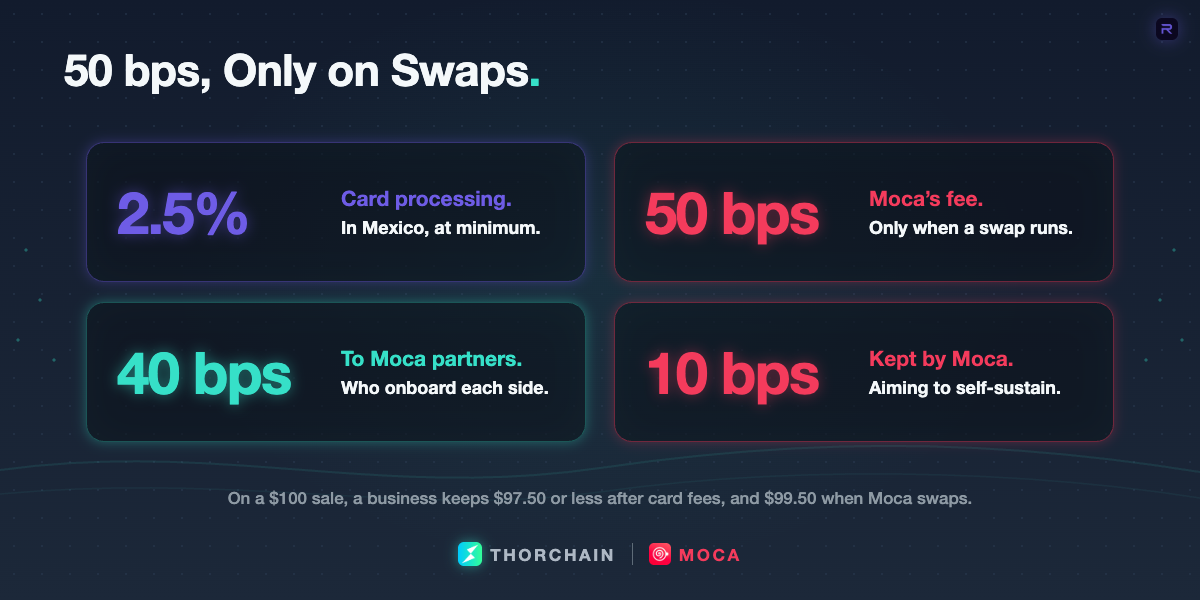
5. 50 bps, Only on Swaps, With 40 bps Going to Partners
Eric explained the economics in Mexican terms. When a customer pays by card, at least 2.5% goes to the payment processor, so a business keeps $97.50 or less of a $100 sale. With Moca it keeps $99.50, even when the payment needs a swap.
Moca charges 50 bps, but only when a payment involves a swap. If a customer pays in $RUNE and the business settles in $RUNE, it is a direct send with only network fees. Eric said the team discussed charging on every payment and decided against it. A business already accepting Bitcoin Cash would not switch for convenience if it cost 50 bps.
"Making revenue right now is not as important as getting adoption." (Eric)
The bigger idea is where the fee goes. Of the 50 bps, 40 bps goes to the Moca partners who onboard the business and the customer, up to 20 bps per side. Eric suggested each partner aim to onboard five businesses or customers. Moca keeps 10 bps and aims to be self-sustaining on that. Eric said partners earn on the volume of every business and customer they onboard, with no expiration and no limits, for everyone onboarded in the first phase, which he suggested would be the first year. After that, terms might be capped depending on how the market behaves. He compared it to being an early promoter of Visa.
Partner rewards go to the wallet created with the Moca account, in whichever THORChain-supported coin the partner chooses, such as $RUNE. Eric also floated letting partners receive and bond rewards in a single click someday, an idea rather than a commitment, while admitting someone might be unhappy with him for saying so. When a business joins without a partner, Moca keeps the extra 20 bps for a treasury that can fund incentives later. The partner program is at partners.moca.app.
The hosts asked what happens if competitors force fees down. Eric said the market will decide, and that the treasury gives Moca room to adjust. Asked about future revenue, he floated a paid dashboard tier for multi-store businesses that want deeper analytics, and said the free product should stay good.
"The network is the most important part of this whole thing." (Eric)
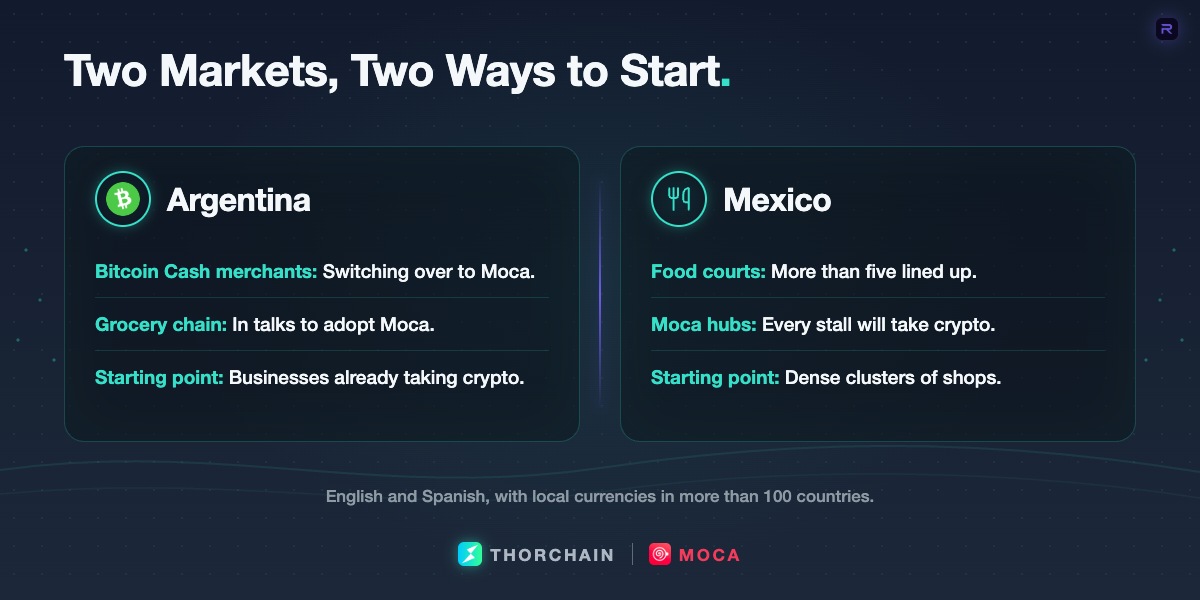
6. Argentina and Mexico: Two Ways to Build a Circular Economy
Moca supports English and Spanish, plus local currencies in more than 100 countries, and anyone who meets their local rules can use it. The go-to-market starts with two countries, deliberately run as an A/B test.
Argentina has heavy crypto adoption and a large Bitcoin Cash community. Moca met that community there about six months ago. Many businesses already accept Bitcoin Cash through a simple solution that, Eric said, does not scale, and the community has agreed to steer those merchants to Moca at launch, so they will keep receiving $BCH through Moca's app. Eric mentioned the Dash community alongside Bitcoin Cash as peer-to-peer communities interested in Moca. Moca is also talking with a grocery store chain in Argentina that plans to adopt Moca once Moca meets its requirements.
Mexico is a market the team knows well. Moca has arrangements with more than five food courts, where every stall will adopt Moca at launch. They will be marketed as Moca hubs or crypto hubs, a name still being decided, with a map showing where to spend crypto. Eric noted that more than 40% of Mexico's economy is informal.
The bet is that circular economies start small and local. If five coffee shops on one street ask the same napkin supplier to accept crypto, the supplier is far more likely to say yes than if one asks alone. Stalls could ask their landlords to accept rent in crypto. One of the hosts put it simply: a circular economy has to start as an actual circle, then grow from one street to a neighborhood. Eric added that Moca has plans for funding to speed this up. Answering a viewer question, Denny confirmed that other Latin American countries can use Moca too.
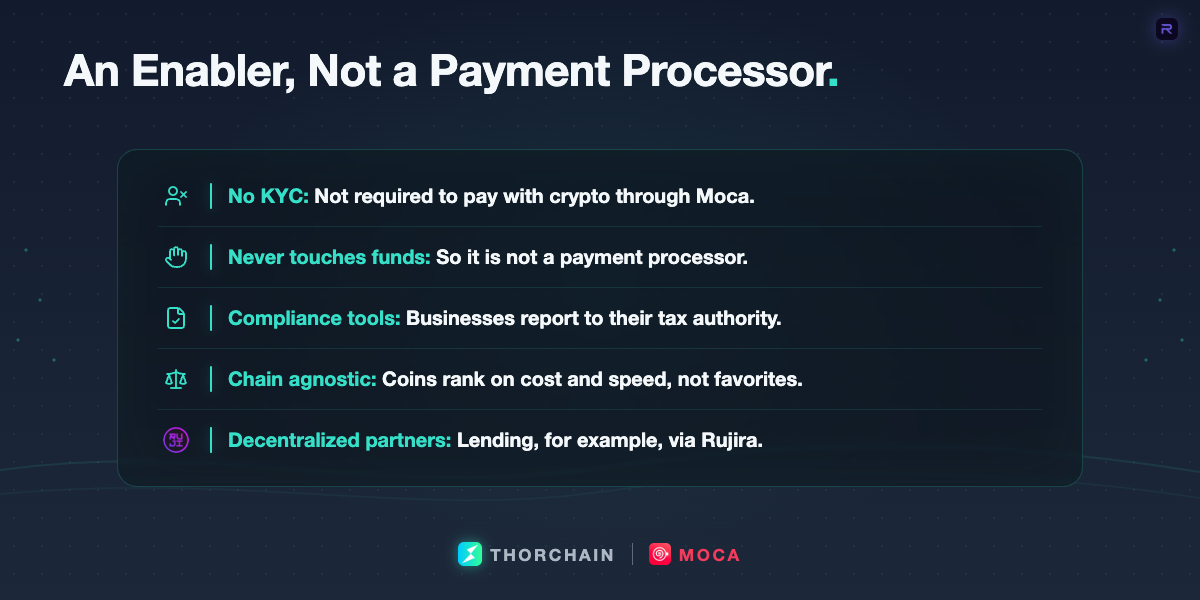
7. No KYC, Never Touching the Money
Asked whether Moca requires KYC, Eric said no. It is one of four stances the company says it will not change. Eric said that because Moca never takes custody of funds, it is not a payment processor and is not legally required to collect identity data, so it neither asks for nor stores it.
"We are just an enabler for payments. We are not a payment processor." (Eric)
Off-ramps may have their own KYC requirements. A business that never off-ramps never goes through KYC. Eric compared using crypto to using cash: compliance is the business's responsibility, so Moca builds tools that help businesses report to their tax authority. For future features such as lending, he said Moca would rely on decentralized systems aligned with THORChain, such as Rujira, rather than run them itself. Moca also cannot shut anyone off. Eric contrasted that with digital payment platforms that have cut off users over politics.
Moca is also deliberately chain agnostic. Eric said the team told the Bitcoin Cash community in Argentina it would never put Bitcoin Cash at the top of the payment options unless it earned the spot on cost or speed. The same applies to THORChain. Eric said Moca is not competing with THORWallet or Vultisig either, because it is bringing in new users rather than taking existing volume.
His closing ask was for Moca partners, especially from the "Valhalla adjacent" THORChain and Maya community. Moca has stickers ready for businesses, plus a special version for those partners that puts the THORChain and Maya logos underneath.
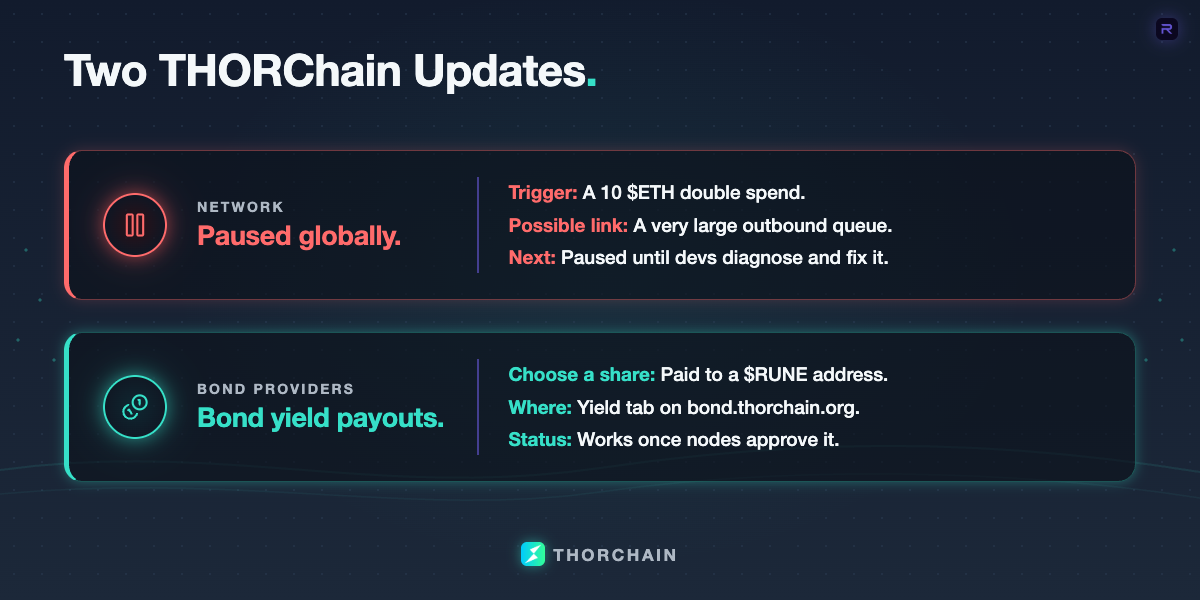
8. THORChain Notes: A Global Pause and Bond Yield Payouts
Denny opened with a network update. At the time of recording, THORChain was paused globally after a 10 $ETH double spend. He said the cause is not yet clear and may be linked to the very large outbound queue built up by a high number of swaps. The network was to stay paused until developers diagnose and fix the problem.
Kenton shared a feature he believes he first requested about four years ago. Bond providers will be able to choose a percentage of their rewards to be sent to their $RUNE address, instead of compounding everything back into the node, so those rewards are free to trade or use. The option is on bond.thorchain.org under the Yield tab. Kenton was not sure whether nodes have approved the feature yet, and it will not work until they do. Kenton said it is still being refined and asked users for feedback.
What to Watch
- Moca's two launch dates: Crypto-savvy businesses are slated for November 6 and ordinary merchants for November 20. Watch whether Moca hits both, and how the beta businesses' UX feedback shapes the release.
- Off-ramps and the card: Which off-ramp partners arrive at launch, and how the crypto card works for businesses that want to spend what they receive.
- Argentina and Mexico: Whether the Bitcoin Cash merchants switch over, the grocery chain adopts, and the food-court hubs turn into a working circular economy.
- Wallet integrations: Whether the Bitcoin Cash and THORChain community wallets ship one-tap Moca payments, and whether others follow.
- v2 in Q1 2027: Whether inventory and table and order features arrive on schedule, and whether automatic bill splitting makes the cut.
- THORChain's restart: What developers find behind the $ETH double spend, when the network resumes, and whether nodes have approved bond yield payouts.

More THORChain data, check out raynalytics.net
Follow Raynalytics for more Weekly Analytics and Podcast recaps.

Related articles
![Protocol Update Podcast with CodeHans, Pragmatic Monkey, Boone, Chad Barraford, Kenton and Denny]()
Oct. 29, 2026
Inside Rujira’s Kaiyo Debate: Can a Rujira Chain Stay Aligned With THORChain?
- Podcast
![Ecosystem Update Podcast with Zodl]()
Oct. 23, 2026
Zodl and THORChain: Shielded Zcash, Zodl Vault and the Case for Redundant Swap Routes
- Podcast
![Protocol Update Podcast with Chad Barraford, Kenton and Denny]()
Oct. 22, 2026
Monero on THORChain Waits on v3.21.1, SwapKit Rev-Share and 2-Second Blocktime
- Podcast
![Protocol Update Podcast with Chad Barraford, Kenton and Denny]()
Oct. 15, 2026
SwapKit Rev-Share Week One: Early Data Looks Promising, v3.21 and Monero Next
- Podcast
![Ecosystem Update Podcast with Zano]()
Oct. 10, 2026
Zano’s Recovery Plan and the Road to THORChain
- Podcast
![Protocol Update Podcast with Chad Barraford, Kenton and Patriot]()
Oct. 8, 2026
Chad's Unchained Podcast Debrief, Rev-Share and Monero
- Podcast
![Ecosystem Update Podcast with Houdini Swap]()
Oct. 3, 2026
Houdini Swap on THORChain Explained: What It Means for Users and Treasury Revenue
- Podcast
![Protocol Update Podcast with Chad Barraford, Kenton and Denny]()
Oct. 1, 2026
Can or Should THORChain Censor Transactions?
- Podcast
![Protocol Update Podcast with Chad Barraford, Kenton, Devel and Boone]()
Sep. 24, 2026
Inside the Houdini Swap Debate: THORChain’s Treasury, Privacy and Revenue
- Podcast
![Ecosystem Update Podcast with Radix]()
Sep. 19, 2026
Radix and THORChain: Building Trust for the Agentic Future
- Podcast
![THORChain Podcast protocol update cover]()
Sep. 17, 2026
THORChain Returns to Shipping: Zcash, Monero and Self-Sufficiency
- Podcast
![Ecosystem Update Podcast with Station Wallet]()
Sep. 13, 2026
Terra’s Station Wallet Is Back as Vultisig’s Agentic THORChain Wallet
- Podcast
![Protocol Update Podcast with Chad Barraford, Kenton and Patriot / Denny]()
Sep. 10, 2026
THORChain Prioritizes Stability Before Monero and New Features
- Podcast
![Ecosystem Update Podcast with RAVN]()
Sep. 5, 2026
Inside RAVN’s Native $BTC Aggregator and Its THORChain Integration
- Podcast
![Protocol Update Podcast with Hans, Devel, Chad, Kenton & Denny]()
Sep. 3, 2026
THORChain Churns Again: POL Goes Live, Rujira Resumes and BLO Debate
- Podcast