THORSday Community Podcast #248 ft. CBarraford, KentonC137 & Patriotsounds | November 5, 2026 | Watch the full episode on YouTube
By Raynalytics
TL;DR
- v3.21.1 finished the Monero work, so the chain now has everything it needs to add $XMR. It still needs a working churn first, and Chad, Kenton and the PR agency suggested holding off on real liquidity until the Binance hack news cycle passes. The nodes decide.
- SwapKit Rev-Share is holding at about 2.2x. Ray's analysis found smaller trades return close to 3x and trades above about $100K closer to 2x. He also found the bugs that the SwapKit team is now fixing.
- Base trading is paused until v3.22, which Chad expects to take about two weeks with the node vote. v3.21.2, a Bifrost patch to restart Solana, should land within about a day.
- Bond providers can now have part of their yield paid to their wallet, in any asset via a THORName preferred asset, and Kenton proposed letting a single bond provider leave at a churn without forcing the whole node out.
- The hosts sketched a single THORChain vault guarded by a multisig across five or six signing parties, and Chad laid out the tradeoffs that would come with it.
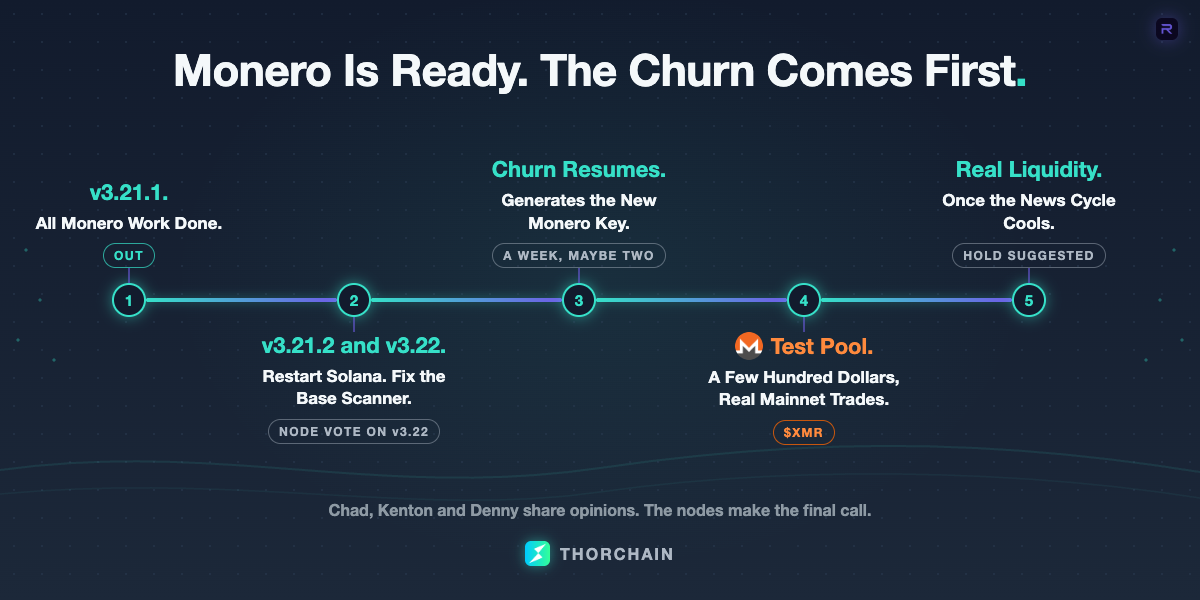
1. Monero Is Ready in v3.21.1, but the Launch Timing Is Open
v3.21.1 is out, and Chad said it completed all the Monero work: the chain now has everything it needs to add $XMR. The catch is the churn. Monero needs an entirely new private key, which can only be generated in a churn, and THORChain still cannot churn while Solana is stuck and Base is paused (see Section 3). Chad's estimate is at least a week, maybe two.
That delay may suit the timing. Chad asked whether THORChain should flip Monero on at all while the Binance hack dominates the news. The integration has been in the works for months and has nothing to do with the hack, but he worried it could look like THORChain poking the bear, and said his own preference is to hold off until the noise calms down.
Kenton said MarketAcross, the PR agency he has been consulting, gave the same advice. Beyond the optics, a launch now would waste the moment: the goal has always been to get journalists to write about Monero on THORChain voluntarily, and that will not happen in the middle of this news cycle.
"We don't control THORChain, right? We're just offering our opinions and ideas." (Kenton)
The hosts landed on a middle path. The pool needs to go live with just a few hundred dollars first anyway, for real test trades on mainnet, and that alone could take a week or two and surface bugs. The part to hold back is adding real liquidity, not the preparation. Chad floated a symbolic ADR to get the community's official view, and the hosts stressed that the quorum of nodes makes the call. Chad also discussed Monero on Monero Talk with Douglas Tuman later that evening.

2. SwapKit Rev-Share Holds at 2.2x, With Small Trades Returning the Most
Rev-Share with SwapKit is still returning about 2.2x: for every $1 of credits THORChain gives SwapKit to discount quotes, it gets back about $2.20 in fees. That is the same level reported after the accounting fix in the Podcast #246 recap.
Chad credited Ray with two findings. Ray found a couple of small bugs that the SwapKit team is now fixing. One of the bugs leaves roughly $4K to $5K of deposits not yet counted. Ray also broke the return down by trade size: smaller trades come back at close to 3x, while trades above about $100K return closer to 2x.
The hosts walked through Ray's SwapKit Revenue Share dashboard. About $18K of credits had accrued, about $12K had been spent and about $6K remained, with single days reaching as high as 3.8x. On the fees tab, THORChain had kept about $52K more in liquidity fees than its pre-Rev-Share baseline, after paying the credits.
"If I give you a dollar and you give me $2.20, that's pretty good." (Chad)
SwapKit is coming out ahead too. Rough math on the show put its extra earnings at about $10K on around $13M of volume, though Chad said only SwapKit can know the exact figure. Chad said the volume THORChain receives from SwapKit has nearly doubled, as has THORChain's share of SwapKit's volume, and the dashboard's wallet tab shows a wave of new wallets since activation.
There is more to come. Trust Wallet is not yet enabled to spend credits and needs a conversation with its team, which Chad expects to take a couple of weeks. SwapKit also wants to spend more precisely, with partial discounts such as 4, 5 or 7 bps instead of all or nothing on its 10 bps fee. Raising the share from 20% to 25% does not make sense yet, Chad said, because SwapKit is not spending everything it receives. Meanwhile, Rujira is working on keeping THORChain's pool prices more tightly coupled to market prices, which should make each discount win more trades.
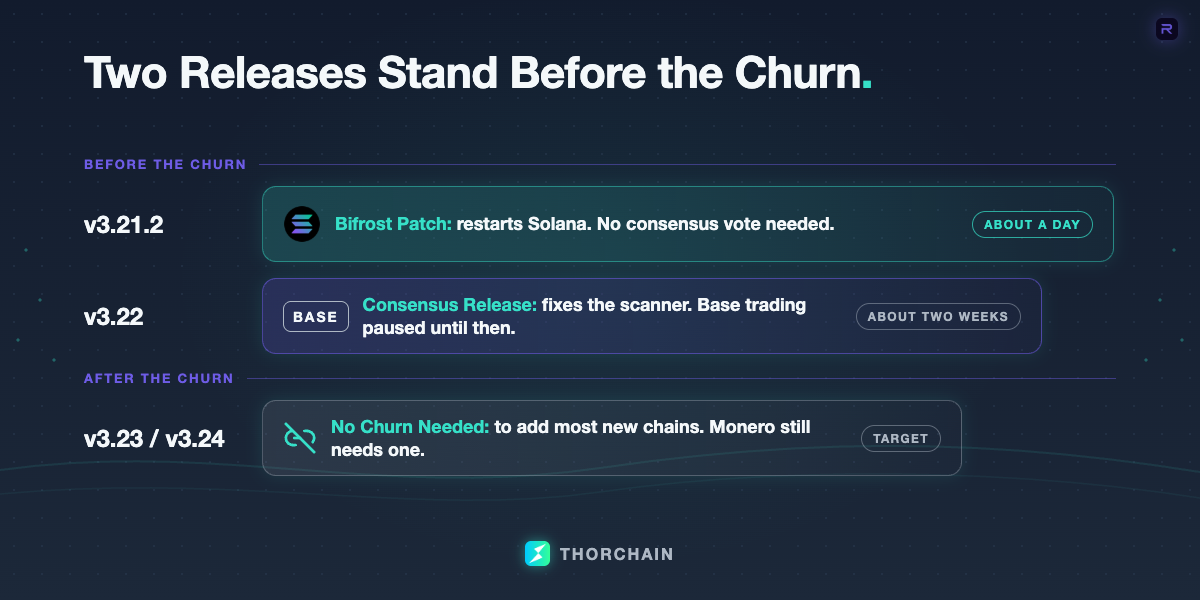
3. v3.21.2, v3.22 and the Base Pause: What Stands Before the Churn
Two releases stand between THORChain and a working churn. v3.21.2 fixes Solana, which is still stuck. It is a patch release that only touches Bifrost, not the consensus layer, so nodes can update whenever they like without a coordinated vote, and Chad hoped it would go out within a day. The hosts would like Solana trading again while Chad is in London next week.
v3.22 is the bigger one. Denny flagged during the show that Base had changed its block times to around 200 milliseconds, and minutes later nodes paused Base trading over scanner issues, which Chad assumed were tied to the block-time change. The fix needs a consensus release, and the node vote to adopt one generally takes about a week, so Chad guesstimated about two weeks before v3.22 is live.
"They're all changing themselves all the time and shutting down, and because we're downstream from all of them, it's just really, really difficult." (Chad)
Chad has also been pushing to remove the churn requirement for adding chain clients, targeting v3.23 or v3.24. More than 90% of new chains could then be added at any time, since THORChain already supports the ECDSA and EdDSA signing schemes they use. Monero is the rare exception, because it needs its own new key.
One smaller item: the vote to change the memoless pricing curve has passed. With it, each new memoless registration gets more expensive as fewer slots remain. Memoless itself still needs to be switched back on, and Boone said in the chat that it can be, but more urgent work got in the way.
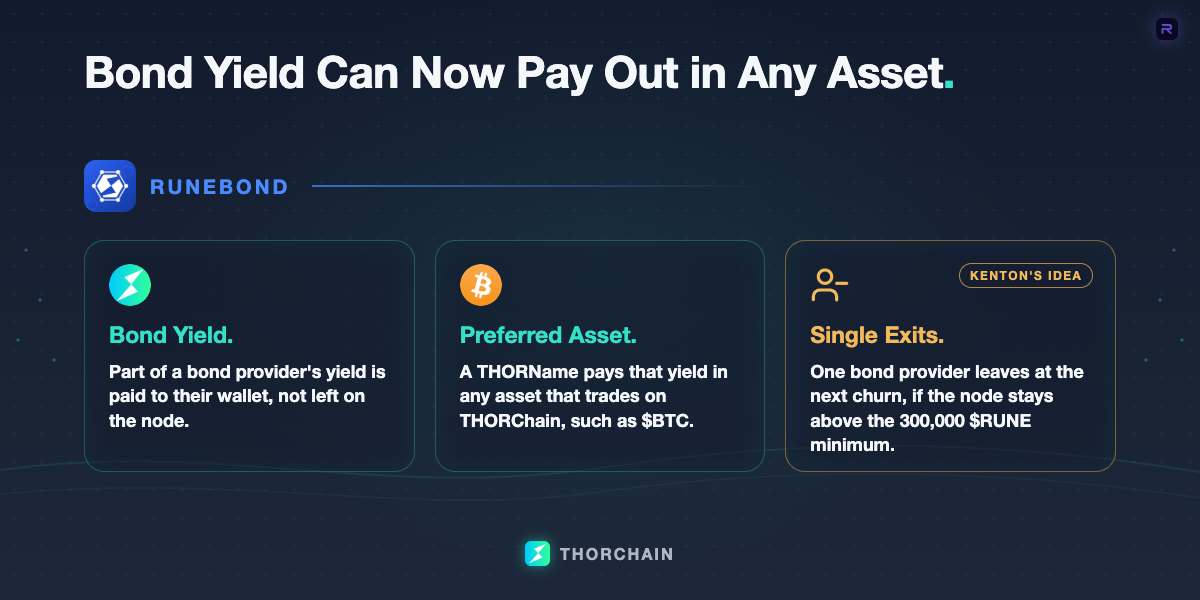
4. Bond Yield, Preferred Assets and Kenton's Idea for Bond Provider Exits
Kenton shouted out Denny and RUNEBond for surfacing bond yield. Bond providers can now have a percentage of their yield paid to their wallet, where they can use it, instead of leaving it locked on the node. RUNEBond also pointed out that the payout does not have to be $RUNE. With a THORName, it can come in any asset that trades on THORChain.
That works through a THORName's preferred asset. Owners can go to thorname.thorchain.org, click manage and pick an asset, such as $BTC or $LTC, with a receiving address that does not even need to belong to the connected wallet. Bond yield, or affiliate fees for partners, then pays out in that asset. Kenton, who had missed the feature, has since added it to THORChain Swap, and noted that a THORName can receive any asset on THORChain.
The hosts asked whether node operators should get the same option. A node operator they checked with confirmed that operator commissions are already paid out each churn, outside the bond, which matters more than ever while churns are hard to complete. Operators might also want that fee in stablecoins straight away to avoid $RUNE price risk.
Then Kenton floated a new idea. Most nodes are funded by many bond providers, and today a single provider with 20,000 $RUNE who wants out forces the whole node to churn out and back in. He proposed letting the node eject just that provider at the next churn, as long as the node stays above the 300,000 $RUNE minimum bond. Chad added a variant where a provider could leave between churns if someone else swaps in with the same amount.
"In general, when it comes to money, the easier it is to withdraw, the stickier the money." (Kenton)
Chad said it is not a bad idea but wants to think through the game theory. One risk they discussed: if node operators control the exit, a bad operator could push out the bond providers who hold it accountable, so any version should keep that power with the bond providers. The hosts asked node operators for feedback.
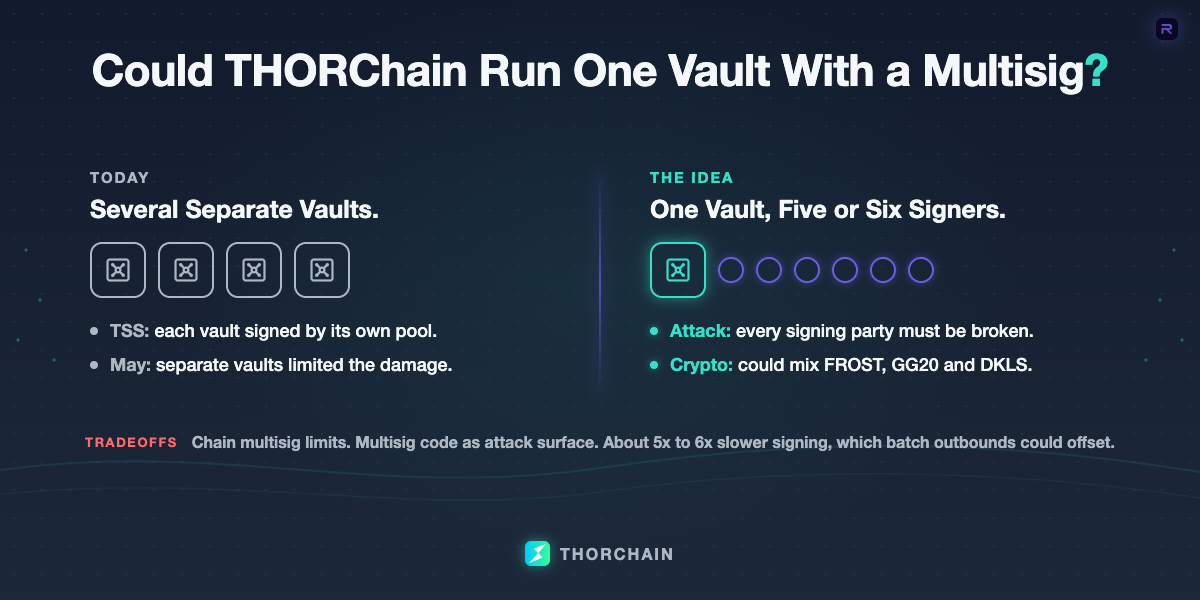
5. Could THORChain Move to One Vault With a Multisig?
The hosts raised a devil's-advocate point. If THORChain grows to a billion dollars in TVL, it becomes the giant honeypot, and keeping funds across multiple vaults is what limited the damage in May.
The hosts sketched an alternative: a single vault controlled by a multisig across five or six signing parties, which Chad called an option. Each party is a signing pool with no funds of its own, and together they produce the signatures to move funds. An attacker would have to break every one of them, and Chad said the count could be 30 or 100. The hosts also floated using different cryptography on each key, such as FROST for one, GG20 for another and DKLS for a third.
Chad laid out why THORChain does not use multisig today. Each chain implements it differently, some cap the number of signers, and some do not support it at all, while THORChain was built to support any chain with as few requirements as possible. Multisig code is also attack surface: Bitcoin once had a significant multisig bug. Having every signing party sign every transaction would also cut signing throughput by about 5x to 6x and lengthen the outbound queue, though batch outbounds, sending many Bitcoin outputs in one transaction, could offset that.
"The more surface area of your code, the more difficult it is to secure." (Chad)
That logic is also why THORChain is moving away from GG20 toward FROST or DKLS. The newer schemes have cleaner, simpler math, which makes it easier to verify that an implementation matches the math and cannot leak private key data through failed key signs.
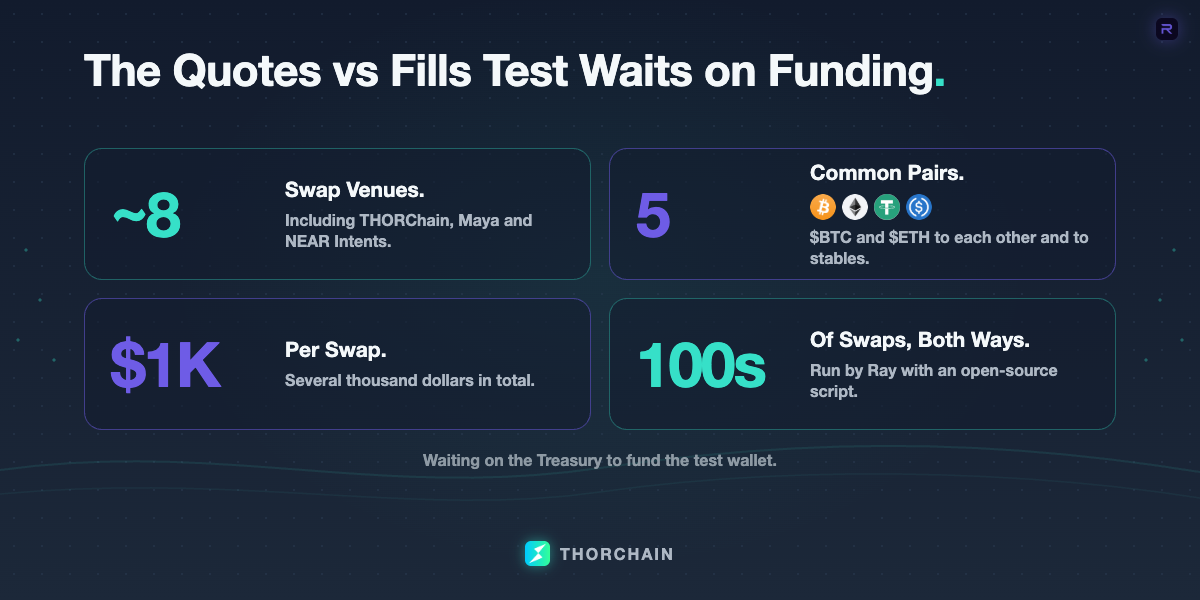
6. The Quotes vs Fills Experiment Is Waiting on Funding
Kenton said Randy has been hearing from wallets that are taking a harder look at whether their swap providers' quotes match execution, and some may start turning providers off for feeding bad quotes. Randy has been pushing for the quotes vs fills experiment first proposed in the Podcast #243 recap.
Kenton and Ray went back and forth on the procedure, which is now quite different from the first draft. It compares about eight venues, including THORChain, Maya Protocol and NEAR Intents, on the five most common pairs that every venue supports: $BTC to $ETH, $BTC to $USDT, $BTC to $USDC, $ETH to $USDT and $ETH to $USDC. Each pair runs back and forth many times, for several hundred swaps. Each swap is $1,000, which keeps the total cost to several thousand dollars instead of a few hundred thousand, and the small end is where THORChain loses trades today.
Asked whether a firm like Messari or Blockworks should run it independently, Kenton said they would want to be paid, while Ray will run the whole thing with an open-source script anyone can check. If the results went viral, Kenton would welcome a third party re-running it.
Ray thinks the experiment should wait a bit while hacked volume is moving, though testing the other venues can start. Either way, it needs the Treasury to fund the wallet, and Chad admitted it had dropped off his radar.
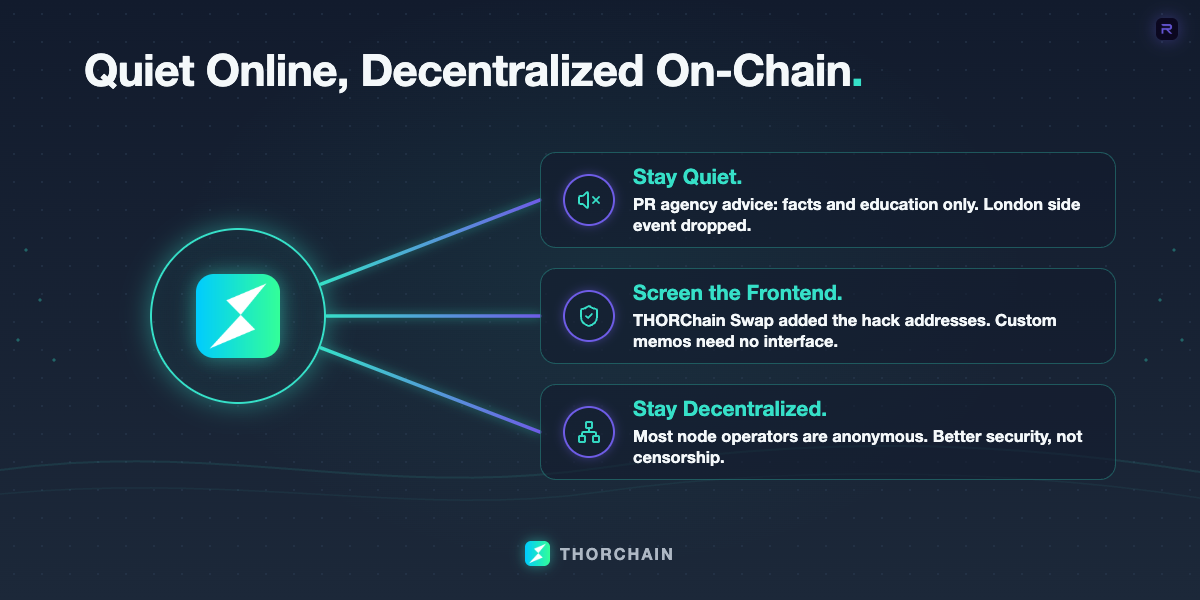
7. Staying Quiet After the Binance Hack, and Making the Case for Decentralization
The episode opened with the Binance hack, the roughly $6.3 billion theft the FBI has attributed to North Korea, and the hosts were clear that the THORChain community does not condone illicit activity of any kind. Kenton said MarketAcross advised THORChain to stay quiet, ignore trolls and let the story pass, so the THORChain account will stick to facts and education for now. The team also dropped plans for a side event at Breakpoint in London. The hosts also floated a semi-comedic video series explaining how THORChain and DeFi actually work, and Kenton asked anyone THORChain or DeFi has genuinely helped, even with $50, to share their story.
THORChain Swap has added the addresses from the hack to its wallet screening. Kenton said screening is a small attempt to protect the people behind the frontend, since the protocol is permissionless but the interface is not. It cannot stop everything: anyone can write a custom memo, with any affiliate's THORName, without touching an interface. He also pointed to LetsExchange, which shut down after compliance became too costly.
Chad argued THORChain is more decentralized than the networks critics hold up. Bitcoin's largest mining pools, such as Foundry USA, and Ethereum's large staking providers are known, registered entities, while most THORChain node operators are anonymous, as he and JP advised from the start. Kenton added that most nodes run on other people's $RUNE: if one operator were forced to shut down, the bond providers would move to another node, and transactions would only be delayed.
"The solution isn't better censorship, it's better security." (Kenton)
The same logic shaped the protocol's design, Chad said: THORChain has no dependencies such as oracles, so problems elsewhere cannot break it. He contrasted that with Aave, which froze lending through a guardian multisig after the hacker borrowed against stablecoins. On protocol-owned liquidity in stablecoin pools, Chad argued an issuer freeze is less of a risk for an AMM, because arbitrageurs trade illicit stablecoins back out of the pool. Boone has opened a merge request letting nodes choose a pool for POL, though Chad prefers algorithmic designs over more governance.
The hosts also thanked the neighboring communities who defended THORChain online, naming Dash, Zano, Quai Network, Zephyr and Pirate Chain.
What to Watch
- v3.21.2 restarting Solana, then v3.22 fixing the Base scanner and passing the node vote.
- The churn resuming, the $XMR test pool and whether nodes hold real liquidity until the news cycle cools.
- Trust Wallet joining SwapKit Rev-Share, and whether 2.2x holds once the counting bugs are fixed.
- Node operator feedback on Kenton's bond provider exit idea.
- The Treasury funding Ray's quotes vs fills experiment.
- Chad at Breakpoint in London next week.
More THORChain data, check out raynalytics.net
Follow Raynalytics for more Weekly Analytics and Podcast recaps.

Related articles
![Ecosystem Update Podcast with Moca]()
Oct. 31, 2026
Moca Nears Launch & How It Uses THORChain to Bring Crypto Payments to the Register
- Podcast
![Protocol Update Podcast with CodeHans, Pragmatic Monkey, Boone, Chad Barraford, Kenton and Denny]()
Oct. 29, 2026
Inside Rujira’s Kaiyo Debate: Can a Rujira Chain Stay Aligned With THORChain?
- Podcast
![Ecosystem Update Podcast with Zodl]()
Oct. 23, 2026
Zodl and THORChain: Shielded Zcash, Zodl Vault and the Case for Redundant Swap Routes
- Podcast
![Protocol Update Podcast with Chad Barraford, Kenton and Denny]()
Oct. 22, 2026
Monero on THORChain Waits on v3.21.1, SwapKit Rev-Share and 2-Second Blocktime
- Podcast
![Protocol Update Podcast with Chad Barraford, Kenton and Denny]()
Oct. 15, 2026
SwapKit Rev-Share Week One: Early Data Looks Promising, v3.21 and Monero Next
- Podcast
![Ecosystem Update Podcast with Zano]()
Oct. 10, 2026
Zano’s Recovery Plan and the Road to THORChain
- Podcast
![Protocol Update Podcast with Chad Barraford, Kenton and Patriot]()
Oct. 8, 2026
Chad's Unchained Podcast Debrief, Rev-Share and Monero
- Podcast
![Ecosystem Update Podcast with Houdini Swap]()
Oct. 3, 2026
Houdini Swap on THORChain Explained: What It Means for Users and Treasury Revenue
- Podcast
![Protocol Update Podcast with Chad Barraford, Kenton and Denny]()
Oct. 1, 2026
Can or Should THORChain Censor Transactions?
- Podcast
![Protocol Update Podcast with Chad Barraford, Kenton, Devel and Boone]()
Sep. 24, 2026
Inside the Houdini Swap Debate: THORChain’s Treasury, Privacy and Revenue
- Podcast
![Ecosystem Update Podcast with Radix]()
Sep. 19, 2026
Radix and THORChain: Building Trust for the Agentic Future
- Podcast
![THORChain Podcast protocol update cover]()
Sep. 17, 2026
THORChain Returns to Shipping: Zcash, Monero and Self-Sufficiency
- Podcast
![Ecosystem Update Podcast with Station Wallet]()
Sep. 13, 2026
Terra’s Station Wallet Is Back as Vultisig’s Agentic THORChain Wallet
- Podcast
![Protocol Update Podcast with Chad Barraford, Kenton and Patriot / Denny]()
Sep. 10, 2026
THORChain Prioritizes Stability Before Monero and New Features
- Podcast
![Ecosystem Update Podcast with RAVN]()
Sep. 5, 2026
Inside RAVN’s Native $BTC Aggregator and Its THORChain Integration
- Podcast