Inside Nym’s Mixnet: How It Hides Crypto Wallets, Node Operators and You From Surveillance

— 13 min read
- Podcast
THORChain x Nym Podcast #253 ft. alexis_roussel, KentonC137 & Patriotsounds | November 21, 2026 | Watch the full episode on YouTube
By Raynalytics
TL;DR
- Nym's mixnet chops traffic into same-size packets, sends each on its own route through about 700 community-run servers and shuffles them at every hop. Alexis said that, unlike a VPN or Tor, even someone watching the whole network cannot tell who is talking to whom.
- NymVPN runs on top of the mixnet. A zero-knowledge credential called a zk-nym separates what users paid from how they use the network, so, as Alexis put it, Nym "cannot snitch on you."
- Wallets such as Edge already let users route through the mixnet, and Alexis said a blockchain's own node network could one day run on it too. For THORChain node operators, the open question is speed: the mixnet's latency is about a second.
- $NYM trades mostly as an ERC-20. Kenton pitched an ERC-20 $NYM pool on THORChain, and Alexis said Nym can "definitely add" one. Nothing has been scheduled yet.
- Alexis offered the THORChain community free one-month NymVPN vouchers, and the hosts asked listeners to comment on the episode's YouTube video or X post to request one.
Introduction
A VPN hides your IP address from the websites you visit, but the VPN server still sees where you come from and where you are going. That is the gap Nym was built to close.
Alexis Roussel, co-founder and COO of Nym, joined Kenton and Denny for a Saturday interview, two days after Joel Valenzuela named Nym as the kind of tool cypherpunks should use in his episode on Dash and cypherpunk allies. He explained how Nym's mixnet differs from a VPN and Tor, why the company cannot hand over its users, and how wallets and node operators can hide their traffic. He also told the story of the digital right he helped write into two Swiss constitutions, and talked about a possible $NYM pool on THORChain.
1. Meet Alexis Roussel, From Bity to Nym
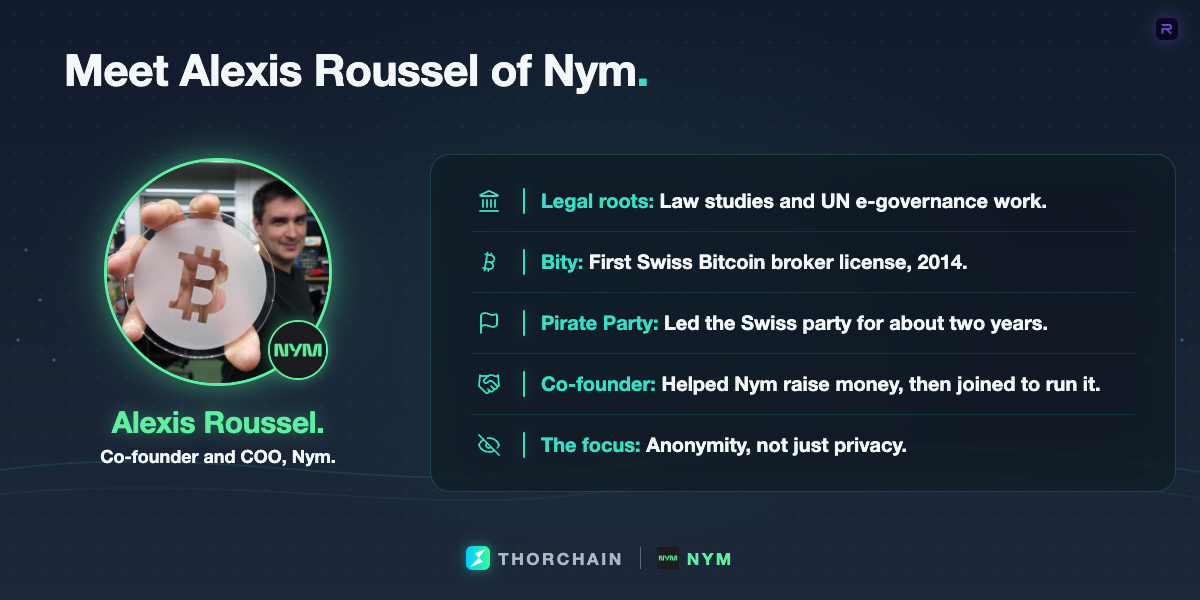
Alexis Roussel has followed Bitcoin since it appeared around 2009 and 2010. He studied law, without becoming a lawyer, and worked at the UN as an e-governance specialist, studying how governments and institutions use technology. When Bitcoin arrived, he said, his interests in privacy, cryptography and energy networks all came together.
He led the Swiss Pirate Party, which he called the first digital-native political party, for about two years. In 2013 he started building Bity, which received the first Swiss license for a Bitcoin broker in early 2014. He ran it for about seven years, offering crypto-to-fiat salary and invoice payments and a Bitcoin ATM network, and helping projects raise money. After the DAO hack on Ethereum, he said, the white hats recovering the funds came to his place, and they spent months making sure the funds went back to the community.
That fundraising work brought him to Nym. He helped its founder, Harry, raise money, admitting he did not understand the technology at first, and then joined as co-founder and COO to run the company. What struck him, he said, was that Nym was the first project working on anonymity rather than privacy. Privacy protects what you have: your data, messages and keys. Anonymity is about becoming unobservable, with no digital footprint at all.
2. VPN vs Tor vs Mixnet
Alexis started with the internet itself. Like Bitcoin, TCP/IP was designed to be fully transparent. TLS, the S in HTTPS, later hid the content of messages, but not the route: anyone watching can still see which IP address talks to which.
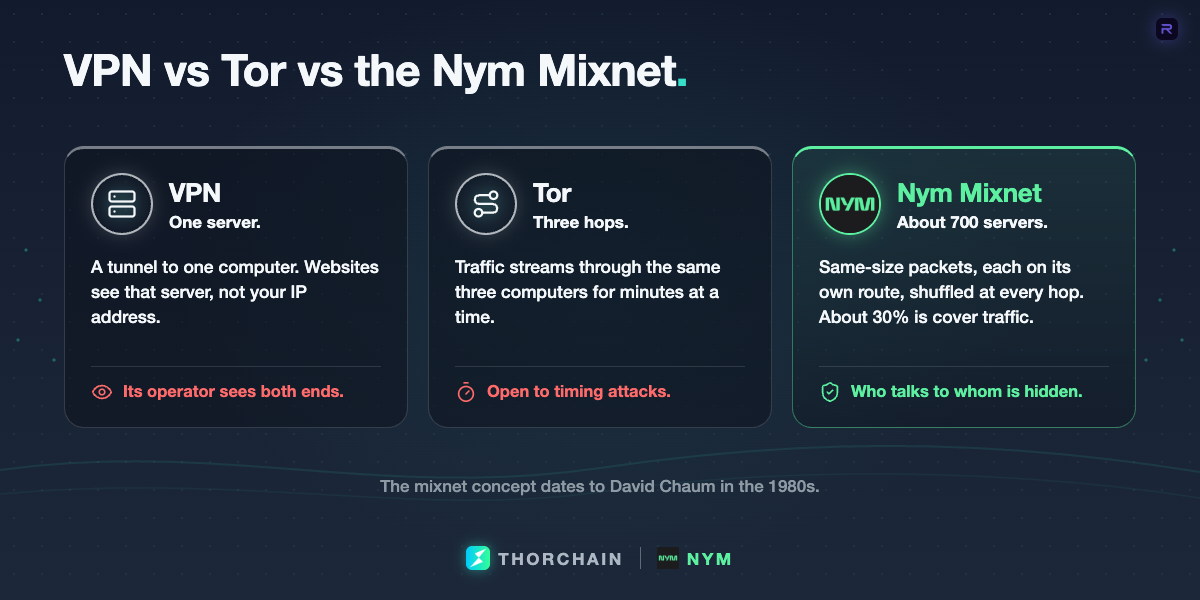
A VPN routes your traffic through one server, so websites see that server instead of you. The weakness, Alexis said, is that whoever runs the server sees both sides. A government, cyber criminal or data broker who gets into it can see where you are and where you go. Tor spreads the risk across three hops on a decentralized network, but traffic streams through the same path for minutes at a time. That makes timing attacks possible, and Alexis said the cost of attacking Tor keeps falling.
The mixnet idea goes back to the 1980s and cryptographer David Chaum. Alexis traced a link to Bitcoin too. In the 1990s, Adam Back ran an anonymous remailer built on a mixnet, and to stop spam he asked senders for proof of work. That is the proof of work Bitcoin later adopted.
Nym's mixnet, launched about six years ago, runs on about 700 servers operated by its community. It chops traffic into packets of the same size, and each packet takes its own route. At every server, packets are shuffled "like a deck of cards" and delayed by different amounts, and about 30% of the traffic is noise. The result, Alexis said, is that even someone observing the whole network cannot tell who is talking to whom.
That anonymity depends on numbers. You cannot be anonymous alone, Alexis said, only inside a large and varied crowd. That is why he opposes an Ethereum-only mixnet: anyone using it would be marked as an Ethereum user.
"Zebra stripes are only as good as the size of the herd." (Kenton)
Alexis does not see Nym as Tor's competitor. Tor is better for browsing and offers hidden services, which Nym does not. Nym focuses on messaging and crypto transactions, where nobody should ever trace the data back to its sender.
3. NymVPN: Built So It Cannot Snitch
Nobody would pay for a mixnet, Alexis said, because people do not understand what one is. People do understand VPNs, and many were already trying to use the mixnet as one. So Nym built NymVPN on top of its infrastructure. Its fast VPN mode uses part of the system, while the full mixnet mode gives up some speed for anonymity. The mixnet itself is free, and VPN subscriptions subsidize it.
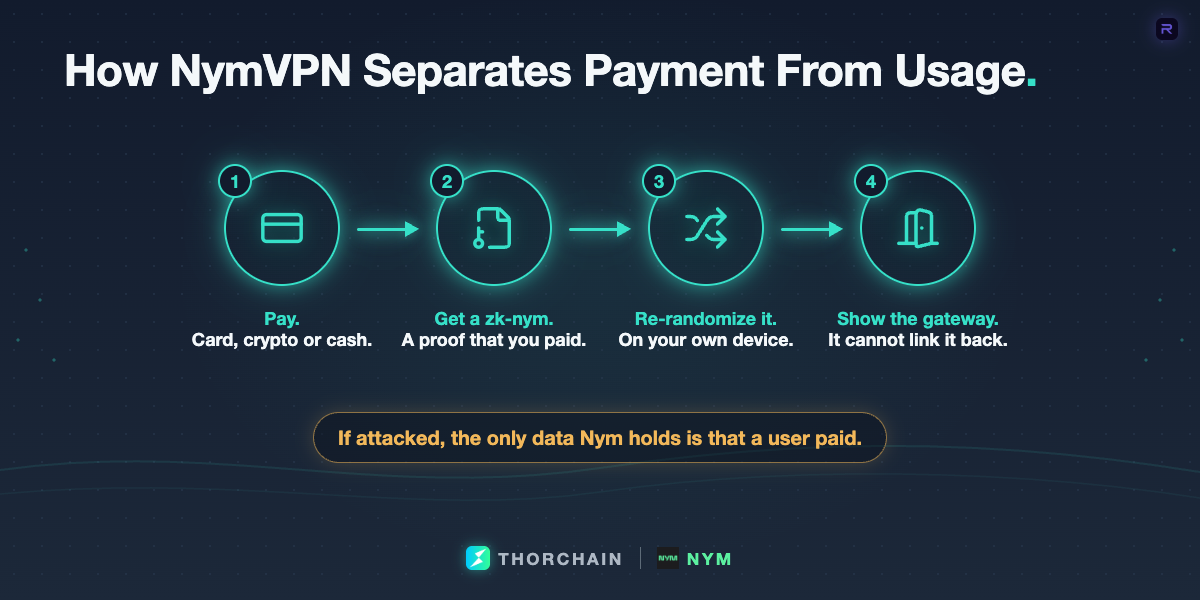
The key piece is the zk-nym, a zero-knowledge proof that you paid for the network. Nym is its first user. You show it to the first gateway you connect to, but if the same proof were shown each time, the gateway and the issuer could collude and match them. So the proof is re-randomized on your own device every time you use it. It stays valid, but nobody can link it to the original, and even the same gateway cannot tell it is the same user.
That lets Nym accept a credit card or transparent $BTC without knowing how the service is used. For private payments as well, it accepts $XMR, $ZEC, Litecoin MWEB and even cash sent by post. If Nym were attacked, Alexis said, the only data it would hold is that you paid.
One of the hosts, a Proton VPN user, asked why he should switch. Alexis called the Proton team friends who do a good job and do not log. But if police arrived with a request and installed a listening device in a centralized VPN's system, they could wait for a user to connect and track them down. Nym never learns where a credential is used.
"We cannot snitch on you." (Alexis)
4. From Crypto Wallets to THORChain Nodes
When you send a Bitcoin transaction, Alexis said, your wallet usually talks to a third-party RPC node that sees your IP address and exactly when you broadcast. Companies like Chainalysis map the world's nodes and time broadcasts to trace transactions back. Monero and Zcash are private on-chain, but your phone provider can still see you connecting to a node. Through the mixnet, the RPC node receives a valid transaction with no idea where it came from. Nym, he said, is about removing metadata: the IP address, timing and location.
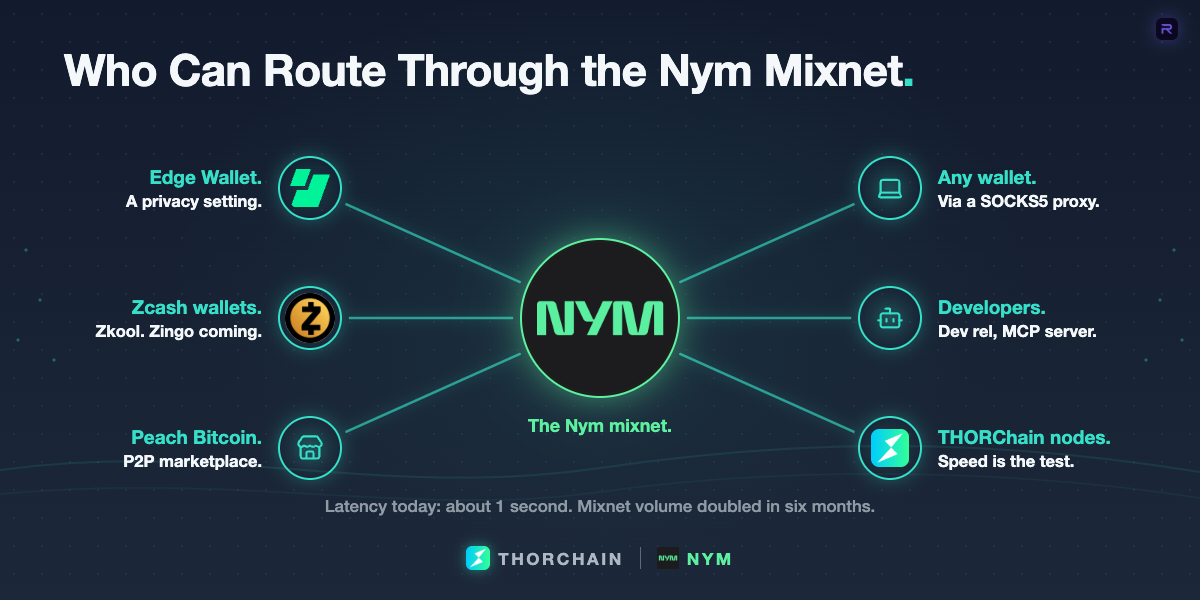
The easiest path is through wallets. Edge Wallet users can enable Nym in their privacy settings, and Alexis integrated the Zkool wallet for Zcash himself. Another Zcash wallet, Zingo, is coming, and Peach Bitcoin has integrated Nym too. Nym's developer relations team helps with integrations, and an MCP server gives developers' AI agents Nym's documentation. Any user can already route a desktop wallet through the mixnet with a SOCKS5 proxy from the Nym app.
THORChain node operators watching the show had questions. Would Nym offer VPS hosting? No: the network's servers belong to its community, who earn for running them, and that financial incentive makes the network more costly to attack than Tor, which runs on goodwill.
Kenton asked how a validator could use Nym. Alexis said Nym has done work for Ethereum and has working examples for Monero. The endgame, he said, is a blockchain's own peer-to-peer network running on the mixnet, so that the whole chain and its users are unobservable from outside.
Speed is the open question. Denny, who had told node operators about the episode, noted that THORChain nodes must perform, because the network slashes them when they do not. The mixnet's latency is about a second, which Alexis said is fine for broadcasting a transaction, but not for a server that needs low latency and high availability. Improving speed is Nym's main task for next year. In theory, more users also means a faster mixnet, since less delay is needed to hide each packet. Volume through the mixnet has already doubled in six months.
"The theory is that the more people are on the mixnet, the faster it can be." (Alexis)
5. $NYM and a Possible THORChain Pool
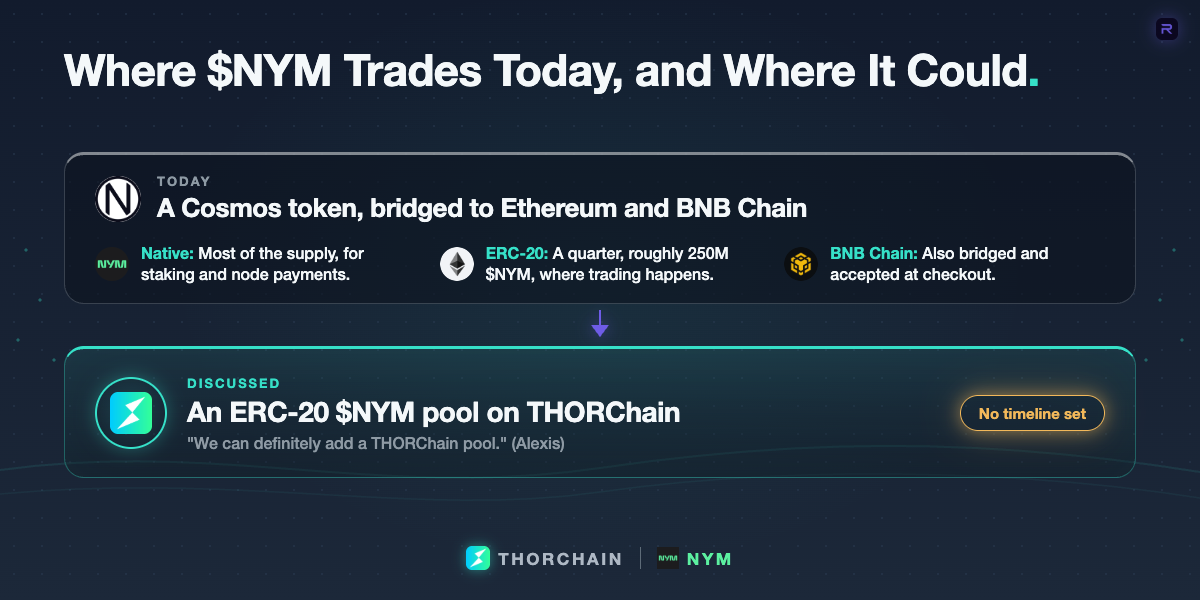
Nym needed a shared, decentralized registry of its servers and a way to pay the people who run them, so it put that logic in a smart contract. $NYM is a Cosmos token, chosen when Ethereum fees were "out of the roof." It is bridged to Ethereum and BNB Chain. Alexis said Nym is blockchain agnostic and might move chains one day.
Most $NYM sits on the native chain, where staking and infrastructure payments happen. About a quarter, roughly 250M $NYM, is bridged as an ERC-20, and that is where the trading happens, including a small Uniswap pool.
Denny urged Nym to bring its token to THORChain, and Kenton made the pitch. THORChain wants more tokens beyond $RUNE, $TCY and $RUJI, and he asked why Nym would let centralized gatekeepers and market makers control its token. He suggested an ERC-20 $NYM pool on THORChain, and Alexis was open to it. Kenton also asked Nym to add THORChain to its list of chains for the token itself, though Alexis said any chain has technical conditions to meet. No timeline was set for either.
"We can definitely add a THORChain pool." (Alexis)
6. How to Try NymVPN, Free for a Month
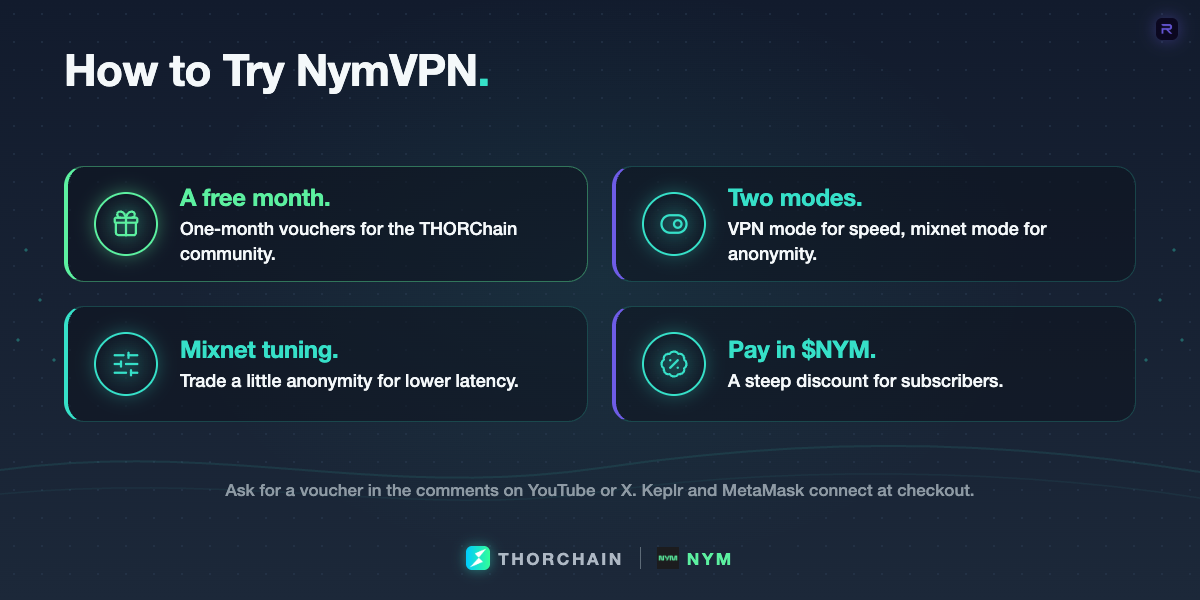
Alexis offered the THORChain community one-month NymVPN vouchers. The hosts asked listeners who want one to comment on the episode's YouTube video or X post asking for a free voucher, and Alexis said Nym would provide enough for everyone who reached out: "If there's 50 people, we'll give you 50 vouchers."
The app, on nym.com and the Apple and Google app stores, shows an entry point and an exit point and switches between VPN mode and mixnet mode. Under settings, mixnet tuning lets users trade a little anonymity for lower latency. The same controls are in the command-line client.
For anyone who subscribes after the trial, paying in $NYM brings a steep discount. Alexis said it is worth buying a little $NYM on the market to pay with. Native, ERC-20 and BNB $NYM are all accepted, and Keplr Wallet and MetaMask connect directly at checkout.
Nym is maturing the software quickly, Alexis said, and wants feedback, especially from places with heavy censorship such as China and Russia. The app already includes features for getting past censorship.
7. The Right to Digital Integrity
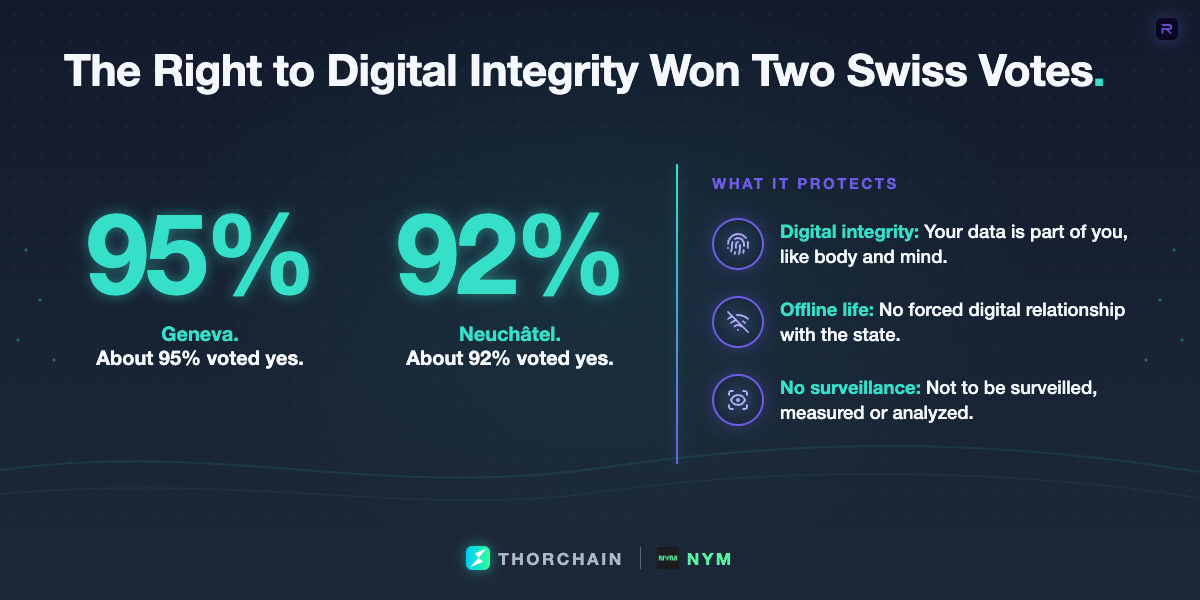
Alexis wrote a book on a new fundamental right: the right to digital integrity. Swiss constitutions already protect physical and mental integrity, so no authority may harm you physically or mentally. He argued that your data and digital footprint are part of you too, and that touching them can manipulate or harm a person.
His case is that privacy law has failed. Privacy rights grew out of wealthy people's fear of journalists, he said, so the burden sits on the individual to defend themselves. GDPR then regulated the market for personal data instead of ending it. Digital integrity flips the default: like abolishing the trade in human beings, it would end the market in personal data, and anyone collecting your data would be the wrongdoer by default.
"By default, anyone who holds data on you is the criminal." (Alexis)
It moved fast, he said, taking about 10 years. A friend on Valais's constitutional assembly put the idea forward, and it was accepted there. Alexis then took it to a constitutional law professor, and a conference at Geneva's law university followed. A Geneva political party put it to a vote, and it passed with about 95% yes. Neuchâtel followed with about 92%. The package includes a right to an offline life, so the government cannot force a digital relationship on you, and a right not to be surveilled, measured and analyzed. That wording, he said, was easier to accept than a "right to anonymity."
A city in France has adopted it, Germany's Die Partei added it to its program, and court cases are starting: one has already been heard, though it failed for other reasons, and more are expected. His co-author, then a journalist, is now Geneva's head of digital affairs, tasked with enforcing it.
Kenton, who is from Alberta, offered to bring the idea to Alberta politicians through his contacts there, calling Alberta the most pro-freedom province in Canada. Denny, nodding along, joked that the episode had become "a nodding simulator."
What to Watch
- A $NYM pool on THORChain: Whether Nym follows through on adding an ERC-20 $NYM pool, and whether THORChain makes its list of chains for the token.
- Mixnet speed: Nym's work next year to cut latency, and whether more users make the mixnet faster, as Alexis's theory predicts.
- Node operators on Nym: Whether any THORChain node operators test routing through the mixnet, and how a node network's peer-to-peer traffic could move onto it.
- More wallet integrations: The Zingo integration and other wallets that add Nym, after Edge, Zkool and Peach Bitcoin.
- Digital integrity: More court cases under the new right, and whether it reaches Canada through Kenton's contacts in Alberta.

More THORChain data, check out raynalytics.net
Follow Raynalytics for more Weekly Analytics and Podcast recaps.

Related articles
![Ecosystem Update Podcast with Joel Valenzuela, Kenton and Denny]()
Nov. 19, 2026
THORChain as Dash’s Stablecoin Bridge? Joel on Shielded Assets and Cypherpunk Allies
- Podcast
![Protocol Update Podcast with Devel, Boone, Kenton and Denny]()
Nov. 14, 2026
THORChain Needs a Churn for $XMR and Base Limit Orders Could Cut Slippage by Up to 20 bps
- Podcast
![Protocol Update Podcast with Andy from Liquify, Kenton and Denny]()
Nov. 12, 2026
Liquify Fixes THORChain’s Quote Slowdown & Kenton Reviews a Year of THORChain Marketing
- Podcast
![Ecosystem Update Podcast with Aaluxx]()
Nov. 7, 2026
Aaluxx on How $MAYA Inspired $TCY, $CACAO’s Fair Launch and Maya’s Aztec Intents
- Podcast
![Protocol Update Podcast with Chad Barraford, Kenton and Denny]()
Nov. 5, 2026
Monero Is Ready on THORChain, Bond Yield and SwapKit Rev-Share
- Podcast
![Ecosystem Update Podcast with Moca]()
Oct. 31, 2026
Moca Nears Launch & How It Uses THORChain to Bring Crypto Payments to the Register
- Podcast
![Protocol Update Podcast with CodeHans, Pragmatic Monkey, Boone, Chad Barraford, Kenton and Denny]()
Oct. 29, 2026
Inside Rujira’s Kaiyo Debate: Can a Rujira Chain Stay Aligned With THORChain?
- Podcast
![Ecosystem Update Podcast with Zodl]()
Oct. 23, 2026
Zodl and THORChain: Shielded Zcash, Zodl Vault and the Case for Redundant Swap Routes
- Podcast
![Protocol Update Podcast with Chad Barraford, Kenton and Denny]()
Oct. 22, 2026
Monero on THORChain Waits on v3.21.1, SwapKit Rev-Share and 2-Second Blocktime
- Podcast
![Protocol Update Podcast with Chad Barraford, Kenton and Denny]()
Oct. 15, 2026
SwapKit Rev-Share Week One: Early Data Looks Promising, v3.21 and Monero Next
- Podcast
![Ecosystem Update Podcast with Zano]()
Oct. 10, 2026
Zano’s Recovery Plan and the Road to THORChain
- Podcast
![Protocol Update Podcast with Chad Barraford, Kenton and Patriot]()
Oct. 8, 2026
Chad's Unchained Podcast Debrief, Rev-Share and Monero
- Podcast
![Ecosystem Update Podcast with Houdini Swap]()
Oct. 3, 2026
Houdini Swap on THORChain Explained: What It Means for Users and Treasury Revenue
- Podcast
![Protocol Update Podcast with Chad Barraford, Kenton and Denny]()
Oct. 1, 2026
Can or Should THORChain Censor Transactions?
- Podcast
![Protocol Update Podcast with Chad Barraford, Kenton, Devel and Boone]()
Sep. 24, 2026
Inside the Houdini Swap Debate: THORChain’s Treasury, Privacy and Revenue
- Podcast