THORChain Podcast #212: ADR29 Fee Debate ft. BooneW, KentonC137 & Patriotsounds | June 28, 2026 | Watch the full episode on YouTube
By Raynalytics
TL;DR
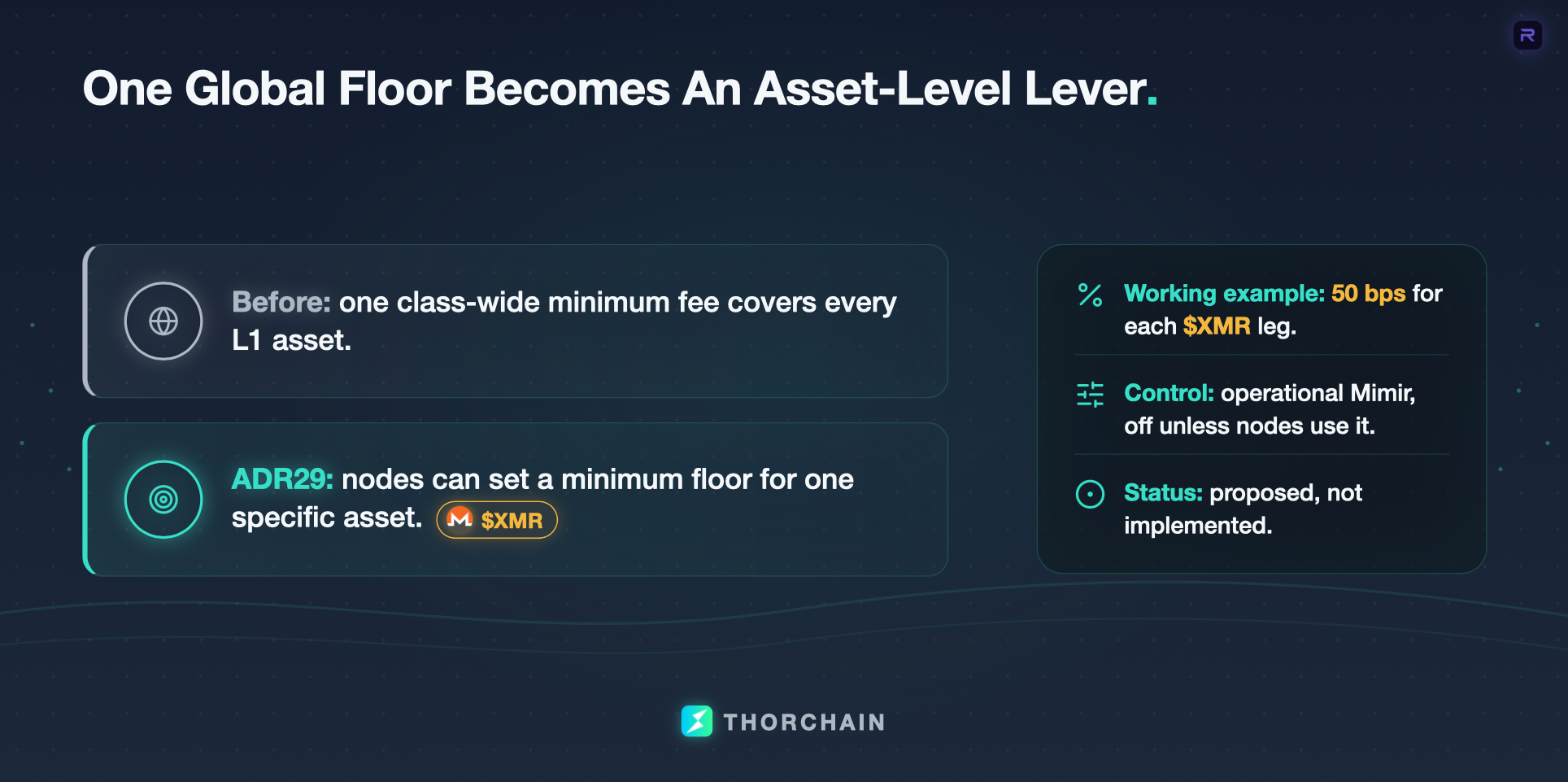
- Boone proposed ADR29, an asset-specific minimum swap fee lever built with Monero in mind. His working example is a 50 bps floor on each $XMR leg, but the proposal is not approved or implemented.
- ADR29 is designed to complement, not replace, THORChain’s dynamic fee model. When both apply, the protocol would use the higher floor.
- The core disagreement was strategic: charge more where THORChain has a permissionless edge, or keep fees low enough to win volume and discourage competitors.
- Higher Monero fees could feed more system income into protocol-owned liquidity, helping a shallow Monero pool deepen without depending entirely on outside LPs.
- The second half moved from fees to distribution: affiliate tooling, a swap widget, more browser wallets, and possible mobile paths for THORChain Swap.
Introduction
Podcast #212 was supposed to feature Amir Taaki, but technical problems cut that conversation short. Boone joined while out shopping, without video and with one specific mission: make sure the community understood ADR29.
That intervention turned into a full debate about what THORChain should optimize for. Boone argued for monetizing permissionless demand now. Kenton argued that low prices build a longer-lasting moat. Denny focused on whether decentralized governance can manage manual fee levers quickly enough. Nobody pretended the answer was settled, which made the discussion more useful.
The result was less a sales pitch for one proposal and more a map of the choices around Monero, dynamic fees, protocol-owned liquidity, and THORChain’s route to a larger market.
1. ADR29: A Fee Floor for Each Asset
Today, THORChain applies minimum swap fee floors broadly by asset class. The same L1 floor covers many unrelated assets, even when their liquidity, competition and market structure look completely different.
Boone’s proposed ADR29 adds per-asset minimum slip settings. Instead of raising the L1 floor for every pool to address one asset, nodes could set a different floor for Monero, Bitcoin or another specific asset. The proposal also allows an explicit zero override and optional economic caps on those operational fee levers.
Monero is the reason Boone built it. THORChain is preparing a genuinely permissionless $XMR route, while many existing cross-chain options rely on centralized or permissioned infrastructure. Boone’s working number was 50 bps per Monero leg. On an asset-to-$XMR double swap, that would produce a combined floor near 1%, roughly where he said many existing Monero venues already price their service.
His pitch is not simply “charge more because we can.” It is that THORChain could offer a better product at a familiar market price, then route the additional system income toward deeper protocol-owned liquidity.
The proposal remains an initial draft. Even if the code is accepted, the per-asset floor would be off unless nodes chose to use it.
"All it does is give the nodes more optionality." (Boone)
2. Why ADR29 Is Not a Replacement for Dynamic Fees
The episode repeatedly returned to the difference between ADR29 and ADR26, THORChain’s dynamic L1 fee model.
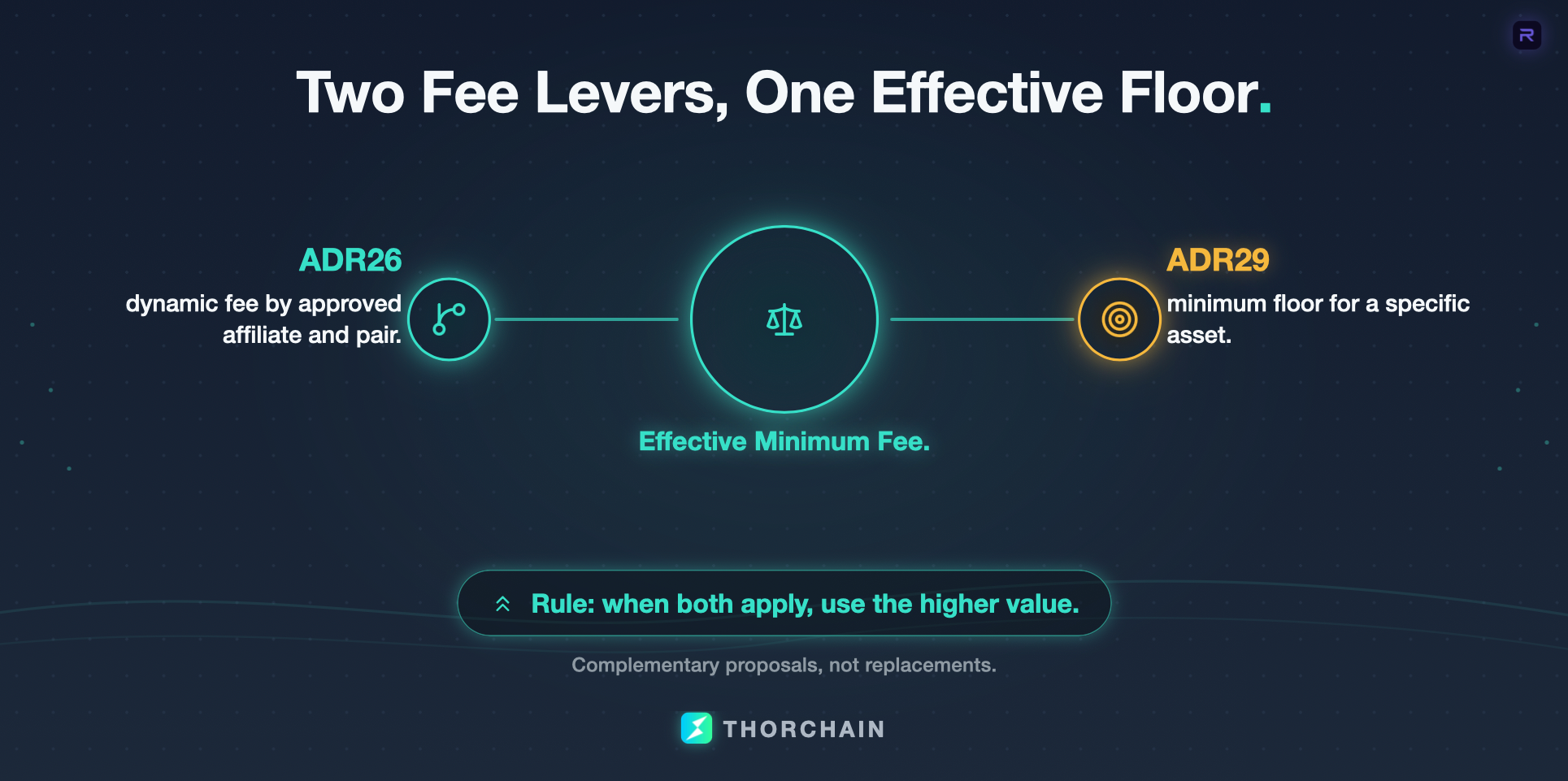
Dynamic fees tune the minimum fee for eligible L1 swaps associated with approved affiliate THORNames and trading pairs. The aim is to discover whether a lower or higher fee produces more protocol revenue for that flow. ADR29 is broader in a different direction: it sets a governance floor for an individual asset and also reaches activity that the affiliate-based model does not, including arbitrage flow through trade and secured assets.
Boone estimated that arbitrage accounts for roughly 60% of THORChain volume. In a separate two-hour sample, he found that L1 swaps with affiliate fees represented about 33% of volume. Those were his working observations, not a complete protocol study, but they explain his concern: a dynamic feature limited to qualifying L1 affiliate flow may leave much of the network untouched.
He also questioned the signal used to adjust dynamic fees. If the controller reacts to revenue without accounting for changes in the wider exchange market, a high-volume market day could look like proof that the fee changed correctly even when macro conditions caused the move. His suggestion was to normalize against global exchange volume so the controller reads less noise.
ADR29 is designed to coexist with that experiment. If an affiliate’s dynamic fee and an asset-specific floor both apply, the higher value wins. Nodes can still test dynamic fees first, learn from live behavior, and consider ADR29 later.
"This is not a replacement. This is not instead of Chad’s dynamic fees." (Boone)
3. The Real Debate: Revenue Now or Market Share Later?
Once the mechanics were clear, the conversation became a strategy argument.
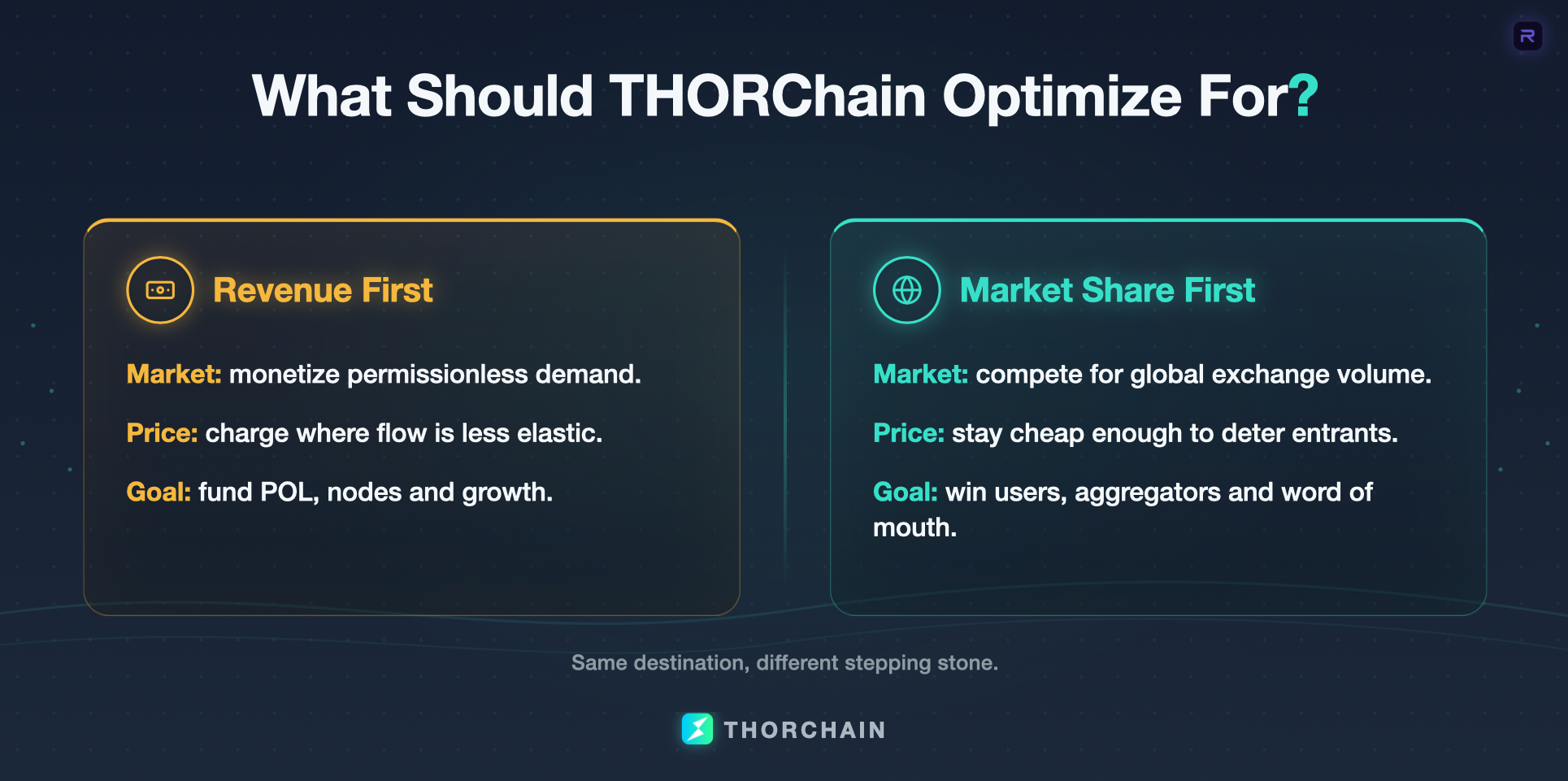
Boone sees two markets. The first is the enormous global exchange market, where centralized exchanges dominate and most users optimize for familiarity, price and convenience. The second is the much smaller permissionless market, where THORChain already has a meaningful edge.
His preferred sequence is to monetize the smaller market first. Higher-margin permissionless flow could build POL, fund marketing, strengthen node participation and give the network more resources before it attacks the mass market. In his framing, trying to beat subsidized competitors such as Near Intents on price today risks joining a race where other protocols can spend emissions or investor capital to offer uneconomic swaps.
Kenton pushed the other way. A high Monero fee could invite competitors, while a low fee makes the market less attractive to enter. More importantly, users who discover THORChain as the cheapest permissionless route may carry that first impression forward and spread it by word of mouth. If the long-term target is centralized exchange volume, price has to be part of the conversion story.
That question also reaches aggregators. SwapKit and other routers can move flow quickly when another venue offers a better quote, so loyalty may matter less than execution. Boone saw that as a reason fees can be lowered later when competition arrives. Kenton saw it as a reason to undercut competitors before they gain a foothold.
Denny added a governance concern. A centralized business can move a pricing lever quickly. A decentralized network may be slower to reach consensus, making an algorithmic approach more attractive than frequent manual adjustments. He also argued for getting the $XMR pool stable before experimenting with higher fees.
"Long term, of course we want to capture all swap volume." (Boone)
The disagreement stayed productive because everyone shared the same destination. The open question is which stepping stone gets THORChain there.
4. POL Turns Fees Into Permissionless Liquidity
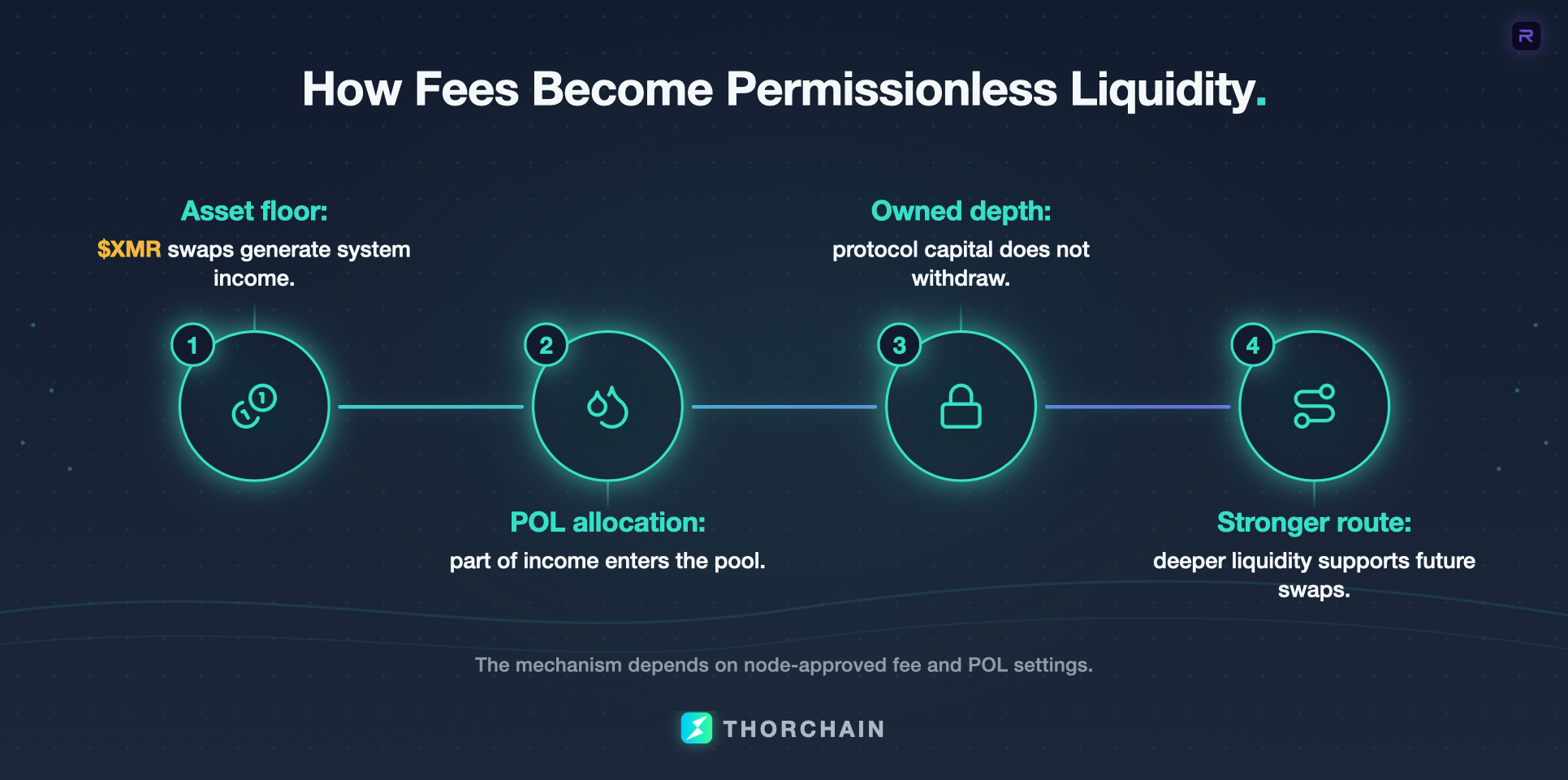
ADR29 matters beyond the fee itself. Boone tied it directly to protocol-owned liquidity.
If a shallow Monero pool generates higher fees and a portion of system income flows into POL, the protocol can progressively own more of that pool. That creates liquidity which does not leave when external LPs decide the return is no longer attractive. It also reduces the problem of asking outside capital to absorb the early operational risk of a new chain integration.
Boone described POL as an asset rather than a liability. If an early $XMR issue costs the pool money, the protocol can learn and recover without owing an external LP. Denny agreed that this makes POL especially powerful for a complex launch like Monero.
The wider security argument is equally important. A permissionless protocol can still become dependent on liquidity providers or market makers who withdraw during stress. Boone pointed to solver and market-maker systems that can lose liquidity exactly when markets become chaotic. POL is always-on capital controlled by protocol rules.
"You don’t just need a permissionless protocol. You need permissionless liquidity." (Boone)
This is why the fee debate and the POL debate cannot be separated. ADR29 asks what each asset should pay. POL asks whether part of that income can become a permanent moat.
5. Distribution: Widgets, Wallets and the Next Front End
The final major thread was how users actually reach THORChain.
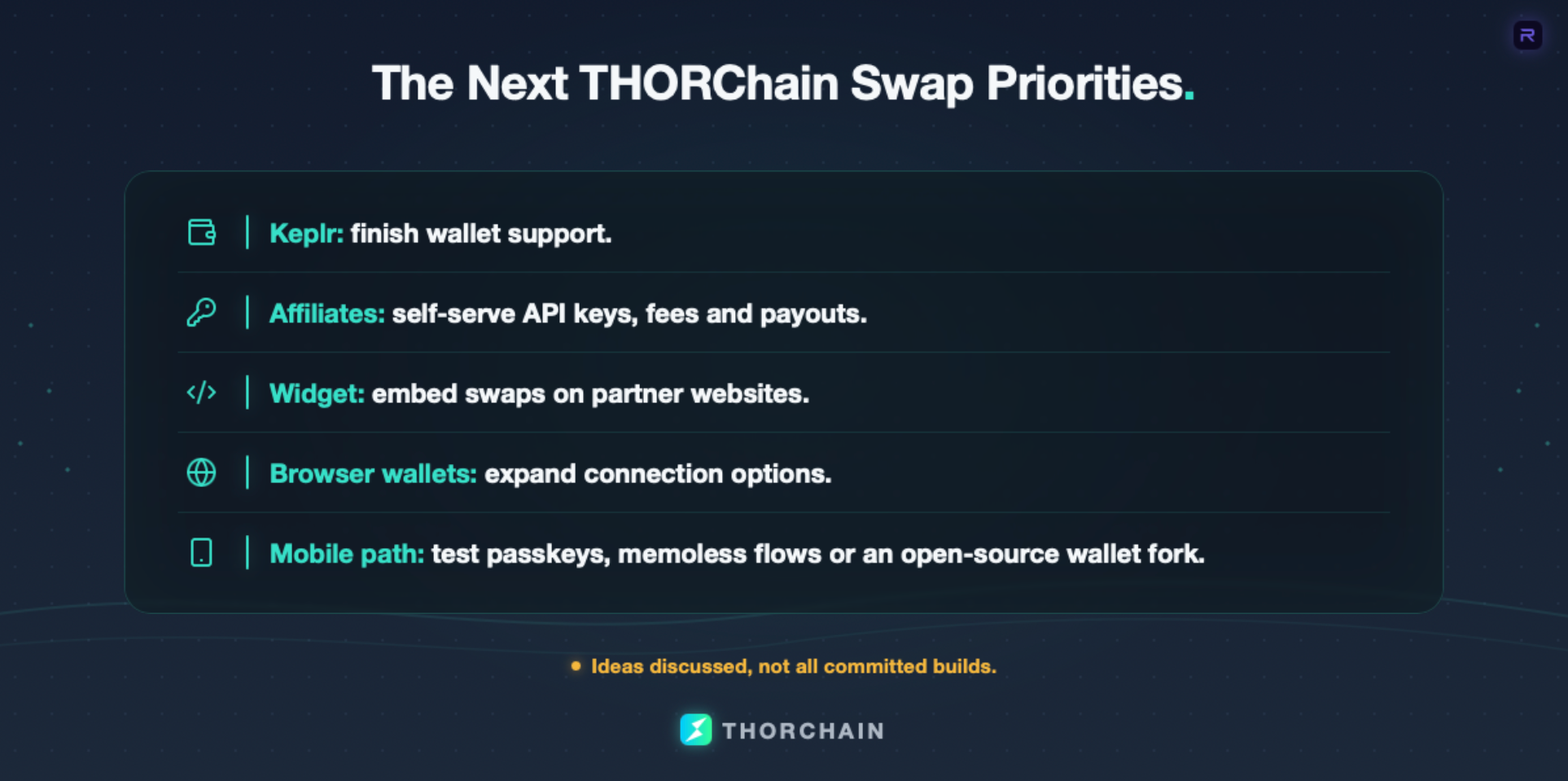
Kenton outlined the immediate THORChain Swap priorities: finish Keplr Wallet support, complete the affiliate page, ship a reusable swap widget, fix the current bug backlog, and add more browser wallets. The affiliate flow is intended to let a partner register, receive an API key, configure its THORName, set a fee and preferred payout asset, then generate widget code for its own website.
The widget is central to Kenton’s distribution thesis. A newsletter or partner site can embed THORChain swaps, earn affiliate fees, and lend its existing credibility to the interface. Kenton said he has already arranged a year-long package of 12 articles with DeFi Llama and wants the supporting dashboard and destination experience ready before promotion ramps up.
Mobile remains the harder problem. IBEC raised a passkey-based wallet path, while Boone suggested he could help as an AI-assisted developer. Another option is a memoless mobile app that works with wallets users already have, avoiding yet another seed phrase. A fuller route would be to fork the open-source Unstoppable Wallet and keep applying upstream improvements, but that was brainstorming, not a committed build.
The team’s sequencing was practical: improve the existing frontend, make integrations self-serve, expand wallet connectivity, then decide whether a dedicated mobile wallet earns its place on the roadmap.
"Strong opinions loosely held." (Kenton)
That line captured the whole episode. ADR29 now gives the community something concrete to evaluate, but its value will come from testing assumptions rather than defending camps.
What to Watch
- ADR29 review: The draft merge request needs technical review and governance discussion. It is proposed, not live.
- ADR26 first: Dynamic fees may get a live trial before ADR29 advances, creating real evidence about eligible flow and fee sensitivity.
- Monero launch quality: The first priority is a stable $XMR pool and safe small swaps. Fee experiments can follow once the product works reliably.
- POL governance: Watch whether nodes gain a more responsive operational lever for directing system income into protocol-owned liquidity.
- Distribution work: Keplr, affiliate onboarding, the swap widget and additional browser wallets are the near-term THORChain Swap milestones.

More THORChain data, check out raynalytics.net
Follow Raynalytics for more Weekly Analytics and Podcast recaps.

Related articles
![Protocol Update Podcast with Chad Barraford, Kenton, Devel and Boone]()
Sep. 24, 2026
Inside the Houdini Swap Debate: THORChain’s Treasury, Privacy and Revenue
- Podcast
![Ecosystem Update Podcast with Radix]()
Sep. 19, 2026
Radix and THORChain: Building Trust for the Agentic Future
- Podcast
![THORChain Podcast protocol update cover]()
Sep. 17, 2026
THORChain Returns to Shipping: Zcash, Monero and Self-Sufficiency
- Podcast
![Ecosystem Update Podcast with Station Wallet]()
Sep. 13, 2026
Terra’s Station Wallet Is Back as Vultisig’s Agentic THORChain Wallet
- Podcast
![Protocol Update Podcast with Chad Barraford, Kenton and Patriot / Denny]()
Sep. 10, 2026
THORChain Prioritizes Stability Before Monero and New Features
- Podcast
![Ecosystem Update Podcast with RAVN]()
Sep. 5, 2026
Inside RAVN’s Native $BTC Aggregator and Its THORChain Integration
- Podcast
![Protocol Update Podcast with Hans, Devel, Chad, Kenton & Denny]()
Sep. 3, 2026
THORChain Churns Again: POL Goes Live, Rujira Resumes and BLO Debate
- Podcast
![Ecosystem Update Podcast with Rujira]()
Aug. 29, 2026
THORChain’s App Layer Rujira Is Paused. Rujira Wants a Clear Restart Path.
- Podcast
![Protocol Update Podcast with Chad Barraford, Kenton and Denny]()
Aug. 27, 2026
THORChain Puts Stability First: Monero & Zcash Delayed, ADR30, AI Agents and Memoless Swaps
- Podcast
![Ecosystem Update Podcast with Unstoppable Wallet]()
Aug. 22, 2026
Unstoppable Wallet Adds $RUNE, $TCY and $RUJI, With a Stablecoin Wallet Next
- Podcast
![Protocol Update Podcast with Chad Barraford, Kenton and Denny]()
Aug. 20, 2026
v3.20 Voting Is Underway. Should THORChain’s TSS Library Remain Open Source?
- Podcast
![Ecosystem Update Podcast with Dash]()
Aug. 15, 2026
Inside Dash’s Zcash Orchard Upgrade and Its THORChain Potential
- Podcast
![Protocol Update Podcast with Chad Barraford, Kenton, Denny and Oleg Petrov]()
Aug. 13, 2026
THORChain is Close to v3.20: FROST, DKLS, SwapKit Rev-Share and Dynamic Fees
- Podcast
![Ecosystem Update Podcast with Morpheus]()
Aug. 8, 2026
Morpheus Maps Decentralized AI, $MOR Inference and a Planned THORChain Pool
- Podcast
![Protocol Update Podcast with Hans and Pragmatic Monkey]()
Aug. 6, 2026
Rujira and THORChain Align on the App Layer: ADR31, CCL, and the Road to Perps
- Podcast