THORChain has updated how System Income is distributed across the network, with 20% now being directed toward Protocol-Owned Liquidity and the RUNE burn reduced from 5% to 1%.
The change gives Protocol-Owned Liquidity a much larger role in THORChain’s economics, allowing part of the income generated by the network to gradually be turned into liquidity owned by the protocol itself.
What Is THORChain System Income?
THORChain generates its system income through swap fees. This income is distributed across several parts of the protocol, including Nodes, liquidity, TCY, the Developer Fund, the Marketing Fund, and the RUNE burn. How System Income is distributed can change over time as Node Operators adjust the network parameters and decide where system income should be distributed.
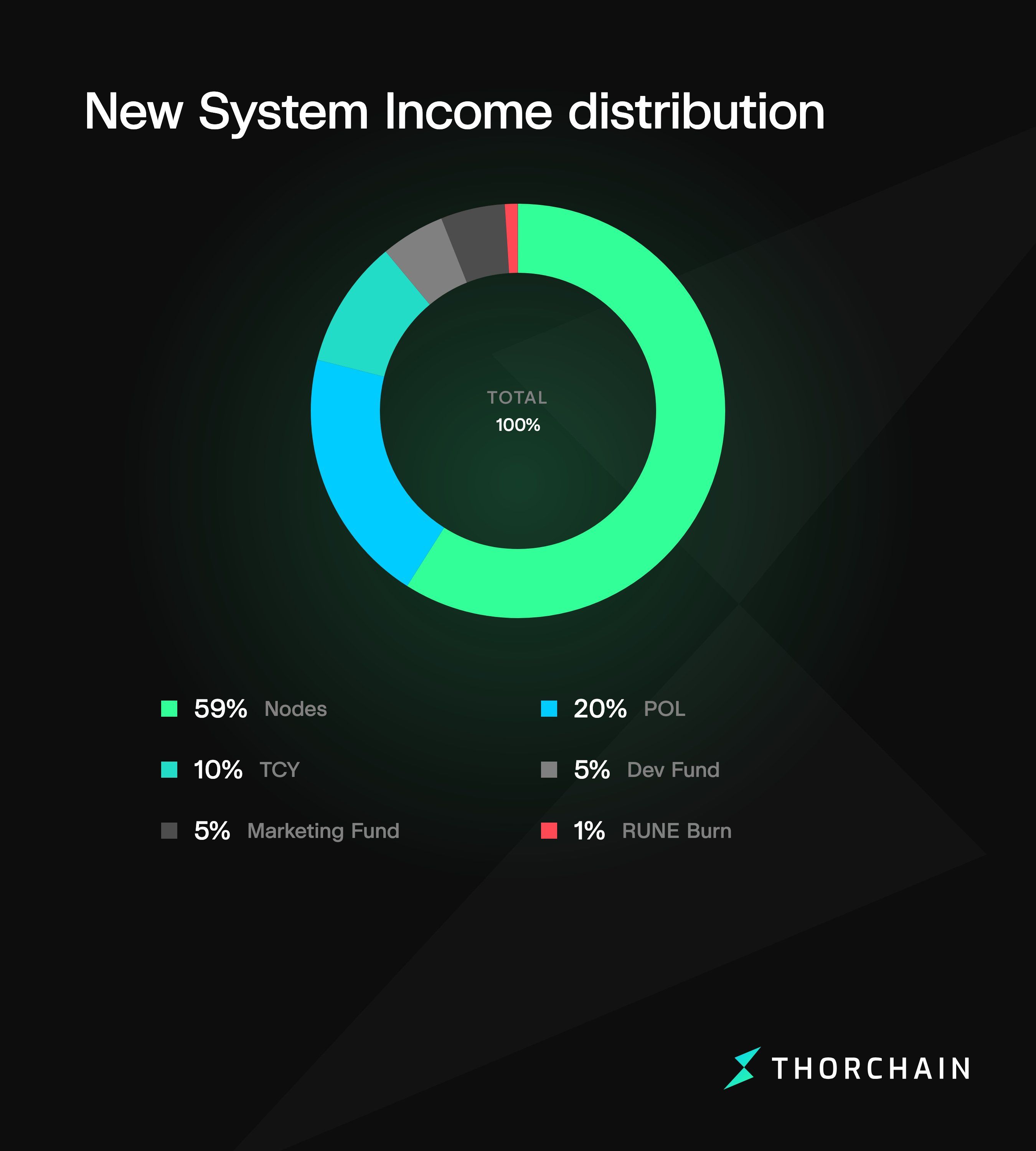
Under the new distribution, 59% goes to Nodes, 20% to Protocol-Owned Liquidity, 10% to TCY, 5% to the Developer Fund, 5% to the Marketing Fund, and 1% is used to burn RUNE. What has changed is the introduction of the 20% allocation to POL and a reduction in the RUNE burn from 5% to 1%.
The Main Change: Protocol-Owned Liquidity Now Receives 20%
THORChain has decided to grow its own liquidity pools with the new allocation of 20% to protocol owned liquidity. THORChain began laying the foundation for its current POL system with v3.18, which introduced a dedicated POL Reserve and made it possible for part of System Income to be redirected toward building protocol-owned liquidity.
With v3.20, the main controls became operational, allowing Node Operators to determine what percentage of System Income goes toward POL and which assets are eligible through THORChain’s existing Mimir governance system.
The RUNE allocated to POL does not just remain idle in the Reserve. It can gradually be deployed into eligible THORChain liquidity pools, where it becomes part of the liquidity available for swaps.
Every three days, THORChain reassesses eligible pools based on their fee generation relative to their liquidity depth and directs new POL toward the highest-scoring market until the next assessment. This gives THORChain a way to direct capital toward pools where additional liquidity can have the most impact.
For the health of the network, this is important because the amount of liquidity inside its pools directly affects the quality of swap execution. Deeper pools generally mean lower price impact for users, especially on larger trades, while also giving THORChain more capacity to handle additional volume.
As System Income continues to flow into POL, the amount of liquidity inside THORChain’s pools can grow over time. This means part of the revenue generated by swaps can be used to strengthen the liquidity that future swaps depend on. The result is a flywheel where deeper pools can make THORChain more competitive, attract more users and swap volume, generate more System Income, and in turn support further growth in protocol-owned liquidity.
The RUNE Burn Has Been Reduced to 1%
The second major change is the reduction of the RUNE burn from 5% to 1% of System Income. THORChain introduced the burn as a way to permanently remove part of the RUNE generated through network activity from circulation. That mechanism remains in place under the new distribution, but at a lower rate.
Reducing the burn creates more room within System Income for other uses, with growing POL now becoming the main priority for THORChain. Instead of 5% of System Income being permanently removed through the burn, only 1% is now burned, while a much larger share can be deployed as liquidity owned by the protocol.
The reasoning is that growing POL can directly support the growth of the network and its System Income. At the same time, POL also reduces the amount of RUNE available on the market because that RUNE is deployed into liquidity pools. Instead of being permanently burned, the RUNE is used to support THORChain’s liquidity while also being removed from liquid circulation.
A More Productive Use of System Income
The biggest change in THORChain’s new System Income distribution is the shift away from using a larger share of revenue to burn RUNE and toward making that RUNE productive inside the network. Instead of permanently removing 5% of System Income from circulation, a much larger share can now be directed into THORChain’s liquidity pools through POL.
This allows THORChain to use its own revenue to strengthen the pools that are generating the most fees and where additional liquidity can have the greatest impact. As activity increases, more System Income can flow back into those markets, helping deepen liquidity and improve execution for future swaps.
Overall, this creates a more sustainable model for THORChain. Instead of relying as heavily on reducing supply, the network can use more of the value it generates to support its own liquidity, improve the trading experience, and help drive further growth over time.

Related articles
![Illustration of THORChain's Protocol-Owned Liquidity system, showing System Income flowing into deeper liquidity pools.]()
Sep. 21, 2026
Why Protocol-Owned Liquidity Matters for THORChain
- Guide
![How to Swap Crypto on THORChain thumbnail, a THORChain guide]()
Sep. 18, 2026
How to Swap Crypto on THORChain
- Guide
![THORChain Thumbnail for the 2026 guide comparing ten decentralized exchanges across cross-chain support, fees and MEV protection.]()
Sep. 10, 2026
The 10 Best Decentralized Exchanges (DEXs) in 2026
- Guide
![Thumbnail for THORChain guide explaining how the Advanced Swap Queue and slip-based fees prevent sandwich attacks on swaps.]()
Sep. 7, 2026
How THORChain’s Swap Queue Prevents Sandwich Attacks
- Guide
![THORChain guide thumbnail explaining how to bond RUNE through direct whitelisting, RUNEBond and bRUNE liquid staking, with yield and risk comparisons for each method.]()
Sep. 2, 2026
How to Bond your Rune: a practical guide
- Guide
![THORChain guide thumbnail showing how to perform a cross-chain swap without connecting a wallet, using the Walletless Swap feature on swap.thorchain.org.]()
Aug. 12, 2026
How To: Walletless Swaps
- Guide
![THORChain is transparent even with privacy coins thumbnail.]()
Jul. 21, 2026
THORChain Is Transparent Even With Privacy Coins
- Guide
![THORChain Community Podcast #198 thumbnail featuring JP and Kenton demonstrating the first live decentralised RUNE to Monero swap on THORChain's chainnet.]()
May. 14, 2026
JP Demos Live Monero on THORChain: 7 Nodes, Real Funds, First Swap Works
- Podcast
- Guide