Bonding RUNE is the highest yielding thing you can do with your holdings on THORChain. We're talking real yield, paid directly from the protocol's revenue and generated by real swap fees from users.
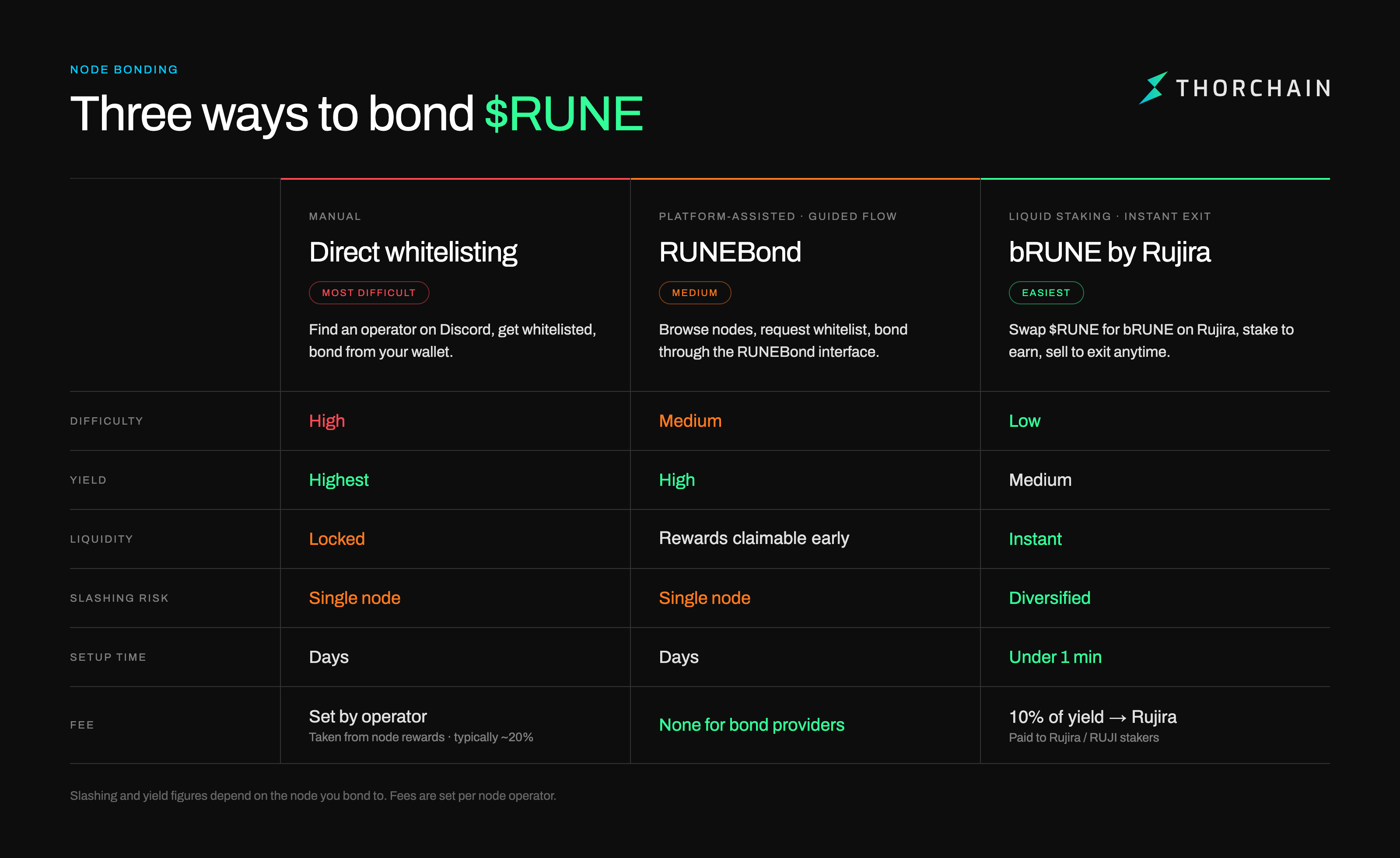
But not all bonding is the same. There are three distinct methods available on THORChain, ranging from fully hands-on to almost completely automated. The right one depends on how much time you want to spend and how much control matters to you.
What Bonding Actually Means
THORChain is secured by approximately 100 nodes. Each node must lock RUNE as collateral. The more bond a node carries, the stronger its position in the active validator set. Nodes who stay active earn fees and those who misbehave get slashed.
Bond providers are holders who contribute RUNE to a node they don't personally run. They help the operator (the person running the node) stay competitive and, in return, earn a proportional share of that node's rewards. It's closer to delegating stake on a proof of stake chain than anything else, except the governance mechanism is different on THORChain.
Option 1: direct whitelisting
This is the original method and the one that gets you the closest to raw bonding yield.
You find a node operator you trust, typically through the THORChain Dev Community Discord (#node-provider channel). You give them your THOR wallet address (the one that starts with thor... and never, under any circumstances, your private key). The operator submits an on-chain transaction whitelisting your address against their node. Once that's done, you send a BOND transaction from your wallet with the memo BOND:<node-address> and the amount of RUNE you want to commit.
Your rewards compound automatically into your bonded position. The operator takes a fee of the node's earnings. The fee is defined by the operator and usually between 0 and 20%.
The tradeoff is liquidity. Your RUNE is locked until the node churns out of the active set, which can take weeks or longer depending on the operator's intentions. There's also slashing exposure: routine slash points only trim the yield for that churn period and then reset. Your principal is only touched if the node double-signs or sends an unauthorized transaction. So choose your operator carefully.
Best for: larger holders who want maximum yield and are comfortable doing the legwork.
Option 2: RUNEBond
RUNEBond handles the same process as direct whitelisting but wraps it in a proper interface.
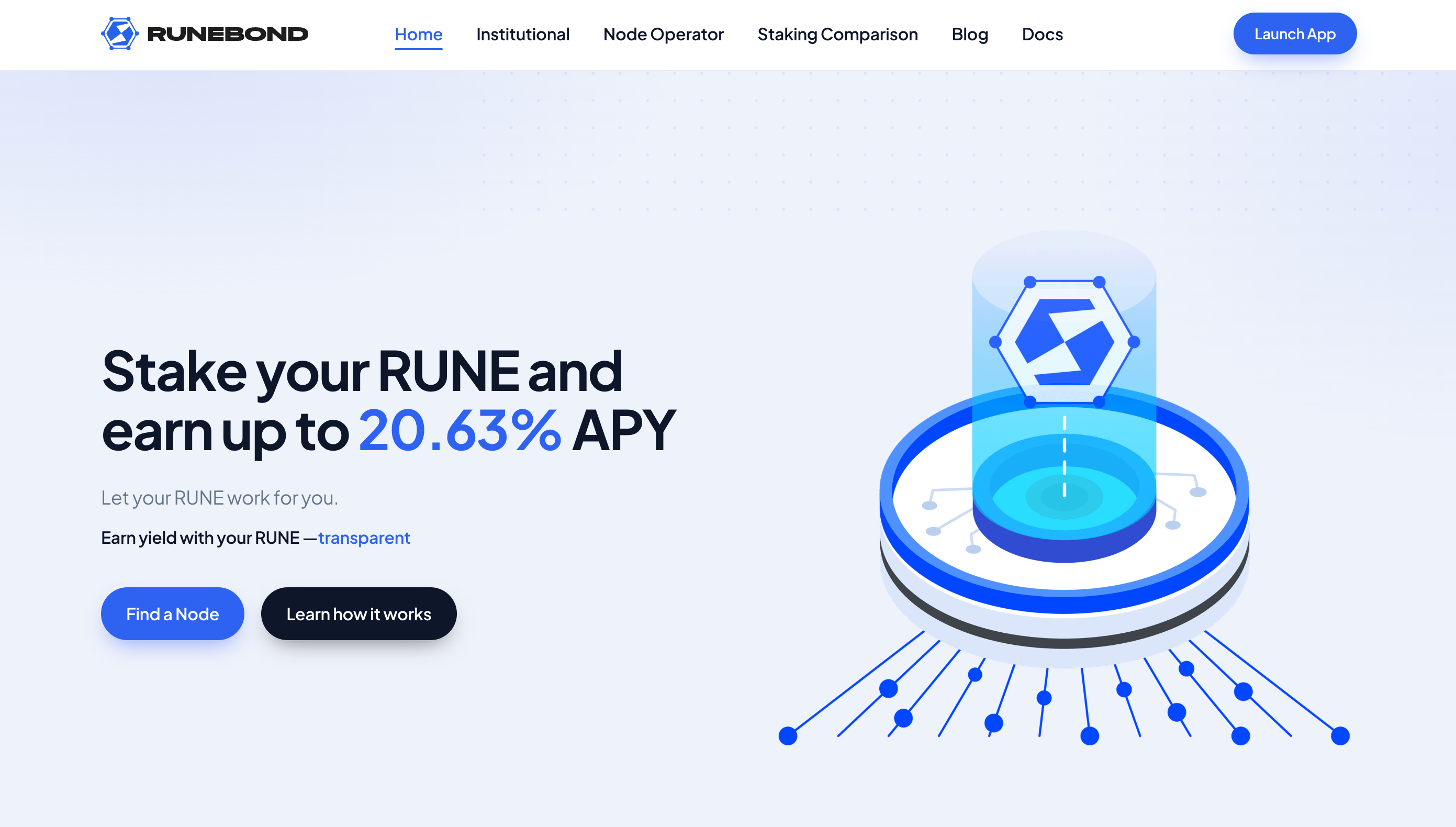
Instead of hunting for operators in Discord, you browse a list of nodes with their stats laid out: current bond size, available capacity, operator fee, performance history, uptime. You pick one that fits your criteria, submit a whitelist request with your THOR address and intended bond amount, and wait for the operator to approve it on-chain. Once approved, you bond directly through the RUNEBond interface in a single transaction.
Nothing about the underlying mechanism changes. You're still bonding to a specific node, still earning yield from that node, still subject to the same liquidity lock and slashing risk. RUNEBond is the coordination layer. There's no fee on your end as a bond provider. RUNEBond charges node operators a finder fee instead: the first 150 RUNE of operator profit is free, and a 10% fee applies to anything beyond that. RUNEBond also lets bond providers claim their accumulated yield without waiting for a full churn out, which addresses one of the main complaints about bonding liquidity.
Best for: holders who want full control and be guided over which node they bond to without the manual friction of doing it entirely on their own.
Option 3: bRUNE
bRUNE is Rujira's liquid staking token for RUNE, launched on mainnet in early 2026. It's the newest option and the most accessible by a significant margin.
You buy bRUNE on RUJI Trade by swapping your RUNE into the bRUNE/RUNE pool. The contract then automatically bonds your RUNE across a diversified set of pre-approved THORChain nodes, targeting equal allocation between them. You don't choose nodes, you don't contact anyone, and you don't wait for whitelist approvals.
To earn yield you then stake your bRUNE on the Rujira strategies page, either receiving rewards in RUNE or auto-compounding them back into your position. When you want to exit, you sell bRUNE back on RUJI Trade. Liquidity is immediate.
The yield is slightly lower than direct bonding because the contract keeps a portion of RUNE liquid at all times (targeting 85 to 90% bonded), and Rujira takes a 10% protocol fee from the bonding yield. Taking a 25% gross yield as an example, after node commissions, the utilisation ratio, and the protocol fee, end users are looking at roughly 18% net APY. Still meaningful, and the diversification across multiple nodes substantially reduces slashing exposure.
There's a hard cap: bRUNE (or any RUNE liquid staking token) cannot exceed 10% of total active bond, to prevent systemic risk to the network.
Best for: most holders. Especially anyone who wants yield without the complexity of finding and vetting individual operators.
Conclusion:
RUNE sitting idle is RUNE not generating yield, and not contributing to the security of the network. With the three bonding solutions presented, every type of user can find the approach that best fits their profile, risk tolerance, and goals. Whether you prioritise simplicity, control, or maximizing returns, there is no reason to leave your RUNE on the sidelines.

Related articles
![A mint green notification bell glyph on a black key, cover of THORChain's guide to its official channels, podcasts and social media.]()
Oct. 9, 2026
How to Stay Up to Date With THORChain
- Guide
![Zcash (ZEC) logo alongside the THORChain logo, illustrating native ZEC swaps across blockchains on THORChain.]()
Oct. 7, 2026
Bringing Native Zcash to THORChain
- Guide
![boone.tools logo on a dark THORChain background, introducing Boone's collection of THORChain analytics dashboards.]()
Oct. 5, 2026
Introducing boone.tools: A Better Way to Understand THORChain
- Spotlight
- Guide
![THORChain's System Income distribution, with 20% now directed to Protocol-Owned Liquidity and the RUNE burn reduced to 1%.]()
Sep. 23, 2026
How THORChain’s New System Income Distribution Works
- Guide
![Illustration of THORChain's Protocol-Owned Liquidity system, showing System Income flowing into deeper liquidity pools.]()
Sep. 21, 2026
Why Protocol-Owned Liquidity Matters for THORChain
- Guide
![How to Swap Crypto on THORChain thumbnail, a THORChain guide]()
Sep. 18, 2026
How to Swap Crypto on THORChain
- Guide
![THORChain Thumbnail for the 2026 guide comparing ten decentralized exchanges across cross-chain support, fees and MEV protection.]()
Sep. 10, 2026
The 10 Best Decentralized Exchanges (DEXs) in 2026
- Guide
![Thumbnail for THORChain guide explaining how the Advanced Swap Queue and slip-based fees prevent sandwich attacks on swaps.]()
Sep. 7, 2026
How THORChain’s Swap Queue Prevents Sandwich Attacks
- Guide
![THORChain guide thumbnail showing how to perform a cross-chain swap without connecting a wallet, using the Walletless Swap feature on swap.thorchain.org.]()
Aug. 12, 2026
How To: Walletless Swaps
- Guide
![THORChain is transparent even with privacy coins thumbnail.]()
Jul. 21, 2026
THORChain Is Transparent Even With Privacy Coins
- Guide
![THORChain Community Podcast #198 thumbnail featuring JP and Kenton demonstrating the first live decentralised RUNE to Monero swap on THORChain's chainnet.]()
May. 14, 2026
JP Demos Live Monero on THORChain: 7 Nodes, Real Funds, First Swap Works
- Podcast
- Guide
![]()
Apr. 22, 2026
How to read a transaction on THORChain?
- Guide
![]()
Apr. 16, 2026
THORChain’s Native API - plugging liquidity directly to wallets and DEXs
- Guide
![]()
Nov. 26, 2025
Memoless Transactions - THORChain Without Wallet Limitations
- Guide
![]()
Oct. 29, 2025
Advanced Swap Queue & Limit Swaps
- Guide