THORChain’s Native API - plugging liquidity directly to wallets and DEXs

2026-04-16 — 4 min read
- Guide
THORChain can act as a backbone for liquidity and cross-chain swaps across wallets and decentralised exchanges. But how do you actually integrate it? Until now, there were two main options.
The first is to work directly with THORChain’s tech stack. This gives full control, but comes with complexity. Integrators need to handle chain maintenance, upgrades and infrastructure themselves. It offers full flexibility, but comes at a significant resource cost.
The second option is to rely on external SDKs or APIs provided by services such as Xchain.js or SwapKit. This approach is much easier to use. Most of the maintenance is handled by the provider, support is available, and integration can be done in just a few lines of code. It offers simplicity, but introduces dependency on the provider, including its fee structure.
Today, there is a third option: THORChain Native API. Let’s dive in. ⬇️
What is the THORChain Native API
THORChain now offers its own Native API for integrations with a simple objective: give builders direct access to swap functionality without relying on an external provider.
In practice, this means that wallets, interfaces and aggregators can connect straight to THORChain’s infrastructure. They can retrieve supported assets, request swap quotes, execute flows and track transactions, all through a single interface maintained by the protocol itself.
This marks a shift from how integrations were typically built. Until now, most teams accessed THORChain through third-party providers. The Native API removes that dependency and brings integrators closer to the protocol itself.
It doesn't change how THORChain operates. Swaps are executed in the same pools, validated by the same set of nodes, and the protocol continues to generate fees on each transaction.
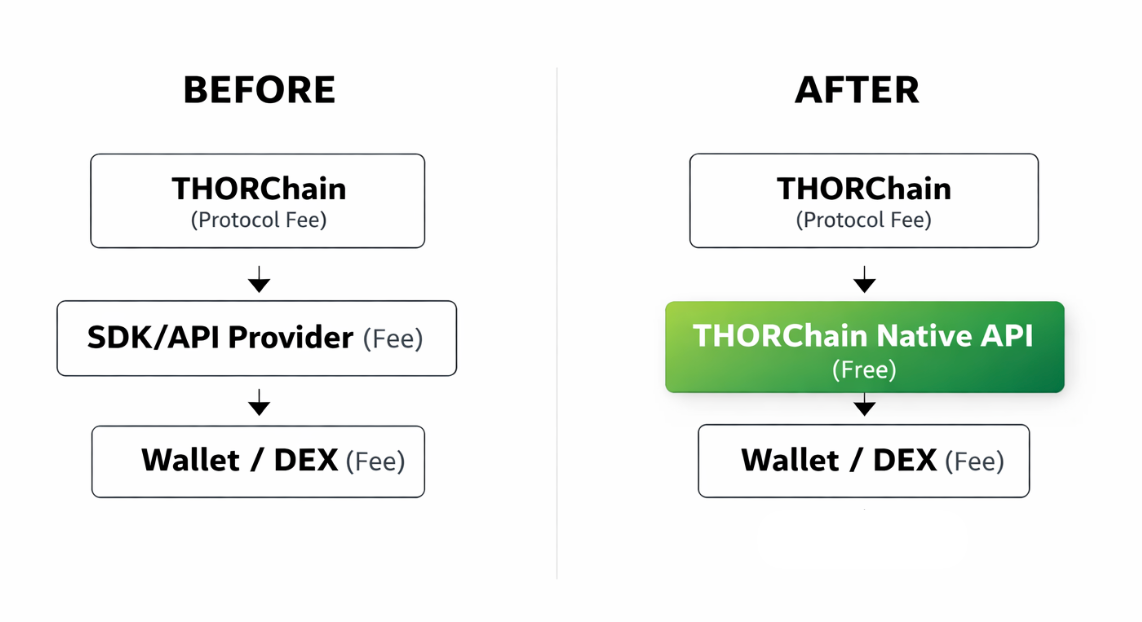
What changes is how integrators connect. By removing the need for external API or SDK providers, the Native API eliminates an additional fee layer and simplifies the overall integration path.
Perks of the Native API: a leaner fee stack
Before looking at how the Native API impacts revenue, it is important to understand the current fee structure on THORChain.
For each swap, the protocol charges a fee, currently around 10 BPS. On top of that, an API or SDK provider may add its own fee, and the wallet or exchange acting as the frontend adds its fee on top.
With the Native API, the provider fee disappears, as the NAtive API is free to use.
For integrators, this creates more flexibility: they can offer more competitive pricing or keep pricing as is and capture more margin. For users, this can translate into better rates.
With fewer layers, the Native API creates a leaner structure, improving efficiency across the stack. This is critical in an increasingly competitive market where pricing and execution are key.
Note: It is also worth noting that the Native API doesn’t replace existing providers entirely. Services like SwapKit still offer value through support, broader integrations and additional routing options. For now, the Native API focuses on direct access to THORChain and MAYAChain routes and assets.
How to interact with the Native API
The Native API is designed for builders. It is relevant for any team that wants to integrate THORChain swaps into their product. This includes wallets, trading interfaces, aggregators and applications looking to offer cross-chain functionality.
Integration is straightforward. Access starts with an API key. From there, teams can interact with THORChain’s endpoints to discover supported assets, retrieve quotes and manage swap flows.
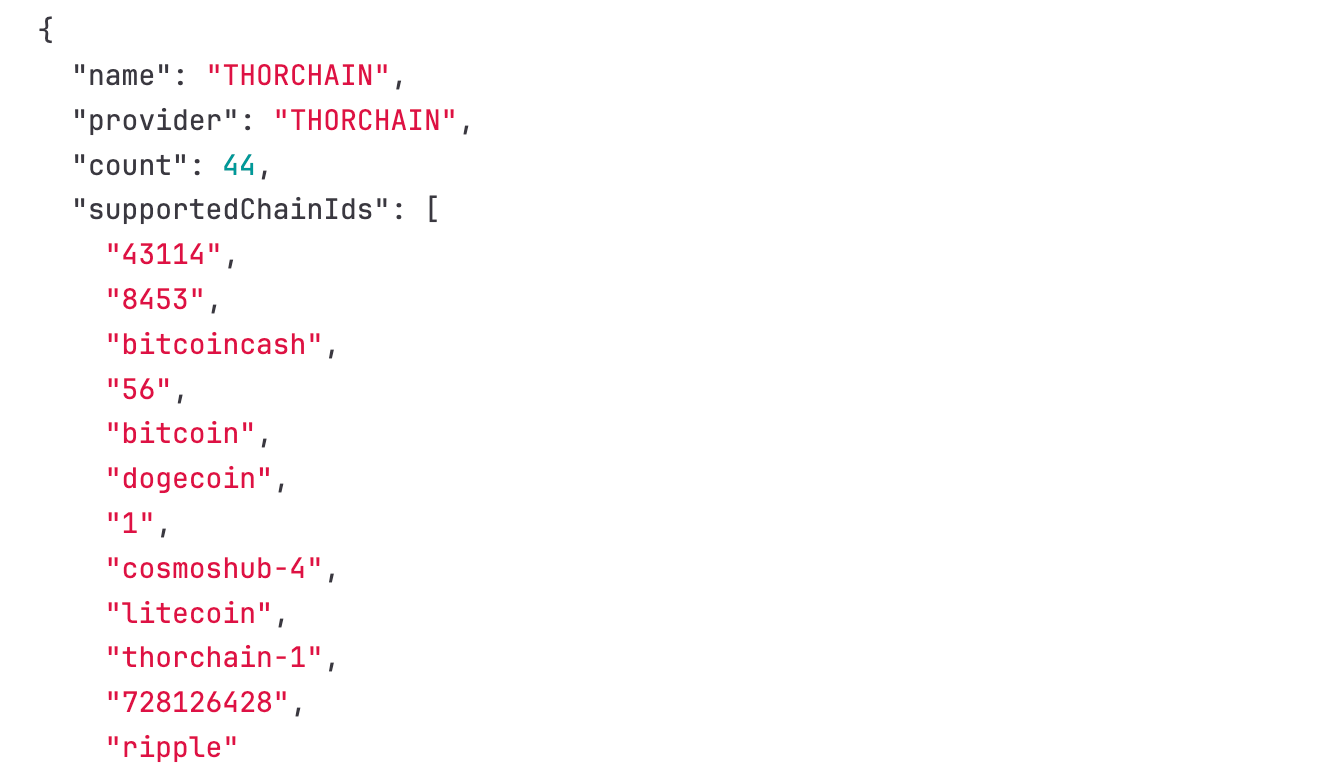
In practice, this means being able to query supported chains, access token data across networks, generate swap quotes with expected outputs and fees, and track transactions throughout their execution.
The API also supports more advanced flows such as memoless swaps, which simplify the user experience by removing the need to manually include transaction memos.
Documentation is structured to allow fast integration while maintaining full visibility on swap execution.
https://gitlab.com/thorchain/client/aggregator/-/blob/master/README.md?ref_type=heads
Final Thoughts
The Native API is a structural improvement in how THORChain is accessed. It makes the path between the protocol and the applications built on top of it more direct, removing a layer of fees and dependency.
In an increasingly competitive market, this is an important step. It gives integrators more flexibility and opens the door to better options for end users, who are constantly looking for cheaper and faster execution.

Related articles
![A mint green notification bell glyph on a black key, cover of THORChain's guide to its official channels, podcasts and social media.]()
Oct. 9, 2026
How to Stay Up to Date With THORChain
- Guide
![Zcash (ZEC) logo alongside the THORChain logo, illustrating native ZEC swaps across blockchains on THORChain.]()
Oct. 7, 2026
Bringing Native Zcash to THORChain
- Guide
![boone.tools logo on a dark THORChain background, introducing Boone's collection of THORChain analytics dashboards.]()
Oct. 5, 2026
Introducing boone.tools: A Better Way to Understand THORChain
- Spotlight
- Guide
![THORChain's System Income distribution, with 20% now directed to Protocol-Owned Liquidity and the RUNE burn reduced to 1%.]()
Sep. 23, 2026
How THORChain’s New System Income Distribution Works
- Guide
![Illustration of THORChain's Protocol-Owned Liquidity system, showing System Income flowing into deeper liquidity pools.]()
Sep. 21, 2026
Why Protocol-Owned Liquidity Matters for THORChain
- Guide
![How to Swap Crypto on THORChain thumbnail, a THORChain guide]()
Sep. 18, 2026
How to Swap Crypto on THORChain
- Guide
![THORChain Thumbnail for the 2026 guide comparing ten decentralized exchanges across cross-chain support, fees and MEV protection.]()
Sep. 10, 2026
The 10 Best Decentralized Exchanges (DEXs) in 2026
- Guide
![Thumbnail for THORChain guide explaining how the Advanced Swap Queue and slip-based fees prevent sandwich attacks on swaps.]()
Sep. 7, 2026
How THORChain’s Swap Queue Prevents Sandwich Attacks
- Guide
![THORChain guide thumbnail explaining how to bond RUNE through direct whitelisting, RUNEBond and bRUNE liquid staking, with yield and risk comparisons for each method.]()
Sep. 2, 2026
How to Bond your Rune: a practical guide
- Guide
![THORChain guide thumbnail showing how to perform a cross-chain swap without connecting a wallet, using the Walletless Swap feature on swap.thorchain.org.]()
Aug. 12, 2026
How To: Walletless Swaps
- Guide
![THORChain is transparent even with privacy coins thumbnail.]()
Jul. 21, 2026
THORChain Is Transparent Even With Privacy Coins
- Guide
![THORChain Community Podcast #198 thumbnail featuring JP and Kenton demonstrating the first live decentralised RUNE to Monero swap on THORChain's chainnet.]()
May. 14, 2026
JP Demos Live Monero on THORChain: 7 Nodes, Real Funds, First Swap Works
- Podcast
- Guide
![]()
Apr. 22, 2026
How to read a transaction on THORChain?
- Guide
![]()
Nov. 26, 2025
Memoless Transactions - THORChain Without Wallet Limitations
- Guide
![]()
Oct. 29, 2025
Advanced Swap Queue & Limit Swaps
- Guide