Cross-chain swap platforms are no longer rare. What remains far less common is the ability to connect a wide range of chains, liquidity venues, bridges, and routing systems, and turn them into a single efficient path for the user.
That is where Rango positions itself.
Rather than operating as another standalone bridge or DEX, Rango acts as an aggregation layer across the cross-chain market. It searches across DEXs, bridges, liquidity protocols, and intent-based systems to find an efficient route between supported assets, even when that route involves multiple networks and several underlying protocols.
How Does Rango Work?
At the centre of Rango is a chain-agnostic routing engine that searches across different chains, DEXs, bridges, and cross-chain protocols.
When a user requests a swap, Rango compares the available paths and determines how the assets can move from the source wallet to the destination wallet. Depending on the trade, the selected route may involve:
- A single swap on one blockchain
- A direct bridge between two networks
- A DEX swap followed by a bridge
- A bridge followed by a destination-chain swap
- A source-chain swap, cross-chain transfer, and destination-chain swap
- A native cross-chain liquidity protocol such as THORChain
- An intent or solver-based execution system
This allows Rango to support more complex routes than a conventional DEX aggregator. Instead of only comparing liquidity pools on one chain, it can evaluate how assets should be exchanged and transferred across entirely different blockchain architectures.
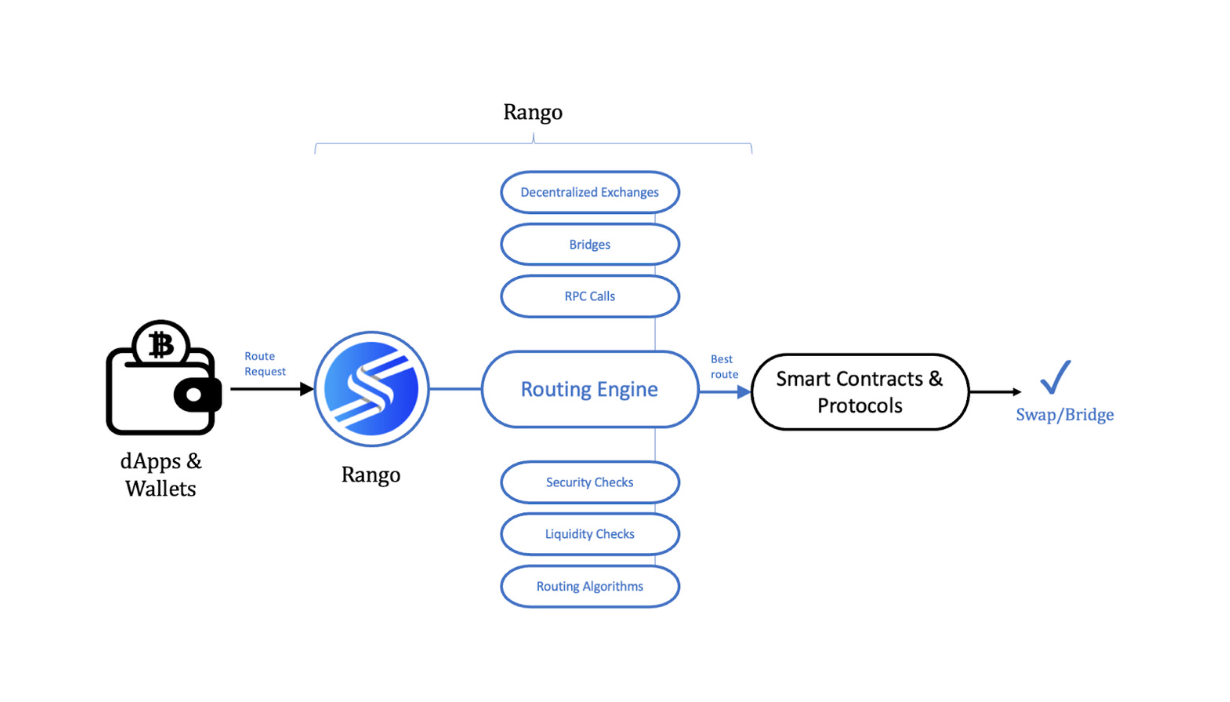
Rango’s routing engine supports EVM networks, UTXO-based chains such as Bitcoin and Litecoin, Cosmos chains, Solana, Sui, TON, TRON, Starknet, XRPL, and other non-EVM ecosystems. It can also interact with different interoperability models, including request-for-quote systems, burn-and-mint bridges, cross-chain liquidity pools, IBC, and decentralized message-passing protocols.
How Is Rango Connected to THORChain?
THORChain is one of the core cross-chain liquidity routes integrated into Rango.While many bridges transfer representations of the same asset between networks, THORChain allows Rango to exchange native assets across different Layer-1 blockchains.
When a user requests a supported native-asset swap, Rango can compare a THORChain route with those offered by other available providers. If THORChain provides the most attractive route based on the expected output and execution conditions, Rango can route the transaction through THORChain’s liquidity pools.
However, Rango’s connection to THORChain extends beyond direct swaps between assets already supported by the network.
Rango can combine THORChain with DEX aggregation on the source or destination chain. For example, a user could:
- Swap an ERC-20 token into ETH through an Ethereum DEX.
- Route the ETH-to-BTC portion through THORChain.
- Receive native BTC directly in a Bitcoin wallet.
This means that THORChain doesn't need to maintain liquidity pools for every long-tail token. Rango can use the same-chain DEXs to convert these assets into native assets supported by THORChain, before using THORChain for the cross-chain portion of the transaction.
This is what makes Rango valuable to THORChain: it expands THORChain’s addressable market by connecting the network to assets it doesn't directly support.
Key Figures
Rango has established itself as one of the most widely used cross-chain aggregation platforms.
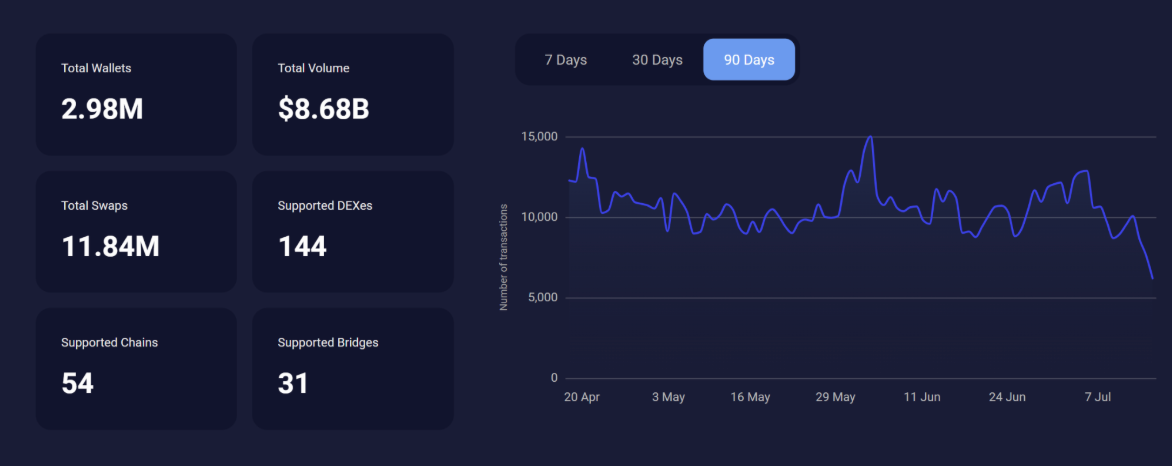
At the time of writing, Rango’s live explorer reports $8.68 billion in cumulative volume across 11.84 million completed swaps and 2.98 million unique wallets. The platform currently connects users to 144 DEXs and 31 bridges.
Rango’s infrastructure is integrated into several major wallets and applications, including MetaMask, Trust Wallet, Binance Wallet, and Exodus. Its reach has also expanded beyond wallets into payment gateways, trading agents, DEX interfaces, and other aggregation protocols.
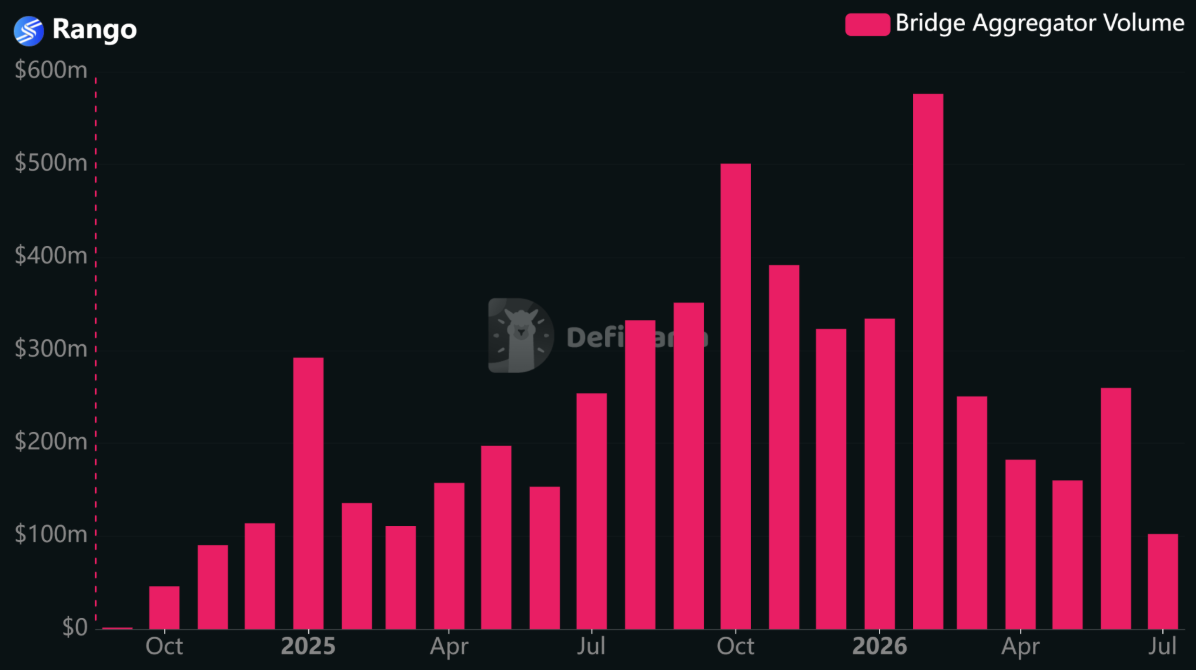
This broad distribution continues to generate meaningful activity. According to DeFiLlama, Rango’s monthly bridge volume in 2026 has ranged from approximately $160 million to $576 million, highlighting sustained demand for its cross-chain routing infrastructure.
Conclusion
Rango has established itself as one of the leading routing and aggregation platforms in the cross-chain ecosystem.
It brings DEXs, bridges, native cross-chain protocols, messaging systems, and intent-based infrastructure together behind a single interface. For users, this provides a simpler way to move assets across chains. For wallets and applications, the same functionality can be integrated through Rango’s API, SDK, or widget.
For THORChain, Rango acts as both an interface and a distribution channel. Although the platform is not exclusive to THORChain, the relationship is mutually beneficial. Rango’s route-agnostic model makes it more useful to users and integrators, while expanding the number of applications and interfaces through which THORChain can compete for cross-chain volume.

Related articles
![NanoGPT and THORChain branding together, representing NanoGPT's accountless AI model marketplace settling crypto payments through THORChain.]()
Sep. 16, 2026
Protocol Spotlight - NanoGPT
- Spotlight
![THORChain Protocol Spotlight thumbnail for BazaarSwap covering cross-chain aggregation across 360 exchanges, native asset routing and THORChain's role as a core liquidity provider.]()
Aug. 31, 2026
Protocol Spotlight - BazaarSwap
- Spotlight
![THORChain Protocol Spotlight thumbnail for depouch covering native cross-chain swap routing, THORChain integration and permissionless liquidity access.]()
Aug. 14, 2026
Protocol Spotlight - depouch
- Spotlight
![]()
May. 4, 2026
Bior Labs Cards Are Imminent: Bill Pay, $10K Virtual Cards and a Stablecoin Alpha
- Spotlight
![]()
Apr. 27, 2026
Unstoppable: The Best Privacy Wallet – THORChain Mobile Interface
- Spotlight
![]()
Apr. 17, 2026
Founder Spotlight - Pragmatic Monkey
- Spotlight
![]()
Mar. 13, 2026
Founder Spotlight - Chad Barraford
- Spotlight
![]()
Mar. 6, 2026
Founder's Spotlight - Hassen
- Spotlight
![]()
Feb. 27, 2026
Protocol Spotlight - THORSwap
- Spotlight
![]()
Feb. 17, 2026
Founder Spotlight: CodeHans
- Spotlight
![]()
Feb. 12, 2026
SwapKit - Powering Cross-Chain Wallets and Apps
- Spotlight
![]()
Nov. 21, 2025
Founder's Spotlight: Zey From MOCA app
- Spotlight
![]()
Nov. 13, 2025
Bloctopus, Helping Devs Build & Test More Efficiently
- Spotlight
![]()
Sep. 21, 2025
Unstoppable Wallet: Privacy and Security at the Core
- Spotlight
![]()
Aug. 29, 2025
Vultisig - Wallet Recovery Re-Imagined
- Spotlight